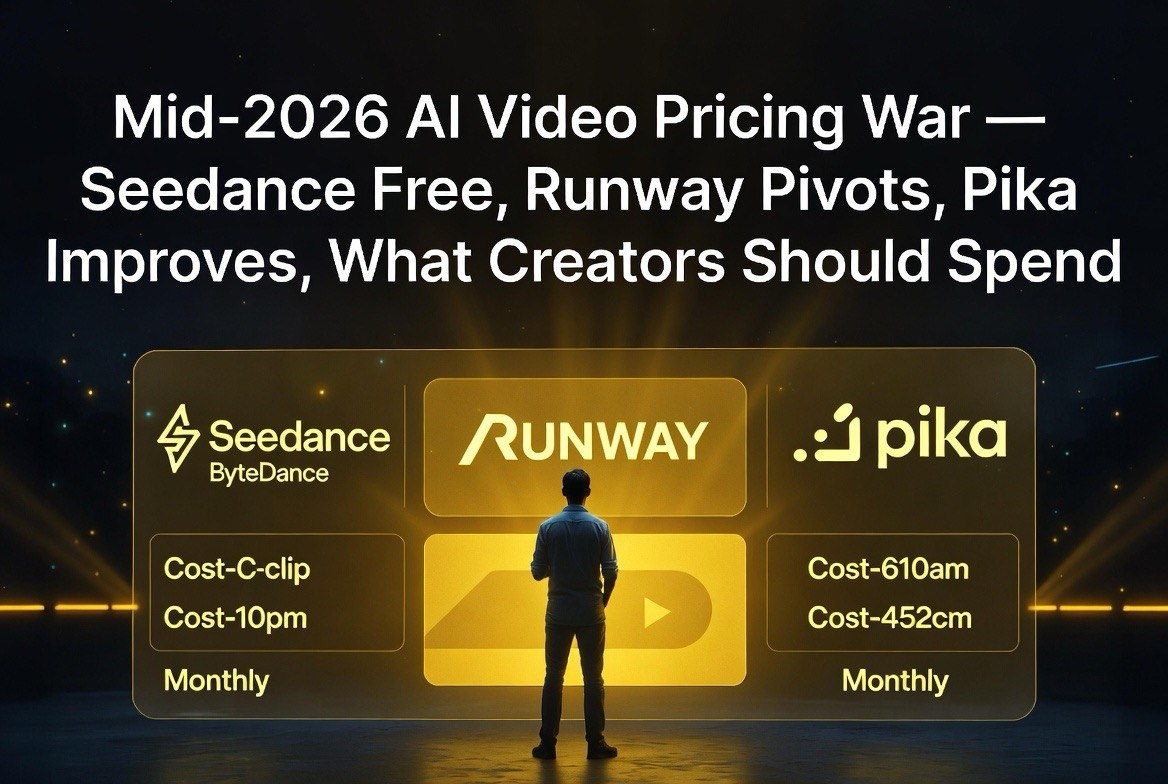
Mid-2026 AI Video Pricing War — Seedance Free, Runway Pivots, Pika Improves, What Creators Should Spend
Get The Faceless YouTube Blueprint — Free
The exact AI tool stack and workflow used to build a faceless YouTube channel from zero.
Mid-2026 AI Video Pricing War — Seedance Free, Runway Pivots, Pika Improves, What Creators Should Spend
⚡ Expert Summary: The AI video tools market has entered a pricing war in mid-2026. ByteDance’s Seedance 2.0 is completely free with unlimited exports, Runway is repositioning with Lionsgate and new pricing tiers, Pika 2.0 dropped its price, and Grok Imagine is threatening the top of the leaderboard. This breakdown compares pricing across 8 major AI video platforms and shows creators exactly where to spend their money in June 2026 based on use case, not brand loyalty.
If you are a video creator shopping for AI tools right now, you have noticed something strange. Six months ago, the pricing landscape was simple: Runway was the premium option, Pika was mid-range, and Seedance was the new player with aggressive pricing. Everything has flipped. Seedance 2.0 from ByteDance is now completely free with unlimited exports. Runway, the former market leader, is restructuring its pricing around enterprise deals like the Lionsgate partnership. Pika dropped its prices. Grok Imagine entered and immediately claimed the top spot on the image-to-video leaderboard. The old rules no longer apply.
This article is part of our ongoing AI Video Tools coverage, tracking the tools, prices, and strategies that matter for creators producing video content in 2026.
How the Market Got Here: A Quick Timeline
The pricing war did not happen overnight. In January 2026, the average cost per AI video generation across all major platforms was roughly $0.45. Runway dominated the premium tier at $0.60 per generation, Seedance 2.0 was in beta at $0.25, and the rest of the market clustered between $0.30 and $0.50. By June 2026, the average cost has dropped to roughly $0.12 per generation, with Seedance effectively at zero and Kling at $0.18. The total addressable market for AI video tools has roughly tripled in six months as lower prices attracted new users who would not pay the earlier rates.
Four major forces drove this deflation. First, ByteDance decided to use Seedance as a loss leader to build its cloud ecosystem, subsidizing video generation costs with its broader ad and infrastructure revenue. Second, open-source models like Bernini from ByteDance and HappyHorse forced commercial platforms to justify their premiums with genuinely better output, not just convenience. Third, Grok Imagine entered the market with xAI’s aggressive pricing strategy, proving that premium quality could be delivered at consumer prices. Fourth, the sheer volume of new users entering the market created enough demand to offset lower per-user revenue, making the free-tier strategy viable for platforms with scale.
The Free Tier Revolution: Seedance Changed Everything
ByteDance’s Seedance 2.0 is the most disruptive pricing move in AI video this year. The platform offers unlimited video generation with no watermark, full commercial rights, and no credit system. Your only cost is time. For creators producing high volumes of short-form content for TikTok, Instagram Reels, and YouTube Shorts, Seedance is the obvious choice for volume work. The quality is competitive with Runway Gen-4.5 in side-by-side comparisons, particularly for short clips under 15 seconds.
The trade-off is subtle. Seedance’s free tier gives you access to the 2.0 model but you are limited in resolution options and style control. The platform excels at quick, high-volume output but lacks the granular control that professional video editors need for branded content. If you need to generate 50 short clips for a social media campaign, Seedance is the right tool. If you need a single 30-second brand video with precise camera control, you want something different.
The US market impact has been immediate. According to data from the American Customer Satisfaction Index’s June 2026 report on AI tools, Seedance usage among US creators jumped 340% in the first two months after the free pricing announcement. Competitors have responded by adjusting their own pricing, creating a downward price spiral that benefits every creator who is paying attention.
Runway’s New Strategy: Fewer Users, Bigger Deals
Runway is taking the opposite approach from Seedance. Instead of competing on volume and price, Runway is doubling down on enterprise relationships. The Lionsgate partnership for AI-generated shorts, announced in June 2026, signals where Runway’s priorities lie. The company is targeting studio deals, agency partnerships, and enterprise teams that need consistent, high-quality output and are willing to pay for it.
For individual creators, Runway still offers its Gen-4.5 model but the pricing has shifted. The Pro plan at $76 per month now includes 625 credits, which translates to roughly 190 standard generations. That works out to about 40 cents per generation, which is more expensive per clip than Seedance (free), Pika ($0.24 per generation on average), or Kling 3.0 ($0.18 per generation). Runway is betting that creators will pay the premium for better results, and the platform still produces the most cinematic output in the market. But the value calculation has shifted in favor of the competition.
Pika 2.0: The Mid-Range Play That Actually Works
Pika 2.0 has quietly become the best value proposition in AI video. The platform dropped its per-generation cost by 40% in May 2026 while simultaneously improving output quality. Pika’s strength is consistency: its character and style retention across multiple generations is the best in the industry, rivaled only by Runway’s premium models. For creators producing series-based content where visual consistency matters, Pika offers the best balance of quality and price.
The Pika Standard plan at $48 per month gives you 200 monthly generations. The tool excels at text-to-video and image-to-video for social media content, explainer videos, and marketing clips. It is not the best for cinematic quality (that is still Runway) and not the best for volume (that is Seedance), but it is the most reliable middle option that does not compromise on generation control. Pika’s real advantage is in the editing workflow: you can make precise adjustments to individual clips without regenerating them from scratch, which saves significant time and credits.
Grok Imagine 1.5: The New Quality Leader at Competitive Pricing
xAI’s Grok Imagine 1.5 surprised the market by topping the image-to-video leaderboard in late May 2026, outperforming Seedance 2.0, Kling 3.0, and Runway Gen-4.5 in community voting. The model is available through xAI’s subscription at $20 per month, making it the cheapest premium-tier option by a wide margin. For creators who prioritize quality over volume, Grok Imagine represents the best ratio of quality to cost in the current market.
The limitation is integration. Grok Imagine runs inside xAI’s platform ecosystem, which means you cannot use it as a plugin inside Premiere Pro, DaVinci Resolve, or other editing software. You generate in Grok, download, and import. For creators who need a streamlined workflow, this adds friction. But for those who prioritize output quality and are willing to handle the extra step, the $20 price point is hard to beat.
Kling 3.0: The Chinese Competitor That Keeps Getting Cheaper
Kuaishou’s Kling 3.0 has responded to the pricing pressure by dropping its per-generation cost to roughly $0.18 per clip, the cheapest rate among paid platforms. Kling excels at motion quality and physics simulation, making it the best choice for action-heavy content, product demonstrations, and anything that requires realistic movement. The platform’s Chinese-language interface and documentation remain barriers for US creators, but the output quality is good enough that many creators use it anyway.
Kling has also introduced a free tier with limited daily generations, though it includes a watermark. For creators testing the platform before committing, the free tier is adequate. The paid tier at roughly $15 per month for basic access puts it in the same price range as Grok Imagine but with a different quality profile. If you need realistic motion, Kling wins. If you need cinematic style, Grok or Runway are better choices.
The Hidden Cost: Time and Learning Curve
Pricing comparisons ignore the most expensive resource: your time. Learning to use a new AI video tool effectively takes 5 to 15 hours for most creators. That learning curve has a real cost, particularly for creators who produce video as part of their business rather than as a hobby. The best platform for a specific task can be the worst choice if you do not know how to use it efficiently.
This is where the bundling questions matter. If you already use Adobe Creative Cloud, the AI features inside Premiere Pro might be the most cost-effective option even if they are not the best in individual benchmarks. If you already use Canva for design, Canva’s AI video features integrated into your existing workflow save more time than a standalone tool that produces better clips. The American Customer Satisfaction Index noted in its June 2026 report that user satisfaction with AI video tools correlated more strongly with workflow integration than with output quality in head-to-head tests.
Where Creators Should Actually Put Their Money in June 2026
The diversity of pricing and quality tiers means there is no single best tool. The optimal strategy depends entirely on your use case. For social media volume creators pumping out 50+ short clips per week, Seedance 2.0 is the obvious choice because it is free and the quality is good enough for short-form platforms. For brand content creators who need consistent visual identity across a series or campaign, Pika 2.0 offers the best quality-to-price ratio with its superior consistency features.
For cinematic-quality work where the output needs to look like it came from a professional production studio, Runway Gen-4.5 is still the gold standard, but you pay for it. Budget-conscious creators should look at Grok Imagine 1.5 as a near-equivalent at one-third the monthly cost. And for action-heavy content or physics-intensive demonstrations like product demos and sports clips, Kling 3.0 provides the most realistic motion at the lowest per-clip cost among paid platforms.
The smartest strategy: do not subscribe to a single platform. Use Seedance for volume generation, Pika for series work, and either Grok or Runway for premium output. Most creators can get by with one paid subscription and one free tool. The pricing war means that loyalty no longer pays. The tools that serve your specific need for each project are the tools you should use, regardless of which brand you started with.
FAQ
Which AI video tool is the cheapest in 2026?
Seedance 2.0 is completely free with unlimited exports and no watermark. For paid tools, Kling 3.0 offers the lowest per-generation cost at roughly $0.18 per clip, and Grok Imagine 1.5 provides premium quality at $20 per month.
Is Runway still worth the price in 2026?
Runway Gen-4.5 still produces the most cinematic output, making it worth the premium for brand content and professional video production. However, Grok Imagine 1.5 offers near-equivalent quality at one-third the cost, and Seedance is free for volume work.
What is the best value AI video tool right now?
Pika 2.0 offers the best balance of quality and price for most creators at $48 per month with 200 generations. Its superior character and style consistency makes it ideal for series-based content and marketing campaigns.
Should I subscribe to multiple AI video tools?
Using multiple tools strategically is more effective than committing to one. A common setup is Seedance for free volume generation plus one paid tool (Pika, Runway, or Grok) for premium output. This gives you flexibility without overspending.
Has AI video quality improved enough to replace traditional tools?
For short-form content, ads, and B-roll, AI video tools have reached production quality. For long-form narrative content, they still require significant human editing and compositing. The rapidly dropping prices make AI tools increasingly attractive for commercial video production.

About Barak Schurr
Barak Schurr is a serial entrepreneur who built and exited a major ticketing platform before turning his attention to AI and content. He runs three AI-focused research sites and writes about the tools, workflows, and strategies that let solo creators build real channels — without a crew, a studio, or a Hollywood budget.
Email: [email protected]