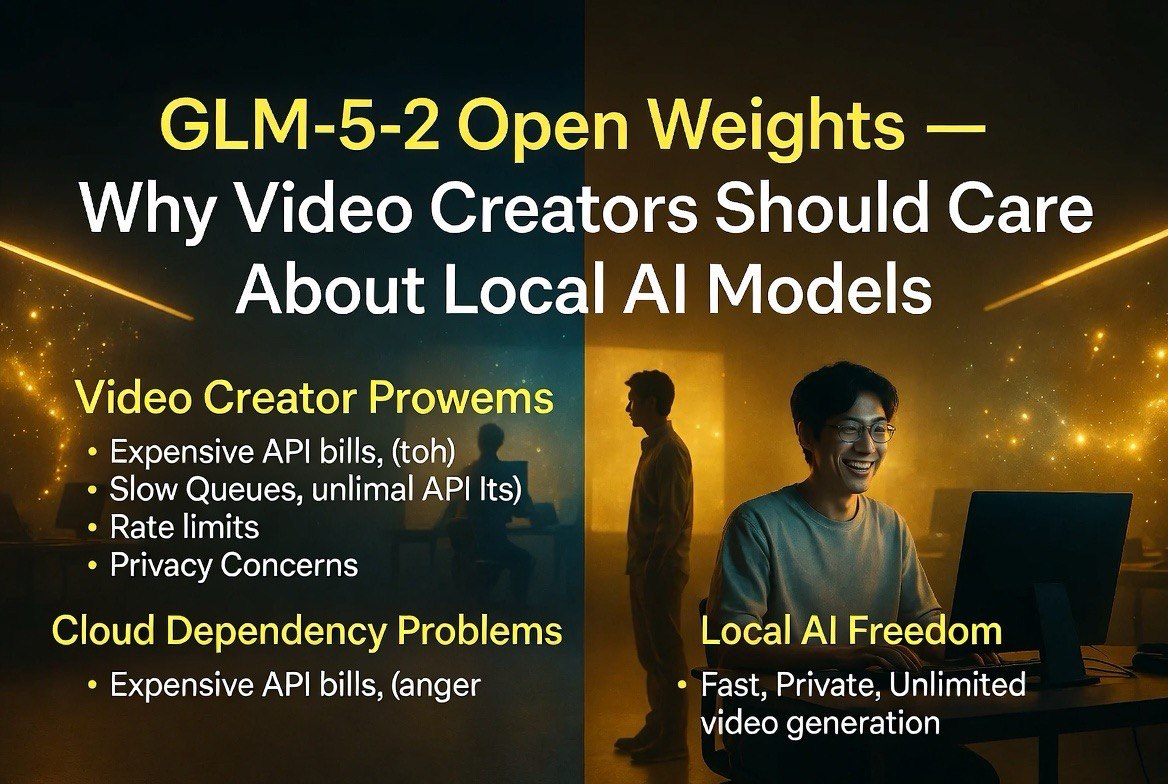
GLM-5.2 Open Weights — Why Video Creators Should Care About Local AI Models
Get The Faceless YouTube Blueprint — Free
The exact AI tool stack and workflow used to build a faceless YouTube channel from zero.
GLM-5.2 Open Weights — Why Video Creators Should Care About Local AI Models
⚡ Expert Summary: Z.ai released GLM-5.2, a 753-billion parameter open-weights model that beats GPT-5.5 on coding benchmarks at one-sixth the cost. For video creators, the significance isn’t coding performance — it’s that frontier-level AI can now run locally, uncensored, and without API costs. This changes the calculus for creators who want AI tools without vendor lock-in, ongoing subscription fees, or the risk of sudden service shutdowns.
What GLM-5.2 Actually Is
Z.ai, formerly known as Zhipu AI, released GLM-5.2 on June 16, 2026. It is a 753-billion parameter large language model released under an MIT open-source license, meaning anyone can download, modify, and run it without paying licensing fees. The model is available on Hugging Face and through Z.ai’s API starting at $12.60 per month for enterprise tiers.
The benchmark numbers are impressive. On SWE-bench Pro, GLM-5.2 scored 62.1, beating GPT-5.5’s 58.6. On FrontierSWE Dominance, it hit 74.4%, surpassing GPT-5.5’s 72.6% and nearly matching Claude Opus 4.8 at 75.1%. All at approximately one-sixth the inference cost of GPT-5.5.
But if you are a video creator, you probably do not care about SWE-bench scores. You care about whether this model can help you produce better videos, automate tedious tasks, or reduce your tool costs. And the answer to all three is yes.
IndexShare Architecture: Why This Model Is Different
GLM-5.2 introduces a major architectural innovation called IndexShare that makes it practical despite its massive 753-billion parameter count. In standard large language models, recalculating attention mechanisms across long documents is computationally expensive. IndexShare solves this by reusing the same indexer across every four sparse attention layers.
At the maximum 1-million-token context length, this single innovation reduces per-token compute FLOPs by 2.9 times. For creators processing long video transcripts or large batches of content, this means faster inference and lower hardware costs.
The model also features Multi-Token Prediction for speculative decoding, boosting accepted token length by up to 20% during inference. Z.ai has implemented flexible Thinking Modes that let users toggle between Max reasoning for complex analysis and High for a balance of performance and speed.
These architectural choices matter because they determine whether a frontier model is practically usable for day-to-day creator work, not just theoretical benchmarks.
What Open Weights Mean for Creators
The key phrase in the GLM-5.2 announcement is “MIT open-source license.” This is not a free trial or a limited API. It is the actual model weights, released for unrestricted use.
No API Costs
Every time you use ChatGPT, Claude, or Gemini, you pay per query. Even with a monthly subscription, there are usage limits and rate caps. With GLM-5.2 downloaded and running on your own hardware, you pay only for compute and electricity. For high-volume users — creators who run dozens of queries per day for script generation, captioning, image analysis, and editing — this eliminates the single largest recurring AI cost.
No Censorship or Content Restrictions
Open-weights models have no content filters, no usage policies, and no restrictions on the type of content you can generate. For video creators who work with mature themes, satire, political content, or experimental formats, this removes the unpredictable moderation that plagues commercial AI services. Your creative workflow is not subject to someone else’s content policy.
No Service Shutdowns
The Anthropic Fable 5 situation from last week was a stark reminder: government orders can shut down access to commercial AI models overnight. GLM-5.2 is downloaded to your machine. No government can cut your access. No company can change the terms. No API endpoint can go down. The model is yours permanently.
How Video Creators Can Actually Use GLM-5.2
Script Generation at Scale
Running an open-weights model locally means you can generate scripts without per-query costs. A creator producing daily YouTube content can batch-generate 30 scripts in one session without watching a meter tick. The quality is competitive with ChatGPT for structured content creation tasks.
Transcription and Captioning Pipeline
GLM-5.2’s 1-million-token context window makes it practical for processing long-form video transcripts. You can feed an entire podcast transcript, meeting recording, or documentary narration into a single context window and generate captions, summaries, chapter markers, and show notes in one pass.
The 1-million token capacity means roughly 750,000 words of context. That is approximately 50 hours of transcribed audio in a single processing window. No other commercially accessible model offers this capacity.
Automated Editing Decision Support
Creators who work with AI video editing tools like Runway, Descript, or DaVinci Resolve’s AI features can use GLM-5.2 as a backend brain. It analyzes footage descriptions, suggests cuts, generates b-roll descriptions, and optimizes video structure. Running this locally means no data leaves your machine — important for creators who handle client footage with confidentiality requirements.
Custom Fine-Tuning for Your Style
Because the weights are open, you can fine-tune GLM-5.2 on your own content archive. Feed it your previous scripts, your editing notes, your caption style guide, and your audience analytics. The result is a model that writes in your specific voice, applies your editorial standards, and generates content that matches your channel’s style.
This is the killer feature that commercial APIs cannot match. ChatGPT can generate generic scripts. A fine-tuned GLM-5.2 generates scripts that sound like you.
The Privacy Advantage
For creators who handle sensitive client content, the privacy benefits of open-weights models cannot be overstated. When you use ChatGPT, Claude, or Gemini, your prompts and uploaded content are processed on the provider’s servers. This means your intellectual property, client footage descriptions, unreleased project details, and creative concepts exist on someone else’s infrastructure.
Open-weights models running locally change this entirely. Every prompt, every transcript, every analysis stays on your machine. No data is transmitted to an external API. For creators working with NDAs, unreleased products, or confidential client materials, this eliminates a significant vulnerability.
The Fable 5 incident adds another dimension: even if you trust the AI provider, the government can compel access to their servers. Local models are not subject to third-party data requests.
The Hardware Reality Check
A 753-billion parameter model is not running on a laptop. Running GLM-5.2 requires significant hardware: multiple high-end GPUs with substantial VRAM. A full 753B model setup requires approximately 1.5TB of combined GPU memory, which translates to roughly eight NVIDIA A100 80GB GPUs or four H100 80GB GPUs.
For most individual creators, this means running GLM-5.2 on rented cloud GPU instances rather than local hardware. Providers like RunPod, Vast.ai, and Lambda Labs offer GPU rentals starting at approximately $2-4 per hour for the required hardware. A weekend processing batch might cost $50-100 worth of compute time.
However, Z.ai offers a quantized version of GLM-5.2 that reduces hardware requirements by approximately 60% with minimal quality loss. The quantized model can run on fewer GPUs, bringing the entry cost down significantly. And the company is releasing smaller variants of the model in the coming weeks.
For creators who do not need the full 753B model, the smaller GLM variants will offer a more accessible entry point while retaining the open-weights advantage.
Why This Matters More After the Anthropic Fable 5 Incident
The timing of GLM-5.2’s release is not coincidental. Just days earlier, Anthropic blocked all public access to Claude Fable 5 and Mythos 5 following a US government export control order. Paying enterprise customers lost access to models they were actively using. Sessions terminated mid-query.
This event sent a clear signal to every creator and business relying on commercial AI: your access can be revoked at any time, for any reason, by any government. The Fable 5 situation may resolve, but the precedent is set.
Open-weights models eliminate this risk. GLM-5.2 is not subject to export controls because it is already downloaded. It is not subject to company policy changes because you control the running instance. It is not subject to pricing changes because your only costs are hardware.
For video creators who depend on AI tools for their production pipeline, this is not a theoretical concern. If OpenAI, Anthropic, or Google were subject to similar restrictions, the disruption to creator workflows would be catastrophic. GLM-5.2 is the first model that offers frontier-level capability without that single point of failure.
What GLM-5.2 Cannot Do (Yet)
Open-weights models are powerful but not perfect. Creators should understand the current limitations.
GLM-5.2 is optimized for structured tasks like coding, analysis, and text generation. It is less capable at creative writing and narrative tasks than GPT-5.5 or Claude Opus 4.8, where it scores slightly lower on benchmarks. For video creators who need punchy, engaging script dialogue, commercial models may still produce better first drafts.
The model’s strength in long-horizon tasks — sustained reasoning over extended contexts — makes it ideal for document analysis, transcription processing, and project planning. Its creative generation is competitive but not best-in-class.
The open-weights community will improve the model through fine-tuning. Within weeks of release, community fine-tuned variants optimized for creative writing, script generation, and content creation will appear on Hugging Face. The beauty of open weights is that the ecosystem improves the model continuously.
How to Start with Open-Weights AI
Step one: determine your use case. If you need occasional script generation, the $20 monthly ChatGPT subscription is probably sufficient. If you need high-volume, custom-tuned AI that runs without per-query costs or content restrictions, open-weights is the path.
Step two: assess your hardware resources. Try GLM-5.2 through Z.ai’s API at $12.60 per month first. This gives you access without hardware investment. If the quality meets your needs, explore local deployment options.
Step three: download the model from Hugging Face and set up a local inference server. Z.ai provides deployment guides for Docker, Kubernetes, and standard Linux environments.
Step four: fine-tune the model on your own content. Collect your previous scripts, captions, and production notes. The fine-tuning process requires additional compute but produces a model customized to your specific creative workflow.
Step five: integrate into your production pipeline. Replace your commercial AI API calls with local model calls. Monitor quality and adjust. You now own your AI infrastructure.
Frequently Asked Questions
What is GLM-5.2 and why does it matter for video creators?
GLM-5.2 is an open-weights 753-billion parameter AI model that beats GPT-5.5 on coding benchmarks. For video creators, it means having access to frontier-level AI that runs locally with no API costs, no content restrictions, and no risk of service shutdown.
Can I run GLM-5.2 on my laptop?
The full 753B model requires multiple high-end GPUs. Quantized versions and smaller variants will run on consumer hardware. Cloud GPU rental is the most practical option for most creators.
How does GLM-5.2 compare to ChatGPT for content creation?
GLM-5.2 matches or exceeds GPT-5.5 on technical benchmarks. For creative tasks like script writing and content planning, performance is comparable. The advantage of GLM-5.2 is zero per-query costs, no content restrictions, and the ability to fine-tune on your own data.
Why does the Anthropic Fable 5 shutdown matter for open-weights models?
The Fable 5 incident demonstrated that governments can shut down access to commercial AI models at any time. Open-weights models are immune to this risk because they run on your own hardware.
How much does it cost to use open-weights AI vs commercial subscriptions?
Commercial AI subscriptions cost $20-200 per month with per-query limits. Open-weights deployment costs are hardware-dependent: cloud GPU rentals run $2-4 per hour, and full local deployment requires significant upfront hardware investment. For high-volume creators, open-weights is dramatically cheaper long-term.

About Barak Schurr
Barak Schurr is a serial entrepreneur who built and exited a major ticketing platform before turning his attention to AI and content. He runs three AI-focused research sites and writes about the tools, workflows, and strategies that let solo creators build real channels — without a crew, a studio, or a Hollywood budget.
Email: [email protected]
More AI Resources for Your Business