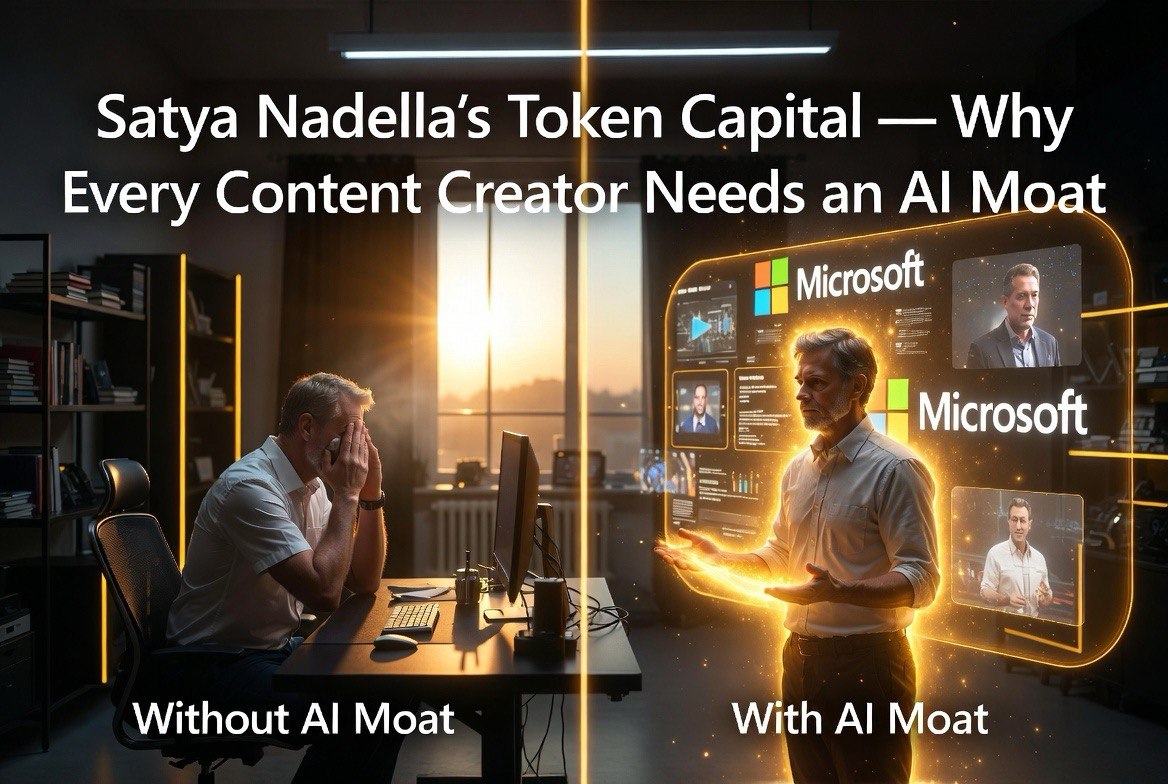
Satya Nadella’s Token Capital: Why Every Content Creator Needs an AI Moat
Get The Faceless YouTube Blueprint — Free
The exact AI tool stack and workflow used to build a faceless YouTube channel from zero.
Satya Nadella’s Token Capital: Why Every Content Creator Needs an AI Moat
⚡ Expert Summary: Microsoft CEO Satya Nadella just published a sweeping essay warning that AI could “hollow out entire industries” — and his solution is something he calls “token capital.” For content creators, this is the most important AI concept you will hear this year. Token capital means building proprietary AI workflows, custom models, and unique datasets that create a competitive moat around your creative business. If you use the same AI tools as everyone else and feed them the same prompts, you produce the same output as everyone else. Here is how to build real token capital as a creator — before the window closes.
Satya Nadella published an unusual essay last week. The CEO of Microsoft — a company worth over $3 trillion — posted a philosophical piece on X titled “A Frontier Without an Ecosystem Is Not Stable.” In it, he warned that AI concentration could hollow out entire industries, echoing the damage done by globalization in the 1990s and 2000s.
“If all the value is accrued by only a few models, the political economy will simply not tolerate it,” Nadella wrote. “There is no societal permission for an AI future that hollows out entire industries.”
But buried in the middle of this essay is a concept that every content creator, video producer, and digital entrepreneur needs to understand: token capital.
According to VentureBeat’s analysis of the essay, Nadella defines token capital as “the firm’s AI capability it builds and owns.” He contrasts this with human capital — the knowledge, judgment, relationships, and pattern recognition of your team. Both are valuable. Both reinforce each other. But in 2026, most creators are building neither.
What Is Token Capital for Content Creators?
Let me translate Nadella’s corporate framework into something practical for creators.
Token capital is the collection of AI assets that are uniquely yours. Not the AI tools you subscribe to — those are available to everyone. Not the prompts you use — those get copied in seconds. But the proprietary assets you build on top of those tools:
- Your training data — Transcripts of your best videos, your writing style guide, your brand voice framework, your content library organized and tagged
- Your custom fine-tuned models — A version of an AI model trained on your content, your audience, your style
- Your AI workflows — The specific sequences of prompts, tools, and human review that produce your unique output
- Your audience data — What your audience responds to, what they ignore, what drives engagement on your platform
- Your proprietary prompts — Not generic prompts, but prompts that contain your brand rules, your tone guidelines, your content strategy encoded into reusable templates
Nadella’s key insight is this: if you use the same AI models as every other creator, with the same generic prompts, you will produce the same generic content. Your competitive advantage doesn’t come from having access to better AI. It comes from having better context for the AI to work with.
As Nadella wrote in his essay, the real opportunity is “not in picking the best model but instead in building a learning loop on top of models where human capital and token capital compound.” This is a direct description of how successful creators will operate in the AI era.
Why Most Creators Are Building Zero Token Capital
The harsh truth is that most content creators are using AI in the most commoditized way possible. They use the same version of ChatGPT or Claude as everyone else. They use the same prompts posted on Reddit and X. They generate thumbnails with the same AI image tools using the same generic prompts. The result is content that feels, looks, and sounds the same as everyone else’s.
This is exactly what Nadella is warning about. AI commoditization doesn’t just hollow out industries — it hollows out individual creators who fail to build proprietary value on top of the shared tools.
The moment you realize that the AI tools you use are available to every other creator in your niche, you realize that your competitive advantage has to come from somewhere else. That somewhere else is token capital.
How to Build Token Capital as a Creator
1. Archive and Tag Your Content Library
Every video you’ve ever made, every script you’ve written, every thumbnail you’ve designed is a data asset. But it’s only valuable if it’s organized. Start building a searchable archive of your best content, tagged by topic, format, audience reaction, and performance metrics. This becomes the training data for your custom AI.
Tools like Notion, Airtable, or a simple Obsidian vault can serve as the foundation. Export transcripts from YouTube. Save your best-performing scripts. Tag everything by topic and outcome. Within a few months, you’ll have a proprietary dataset that no new creator can replicate.
2. Build Custom AI Instructions Based on Your Voice
Most creators use generic AI instructions: “Write a YouTube script about [topic].” That produces generic output. Instead, build a custom system prompt that encodes your voice, your style, your audience, and your content strategy.
Your custom instructions should include:
- Your tone guide — Specific words you use and avoid. Your sentence rhythm preferences. Your humor style.
- Your audience profile — Who watches your content, what they already know, what they’re trying to learn
- Your content rules — How you structure intros, hooks, transitions, and calls to action
- Your banned topics — What you never cover
- Your reference content — Links to your best-performing videos or posts so the AI understands what “good” looks like for you
This custom instruction set is your token capital. It can’t be copied because it’s built from your unique creative history.
3. Create AI Workflows, Not One-Off Prompts
Nadella emphasizes “learning loops” — systems where your AI gets better over time because it learns from your corrections and feedback. A one-off prompt doesn’t learn. A workflow does.
Here’s an example workflow for a YouTuber:
Step 1: Feed the AI your research notes and ask it to identify 3-5 angles
Step 2: Pick the best angle, feed it into a custom script generator with your voice instructions
Step 3: Review and edit the script, feeding your changes back into the system
Step 4: Run the approved script through a thumbnail generator with your brand guidelines
Step 5: After the video publishes, feed performance data back into the system
After 10-20 iterations of this workflow, the AI produces output that’s 80% usable on the first attempt — because it’s learned your preferences. That’s compound token capital.
4. Measure Your Token Capital Growth
What gets measured gets built. Track how much of your content is now produced using your proprietary AI systems versus generic tools. Track how much time you save per piece of content. Track the improvement in engagement rates. If your token capital is growing, you should see: fewer first-draft revisions, faster time from idea to publish, and better audience response to AI-assisted content versus purely manual content.
Nadella’s concept of “learning loops” means your token capital should compound over time. If you’re not measurably better at using AI today than you were three months ago, your token capital isn’t growing — and neither is your competitive advantage.
5. Decouple Your Token Capital From Any Single AI Tool
This is the most important point in Nadella’s essay. He writes that the key test of a company’s sovereignty is whether it can “switch out a ‘generalist’ model without losing the ‘company veteran’ expertise built into their learning system.”
Your token capital should be tool-agnostic. Your voice guide, your content library, your performance data, and your workflow documentation should work with ChatGPT, Claude, Gemini, or whatever comes next. If you build your entire creative process around one AI platform and that platform changes its pricing, policies, or availability, you lose everything.
The Window Is Closing
The comparison Nadella draws between AI concentration and globalization is worth sitting with. In the 1990s and 2000s, entire industrial economies were hollowed out by outsourcing. The GDP numbers looked fine on the surface, but the displacement was real and lasting. “Let us not bring that dynamic into the AI era,” Nadella wrote, “with a small number of AI systems capturing all the economic returns, while entire industries find their knowledge commoditized right out from underneath them.”
For creators, the parallel is direct. If you put all your creative workflows into one AI tool — all your prompts, all your templates, all your training — and that tool changes terms, raises prices, or shuts down, you’re displaced the same way factory towns were when the plant moved overseas. The only defense is owning the unique assets that the tools can’t replicate.
ChatGPT’s market share just dropped below 50% for the first time. The AI tool landscape is fragmenting. The creator who builds their business around one platform is building on sand. The one who builds portable token capital — custom datasets, voice guides, workflow documentation — can switch platforms in a day.
Nadella’s essay is a warning to every business, but it’s especially urgent for individual creators. In the AI era, the gap between creators who build token capital and those who don’t will grow exponentially. The ones who build proprietary AI assets will produce better content faster, build deeper audience relationships, and create businesses that survive platform changes, algorithm updates, and AI model shifts.
The ones who don’t will compete on price, format, and volume — the same commoditized race to the bottom that’s already happening in every saturated content niche.
The good news: you don’t need a $3 trillion company’s resources to start. You need a system, a commitment to consistency, and the understanding that your content isn’t just content — it’s training data for your own AI moat.
For more on how AI is reshaping the creator economy, check out our AI video tools and creator guides.
Frequently Asked Questions
What is token capital for content creators?
Token capital is the collection of proprietary AI assets a creator builds and owns: custom voice instructions, organized content libraries, fine-tuned models, AI workflows, and audience data. It’s the competitive advantage that can’t be copied because it’s built from your unique creative history.
Why did Satya Nadella write about token capital?
In an essay published June 2026, Nadella warned that AI concentration could hollow out entire industries — similar to how outsourcing gutted industrial economies. His solution is “token capital”: proprietary AI systems that companies (and creators) build and own, creating competitive moats that survive model changes and platform shifts.
How do I start building token capital as a creator?
Start by archiving and tagging your content library in a searchable system (Notion, Airtable, Obsidian). Then build a custom AI instruction set that encodes your voice, style, and audience. Finally, create repeatable AI workflows that learn from your feedback and corrections over time.
Is token capital the same as using ChatGPT?
No. Using ChatGPT or any AI tool gives you access to a general-purpose model that every other creator has. Token capital is what you build on top of those tools: your proprietary data, custom instructions, and unique workflows. The tools are the same; the token capital is what makes your output different.
Can AI replace content creators who don’t build token capital?
Nadella’s warning suggests that creators who rely solely on commoditized AI tools and generic prompts will struggle to differentiate. Those who build proprietary token capital — unique data, voice, and workflows — create a defensible competitive advantage that AI alone can’t replicate without their specific context and creative history.

About Barak Schurr
Barak Schurr is a serial entrepreneur who built and exited a major ticketing platform before turning his attention to AI and content. He runs three AI-focused research sites and writes about the tools, workflows, and strategies that let solo creators build real channels — without a crew, a studio, or a Hollywood budget.
Email: [email protected]
More AI Resources for Your Business