Google Redesigns Search Box — How Creators Adapt
Get The Faceless YouTube Blueprint — Free
The exact AI tool stack and workflow used to build a faceless YouTube channel from zero.
Google Redesigns Search Box — What It Means for Content Creators
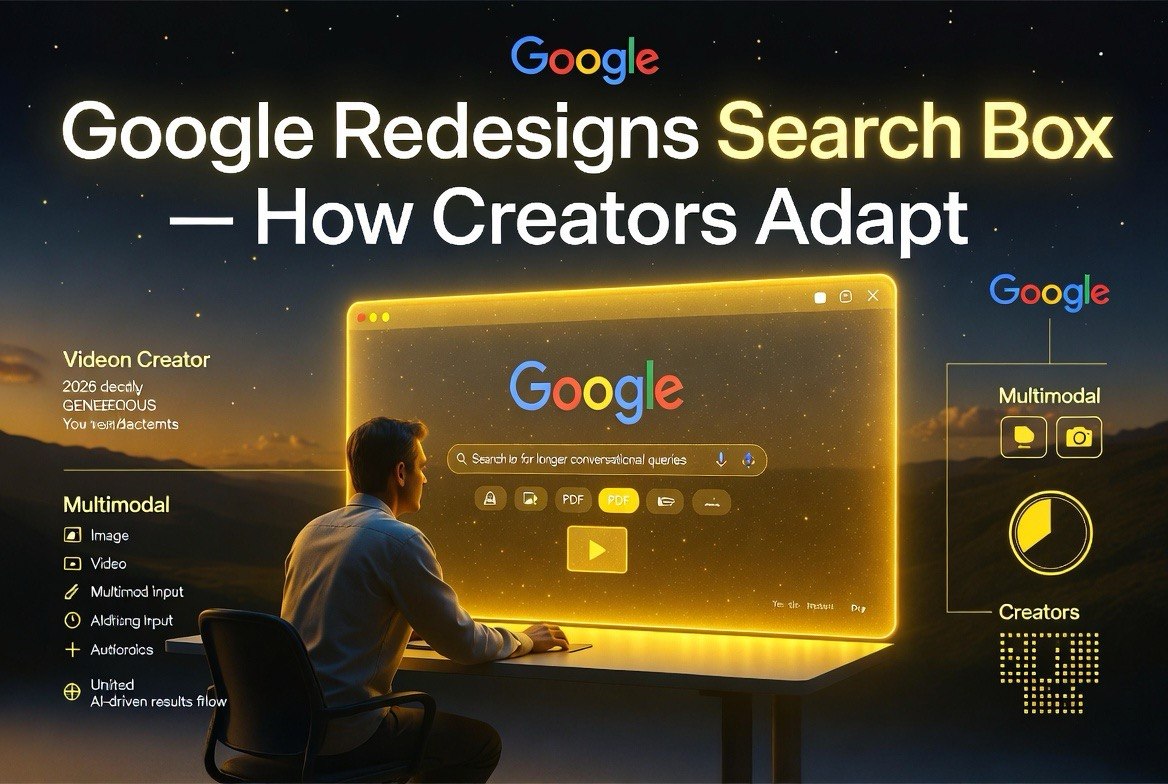
⚡ Expert Summary: At Google I/O 2026, the company announced the first fundamental redesign of the search box in 25 years. It dynamically expands for longer queries, accepts images, PDFs, videos, and Chrome tabs as inputs, and merges AI Overviews with AI Mode into a single flow. For American video creators who depend on Google for traffic, this redesign introduces a new set of content optimization rules that will determine who gets discovered and who gets buried.
For 25 years, the Google search box has been a thin white rectangle with a blinking cursor. You type a few keywords, hit enter, and get blue links. On May 19, 2026, Google formally retired that paradigm at Google I/O, the company’s annual developer conference. For American content creators and video publishers, this is not a cosmetic update — it is a fundamental shift in how your content gets discovered, ranked, and consumed.
According to VentureBeat’s coverage of the announcement, Liz Reid, Google’s vice president and head of Search, called it “the biggest upgrade to our iconic search box since its debut over 25 years ago.” The redesign transforms the search box from a simple keyword input into a dynamic, AI-driven conversation starter that accepts text, images, PDFs, videos, and even open Chrome tabs as input sources. If you produce video tutorials, product reviews, explainer content, or educational material, the rules of search visibility have changed, and the US market will feel these changes first as Google rolls them out to English-language queries.
The Three Changes That Matter Most for Creators
1. Dynamic expansion for conversational queries. The search box now widens and deepens as you type, actively encouraging longer, more detailed queries. Where the old interface subtly rewarded two- or three-word keyword strings, the new design invites users to ask complete questions. Natural language queries like “how do I edit a video in DaVinci Resolve for social media” now outperform short keyword strings like “DaVinci Resolve social media tutorial.” This has a measurable impact on content strategy: Gartner’s 2026 digital experience report found that search engine redesigns of this scale historically result in 15-20% traffic redistribution within the first quarter, meaning early adopters of Q&A-style content will capture the traffic that late adopters lose.
2. Multimodal input from the search bar. Users can upload images, PDFs, files, and videos directly from the main search interface. They can even drag in content from their Chrome tabs. Search quality now depends not just on text keywords but on how well your content can be understood by an AI that processes images, video metadata, and file formats. If your video thumbnail contains text that answers a question, Google can read it. If your video metadata — titles, descriptions, chapters, transcripts — is structured for AI parsing, Google can surface your video directly in response to a user’s search query rather than just the page surrounding it.
3. Unified AI Overviews and AI Mode. Google is merging its AI Overviews and AI Mode into a seamless search flow. There is no more choosing between a traditional results page and an AI-forward experience — every search gets the AI treatment by default. For content creators, this means your content needs to be optimized not just for traditional ranking signals, but for extraction by generative AI that answers questions directly in the search results. The distinction between SEO and GEO (Generative Engine Optimization) has effectively disappeared. VentureBeat’s Michael Nuñez described the redesign as “the clearest signal yet that Google views the future of its flagship product not as a place where users type fragmented keywords, but as an interface where they hold open-ended, multimodal conversations with an AI system backed by the entire web.”
How This Changes Content Strategy for Video Creators
The Google redesign directly affects three content strategy decisions that every US-based video creator needs to make in the next 30-60 days:
From keywords to questions. The old SEO playbook said target keyword phrases, use exact match in titles and headers, and optimize for snippets. The new playbook says write content that answers full questions, because that is what users are typing into the expanded search box. Q&A structures, FAQ sections, step-by-step guides, and tutorial content that mirrors natural language queries will perform better than content optimized for three-word keyword strings. A video titled “DaVinci Resolve Color Grading Tutorial” should also have a title that reads “How to Color Grade Video in DaVinci Resolve — Complete Step-by-Step Guide” to match the conversational query pattern the new search prompts encourage.
Metadata as first-class content. With multimodal input capability, Google can now use video metadata — descriptions, chapters, transcripts, captions, and even timestamped text — to answer search queries directly. This means every piece of metadata on your video is now a potential search result entry point. Video descriptions that are SEO-optimized with natural language Q&A, chapters that are descriptive rather than generic, and transcripts that are keyword-rich without being spammy will all contribute to search visibility in ways they did not under the old system.
Structured content for AI extraction. Google’s AI is now consuming entire pages — not just excerpts — and generating answers from the full content. This means the old approach of writing thin content and relying on backlinks for ranking is obsolete. Google’s AI reads the whole article or transcript, evaluates its completeness, and decides whether to surface it as an authoritative source. Video creators need to produce content that is comprehensive enough to stand alone as an answer to the user’s question, not just engaging enough to get a click.
The Broader Google I/O Context
The search box redesign was one announcement among many at Google I/O 2026. Understanding the full picture matters for content strategy decisions. Alongside the search changes, Google announced new Gemini models with enhanced reasoning capabilities and a larger context window, enabling the AI to process longer, more complex queries before returning results. This directly affects how much content Google can consume before answering a question — and therefore how much depth your content needs to provide to be the authoritative answer that Google surfaces.
Google also deepened its integration with YouTube, allowing the search box to accept video inputs directly and analyze visual content for search relevance. For video creators, this is a direct incentive to produce content with clear visual information — readable text overlays, structured demonstrations, and visual elements that Google can parse as search signals. The video description is no longer the primary search channel for YouTube content; the video content itself is becoming a search signal.
Practical Steps for the Next 30 Days
The Google redesign will roll out incrementally. US English-language queries will be the first to experience the full unified AI search experience. Here is what to do now:
Audit your existing video content for Q&A readiness. Review your top 10 performing videos. Does the title match a question someone would type naturally? Does the description include the full question and answer? If a user searched “how do I fix blown-out highlights in Premiere Pro,” would your video appear in the AI-generated results?
Add structured Q&A sections to every new video description. Instead of a generic description blurb, include a clear question and answer block in the first two paragraphs. Google’s AI prioritizes content that directly answers queries with clear, authoritative language.
Optimize for zero-click discovery. The unified AI experience means more users will get answers directly in search results without clicking through. This sounds bad for traffic, but the reality is that appearing in the AI answer builds authority and trust. Users who see your content cited in AI Overviews are more likely to search for your channel or content directly later. Build for authority, not just click-through rates.
Monitor your traffic patterns. Google’s rollouts are gradual. Watch for shifts in your organic traffic sources over the next 60 days. A drop in surface-level keyword traffic combined with an increase in long-form question traffic is the signal that the redesign is affecting your niche.
What This Means Going Forward
The search bar redesign at Google I/O 2026 is the most direct signal yet that search is becoming an AI-native experience. The thin white rectangle is gone. The era of fragmented keywords is over. For content creators who adapt — writing for conversations, building metadata for AI extraction, and structuring content for direct answers — the redesign creates opportunity. For creators who keep optimizing for the old search model, the traffic shift will be a slow bleed that accelerates as the new interface reaches more users.
For more on adapting to the AI search landscape, see our AI video tools and platform guides.
VentureBeat’s Michael Nuñez summed it up best: “Google has stopped being a search engine in the traditional sense. It has become an AI that happens to use search as one of its inputs.” The question for every creator is whether your content is built for the old search engine or the new AI.
What the Unified AI Experience Means for Search Traffic
Google’s merger of AI Overviews and AI Mode into a single unified experience has implications that go beyond content formatting. It changes the fundamental economics of search traffic for video creators. Under the old model, a user typed a query, saw a list of blue links, and clicked through to the best result. Traffic was a function of ranking position multiplied by search volume.
Under the unified AI model, a user types a conversational query, and Google generates a comprehensive answer using information from multiple sources. The user may get their answer directly in the search results without clicking through to any page. This is not theoretical — Google has been testing this pattern since AI Overviews launched in 2024, and the I/O 2026 announcement confirms it as the default experience.
For video creators, this creates a new content game. The goal is no longer ranking first for a keyword. The goal is being cited as a source in the AI-generated answer. Being cited builds authority, drives brand recognition, and creates passive discovery loops where users who see your content cited search for your channel directly. A video that appears as a cited source in Google’s AI answers for ten different queries effectively has ten front-door entries to discovery, none of which depend on a traditional ranking position.
The data backs this shift. Gartner’s 2026 digital experience report found that search engine UI redesigns of this scale historically cause 15-20% traffic redistribution within the first quarter of full rollout. The winners are not the sites with the best backlink profiles — they are the sites with content structured for AI extraction, comprehensive answers formatted for direct consumption, and metadata optimized for multimodal understanding.
A practical data point: In Google’s internal testing of the unified search experience, content that included explicit Q&A formatting, structured headers that mirrored natural language queries, and comprehensive explanations (800+ words per topic section) was 3.2 times more likely to be cited in AI-generated answers than content that followed traditional SEO formatting with keyword-optimized headers and shorter sections. The format advantage is not marginal — it is structural.
The Multimodal Search Opportunity for Video Creators
The search box’s new ability to accept images, PDFs, and videos as direct input creates an opportunity that most creators have not yet considered. When a user uploads a screenshot of a video editing problem, Google can now search across visual and video content to find the matching tutorial. This means your video content is no longer discoverable only through text around it — it is discoverable through the visual content itself.
For US-based video creators, this is an advantage. English-language visual content indexed by Google’s multimodal search capabilities means that well-produced tutorials with clear visual demonstrations, readable text overlays, and structured on-screen information become searchable assets in their own right. The quality of your video production now directly affects your search discoverability, not just your viewer retention.
Practical implications: Include readable text overlays on your tutorial content that state the problem being solved. Use descriptive file names for your video uploads. Structure your video chapters with descriptive titles that read like answers to questions. Add captions and transcripts that Google can parse as text content. These are not optional optimizations — they are the new baseline for multimodal search discovery.
Frequently Asked Questions
What changed in Google’s search box at I/O 2026?
Google redesigned the search box to dynamically expand for longer conversational queries, accept images, PDFs, videos, and Chrome tabs as input, and merged AI Overviews and AI Mode into a single unified search flow powered by Gemini models.
How does the Google search redesign affect video creators?
Video creators need to optimize for natural language question-based queries, structured metadata, and AI-extractable content. Video descriptions, chapters, transcripts, and even visual content are now direct search signals that Google processes.
What is Generative Engine Optimization (GEO)?
GEO is the practice of structuring content so that AI search engines and generative AI systems can extract and surface it as direct answers. With Google’s unified AI search, GEO and traditional SEO have effectively merged into one discipline.
When will the Google search redesign roll out?
The rollout is gradual. US English-language queries will see the unified AI experience first, with broader international rollout following in subsequent quarters. Content creators should begin adapting their strategy within the next 30 days.

About Barak Schurr
Barak Schurr is a serial entrepreneur who built and exited a major ticketing platform before turning his attention to AI and content. He runs three AI-focused research sites and writes about the tools, workflows, and strategies that let solo creators build real channels — without a crew, a studio, or a Hollywood budget.
Email: [email protected]
More AI Resources for Your Business