Prompt-to-Video Is Already Over
Prompt-to-Video Is Already Over
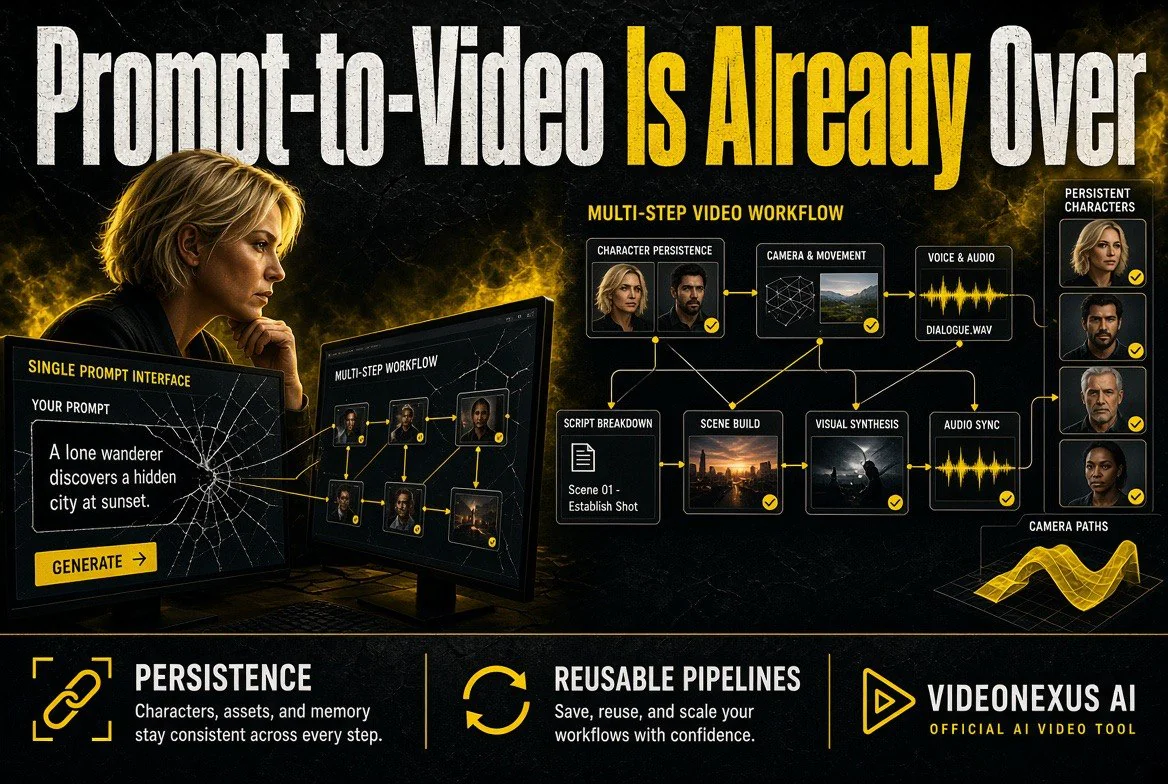
⚡ Expert Summary: For two years the pitch was identical — type a sentence, get a video. That pitch is now the entry level, not the product. The tools that matter in 2026 have stopped selling prompts and started selling workflows: reusable graphs where a character, a look, a camera move and a voice persist across shots instead of being re-rolled from scratch every time. That shift changes who wins. Prompt-wranglers lose their edge to people who can build a system that produces the same result forty times. If you are still measuring a video tool by how good one prompt looks, you are optimising for a game that finished last year.
SitePoint’s November survey of the animation generator market lands on a phrase worth reading twice: the ecosystem is moving beyond simple prompt-to-video tools toward multi-step studio frameworks. That is a polite way of saying the single-prompt model has been demoted.
The demo that sold these tools in 2025 — a five-second clip of a cat surfing, generated from eleven words — is the same trick every competitor can now do. When everyone’s first-generation output looks like everyone else’s, the output stops being the differentiator. The system that produces the output becomes the differentiator.
The Demo Was Never the Product
The first wave competed on fidelity: who had the most realistic motion, the fewest melted hands, the most convincing physics. That competition resolved. The top models now produce output most viewers cannot separate in a blind test.
The second wave competed on control: image-to-video, camera direction, motion brushes. Also resolving. Every serious tool has it.
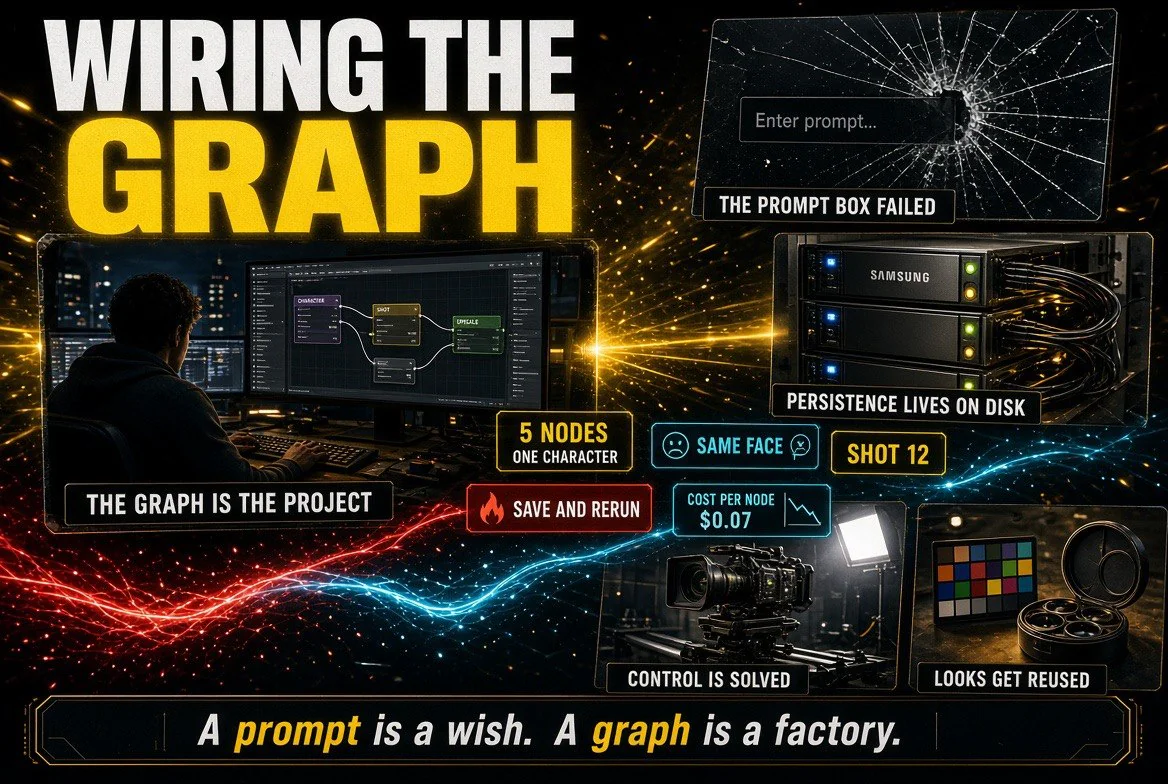
The third wave, the one happening now, competes on persistence. Can the tool remember what it already made? Can your character keep the same face across twelve shots? Can the lighting established in shot one carry into shot nine without re-describing it? Can the voice stay consistent between clips generated on Tuesday and clips generated on Friday?
Persistence is a systems problem, not a prompting problem. That is why the products are changing shape.
| Generation | What It Sold | Why It Stopped Winning |
|---|---|---|
| Prompt-to-video (2024-25) | One good clip from one sentence | Every competitor caught up; the trick became table stakes |
| Controlled generation (2025-26) | Image-to-video, camera moves, motion control | Feature parity; nothing left to differentiate on |
| Workflow systems (2026) | Reusable pipelines with persistent assets | Still unresolved – this is the live fight |
| What buyers now ask | “Can it do this forty times consistently?” | One-off quality no longer closes a deal |
Read the last row as a test you can apply to any tool you evaluate this week. Ask it what happens on the second attempt. If the honest answer involves re-rolling and hoping, you are looking at a generation-two product being sold with generation-three language.
What the Node Canvas Actually Changes
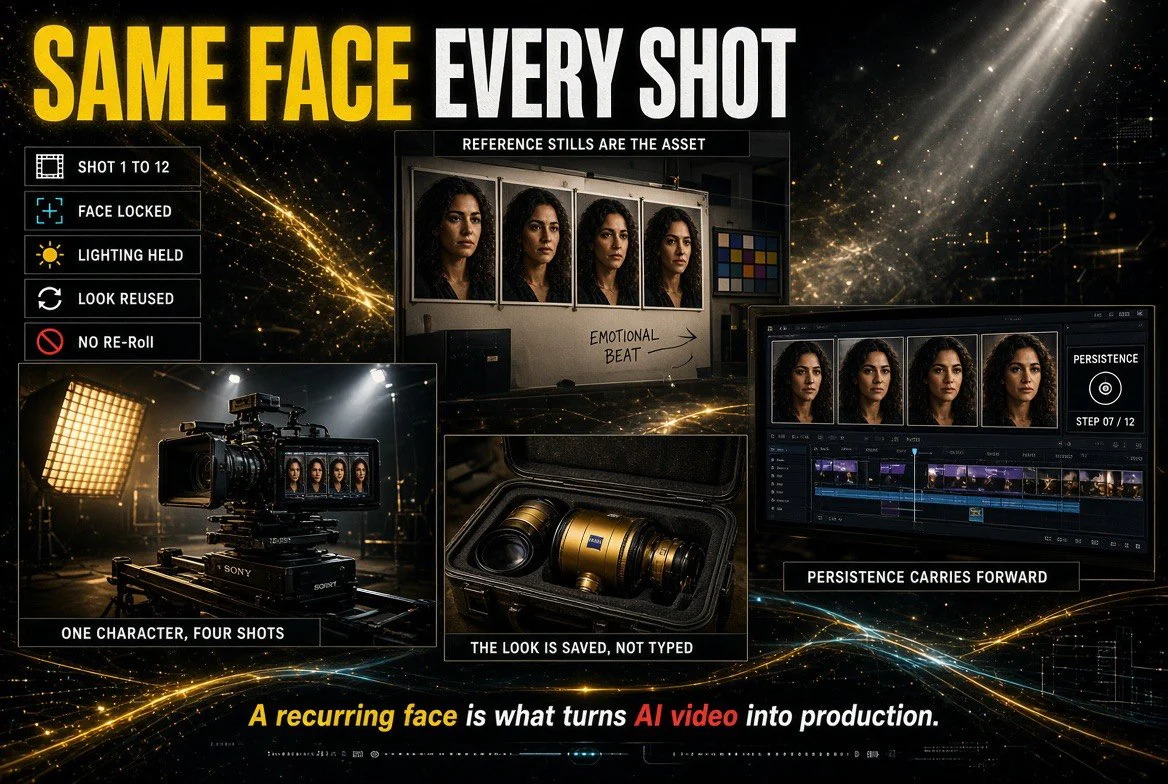
The clearest example of the shift is the move from a text box to a canvas — a node graph where each step is a visible object you wire to the next one. Generate a character, wire it into a shot, wire the shot into a camera move, wire the output into an upscale. The graph is the project.
That sounds like interface preference. It is not. It is an architectural change with three consequences that matter to anyone producing video for money.
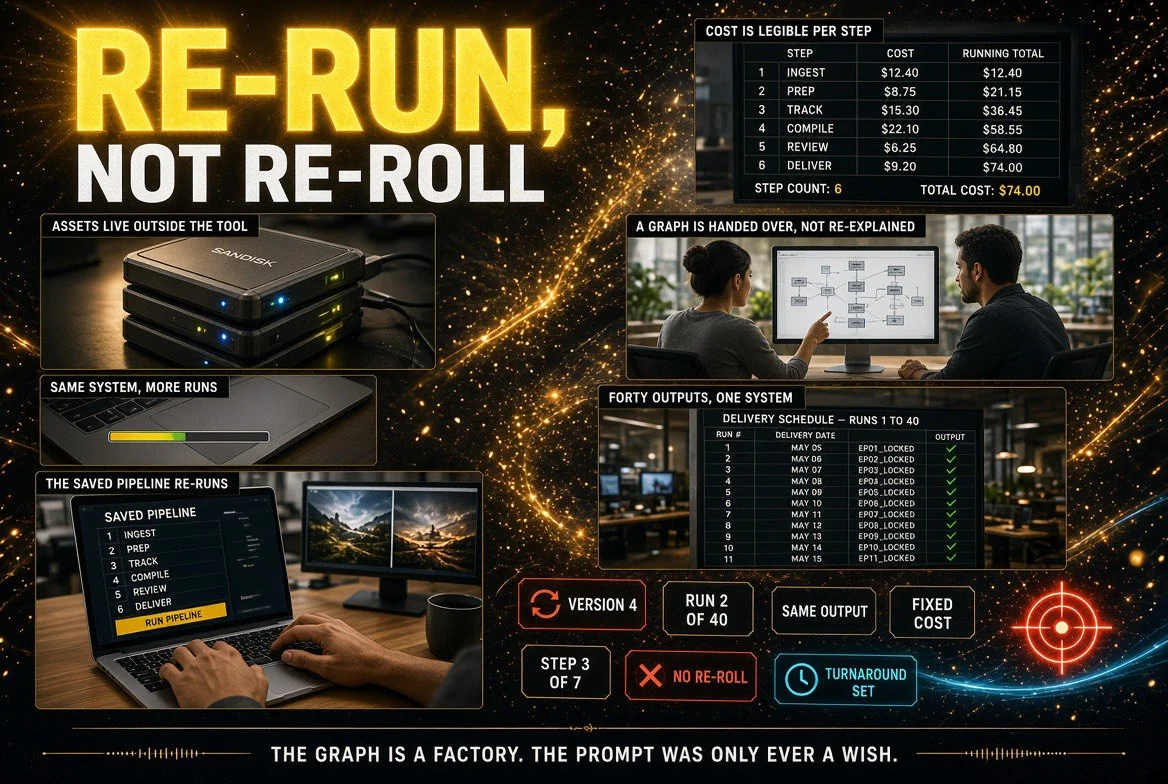
It makes output reproducible. A graph can be saved, versioned and re-run. Change one node and you see exactly what changed downstream. A prompt cannot do this, because a prompt is a suggestion to a model, and the same suggestion produces different results on different days.
It makes assets persistent. A character generated once and stored as a node is the same character in every shot it feeds. This is the biggest single gap between AI video and real production, and it is the gap that made AI video unusable for anything with a recurring cast.
It makes cost legible. In a prompt workflow you pay for every re-roll and cannot predict how many you will need. In a graph you pay for the nodes you run. You can see the price of a shot before you generate it, which is the difference between a hobby and a budget line.
A prompt is a wish. A graph is a factory. The market just worked out which one it needs.
Why Tool Integration Is the Other Half
The second structural change is integration — the ability for the generation model to reach outside itself and use other services. Protocol-level connections are how that happens in practice: the video tool calls a reference database, a style library, a brand asset store and a transcription service, and treats them as available nodes in the same graph.
The practical effect for a solo creator is that the boundary between “my video tool” and “my whole workflow” dissolves. Your brand colours live in one place. Your character reference lives in another. Your voice model lives in a third. The generation step becomes one stop in a chain that can run without you re-describing your entire creative identity every time you sit down.
That is the difference between a tool you operate and a system you maintain. Tools need you present for every output. Systems need you present to design them, then produce on their own.
The Comparison That Actually Matters
When the survey put the major animation generators side by side, the useful dimension was not output quality — that is now a tie among the leaders. It was how much work each tool required to reach a repeatable result.
| Capability | Prompt-First Tool | Workflow Tool | What It Costs You |
|---|---|---|---|
| Character consistency | Re-roll until it matches | Stored asset reused | Hours versus minutes per shot |
| Reproducing a result | Impossible to guarantee | Re-run the saved graph | A reshoot versus a click |
| Cost forecasting | Unknown until you stop rolling | Known per node | Budget risk versus budget line |
| Team handoff | “Here, try my prompt” | Share the graph | Relearning versus inheriting |
| Scaling to 40 videos | 40x the labour | Same system, more runs | Linear versus fixed |
The bottom row is the one that decides which tool you buy. Everything above it is a matter of taste. That row is a matter of whether your business works.
Who Loses When the Prompt Stops Being the Skill
People who built their reputation on prompt craft lose the most, and they will be the last to admit it.
The 2024-25 era rewarded a genuinely difficult skill: knowing which words unlocked which model behaviours, learning the incantations that produced usable output. That skill was real. It was also temporary, because the models got better at understanding plain language, which is precisely what everyone was promising would happen.
What replaces it is less glamorous and more durable: the ability to decompose a creative goal into repeatable steps, identify which steps need a model and which need a rule, and build a system that survives contact with production. That is not a prompting skill. It is a production skill that happens to use AI.
The people who will win the next two years are the ones who can look at a forty-video series and design the pipeline before generating a single frame. They will spend less time in the tool, and the tool will do more of the work.
What to Do About It This Month
This is a shift you can respond to without abandoning whatever you already use.
Stop optimising prompts and start documenting them. The value of a prompt you have to remember is near zero. The value of a prompt written down as one step in a documented sequence compounds. Write down every step, including the boring ones.
Test the second-attempt question on your current tool. Generate something, note the exact inputs, then try to reproduce it a day later. If you cannot get within acceptable range, you are using a generation-two tool for generation-three work, and you should know that before you build a series on it.
Keep a persistent asset library from day one. Characters, looks, voices, lighting setups. Every one you save is a step you never describe again. This is the cheapest possible investment in a workflow, and most creators skip it because their tool does not force it.
Learn one node-based interface, even if you do not need it yet. The mental model transfers. Once you have wired a graph, you will read every new AI video tool through the question “does this fit into what I already built,” which is a much better filter than “does this look impressive.”
Price your work on the system, not the spot. If you can produce a repeatable series, you are not selling individual clips — you are selling a service with a fixed cost and a predictable turnaround. That is a different, better business than competing with everyone who can roll a nice five seconds.
The prompt era did its job. It got the technology into everyone’s hands. What comes next is harder, duller and far more valuable: building the thing that produces the output instead of chasing the output itself.
Frequently Asked Questions
Is prompt-to-video actually dead? As a differentiator, yes. Every major tool can now turn a sentence into a decent clip. It remains an entry point for new users, but it is no longer what buyers compare when choosing a product.
What replaced it? Multi-step workflow systems — node-based canvases and pipelines where characters, styles and voices persist across shots, and where the sequence itself can be saved and re-run.
Do I need a node-based tool to make AI video? Not yet. If you produce one-off clips, a prompt-first tool is fine. If you produce series, brand content, or anything with a recurring cast, the inability to reuse an asset becomes the dominant cost.
Why does character consistency matter so much? Because it is the line between AI video as a novelty and AI video as production. A recurring face is the minimum requirement for narrative, branding, or anything that has to feel like it was made by the same people twice.
How do I test whether my tool can do repeatable work? Generate something with documented inputs, wait a day, then try to reproduce it. If the second attempt does not land close to the first, the tool is not built for repeatable work.

About Barak Schurr
Barak Schurr is a serial entrepreneur who built and exited a major ticketing platform before turning his attention to AI and content. He runs three AI-focused research sites and writes about the tools, workflows, and strategies that let solo creators build real channels — without a crew, a studio, or a Hollywood budget.
Email: [email protected]
More AI Video Resources