
Netflix Now Decides What You’re In the Mood For
Netflix Now Decides What You’re In the Mood For
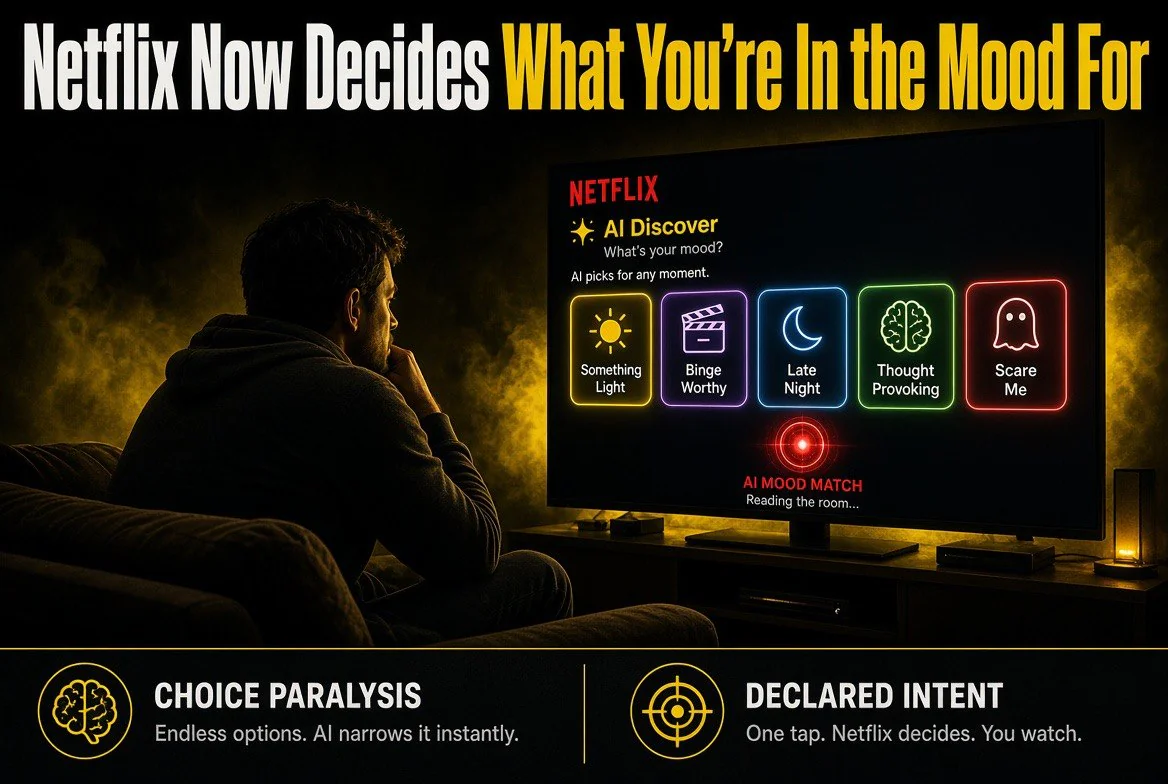
⚡ Expert Summary: Netflix has begun testing an “AI Discover” tab — marked on compatible TVs by a red pulsing jewel icon — that replaces history-based rows with live, mood-driven carousels like “Something Light,” “Scare Me” and “Quick Watches.” It is a direct admission that a decade of behaviour-based recommendation has hit a ceiling. Netflix says the watch data from this tab will not be used to commission shows, which tells you precisely what this is: an interface fix for choice paralysis, not a programming strategy. For creators, the practical change is that discovery now runs on declared intent instead of accumulated history.
For a decade, Netflix’s entire interface rested on one assumption: what you watched before predicts what you want next. Three crime thrillers last week meant a fourth one tonight. It was elegant, it was measurable, and it quietly stopped working — because people do not consume media as a continuous expression of their past selves. They consume it as a mood that changes between Tuesday and Thursday.
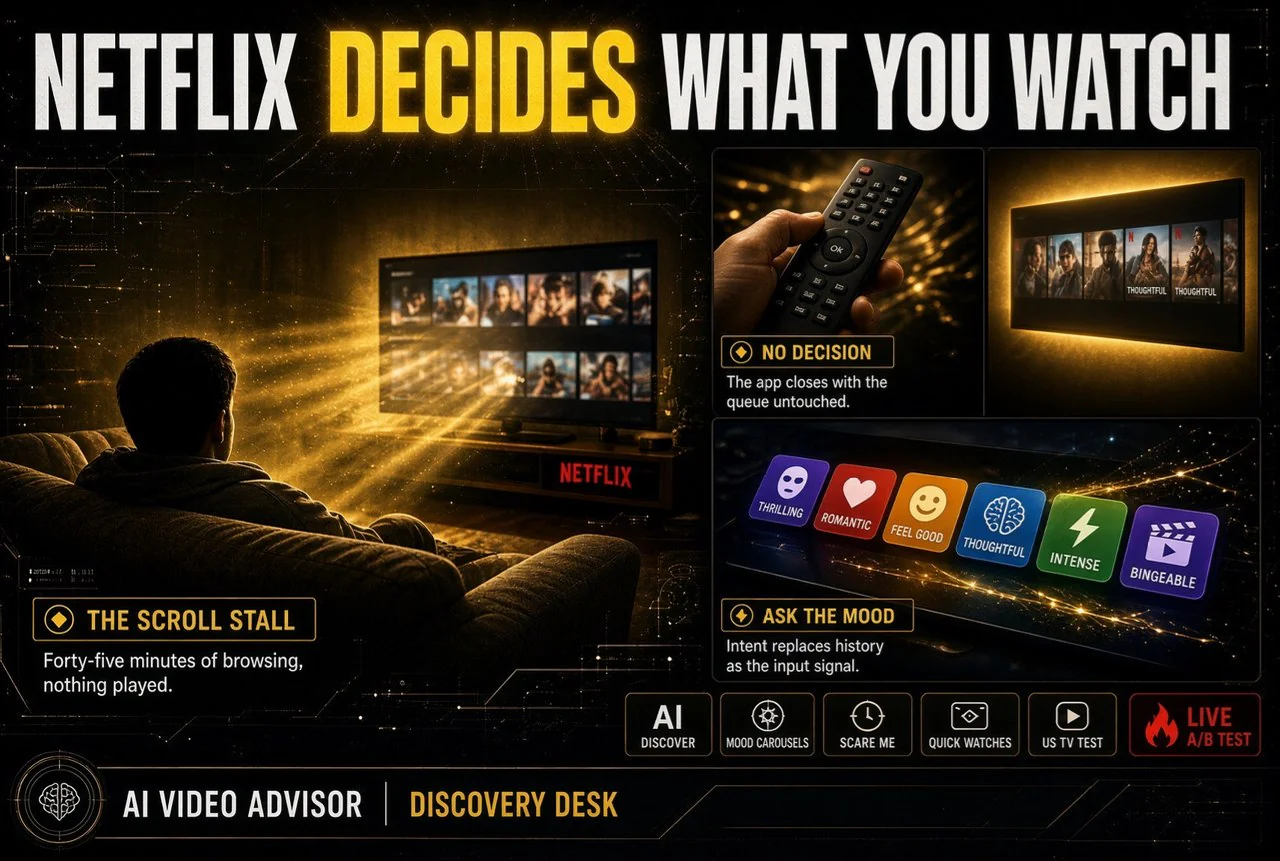
The result is the scroll. Forty-five minutes of grid tiles, an abandoned attempt at a documentary, a rewatch of something already seen twice, and eventually the app closes with nothing played. The industry calls it choice paralysis. Netflix calls it a retention problem. Either way, the company has now conceded the point publicly: the AI Discover tab is an admission that historical curation has reached its ceiling.
What ships in this test is not a smarter version of the old system. It is a different theory of discovery. The old grid assumed your taste was a persona to be modelled; the new layer assumes your taste tonight is a temporary state worth asking about.
What the Mood Tab Actually Is
The interface abandons the horizontal row layout that has defined streaming since 2011. There are no “Because You Watched” carousels in this surface. Instead you get broad, intent-driven buckets — categories phrased the way a person would describe what they want out loud rather than the way a metadata editor would label a title.
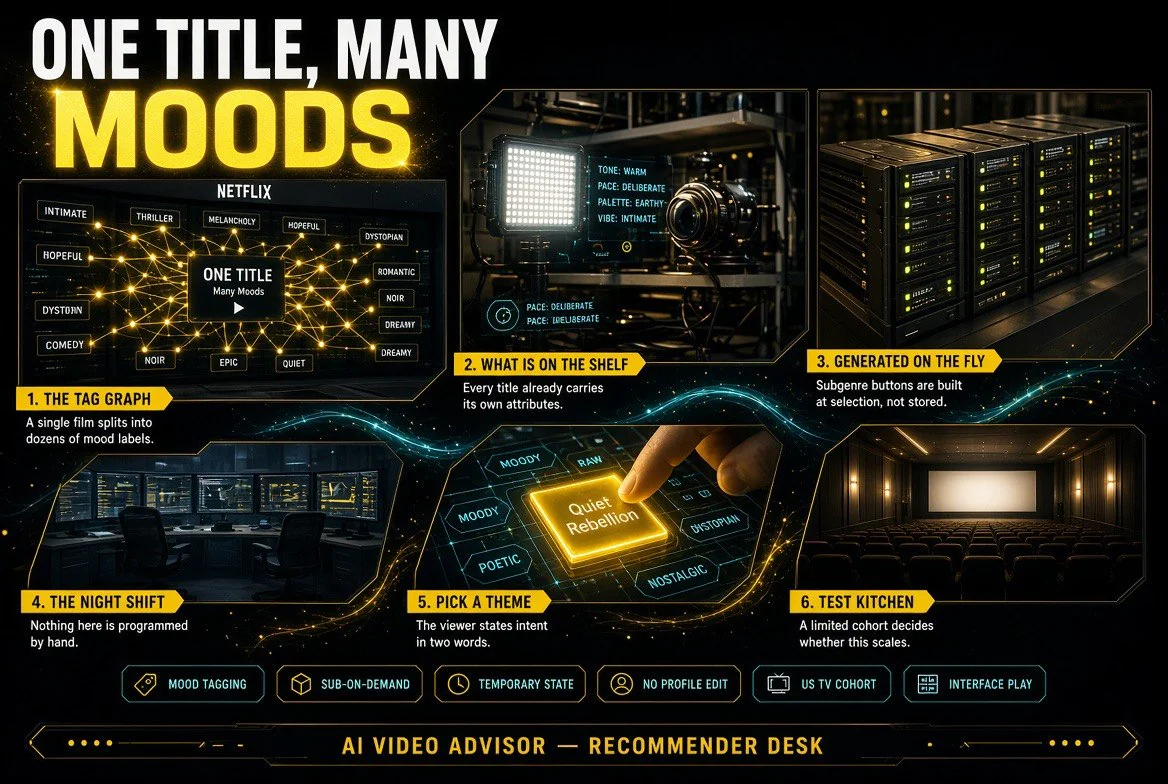
Netflix has used mood-adjacent tags for years — “Gritty,” “Suspenseful,” “Feel-Good.” But those tags were static attributes attached to titles and grouped by editors. The distinction that matters here is that the new layer is responsive: the buckets are the entry point, and everything under them is generated for the moment rather than assembled ahead of time.
| Dimension | Legacy grid | AI Discover mood layer |
|---|---|---|
| Input signal | Accumulated watch history over months | Declared intent at the moment of opening the app |
| Curation | Static rows assembled by editors and models ahead of time | Dynamic subcategory buttons generated on selection |
| Failure mode | Endless scrolling, no selection, app closed | Wrong guess, corrected via “Something Different” |
| Correction | Passive thumbs up or down, absorbed slowly | Explicit rejection reasons logged immediately |
| Persistence | Every session updates a long-term profile | Mood treated as temporary, not added to profile |
The Three Mechanics Worth Understanding
Strip away the marketing and the system runs on three design decisions, each of which carries an implication for anyone whose work depends on being discovered.
1. Mood is treated as a temporary state, not a permanent trait. This is the most significant change and the least visible. In the legacy model, every viewing session edited your long-term profile — a fact that made recommendations self-reinforcing, and made one accidental kids’ film a decade-long liability. In the mood layer, the selection you make is scoped to the session. Netflix is explicitly decoupling “what I want right now” from “who I am as a viewer,” because those two things were being conflated and it was costing them retention.
2. Subcategories are generated on the fly. Pick a macro-theme and the system produces a set of hyper-specific sub-options immediately — narrow clusters rather than a single ranked list. This is a conversational structure dressed as a carousel. It exists because the failure of the old grid was not bad ranking, it was too much choice presented simultaneously. Reducing the visible option set at each step is the actual intervention.
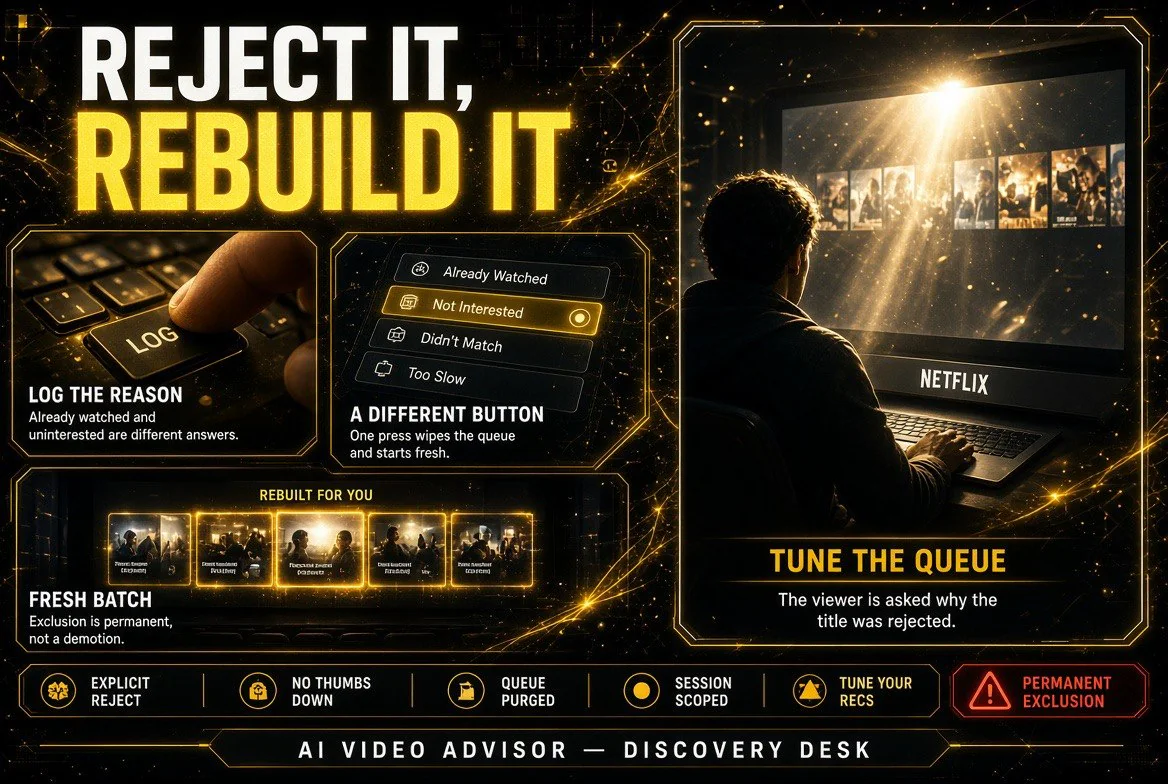
3. The rejection tool is diagnostic, not passive. The “Tune Your Recommendations” control asks why you rejected a title — already watched versus genuinely uninterested — and logs the answer. That distinction is the difference between a title being demoted and a title being permanently excluded from future mood queries. A passive thumbs-down cannot tell those two cases apart, which is why recommendation engines have historically kept serving things you already saw. This one asks.
The escape hatch matters too: “Something Different” wipes the current queue and generates a fresh batch. That is a direct response to the specific frustration of being handed the wrong genre with no way out except backing out of the whole interface.
The Part Netflix Was Careful to Say Out Loud
Netflix representatives stated plainly that data from AI Discover will not be used to greenlight or program future shows. It is worth taking that statement at face value, because it clarifies the company’s actual priority.
This is not a content strategy. It is a logistics play. Netflix does not need an AI to tell it what to commission — it has years of viewing data, licensing relationships and a commissioning apparatus built on it. What it needs is to stop users from closing the app because they could not find something to play. Unwatched inventory is a sunk cost; a user who gives up on a Tuesday night is a churn signal.
Which reframes the whole feature: the product being optimised is not discovery of any particular title. It is the elimination of the dead moment between opening the app and pressing play. Everything in the design — fewer choices, declared intent, instant correction — serves that one metric.
Why This Annoys Some Creators
There is a reasonable anxiety underneath the enthusiasm, and it deserves a fair hearing rather than a dismissal.
If discovery becomes intent-driven, then the titles that benefit are the ones that can be described cleanly in three words. “Scare Me” is a category. “Something Light” is a category. A slow, ambiguous, genre-blurring film that a human curator might have championed is much harder to place into a mood bucket — and if the mood interface becomes the primary surface, describability becomes a distribution advantage.
That is a real risk, but it is not new. Streaming discovery has always rewarded titles that are legible in metadata. The difference is that the old system at least allowed a title to find an audience through behavioural accident — someone who watched three unrelated things and got served your film as an outlier. Intent-based discovery removes the accident.
Set against that, the counter-argument is strong: the current system’s biggest failure is that good titles go unwatched because nobody ever sees them. If a mood interface reduces the scroll, more inventory gets surfaced overall, including titles that a history-based model would never have served. Net effect on discovery is genuinely unclear, and anyone claiming certainty in either direction is guessing.
The Rollout Is a Test, and That Matters
This is an experimental “test kitchen” phase, not a general release. It runs on supported TV applications in the United States for English-language profiles. If your account is included, you are part of a measurement cohort deciding whether the layer eventually reaches the main home screen.
That distinction should shape how you read the coverage. A test rollout means Netflix is watching the feedback loop closely — which selections escalate to playback, how quickly users abandon a bucket, whether the rejection tool meaningfully improves the next attempt. The feature that ships broadly, if it ships at all, will not be this one. It will be whichever version of this survived the data.
It also means the feature is not coming to every account, and if you do not see a red pulsing jewel icon in your TV interface, nothing is broken. You simply are not in the cohort.
| Element | Status | What it means |
|---|---|---|
| Availability | Experimental test phase | Not a general release; cohort-based |
| Devices | Supported TV applications | Mobile and web interfaces are not the target surface |
| Region | United States, English-language profiles | Non-US accounts will not see it in this phase |
| Precursor | Private generative AI search beta on iOS, mid-2025 | Conversational search was validated before the TV build |
| Data use | Excluded from commissioning decisions | Interface and retention play, not a programming signal |
The Long Bet: Search Bars Are Dying
The most durable thing in this story is not the tab. It is the trajectory the tab confirms.
The precursor to AI Discover was a private generative AI search beta Netflix tested on iOS in mid-2025 — an experiment that showed people will type or speak natural, conversational prompts (“something funny but short”) rather than construct keyword queries. That result, if it holds, kills the search box as an interface primitive.
A text box asks the user to translate a feeling into a query the machine can parse, then punishes them when the translation is wrong. “Nothing matches” is one of the most hostile responses an interface can give, and it is the standard response of every media search bar ever built. A mood layer replaces the translation problem with a selection problem, and selection is something humans are much better at.
The same shift is happening in video generation workspaces, where the winning interfaces increasingly ask for an intent and a vibe rather than a prompt string — the pattern we track over at AI Video Advisor. That is the tell: when both the consumer interface and the production tool converge on “tell me the feeling, I’ll handle the parameters,” the prompt box is on its way out.
What This Actually Changes
Three honest conclusions, in order of confidence.
The scroll is being treated as a product defect, not a user habit. That is a meaningful shift. For a decade, endless browsing was framed as engagement. Netflix is now describing it as failure. Any platform following this lead will be optimising for time-to-playback rather than time-in-app, and those two metrics pull in opposite directions.
Declared intent beats inferred history for the specific problem of tonight. History remains a powerful signal for what you broadly like. It is a poor signal for what you want in the next ten minutes. The separation of those two timescales is the actual technical insight, and it will be copied.
The creative implication is smaller than the discourse suggests. Mood buckets are a discovery surface, not a greenlight committee. Netflix said explicitly that this data will not program shows. The formats that will suffer are the ones that were already struggling to be described — and the formats that will benefit are the ones currently invisible because nobody scrolls far enough to reach them.
The grid is not dead. But Netflix just admitted, in product form, that it was never the right answer to the question they were actually asking — which was never “what did you like before,” but “what do you feel like tonight.”
Frequently Asked Questions
What is the Netflix AI Discover tab? An experimental feature in Netflix’s TV applications that replaces history-based content rows with mood-driven, intent-based carousels. Rather than scrolling a grid of titles, users pick a broad theme such as “Something Light,” “Scare Me” or “Quick Watches,” and the system generates a narrower set of options from there.
How does it differ from the existing recommendation system? The existing system builds a long-term profile from viewing history and curates rows from it. AI Discover treats mood as temporary, asks for intent at the moment of use, generates subcategories on the fly, and allows explicit rejection reasons that permanently exclude a title from future mood queries.
Will Netflix use this data to decide which shows to make? No. Netflix representatives stated the data from AI Discover will not be used to greenlight or program future shows. The feature is aimed at interface and retention performance — reducing the time between opening the app and starting playback.
Who can see it right now? A limited test cohort only, running on supported TV applications in the United States for English-language profiles. It is not a general release. Accounts outside that cohort, or on mobile and web, will not see the interface in this phase.
What is the “Tune Your Recommendations” button? A control that asks why you rejected a title — for example “already watched” versus “not interested” — and logs the answer. Distinguishing those two cases lets the system permanently exclude content you have seen rather than repeatedly resurfacing it.
Is a mood interface better than a search bar? For discovery, usually yes, because it replaces the problem of translating a feeling into a keyword query with the simpler problem of choosing from a short list. Search still wins when a viewer knows the exact title they want. The two interfaces serve different intents and are likely to coexist.

About Barak Schurr
Barak Schurr is a serial entrepreneur who built and exited a major ticketing platform before turning his attention to AI and content. He runs three AI-focused research sites and writes about the tools, workflows, and strategies that let solo creators build real channels — without a crew, a studio, or a Hollywood budget.
Email: [email protected]
More AI Video Resources