Alphabet Lost $500 Billion in a Day. AI Ate the Ad Revenue That Funded It.
Alphabet Lost $500 Billion in a Day. AI Ate the Ad Revenue That Funded It.
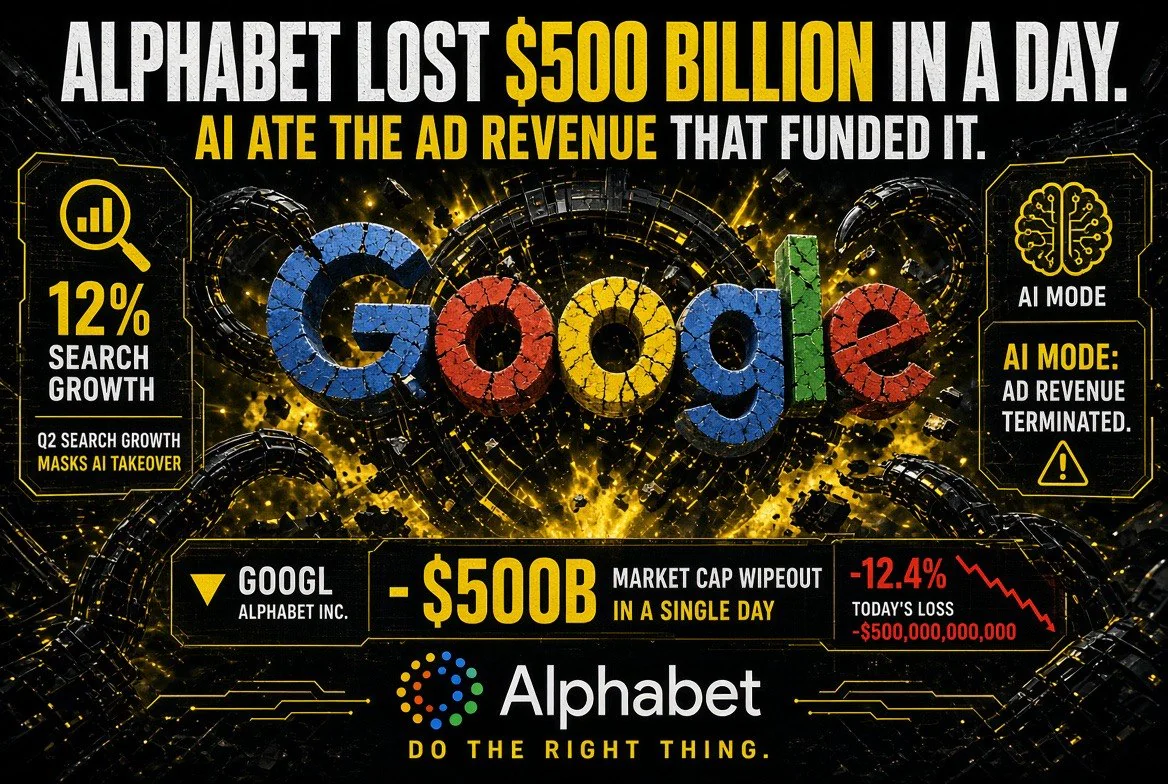
⚡ Expert Summary: Alphabet fell about 12% on October 29, 2026, its worst trading day on record, wiping out roughly $500 billion in market value. The trigger was not a bad quarter in isolation. It was that Google’s AI search products are growing faster than the ad revenue that pays for them. Search revenue growth slowed to 12% — the weakest pace in five quarters — while free cash flow went negative for a second straight quarter. For anyone building a business on search traffic or ad-funded content, this is the clearest signal yet that the economics underneath your funnel are being repriced.
For twenty years, Alphabet had the simplest business model in technology. People searched, Google sold ads against those searches, and the cash arrived in torrents. The company’s free cash flow was so reliable that investors treated it as a utility with a growth multiple attached.
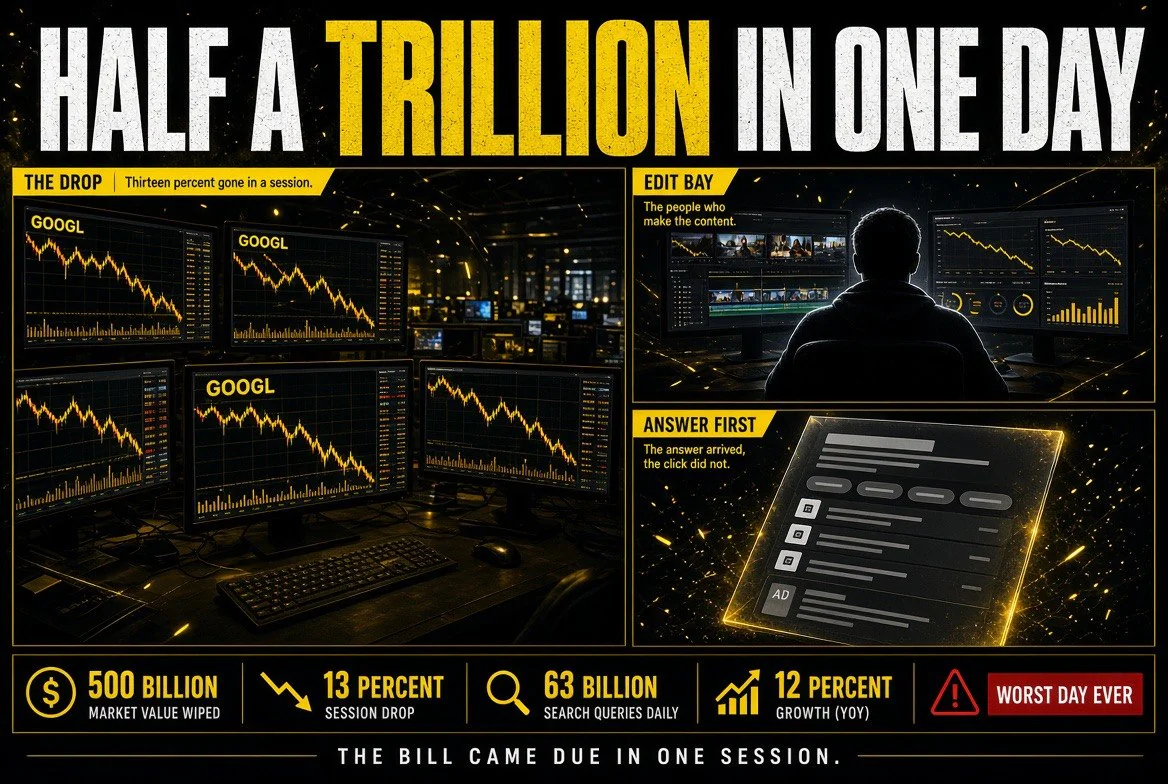
On October 29, that model got repriced in a single session. Alphabet fell nearly 13%, its worst day on record, and roughly $500 billion of market value disappeared. By Friday the damage had spread: the Nasdaq fell 2.9%, Nvidia dropped 4%, Broadcom more than 5%, Qualcomm 11%.
The cause is the thing everyone was assured would never happen. Google built AI search products that people actually use, and those products monetize worse than the search they replace. The company said so itself on its own earnings call.
The Numbers Behind the Wipeout
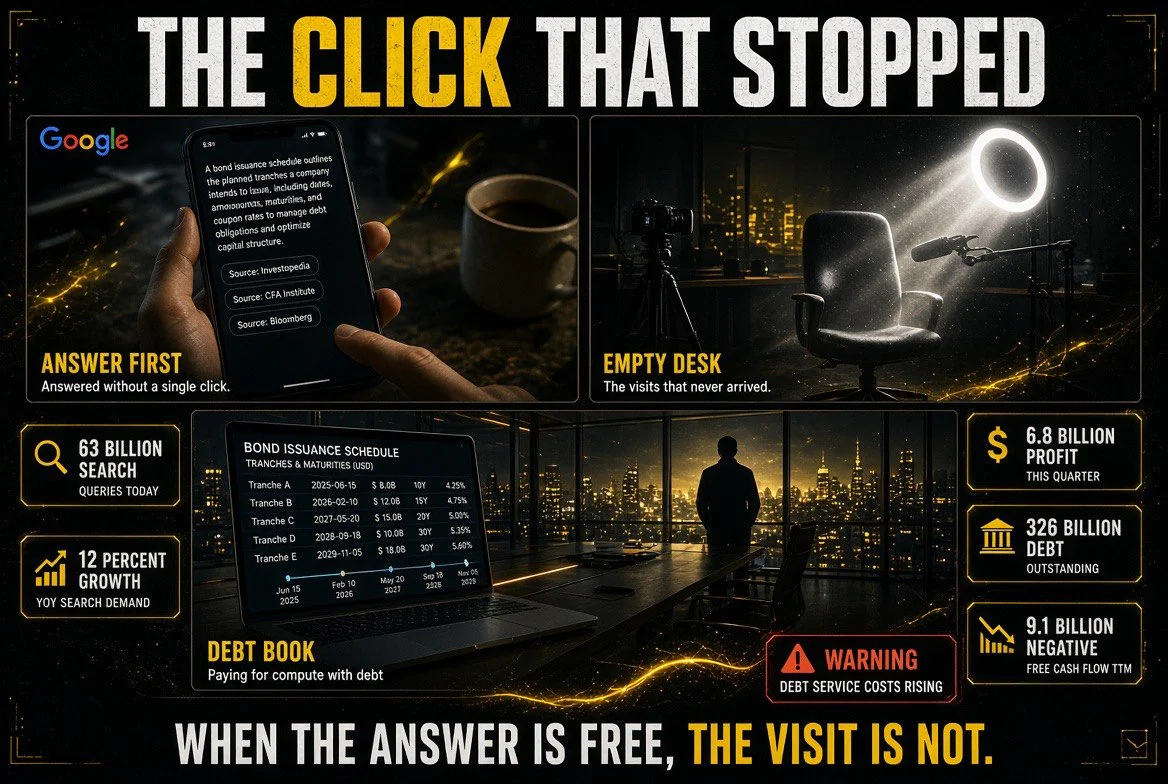
Alphabet reported negative free cash flow of $9.1 billion in the third quarter — its second consecutive quarter in the red — even as quarterly capex rose. Free cash flow is the money left after a company pays to keep itself running and grow. Negative means the core business did not fund the quarter.
Search advertising, which makes up roughly half of Alphabet’s revenue, grew 12% year over year to $63 billion. On any normal day that is a fine number. For Google, it was the weakest growth in five quarters, and Wall Street read it as the first clear evidence that AI is cannibalizing the ad business it was built to extend.
The uncomfortable detail came from Google’s own chief business officer. Asked on the earnings call why search revenue growth was slowing while query volume hit a five-year high, Philipp Schindler did not blame the economy. He named the product: “The strong growth in AI Overviews had an impact because of the lower monetization we were seeing in AI Mode.”
Read that again. Query growth is the highest it has been in five years — Sundar Pichai said so on the same call. More people are searching than ever. Google is simply making less money from each of them, because the AI answers they now read do not carry the ad load that ten blue links did.
Where the $500 Billion Actually Went
Market cap loss is an abstraction until you break it down. What investors repriced was not Google’s revenue. It was the assumption that AI spending at this scale would eventually pay for itself.
| Metric | What Alphabet Reported | Why It Mattered |
|---|---|---|
| Stock move | Down nearly 13% on Oct 29 | Worst single day in company history |
| Market value lost | About $500 billion | Second-largest single-day loss on record for any company |
| Free cash flow | – $9.1 billion in Q3 | Second straight quarter in the red |
| Search ad revenue | $63 billion, up 12% | Weakest growth in five quarters |
| Query volume | Highest growth in five years | More usage, less revenue per query |
Those two lines at the bottom are the whole story. Usage is up. Revenue per unit of usage is down. Google spent a decade building the most profitable advertising machine in history and then built the successor that charges less.
The $740 Billion Problem Nobody Budgeted For
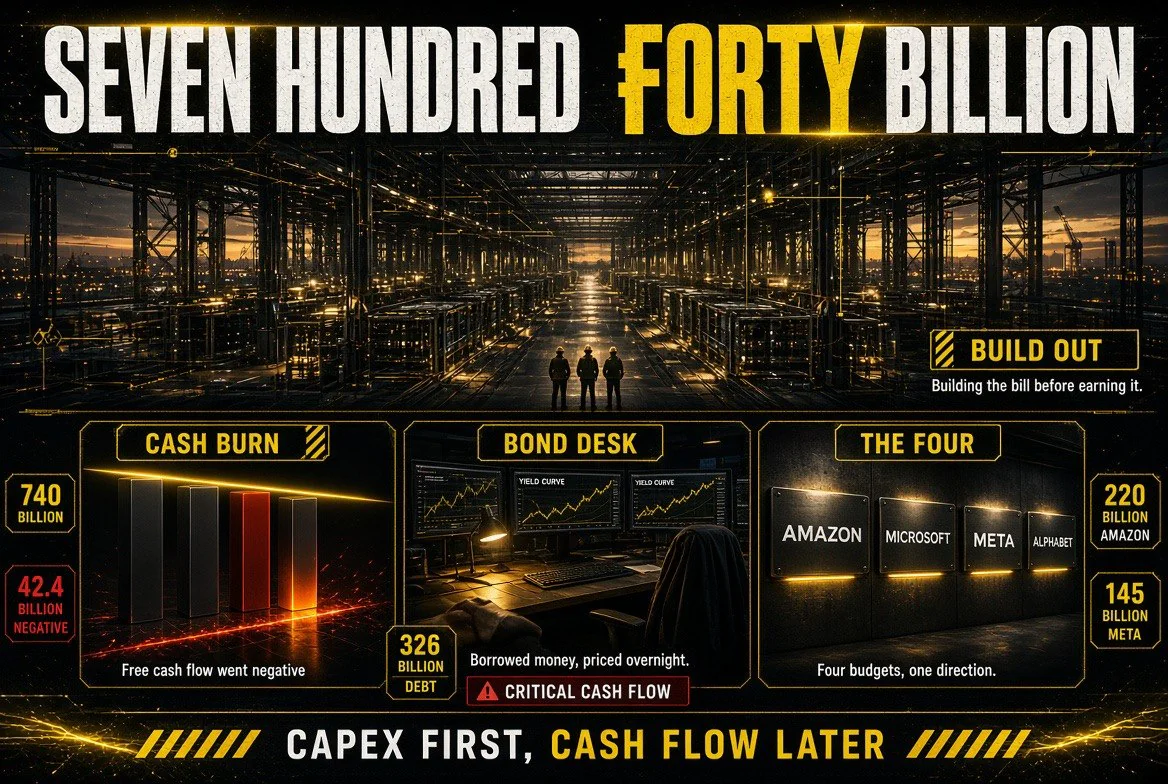
Alphabet did not make this bet alone. Over the past two weeks, Alphabet, Amazon, Meta and Microsoft have outlined plans to spend more than $740 billion on capital expenditures this year — money Wall Street reads as AI infrastructure: data centers, chips, power, land.
Earlier in the boom, investors rewarded that spending. A company spending aggressively on AI was a company that believed in its own future. In the fourth quarter of 2026 the market changed its mind. The concerns are now specific: negative free cash flow, mounting debt, and whether these investments will ever generate enough return to justify them.
Amazon reported negative free cash flow of $42.4 billion over the past twelve months, against $14.8 billion positive the year before, while guiding to $220 billion in capex this year. Its stock fell 7% after earnings despite AWS revenue growing 39%. Meta posted negative free cash flow of $2.1 billion in the third quarter, guiding to as much as $145 billion in capex, though ad revenue grew 26%.
Microsoft was the exception. It recorded $18.6 billion in positive free cash flow with $45.2 billion in capex — under its own $50 billion projection. Microsoft attributed that to delays in capacity from third-party providers, not a deliberate pullback.
Side by Side: Who Is Still Paying Cash, and Who Is Borrowing
Four companies, four very different balance sheets, one shared bet. This is where the story stops being about AI and starts being about finance.
| Company | Free Cash Flow | 2026 Capex Guidance | Market Reaction |
|---|---|---|---|
| Alphabet | – $9.1B in Q3, second straight negative quarter | Rising quarter over quarter, part of the $740B total | Down ~13%, worst day on record |
| Amazon | – $42.4B over twelve months, from +$14.8B a year earlier | $220B | Down 7% after earnings |
| Meta | – $2.1B in Q3 | Up to $145B | Ad revenue up 26%, offsetting the burn |
| Microsoft | + $18.6B in latest quarter | $45.2B, below its $50B plan | The only one of the four still generating cash |
Microsoft’s capex miss was not discipline, and the market knows it. The company said capacity from third-party providers came late. That means even the healthiest balance sheet in the group is constrained by the same physical bottleneck as everyone else — racks, power and chips arriving on someone else’s schedule.
And the money is no longer coming purely from profits. According to S&P Global Market Intelligence, Microsoft, Alphabet, Amazon, Meta and Oracle raised a combined $326 billion in debt in 2026 — triple the amount raised last year.
What “Lower Monetization” Actually Means for a Creator
If you run an ad-supported publication, a YouTube channel, or a small business that depends on search to find customers, the phrase “lower monetization in AI Mode” is not an Alphabet problem. It is your problem, spelled out by the company that used to send you traffic.
Google built a generation of businesses on a simple contract: create pages, receive clicks, convert visitors. AI Overviews and AI Mode are changing that contract in real time. Users get the answer without the click. Google gets the query without the ad inventory that used to surround it. Advertisers get fewer places to appear, which is precisely why Google is now testing multi-turn ads inside conversational search and expanding ads in AI Overviews to more users and queries.
Those tests are the tell. Google is admitting, in product decisions, that the old placement model does not survive AI answers and it needs new ad formats to recover the revenue per query. Until those formats work, everyone downstream of search gets less.
The Compute Bill Is Now a Credit Story
There is a second-order effect that matters more for the AI video and creator tool market specifically. The price of generative tools is set by the price of compute. When compute is funded by profit, prices fall over time. When it is funded by debt, the cost of that debt becomes part of the price you pay.
You can see it forming. Anthropic filed to go public this week, and its future growth depends on securing enormous amounts of compute. The Financial Times reported Friday that Blackstone has warned investors the company might not qualify for an investment-grade rating after its IPO — which would leave it more reliant on expensive capital to buy the compute its models need.
That is the same dynamic described in this breakdown of the $720B debt decade landing on creators, arriving one step earlier in the chain. When the companies selling you generation credits borrow at junk rates, the credits do not get cheaper.
For a creator, the practical read is straightforward: assume tool pricing stays flat or rises, not falls. Build your margins on today’s prices. The era of every AI tool getting cheaper every quarter was funded by venture money and ad profits. Both of those wells are being questioned in the same week.
What to Do With This
Nobody should read one earnings report as the end of Alphabet. The company still generated $63 billion in search ad revenue in a single quarter, still has the most-used search product on earth, and still controls the distribution for its own AI answers. What changed is the assumption of inevitability.
The useful takeaways are operational, not financial:
- Do not build your traffic plan on search clicks. Query volume can hit a five-year high while the traffic you receive declines, because the answer is now served on the results page. Diversify to email, direct, community and video before you are forced to.
- Model your tool costs at current prices, not future ones. The compute market is now partially debt-financed, and junk-rated debt does not produce price cuts.
- Watch the capex guidance, not the stock price. The stock reaction is noise. The capex number is the commitment. If Microsoft is missing capacity because third parties are late, the bottleneck is physical and it will hit smaller buyers first.
- Treat AI Mode and AI Overviews as a new channel with new rules, not a replacement for the old one. Ads are being tested there precisely because the economics are unresolved. Early advertisers get cheap inventory; late ones get the same placement at a higher price.
Alphabet’s worst day on record was not caused by a product failure. It was caused by a product success that pays less than the thing it replaced. Every company that has built a business on an ad-funded, traffic-dependent model now has a live case study in what happens when the platform solves its users’ problem more efficiently than it solves its own.
The AI spending boom did not end on October 29. It just stopped being free.
Frequently Asked Questions
Why did Alphabet lose $500 billion in a day?
Alphabet fell nearly 13% on October 29, 2026, its worst trading day on record, wiping out about $500 billion in market value. The trigger was its third-quarter earnings: free cash flow went negative for a second consecutive quarter at -$9.1 billion, and search advertising growth slowed to 12%, the weakest pace in five quarters, even as query volume hit a five-year high.
What does lower monetization in AI Mode mean?
Google’s chief business officer Philipp Schindler said on the earnings call that strong growth in AI Overviews had an impact because of lower monetization in AI Mode. In plain terms, AI answers do not carry the ad load that ten blue links did, so Google earns less per query even as the number of queries rises.
How much are the big tech companies spending on AI infrastructure?
Over the past two weeks, Alphabet, Amazon, Meta and Microsoft have outlined plans to spend more than $740 billion on capital expenditures this year. Amazon alone guides to $220 billion and Meta to as much as $145 billion. Microsoft planned $50 billion but spent $45.2 billion, citing late capacity from third-party providers.
Are tech companies funding AI with debt?
Yes. According to S&P Global Market Intelligence, Microsoft, Alphabet, Amazon, Meta and Oracle raised a combined $326 billion in debt in 2026, triple the amount raised in the prior year. That shift from profit-funded to debt-funded spending is a large part of why investors repriced the sector.
Will this affect AI tool prices for creators?
Indirectly, yes. Generative tool pricing tracks the cost of compute. When compute is funded by profit, prices tend to fall. When it is funded by debt, the cost of that debt becomes part of the product price. Build your margins on today’s tool prices rather than assuming continued price cuts.
What should I do if my traffic comes from Google search?
Treat search traffic as a declining channel and diversify before you are forced to. Query volume can reach a five-year high while the clicks you receive fall, because AI Overviews and AI Mode answer on the results page. Move readers to email, direct, community and video channels you control.

About Barak Schurr
Barak Schurr is a serial entrepreneur who built and exited a major ticketing platform before turning his attention to AI and content. He runs three AI-focused research sites and writes about the tools, workflows, and strategies that let solo creators build real channels — without a crew, a studio, or a Hollywood budget.
Email: [email protected]
More AI Video Resources