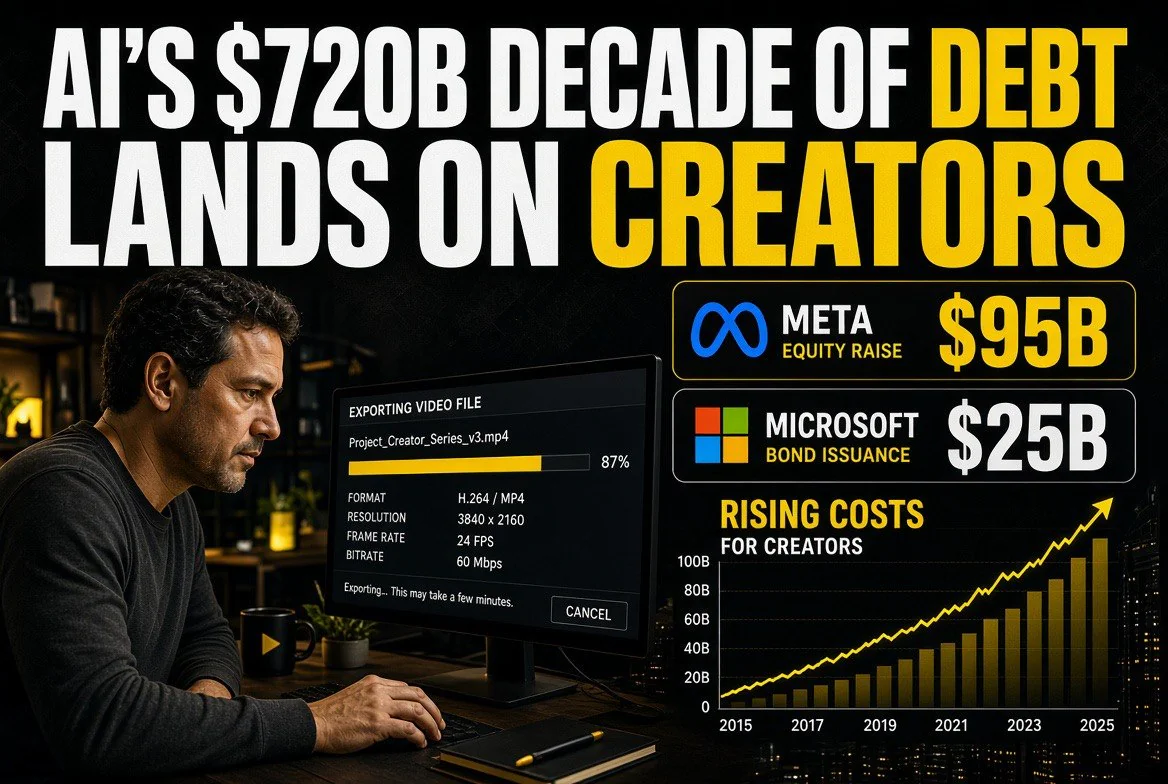
AI’s $720B Decade of Debt Lands on Creators
AI’s $720B Decade of Debt Lands on Creators
⚡ Expert Summary: Meta is raising $95 billion in stock. Microsoft is borrowing at least $25 billion in its first US bond sale since 2017. Combined borrowing across Alphabet, Amazon, Meta, Microsoft and Oracle has reached roughly $350 billion. This is not a finance story you can skip because you are a solo creator. The infrastructure underneath every editing tool you rent is being paid for with debt, and debt has a repayment schedule. When those payments start competing with your subscription discount, the cheap tier ends. The good news is the window is still open, and it will probably stay open longer than the panic suggests. Use it to build the one thing the price change cannot take away: an audience that follows you, not the tool.
Two numbers landed this week that most creator coverage will ignore, and both of them decide what your editing suite costs in 2028.
Meta announced it plans to raise $95 billion through equity offerings to fund its artificial intelligence build-out. Microsoft went to the bond market seeking at least $25 billion, its first major US debt sale since January 2017, in a deal structured across up to ten tranches with maturities running from two to forty years.
Neither company is in trouble. That is exactly why this matters. These are two of the richest companies on earth, and they have both decided the cash they generate is no longer enough to pay for the build.
What Actually Changed This Week
For most of this boom, the hyperscalers funded AI infrastructure out of cash flow. That is a luxury, and it is over.
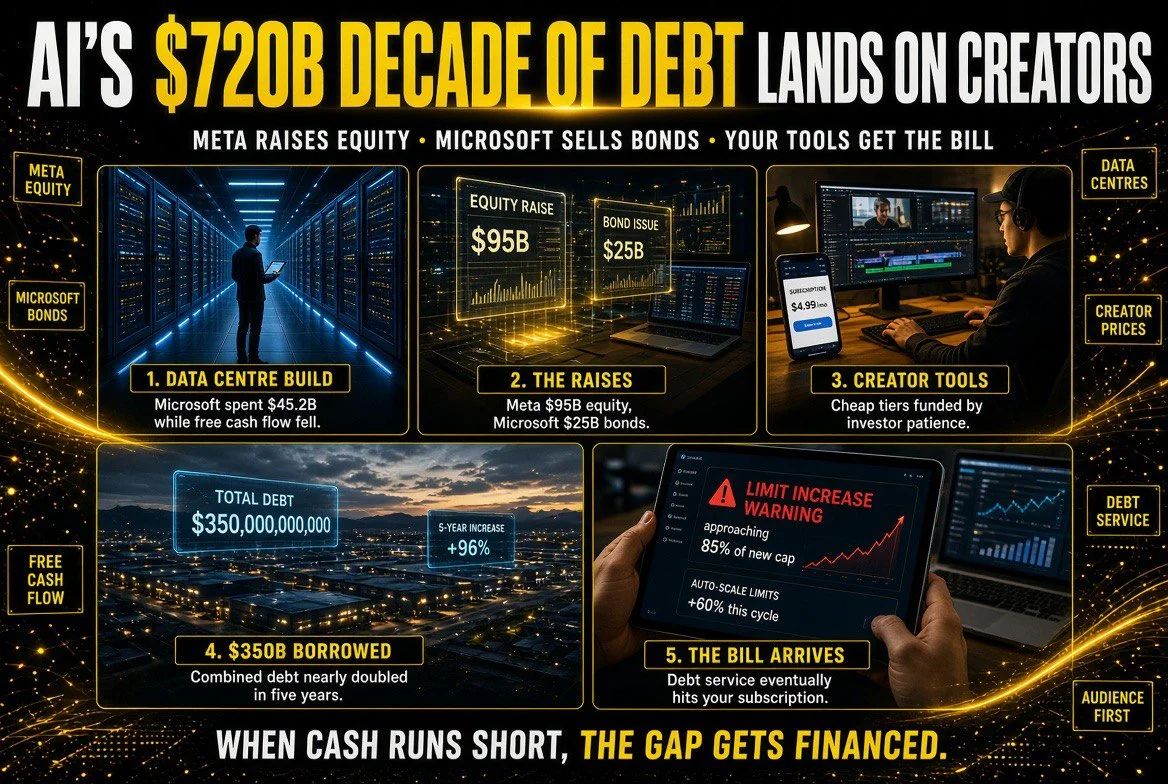
Microsoft disclosed that spending on data centres and equipment, including leases, reached $45.2 billion in the three months ending September. Over the same period its free cash flow fell 27% to $18.6 billion. Read those two figures together and the story writes itself: the build is now consuming more than the business throws off, and the difference gets financed.
Meta’s structure is worth understanding because it signals how confident, or how stretched, management actually is. The plan reportedly has two phases: an immediate $35 billion underwritten public offering blending common stock with convertible preferred shares, then a $60 billion at-the-market program leaning on non-voting Class C shares in early 2027. That is not a company casually topping up a budget. That is a company staggering a raise so the share price does not collapse on the announcement.
Microsoft’s deal is the mirror image. It carries an AAA rating, one of only two publicly traded US companies with top-tier marks from both Moody’s and S&P, alongside Johnson & Johnson. AAA borrowers do not need to borrow. It is borrowing because the alternative is slowing down.
The Debt Number That Should Get Your Attention
Single deals are noise. The aggregate is the signal.
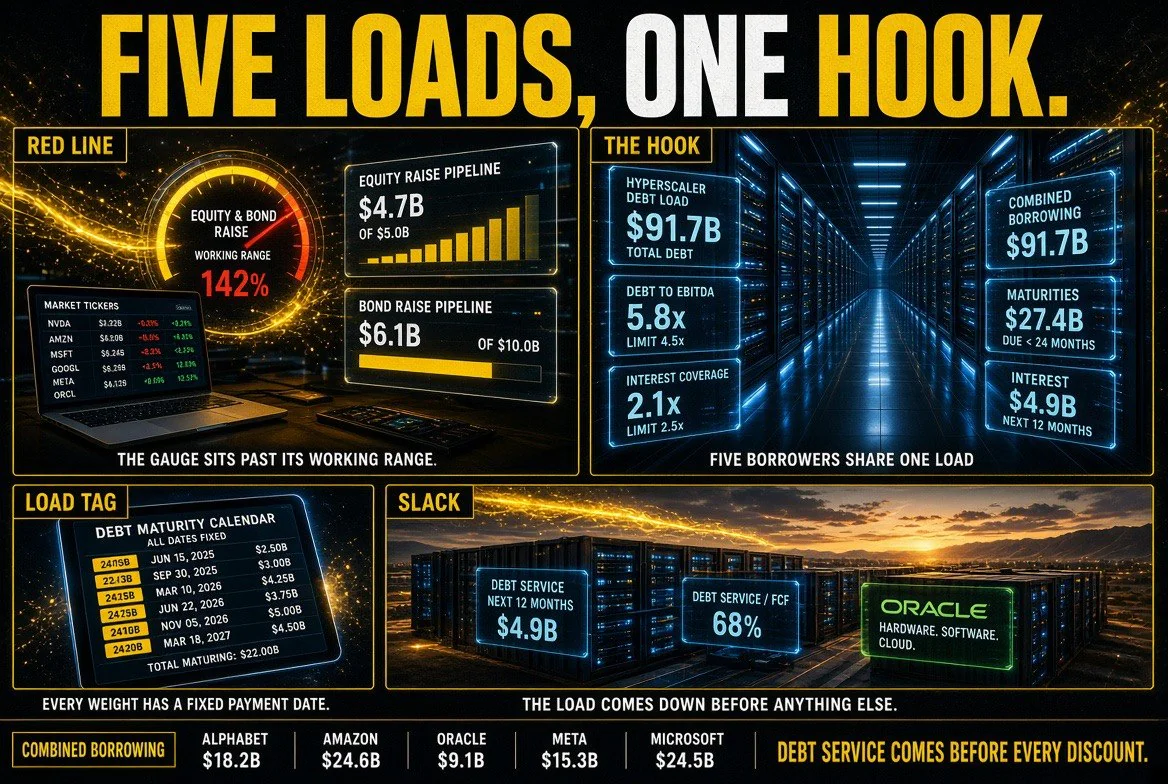
Combined borrowing by Alphabet, Amazon, Meta, Microsoft and Oracle has climbed to roughly $350 billion, nearly double where it stood five years ago. Alphabet raised $25 billion in a ten-tranche bond sale in August. Amazon raised $25 billion earlier this year and met only tepid demand. Oracle has been a heavy issuer throughout.
That $350 billion has a coupon. Debt service is a fixed, scheduled, non-negotiable outflow that sits ahead of every discretionary line in the budget, and it does not care whether a model release lands well or a quarter comes in soft.
| Company | This Week’s Move | What It Signals to a Creator |
|---|---|---|
| Meta | $95 billion equity raise in two phases | Selling ownership rather than borrowing, so it expects the build to pay back slowly |
| Microsoft | At least $25 billion in bonds, first since 2017 | AAA borrower choosing debt, which means it wants the spend off the cash-flow line |
| Alphabet | $25 billion across ten tranches in August | Lengthening maturities to match assets that take years to earn |
| Amazon | $25 billion met with tepid demand | Investors are starting to price the risk differently across issuers |
| Oracle | Heavy and repeated issuance | The most leveraged path to cloud capacity is also the most exposed to rates |
Notice the Amazon row. A $25 billion raise that meets tepid demand is how a market starts to differentiate. Up to now every hyperscaler bond has been treated as close to risk-free, because the companies are enormous and the AI story is good. That assumption is now being tested line by line.
Why This Reaches Your Editing Timeline
Here is the chain, and it is short.
You pay $20 to $60 a month for a tool. The tool pays a model provider per token and pays for GPU capacity to run inference. The model provider pays for the data centres the hyperscalers are building. The hyperscalers are borrowing $350 billion to build them. Every link in that chain has a cost, and every cost eventually surfaces at the retail end, because the retail end is the only place with a credit card attached.
Underpricing has been the strategy so far. Cheap inference, generous free tiers, aggressive annual discounts. That pricing was funded by investor patience, not by unit economics, and patience has a term.
The first place this shows up is not your subscription price. It is your limits. Render caps get tighter. Queues get longer at peak. The feature you used daily moves behind a higher tier. The free tier loses the export option. Prices are sticky and public; limits are flexible and quiet, which makes them the easier lever to pull first.
The Counterargument, Which Is Genuinely Strong
I am not going to pretend the bearish read is the only read, because it is not, and the bullish version has better evidence behind it right now.
Infrastructure spending on this scale does what infrastructure spending always does: it collapses the unit cost of the thing being built. Data centre capacity that cost a fortune in 2024 becomes a commodity in 2027. Every marginal GPU-hour gets cheaper as utilisation improves and competition among providers sharpens.
Which is exactly what has happened to creators so far. Video generation that was a novelty two years ago is now a line item. Editing tools that required a subscription tier reserved for agencies are in packages a solo creator can justify. The price of producing a competent video has fallen, hard, and it fell because somebody else spent the capex.
So both things are true. The build is being financed with debt that must be repaid, and the build is making your tools cheaper in real terms. The question is not which one is true. It is the timing of the turn, and nobody including the people signing the bonds knows it.
| Creator Decision | Debt-Funded Cheap Era Continues | Debt Service Starts Biting |
|---|---|---|
| Monthly versus annual billing | Annual discount is free money | Annual lock-in protects you from a mid-term rise |
| Stacking tools per workflow | Cheap to experiment, keep options open | Consolidate to two tools you actually finish work in |
| Building on one vendor’s API | Fastest route to shipping | Cheapest route to being repriced without warning |
| Where your audience lives | Does not seem to matter yet | Matters more than any tool choice you make |
| Archive and master files | Nice to have | The only assets that survive a vendor change intact |
Look at how few of those rows are actually about money. The two that decide whether a price change hurts you are where your audience lives and whether you have your own masters. Both are decisions you make before any bill arrives.
What the Debt Actually Buys, and Why It Matters to You
There is a detail in Microsoft’s filing that creators should read twice: proceeds will be used for general corporate purposes, including capital expenditures, working capital, share repurchases, acquisitions and repayment of existing debt.
Share repurchases. That is the part of the sentence that links Wall Street to your subscription. If a company is borrowing to buy back its own stock while also funding a capital build, the pressure to monetise the build accelerates. You do not run a $95 billion equity raise and a $25 billion bond sale and then leave a generous free tier alone forever.
None of this is villainy. It is just how a financed build reaches the customer. The money has to come from somewhere, and after the bond market and the equity market have had their turn, the subscription line is what remains.
What I Would Actually Do About It
Not panic. Prep. Three moves, all of them cheap.
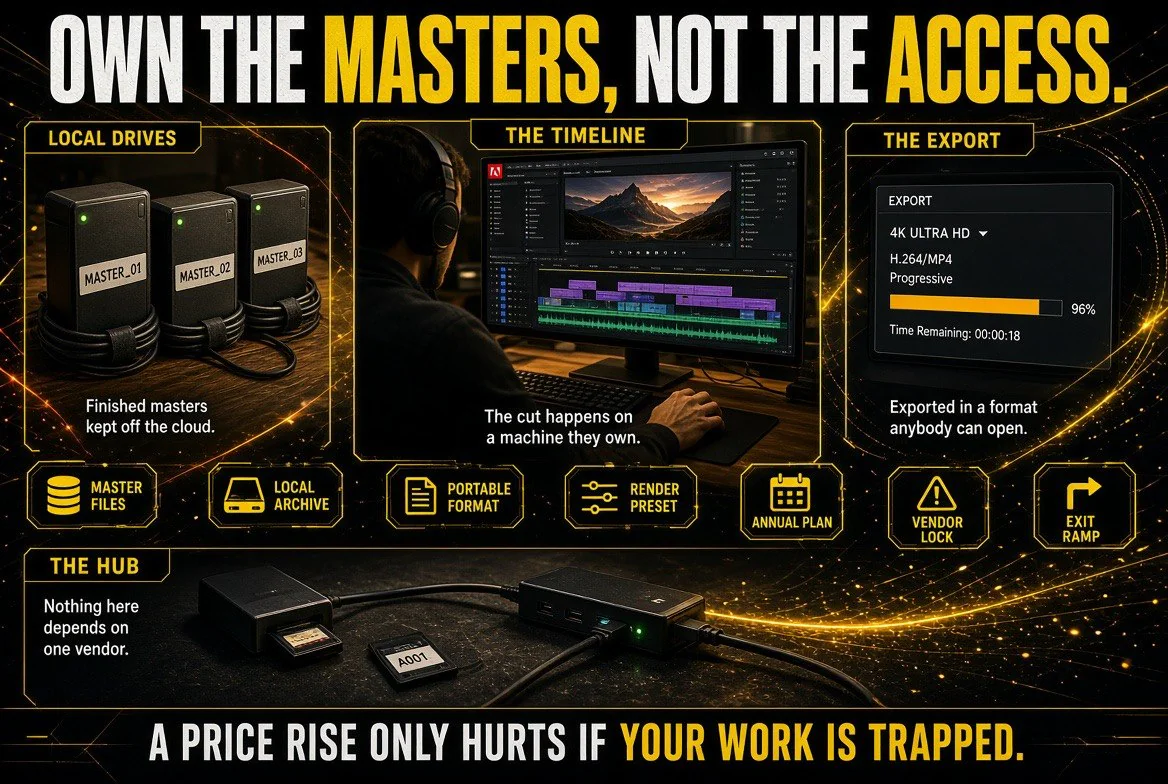
Own your masters. Every finished video, every project file, every audio stem lives on a drive you control in a format you can open without a specific app. This is the single highest-value habit in this whole story, because it is the only one that makes you vendor-independent. If your entire archive is inside one tool’s cloud project format, you do not own your work, you rent access to it.
Build the audience somewhere portable. Email, a site you control, a community that follows you rather than the platform. Tool prices can rise and platform algorithms can change, but a list of people who want to hear from you survives both. Every creator who got repriced out of a workflow in the last three years learned this the hard way.
Buy the annual plan only where you would renew anyway. The debt math cuts both ways. Annual billing locks a price in a rising market and wastes money in a falling one. Use it as a hedge on the two or three tools that are genuinely central, and stay monthly on the experiments.
Then watch the limit changes rather than the price pages. Limits move first and they tell you what management is thinking months before a headline price does. When a free tier quietly loses an export option, that is the company telling you where the next dollar comes from.
The Honest Bottom Line
Two things can be true, and in this case both probably are.
The $720 billion class of annual AI infrastructure spend is producing tools that would have been unimaginable for a solo creator five years ago, at prices that are still falling in real terms. And the same spend is being financed with debt that has a schedule attached, at companies under pressure to show that the build earns its cost.
You cannot control either one. You can control whether your work exists outside any single vendor. That is not a finance strategy, it is an insurance policy, and it costs nothing but discipline.
The debt is going on somebody’s balance sheet. Make sure the thing it is paying for is not the only place your work lives.
Why the Free Tier Is the First Thing to Go
Follow the incentives and the sequence becomes obvious.
A company that has just sold $95 billion of equity and borrowed $25 billion has made a promise to two groups of people at once. To bondholders, it promised scheduled interest. To shareholders, it promised the build eventually earns a return. Neither promise is satisfied by giving work away, and both are satisfied by conversion.
Which is why the free tier is where the pressure shows first. It is the cheapest lever to pull and the least visible to a press that reports headline prices. Every creator who has watched a generous free plan quietly tighten over the past two years has already seen this mechanism working. It did not require a debt sale to start, and the debt sale makes it faster.
The practical read for you is not “cancel everything.” It is that a tool’s free tier is a promotional instrument, not a permanent one, and any workflow you have built on top of a free layer is a workflow with an expiry date you do not control.
What the Industry’s Own Numbers Say About the Math
There is a figure from earlier this year that explains the whole squeeze in one line: hyperscalers have been spending roughly 102% of cloud revenue on capital expenditure. Not 60%. Not 80%. More than every dollar the cloud business brings in goes straight back out into the build.
That is a growth posture, and it works while growth continues. It stops working the moment growth slows, because the spending has already been committed in the form of leases, power contracts and construction schedules that cannot be paused without writing off money already spent.
So the correction, when it comes, will not look like a decision. It will look like a series of small repricings, each one defensible in isolation: a limit tightened here, a tier restructured there, an enterprise feature fenced off. Creators experience those as one thing: the tool that used to do the job now costs more to do the same job.
The Part Nobody Says Out Loud
Creators have spent three years being told that AI would democratise video production. That has largely happened, and I am not going to argue with the evidence of my own workflow.
What did not get democratised is the infrastructure. The capacity to generate and edit at scale sits with a handful of companies who are now borrowing enormous sums to own more of it. Democratised access to a centrally-owned capability is a rental arrangement, and rentals get repriced.
That is not a reason to stop using the tools. It is a reason to be clear-eyed about what you are building on top of them. A channel that depends on remaining inside a specific vendor’s cost curve is a channel with a landlord. A channel that can move its output to cheaper rails, or generate its work on whatever is available, is a channel that survives a repricing.
The $720 billion headline will be reported as an AI story. For anyone who actually makes video for a living, it is a story about the terms of your lease.
Frequently Asked Questions
Why is Meta raising $95 billion in stock?
To fund its artificial intelligence build-out. The plan reportedly runs in two phases, an immediate $35 billion underwritten public offering blending common stock with convertible preferred shares, followed by a $60 billion at-the-market program in early 2027 using non-voting Class C shares.
Why is Microsoft borrowing $25 billion if it has plenty of cash?
Because data centre spending has outgrown even Microsoft’s cash generation. It reported $45.2 billion in capital spending including leases for the quarter ending September, while free cash flow fell 27% to $18.6 billion. The bond sale is its first major US debt issue since January 2017.
Does this affect the AI video tools I pay for?
Indirectly, yes. Your tool pays for inference and compute, and compute providers are the ones carrying the debt. The pressure tends to show up first as tighter limits, longer queues and features moving behind higher tiers rather than as an immediate headline price rise.
Will AI tools get more expensive or cheaper?
Both, in sequence. Infrastructure spending on this scale pushes unit costs down, which is part of why video generation has become so affordable. But the debt raised to fund it has a repayment schedule, so the current pricing is unlikely to be permanent.
What is the single most important thing a creator should do?
Own your masters. Keep every finished video, project file and audio stem on storage you control, in formats you can open without a specific app. It is the only habit that makes you independent of any vendor’s pricing decision.
How much have the big five actually borrowed?
Combined borrowing across Alphabet, Amazon, Meta, Microsoft and Oracle has climbed to roughly $350 billion, nearly double where it stood five years ago.

About Barak Schurr
Barak Schurr is a serial entrepreneur who built and exited a major ticketing platform before turning his attention to AI and content. He runs three AI-focused research sites and writes about the tools, workflows, and strategies that let solo creators build real channels — without a crew, a studio, or a Hollywood budget.
Email: [email protected]
More AI Video Resources