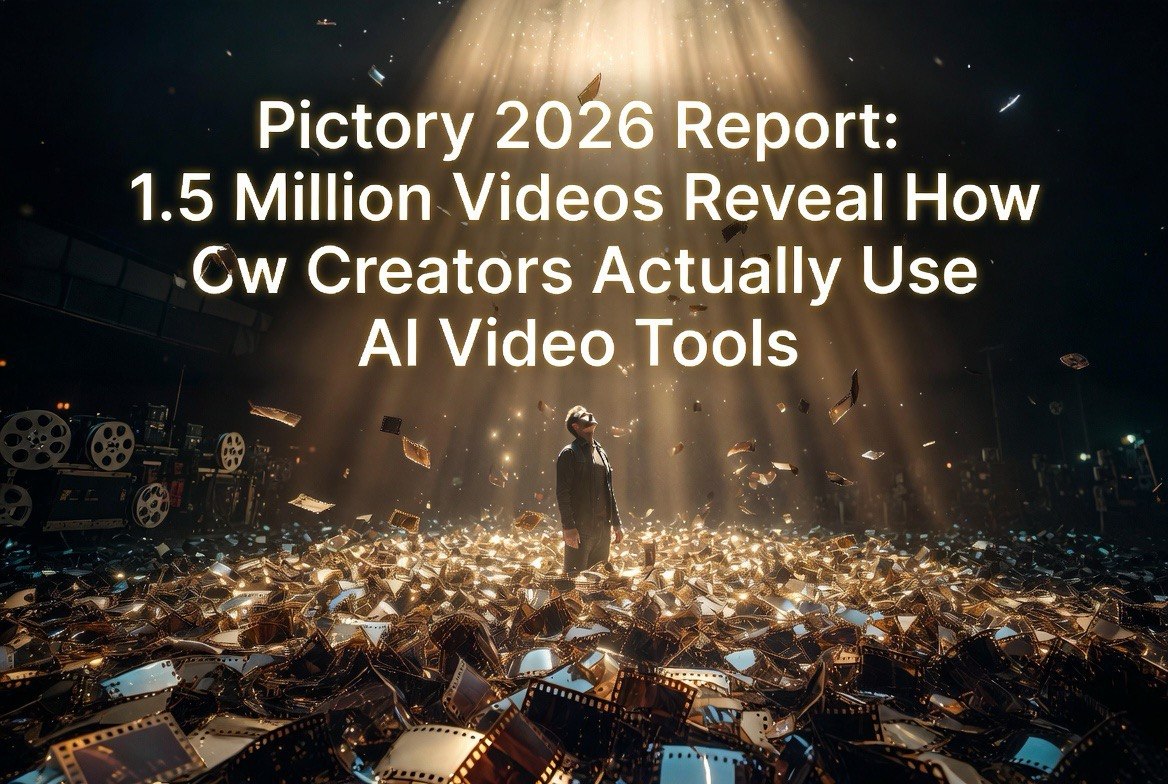
Pictory 2026 Report: 1.5 Million Videos Reveal How Creators Actually Use AI Video Tools
Get The Faceless YouTube Blueprint — Free
The exact AI tool stack and workflow used to build a faceless YouTube channel from zero.
Pictory 2026 Report: 1.5M Videos Reveal How Creators Actually Use AI Video Tools
⚡ Expert Summary: Pictory’s 2026 State of the AI Video-Creation Industry Report analyzed usage data from 1.5 million videos on its platform. Key findings include: peak creation at 9 PM local time (35% of activity 7 PM-1 AM), sales/marketing videos average 1.7 minutes vs. YouTube’s 3.9 minutes, Denmark leads in custom voiceovers at 7× the US rate, and professional users repurpose web content to video at 9× the rate of hobbyists. This article breaks down what the data actually means for video creators and businesses using AI video tools in 2026.
The Largest Behavioral Dataset in AI Video
Most reports on AI video tools are based on surveys — asking creators what they think they do. Pictory’s 2026 report takes a different approach. It analyzes actual platform usage data from 1.5 million videos created on Pictory during the first half of 2026, across text-to-video, URL-to-video, audio-to-video, and PPT-to-video workflows.
The dataset includes behavioral metrics normalized per 1,000 users, making it possible to compare usage patterns across features, regions, and creator segments without the distortion of different user counts. The result is the most detailed behavioral picture of AI video creation available in 2026.
Here is what the data shows, what it means for different types of creators, and where the AI video industry is heading.
The After-Hours Economy of AI Video
The most striking finding in the report is when AI video creation happens. Peak creation time globally is 9 PM local time, and the 7 PM to 1 AM window accounts for 35% of all daily activity. AI video tools have not replaced day-time professional workflows — they have created an after-hours creator economy where marketers, business owners, and content creators produce video in the hours they used to spend on other activities.
This pattern tells us something important about how AI video is being adopted. These are not 9-to-5 production pipelines where a dedicated video team runs AI tools during business hours. The typical user is fitting video creation around their primary work, using AI to compress what would have been hours of editing into the late evening.
The implication for tool developers is clear: features that reduce friction for late-night, low-attention sessions — one-click templates, automated voiceovers, fast rendering — matter more than advanced editing capabilities that require focused concentration.
Video Length: One Size Does Not Fit Anybody
The report found dramatic variation in optimal video length depending on use case and region. This confirms that the “ideal video length” debate is meaningless without context.
Sales and marketing videos averaged 1.7 minutes — tight, optimized for conversion, designed to hold attention through a single message. YouTube creators averaged 3.9 minutes, long enough to deliver substantive content while respecting viewer attention spans. Training and education settled at 2.7 minutes, reflecting a shift toward modular learning rather than long-form training sessions. Employee communications ran 3.5 minutes on average, long enough for internal announcements and updates.
The regional variation was even wider. Spain averaged the longest videos at 7.8 minutes — suggesting a market where longer-form AI video content is accepted and expected. India averaged the shortest at 2.6 minutes. The US came in around 3.6 minutes, close to the global median.
For creators and businesses publishing AI video in 2026, the rule is simple: match video length to use case and market, not to a generic best-practice number. A 1.7-minute sales video and a 3.9-minute YouTube video are both right for their respective contexts.
Regional Leaders: Where AI Video Is Growing Fastest
The report identified specific countries and US states that lead in particular AI video capabilities, revealing where adoption is accelerating beyond the mainstream.
Denmark leads globally in custom voiceover uploads at 7× the US rate. That means Danish creators are not accepting default AI voices — they are recording custom narrations and using Pictory to pair them with AI-generated visuals. The emphasis on high-quality narration suggests a mature market that prioritizes production polish.
Vietnam showed 4× the US rate for audio-to-video conversion, indicating a booming podcast repurposing market. The Philippines led in background music usage at 3.3× the US rate, pointing to a music-driven storytelling culture. The UK generated AI images at 2.3× the US rate, and the UAE used AI avatars at 77% higher than the US.
Within the United States, Oregon led AI image generation at roughly 9× the national average — 1,215 AI-generated images per 1,000 users. Pennsylvania led in AI avatar usage at 4× California’s rate and 6× New York’s. Florida ranked in the top three nationally across four different feature categories, making it the most balanced AI video market in the country.
These data points matter for businesses deciding where to invest in AI video content. A company targeting Danish audiences should prioritize custom voiceover quality. One targeting Vietnamese markets should build audio-to-video repurposing workflows. Geography is not just a demographic variable — it is a feature preference signal.
Professional Users vs. Hobbyists: A Widening Gap
The report’s most strategically important finding is the behavioral gap between professional and hobbyist users. URL-to-video — converting existing blog posts and web pages into video content — is used at 9× the rate by professional users compared to hobbyists. PPT-to-video is dominated by training and education teams at 4× the rate of YouTube creators.
Business users are also 2× more likely to use video summarization features and significantly more likely to use AI avatars and generative images. The professional segment is not just using AI video more — it is using more advanced features in more integrated workflows.
This creates a compounding advantage. Professionals who repurpose existing content into video get more output per unit of input. Their libraries of blog posts, presentations, and training materials become video content without additional creative work. Hobbyists starting from scratch need more time to produce each video and are less likely to adopt the features that accelerate production.
The gap will widen in the second half of 2026 as professional teams build out their repurposing workflows while hobbyists continue producing one-off videos.
Mac Users Create More Advanced AI Video
Hardware matters more than expected. The report found that Mac users significantly outperform Windows users on advanced AI video features: 75% more voiceover uploads, 45% more AI-generated images, and 27% more avatar usage. Seattle leads US cities in custom voiceover creation.
The correlation is not about hardware capability — both platforms run Pictory’s web-based editor identically. It is about user behavior. Mac users in Pictory’s dataset are more likely to be professional creators and marketers who invest time in higher-quality production. The hardware is a proxy for the user segment, not a performance advantage.
For tool developers, the implication is that Mac users are the early adopters of advanced features and likely represent the direction of the broader market. Features that gain traction on Mac first will likely spread to Windows users as AI video tools mature.
What This Means for AI Video in Late 2026
The Pictory report paints a picture of an industry that has moved past experimentation into production. The key trends to watch in the second half of 2026 are all visible in this data.
First, repurposing workflows will drive professional adoption. The 9× advantage in URL-to-video among business users means companies that already produce written content can scale video output faster than pure video-first creators. Every blog post becomes a potential video. Every presentation becomes a training video. The assets are already there — AI video tools unlock them.
For businesses evaluating AI video tools in the second half of 2026, the report suggests a specific strategy: invest in tools that excel at content repurposing rather than tools that claim to be all-purpose video editors. A tool that can turn fifty existing blog posts into fifty videos in an afternoon will produce more measurable ROI than a tool that offers more advanced timeline editing but requires starting from scratch each time.
Second, regional specialization will create targeted tooling opportunities. A tool that optimizes for Danish custom voiceovers or Vietnamese podcast repurposing will capture niche markets faster than a generic all-purpose platform. The one-size-fits-all AI video tool is already losing relevance.
Third, after-hours creation is not a temporary pattern. The 35% of activity between 7 PM and 1 AM reflects a structural shift in how video gets made. AI video tool features that optimize for this window — fast rendering, mobile editing, template-based creation — will win the user base that produces a third of all AI video content.
Fourth, the gap between professional and hobbyist outcomes will continue widening. Professional teams adopting repurposing workflows, AI avatars, and custom voiceovers will produce more video at higher quality with less effort per video. Hobbyists will not catch up unless they adopt the same workflow patterns.
Frequently Asked Questions
What does the Pictory 2026 AI Video Report cover?
The report analyzes aggregated behavioral data from 1.5 million videos created on Pictory during H1 2026, covering text-to-video, URL-to-video, audio-to-video, and PPT-to-video workflows across regions, devices, and creator segments.
When do most people create AI videos?
Peak creation time globally is 9 PM local time. The 7 PM to 1 AM window accounts for 35% of all daily activity, indicating AI video is primarily an after-hours, flexible production tool.
What is the ideal AI video length for marketing?
Sales and marketing videos average 1.7 minutes on Pictory. YouTube creator videos average 3.9 minutes, training videos 2.7 minutes, and employee communications 3.5 minutes. Optimal length varies significantly by use case and region.
Which country uses AI video tools the most?
Denmark leads in custom voiceover usage at 7× the US rate. Vietnam leads in audio-to-video at 4× the US rate. The Philippines leads in background music at 3.3× the US rate. Each country shows different AI video feature preferences.
Do professionals use AI video differently than hobbyists?
Yes. Professional users repurpose web content to video at 9× the rate of hobbyists and are 2× more likely to use video summarization and AI avatar features. The gap between professional and hobbyist AI video production is widening.
Does hardware affect AI video quality?
Pictory data shows Mac users create 75% more custom voiceovers, 45% more AI images, and 27% more avatars than Windows users. This likely reflects professional user preference rather than hardware performance differences.

About Barak Schurr
Barak Schurr is a serial entrepreneur who built and exited a major ticketing platform before turning his attention to AI and content. He runs three AI-focused research sites and writes about the tools, workflows, and strategies that let solo creators build real channels — without a crew, a studio, or a Hollywood budget.
Email: [email protected]