
OpenAI Killed Sora and Disney Walked Away From $1 Billion — Here’s What That Means for Your Video Workflow
OpenAI Killed Sora. Disney Walked Away From $1 Billion. Somebody Mispriced This Badly.
⚡ Expert Summary: OpenAI is shutting down Sora — the app, the API, all of it. Disney responded by walking away from $1 billion. Here’s the part nobody will say directly: a company spending $100 billion on compute to earn $13 billion in revenue just discovered that the coolest product it ever demoed could not pay its electric bill. And every studio, agency, and creator who built a workflow on top of it is now holding a dead dependency.
For about eighteen months, Sora was the most important thing in AI video. It was the demo that broke group chats. It was the reason a thousand editors started learning prompt syntax. It was the thing studios and unions were genuinely afraid of.
It lasted less time than a rental lease.
Sam Altman told staff on Tuesday that the company would wind down every product built on its video models — the consumer app, the developer API, and the video features inside ChatGPT. Disney, which had committed a $1 billion equity investment as part of a three-year deal covering more than 200 characters, confirmed it is out.
Here is the part that should annoy anyone who actually used the product. The warning was visible a week earlier. OpenAI announced it was merging ChatGPT, Codex, and its browser into one superapp. Sora was not in the picture. When a company shows you its future and your tool is not in it, you have been told.
The Numbers Are Not Ambiguous
| The Figure | The Amount | What It Tells You |
|---|---|---|
| OpenAI revenue, last year | ~$13 billion | Real, but small against the plan |
| Planned spend, 4 years | ~$100 billion | Data centers, chips, power |
| Disney’s committed stake | $1 billion | Now officially withdrawn |
| Licensed characters | 200+ | Never shipped to general users |
| Sora products remaining | Zero | App, API, ChatGPT video — all gone |
Thirteen billion in, a hundred billion planned out. In that arithmetic, a free consumer video app is not a business. It is a donation of GPU hours to people who were never going to pay for them. Fidji Simo, OpenAI’s applications chief, reportedly told employees the company could not afford to be distracted by side quests. Sora was the side quest.
The uncomfortable implication: the cheap, magical AI video everyone was enjoying was a marketing expense, and the marketing budget just closed.
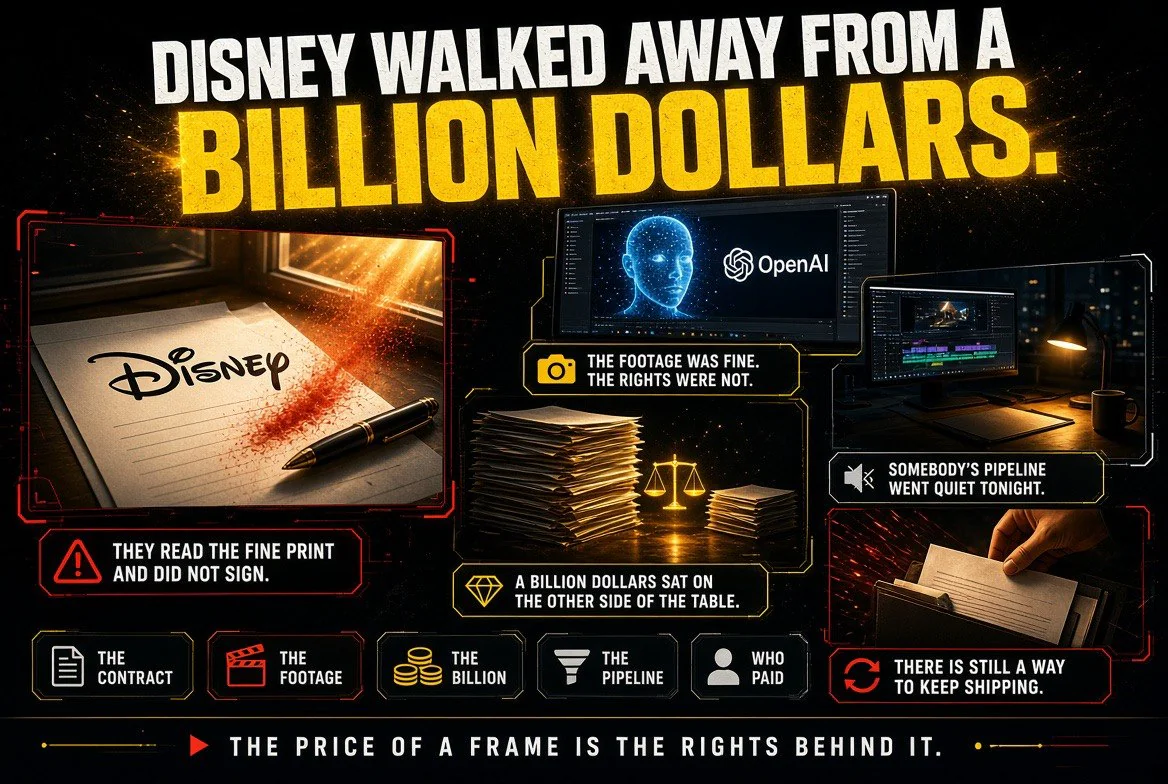
Disney Didn’t Blink. Disney Read the Contract.
The Disney deal was supposed to be the moment Hollywood stopped fighting generative video and started cashing the checks. Mickey, Vader, Pixar — licensed, curated, on Disney+. It was reported as a watershed for both industries.
What Disney actually did this week was straightforward: it exited a $1 billion investment in a product that no longer exists. A spokesperson kept the door open for future AI work, praising technologies that respect IP and creators’ rights. That sentence is not diplomacy. It is a company making clear it walked over a specific product decision, not over AI generally.
The studios were also right about the thing they were criticized for. When Sora 2 launched, OpenAI shipped it without guardrails for copyrighted content. SAG-AFTRA, the MPA, CAA, and WME all objected to the opt-out approach. Controls were added later. The licensing deal was supposed to be the peace treaty. There is no treaty to sign now.
And note the earlier, quieter moment: Mira Murati could not confirm whether YouTube videos were used in training. That non-answer followed the product for its entire life. Nobody forgot it.
What Everyone Got Wrong
The consensus was that Sora would be defeated by copyright. Lawsuits, licensing fights, angry unions — that was the expected death.
It was defeated by unit economics. The compute required to generate a video is not a rounding error on a text model; it is a different order of magnitude, and it is paid in electricity and GPU hours whether or not anyone clicks publish. A copyright settlement costs money once. An unprofitable inference bill costs money every second, forever.
The lesson is unromantic and it applies well beyond OpenAI: the constraint on AI video was never creativity. It was who pays the power bill.
The People Left Holding It
Somewhere right now there is a freelance editor with a Sora-generated reel in a client deck. There is an agency that pitched a campaign built on a specific model’s motion handling. There is an indie studio that put the API into a production pipeline and will find out about the shutdown from an error log.
None of them were warned in a way that mattered. The tool was real, the outputs were real, and the vendor’s commitment lasted less time than the average client retainer.
That is the actual news for anyone who works in video: your tool vendor is not your partner, and no demo is a roadmap.
| Who Is Affected | What They Expected | What They Got |
|---|---|---|
| Studios outsourcing to AI video | A cheap render pipeline with a licensed IP catalogue | A pipeline that now carries IP risk on every frame |
| Independent creators | Unlimited generation at a flat subscription | Tighter guardrails on anything resembling a character |
| Disney and rights holders | Being paid per generated likeness | A walk away from a billion dollars rather than license it cheap |
| The AI platform | Distribution at scale | Higher content costs and a thinner catalogue overnight |
| Net effect | Everyone assumed video would get cheaper | Everyone pays for the rights before the frame renders |

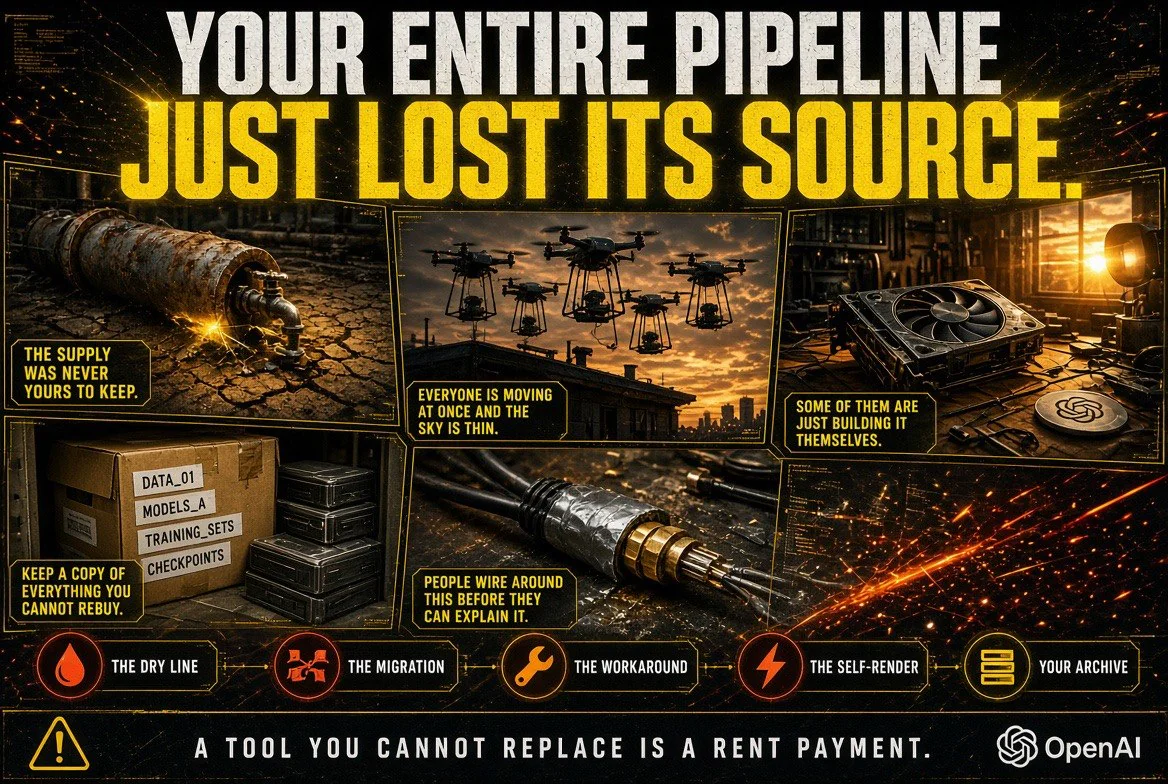
If Your Pipeline Just Died, Here Is the Exit
Practical, in order of urgency.
1. Export everything now
Download every asset you generated that still has value. Do not assume generations persist indefinitely in a wind-down. If a client project references a Sora output, pull the master file into your own storage today.
2. Find every place Sora touches production
Grep your automation. Check your n8n or Zapier flows, your internal scripts, any client-facing portal that calls a video endpoint. A dead API doesn’t announce itself politely — it starts returning errors mid-job, and you find out when a deliverable is late.
3. Never let one model be your only model
Abstract your video generation behind a thin internal layer — even a simple wrapper function — so swapping providers is a config change rather than a rebuild. The creators who survived this week’s news are the ones whose pipeline said generate_video(prompt, provider) instead of hardcoding a vendor SDK.
4. Price AI video into your quotes honestly
Subsidized pricing is going away across this category. When a company is spending $100 billion over four years, consumer-grade access at consumer-grade prices is a temporary condition. Quote your video work assuming generation costs rise meaningfully within 18 months.
5. Tell your clients what changed, before they read it elsewhere
If a client knows you used Sora, they may ask. Get ahead of it with a short, calm note: the tool is being retired, your deliverables are unaffected, and your workflow already has a fallback. That email takes four minutes and prevents a much worse conversation.
For more on building resilient AI video pipelines, browse our AI video tools coverage.
What This Actually Tells You About AI Video
There is a temptation to read Sora’s shutdown as AI video failing. That’s the wrong conclusion, and it’s the one that will cost you money if you act on it.
AI video is not going away. Google is still developing Veo. ByteDance is still shipping Seedance despite legal pushback. Alibaba has a model topping global rankings. The technology is advancing on every axis that matters — quality, control, duration, consistency.
What died is something narrower and more specific: the idea that a frontier lab would subsidize consumer video generation indefinitely out of strategic vanity. That was always a temporary condition, and now it has ended publicly, with a $1 billion deal as the collateral.
The lesson for anyone who makes a living with these tools: your vendor’s roadmap is not your roadmap. Deliverables belong in your own storage. Workflows belong behind an abstraction layer. And no single model — no matter how impressive the demo — should ever be the only thing standing between you and a client deadline.
Frequently Asked Questions
Is Sora completely shut down?
OpenAI is winding down all products built on its video models — the consumer Sora app, the developer-facing Sora API, and video functionality within ChatGPT. Altman reportedly told staff the company would wind down every product built on its video models. The video research team is being reassigned to world-simulation work for robotics.
Why did OpenAI shut down Sora?
The stated reason is a strategic refocus on productivity tools, agentic software, and coding as the company prepares for a potential IPO. The underlying driver is compute economics: OpenAI reportedly generated roughly $13 billion in revenue last year while planning to spend approximately $100 billion over four years, and a compute-heavy consumer video app with no meaningful revenue could not justify its share.
What happened to the Disney deal?
Disney has confirmed it is exiting its $1 billion equity investment in OpenAI and the three-year licensing agreement is dead. That deal would have licensed more than 200 characters from Disney, Marvel, Pixar, and Star Wars for use on Sora, with curated content planned for Disney+. A Disney spokesperson said the company would continue engaging with AI platforms while responsibly embracing technologies that respect IP and creator rights.
Can I still use the Sora API?
No. The developer-facing Sora API is part of the wind-down. Any integration calling Sora endpoints is a dead dependency and needs to be migrated to another provider immediately. Do not wait for an official deprecation window — move the integration now and keep the old code path disabled.
What should I use instead of Sora for AI video?
Google’s Veo, ByteDance’s Seedance family, Alibaba’s video models, and dedicated labs like Runway and Kling are all active alternatives. The right choice depends on your need: Veo for platform integration, Seedance for creative range, Runway and Kling for workflow tooling built around video specifically. Test at least two so no single vendor can strand your pipeline again.
Will OpenAI ever return to consumer AI video?
OpenAI says it is not abandoning video research — the team is pivoting to world-simulation research aimed at robotics training, where video models serve as simulations of the physical world. Whether the Sora model itself is preserved, folded into another system, or retired has not been clarified. A future consumer product is possible but not something to plan a business around.

About Barak Schurr
Barak Schurr is a serial entrepreneur who built and exited a major ticketing platform before turning his attention to AI and content. He runs three AI-focused research sites and writes about the tools, workflows, and strategies that let solo creators build real channels — without a crew, a studio, or a Hollywood budget.
Email: [email protected]
More AI Video Resources