AI Video Is Cheap Now. The Bottleneck Moved to Distribution
Get The Faceless YouTube Blueprint — Free
The exact AI tool stack and workflow used to build a faceless YouTube channel from zero.
AI Video Is Cheap Now. The Bottleneck Moved to Distribution
⚡ Expert Summary: For three years the question every solo creator asked was which model made the better video. That question is largely settled — not because one model won, but because the floor rose so fast that a competent, publishable clip is now available for pocket change on almost every platform. When generation stops being scarce, it stops being the constraint. What remains scarce is the thing nobody wants to talk about: an audience that reliably watches, and the distribution discipline that produces one. This piece covers what actually changed in AI video economics, which costs collapsed and which did not, and the specific optimizations a solo creator should stop spending time on.
There is a moment in every tool cycle where the conversation quietly changes and almost nobody notices. For AI video, that moment has arrived.
Walk through any creator community in 2026 and you will still find people arguing about which model renders better hands. But the argument has become recreational rather than consequential. The gap between the best model and the fifth-best model is now smaller than the gap between a creator who publishes consistently and one who does not.
That is not a small shift in emphasis. It relocates where the work is.
What Actually Got Cheap
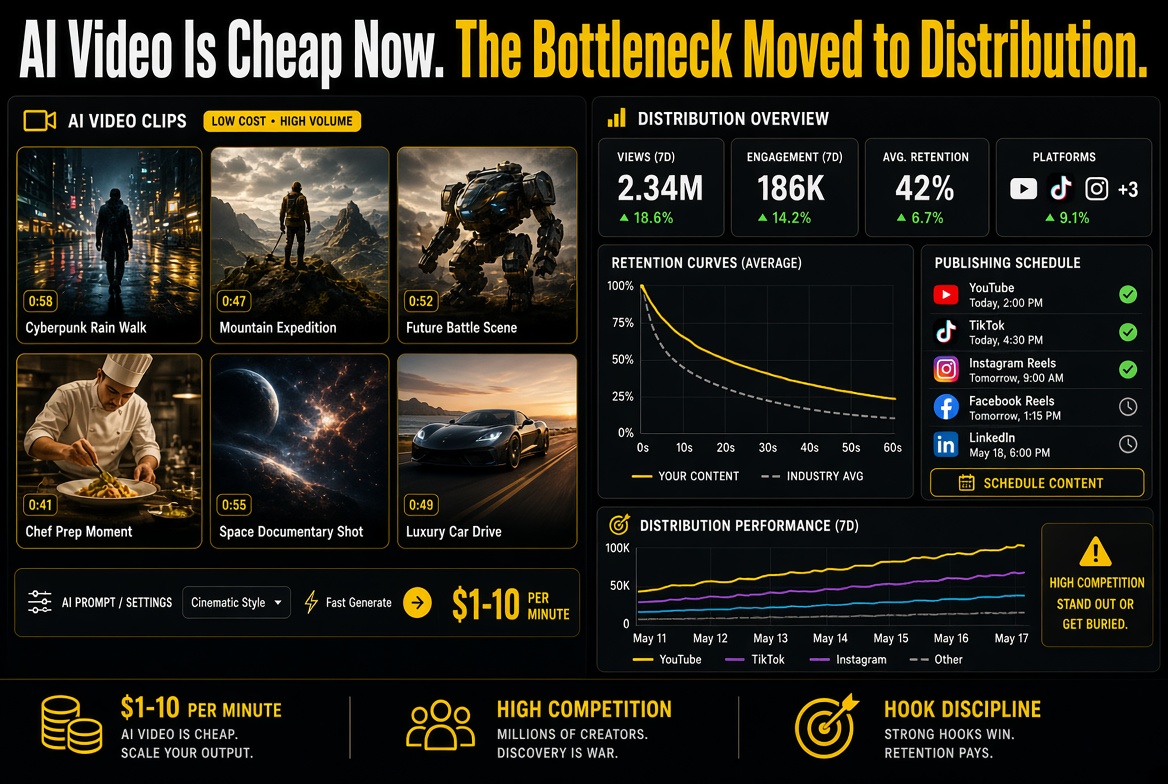
Generation cost collapsed. This is the well-known part, but the magnitude is worth stating plainly because it reframes the whole business.
In 2023, a thirty-second AI video clip was a project — a paid subscription, a careful prompt, several failed generations, and an editing pass to hide the seams. The effective cost per usable second was measured in dollars and hours.
By 2026, a comparable clip costs cents and takes minutes. Free tiers exist that are genuinely usable. A solo creator can produce a week of short-form output on a budget that would have bought one clip eighteen months ago.
What did not get cheap: everything downstream.
[PENDING INLINE IMAGES]
The Cost That Stayed Exactly Where It Was
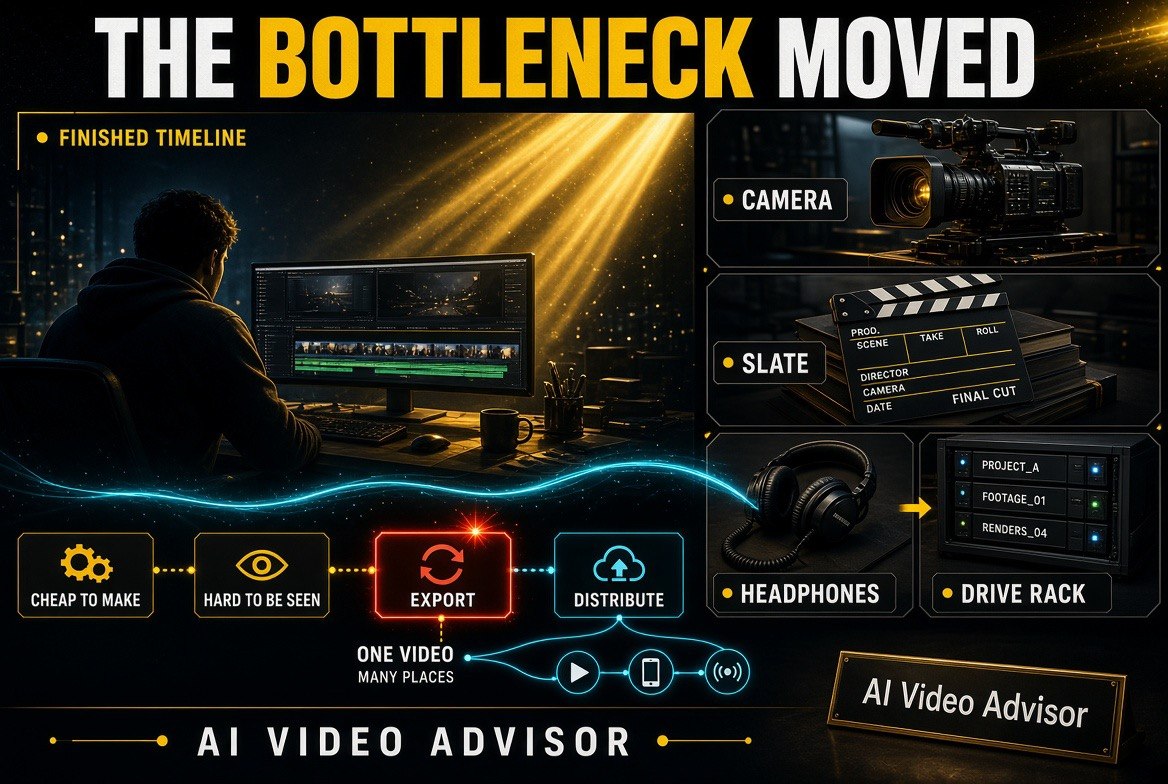
Distribution costs did not fall. Attention did not get cheaper. If anything, it got more expensive, because the supply of watchable AI video expanded faster than the supply of human attention.
This is the arithmetic every creator eventually runs into. When generation is expensive, output is limited by budget, and each piece gets more care because it cost something. When generation is nearly free, output is limited only by your publishing capacity — and the feed fills with everyone else doing the same thing.
| Cost center | 2023 | 2026 | Direction |
|---|---|---|---|
| Generation per finished minute | $40–120 | $1–10 | Collapsed |
| Software stack | $60–150/mo | $20–60/mo | Falling |
| Time to first cut | Days | Hours | Collapsed |
| Cost per thousand views | Low competition | High competition | Rose |
| Audience trust | Neutral | Scarce | Harder to earn |
Read the last two rows again. The inputs got cheaper by an order of magnitude. The output — attention, trust — got more expensive. That inversion is the entire story of solo AI video in 2026.
The Three Optimizations to Stop Doing
When generation was the constraint, optimizing generation was rational. Now it is a way to feel productive while the actual constraint goes unaddressed.
Stop chasing model benchmarks. The difference between the top model and the third-place model will not show up in your retention graph. Switching tools every three weeks resets your workflow and buys nothing measurable.
Stop over-polishing individual pieces. A clip that took six hours instead of one does not perform six times better. It performs roughly the same, and you published six fewer pieces. In an attention market, volume with a floor of quality beats scarcity with a ceiling of polish.
Stop optimizing render settings nobody sees. The viewer is watching on a phone, in a feed, at speed. If your output is clean at that size and pace, additional fidelity is invisible.

What the Constraint Actually Is Now
Three things, and none of them are creative.
Publishing cadence. Platforms reward consistency because consistency predicts supply. A creator who posts three times a week for a year beats a creator who posts brilliantly for two months. This is unglamorous and it is the single strongest predictor of channel growth.
Hook discipline. With infinite supply, the first two seconds decide everything. The hook is not creative decoration — it is the distribution mechanism. A creator who can reliably write a hook is operating a different business than one who cannot.
Format ownership. Channels grow on recognizable formats, not individual hits. A recurring structure — same intro shape, same pacing, same visual signature — trains the audience to expect something, and expectation is the raw material of a subscription.
Why This Favors the Boring Creator
There is an uncomfortable implication here that most AI video coverage avoids: the technology got easier and the job got harder.
When anyone can generate a competent clip in ten minutes, competence stops being a differentiator. What remains is the operational discipline — the calendar, the format, the willingness to publish something good instead of perfecting something great, and the patience to do it for a year before the compounding shows up.
That is a worse fit for the person who was drawn to AI video because it promised to skip the grind. It is a better fit for the person who wanted a production advantage and was always willing to do the grind anyway.

A Practical Reallocation
If generation is cheap, spend less on it and more on the parts that still cost something. A rough reallocation that works for most solo creators:
| Activity | Old split | New split | Why |
|---|---|---|---|
| Generation and rendering | 60% | 15% | Cheap now; returns are flat |
| Hooks and titles | 10% | 30% | Decides distribution |
| Format design | 5% | 20% | Builds expectation and return viewers |
| Publishing and scheduling | 15% | 25% | Cadence compounds |
| Tool research | 10% | 10% | Enough to stay current, no more |
The point is not the exact percentages. It is that the mix should have visibly changed, and for most creators it has not.
What This Means for the Next Twelve Months
Expect generation to get cheaper still — that curve is not finished. Expect the feed to keep filling. Expect the premium on a recognizable format and a reliable hook to keep rising.
The creators who struggle will be the ones who keep treating model selection as the strategic decision, because it is the one decision that no longer changes the outcome. The ones who compound will be the ones who accepted that the easy part got easy and spent their saved hours on the hard part.
Cheap tools do not lower the bar for a channel. They raise the number of people who can clear it — which means the bar that matters was never the tool.
The Distribution Stack That Actually Moves Numbers
If the constraint is distribution, then the work that matters is the work that changes how many people see a piece and how many of them come back. That is a shorter list than most creators expect.
Scheduling discipline. Publishing at consistent times is not superstition. It trains an audience to know when to look, and it removes the decision cost of when to post. A creator who publishes whenever the piece is ready publishes less than one who has a fixed slot and fills it.
Repurposing, deliberately. One piece of source material should produce a long form, three shorts, a text post, and a still image. The generation cost of each derivative is now near zero, which means the only real cost is the thinking about which derivative serves which platform. Creators who repurpose well publish four times as often at the same creative cost.
Retention editing. The difference between a clip that holds and one that leaks is usually the middle, not the beginning. Cutting the two seconds where nothing new is introduced does more for completion rate than any render upgrade.
Feedback loops that are actually short. A creator who reviews retention curves weekly develops instincts faster than one who reviews quarterly. The loop is the skill.
The Economics of Repurposing
Here is where the collapse in generation cost changes the arithmetic most visibly. When a clip costs $80 to produce, repurposing it into five derivatives is a significant investment. When it costs $4, repurposing is nearly free and the only question is whether you have the discipline to do it.
| Output | Extra cost in 2023 | Extra cost in 2026 | Marginal value |
|---|---|---|---|
| Vertical short | $30–60 | $0–3 | High — main discovery surface |
| Long-form cut | $60–120 | $5–15 | Medium — depth and trust |
| Text post | $0 | $0 | Medium — cheap reach |
| Still frame | $5 | $0 | Low — supporting asset |
| Thumbnail variants | $10 | $0 | High — click rate leverage |
None of these derivatives requires a new creative idea. They require a template and the habit of running it. That is the whole trick, and it is why the creators who look prolific are usually not generating more — they are extracting more.
Where AI Still Costs You Money
There is a trap in treating generation as free. It is cheap per output, not per month. A creator running four models, three editing tools, and two avatar services is spending $200 a month to produce work that one $25 tool would have produced.
The discipline is to consolidate ruthlessly. Pick one generation tool, one editing tool, one audio tool, and one scheduler. Everything else is a hedge against FOMO, and FOMO does not appear in retention analytics.
The same applies to storage and rendering credits. Usage-based pricing means the cost scales with volume, so the more you publish the more you pay. That is fine while the channel is growing and worth watching when it plateaus.
The Failure Mode Everyone Hits
The most common failure is not a bad video. It is a creator who produces excellent work in bursts and disappears for three weeks because the next piece needed to be better than the last.
That spiral is a relic of the expensive era. When each piece cost real money, perfection made sense because you could only afford a few. When each piece costs almost nothing, the rational play is to ship, learn, and ship again.
The creators who break out of that spiral report the same realization: the audience never remembers the mediocre piece, but the algorithm does remember the gap.
Frequently Asked Questions
Is AI video good enough for a real channel now?
Yes, for most short-form formats. The remaining weaknesses show up in long-form continuity and complex human motion, not in the short clips that drive most channel growth. If your format relies on sustained character consistency across minutes, plan for more editing.
Will cheap AI video kill creator income?
It compresses income for creators whose only value was production capability. It does not compress income for creators whose value is a recognizable format, a specific point of view, or an audience relationship. The production layer was always the easiest part to replace.
How often should I publish to grow in 2026?
Consistency matters more than volume. Three to four pieces a week, sustained for a year, outperforms bursts. The platform rewards predictable supply because predictability is what makes an audience return.
Should I still learn editing?
Yes, but for a different reason than before. Editing is no longer about assembling a clip — it is about pacing, hook construction, and rhythm. Those are distribution skills wearing an editing costume.
Do I need the newest model to stay competitive?
No. The performance gap between top models is now smaller than the gap created by publishing consistently. Switching tools resets your workflow and costs you cadence, which is the thing that actually compounds.
What is the single highest-leverage change a solo creator can make?
Design one repeatable format and commit to it for at least twenty episodes. Format recognition does more for retention and return viewing than any individual piece of production quality.

About Barak Schurr
Barak Schurr is a serial entrepreneur who built and exited a major ticketing platform before turning his attention to AI and content. He runs three AI-focused research sites and writes about the tools, workflows, and strategies that let solo creators build real channels — without a crew, a studio, or a Hollywood budget.
Email: [email protected]
More AI Resources for Creators and Businesses