JUMPINGGOOSE Says Culture Is the Creator Premium: What It Means for Your Channel
Get The Faceless YouTube Blueprint — Free
The exact AI tool stack and workflow used to build a faceless YouTube channel from zero.
JUMPINGGOOSE Says Culture Is the Creator Premium: What That Really Means for Your Channel
⚡ Expert Summary: JUMPINGGOOSE, a Tokyo creative studio, is making an argument that runs against the entire direction of AI video in 2026: as generation gets cheap, culture becomes the premium. The logic is uncomfortable and correct. If anyone with a text box can produce a polished sixty-second clip, then polish stops being a differentiator — and the things a model cannot generate on demand, cultural fluency, lived specificity, a point of view that comes from somewhere real, become the only things worth paying for. For a solo creator, this reframes the whole job. You are not competing on output quality anymore, because output quality is being commoditized in front of your eyes. You are competing on whether your work could have been made by anyone, anywhere.
Here is the trap in every AI video workflow guide, including the ones on this site: they teach you to close the gap between what you make and what a studio makes.
That gap is closing on its own. Fast. Which means the strategy underneath the guides needs an update.
When a solo creator with a $30 monthly subscription can produce the same clean, well-lit, competently-paced footage as a production house, the footage stops being the product. The market does what markets do — it reprices. And what it reprices upward is the one input that cannot be downloaded, fine-tuned, or prompted into existence: a specific cultural point of view.
That is the claim JUMPINGGOOSE is building its position on, and whether or not you have heard of the studio, the logic applies to your channel this week.
What “Culture Is the Premium” Actually Means
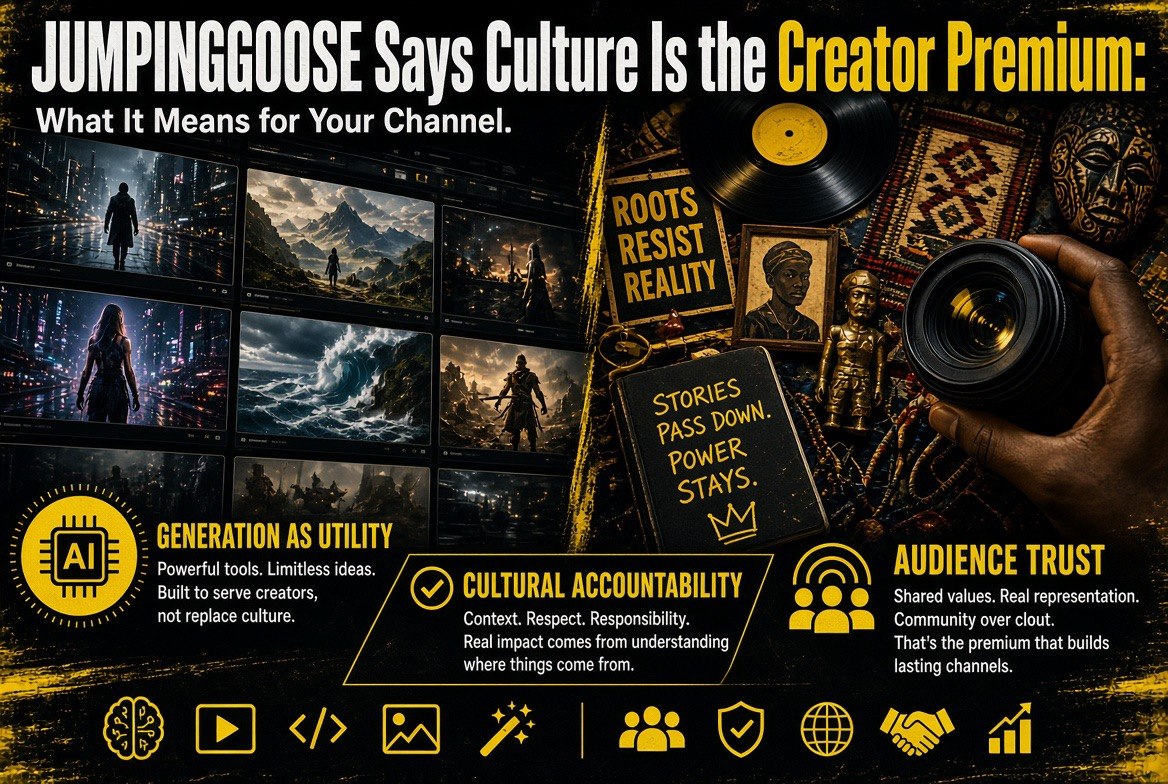
Strip the slogan down and the argument has three parts. Each one has a direct consequence for how you should spend your next forty hours of production.
Part one: generation is becoming a utility. Model quality is converging. The differences between the top video tools are now measured in quirks and edge cases, not in whether they work at all. A capability that used to require a studio is arriving as a feature, first to the paid tiers, then to everyone.
Part two: when a capability becomes a commodity, its price falls to the cost of production. This is not a controversial economic claim. It is what happened to photography, then to music recording, then to web development, then to stock imagery. Every one of those transitions destroyed the value of the commodity capability and increased the value of whatever sat on top of it — taste, audience, distribution, and cultural specificity.
Part three: cultural fluency is the thing that resists automation. A model can generate a scene. It cannot know, from experience, which reference lands with a specific audience, which joke is too far, which detail signals that you actually belong to the culture you are depicting and which one signals you watched three videos about it. That knowledge comes from having been somewhere.
Put together, the conclusion is straightforward: the more capable generic AI video becomes, the more the market will pay a premium for work that is unmistakably from somewhere.
| Asset | Value in 2023 | Value in 2026 |
|---|---|---|
| Production polish | High — required a crew, gear, and a budget | Falling fast — available as a subscription feature |
| Generic footage libraries | Useful — filled gaps cheaply | Near zero — anyone can generate the filler now |
| Cultural specificity | Nice to have — hard to source at scale | Rising — the scarce input models cannot fake |
| Audience trust | Built slowly, monetized indirectly | Compounding — the thing AI output cannot purchase |
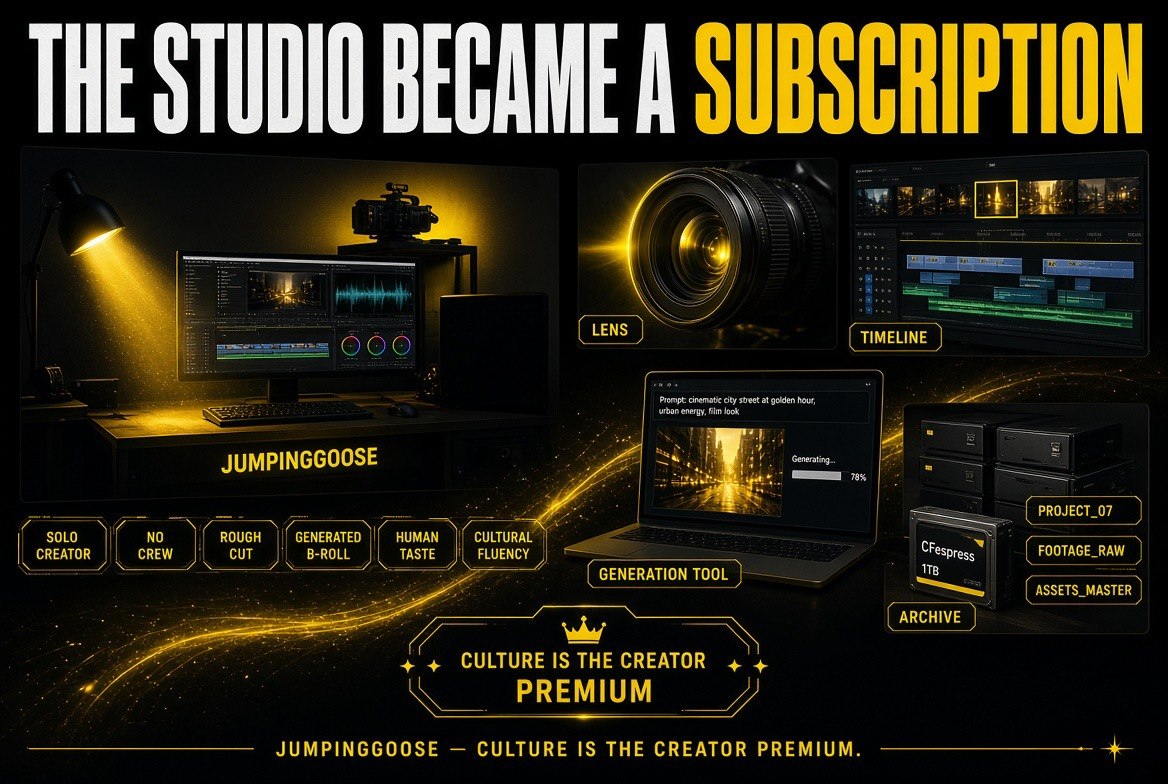
The setup that used to need a crew, a studio and a budget — now a desk, a lens and a monthly subscription.
The Counterargument, and Why It Is Only Half Right
The obvious objection is that models will get cultural fluency too. Give a model enough training data from a specific region, and it will produce work that reads as locally authentic. That is already happening at the edges.
The objection is half right, and the half that is wrong is the important half.
A model can imitate the surface markers of a culture. What it cannot do is participate in one. It cannot have been at the table when the argument happened. It cannot know that a particular phrase is fine in one neighborhood and a fight in the next. It cannot carry the memory that makes a reference land as a shared joke rather than a researched mimicry.
There is also a practical version of this that matters more than the philosophical one. Cultural fluency is not just about producing the right output — it is about knowing what to leave out. Every creator who belongs to an audience knows which jokes not to make, which sponsors to turn down, which trend to sit out. That judgment is invisible in the output and decisive in the outcome.
So the honest version of the JUMPINGGOOSE argument is not “AI cannot do culture.” It is “AI cannot be accountable to a culture.” And accountability is what audiences actually pay attention to.

The input no model can be trained into: a specific street, a specific sign, a specific hour — the detail an audience recognises because it is genuinely from somewhere.
What This Changes About Your Production Stack
If culture is the premium, then the tooling question changes shape. It stops being “which model makes the best video” and becomes “which workflow frees up the most human attention for the parts that carry the premium.”
| Production Stage | Hand to AI | Keep for Yourself |
|---|---|---|
| Editing and assembly | Cutting to a beat, removing filler, matching audio levels, rough-version assembly | Deciding which moment is the one the audience will quote back to you |
| Visual production | B-roll, establishing shots, backgrounds, transitions, graphics | Anything a viewer would recognize as specific to your world |
| Script and structure | Outlines, research summaries, title variants, retention structure checks | The argument, the jokes, the references, the refusal to say the obvious thing |
| Voice and presence | Draft narration for timing, subtitles, translation passes | Whether it sounds like you — the accent, the rhythm, the things you refuse to fake |
The pattern is the same in every row. Hand off the parts where being indistinguishable from a competitor is fine. Keep the parts where being indistinguishable from a competitor is fatal.
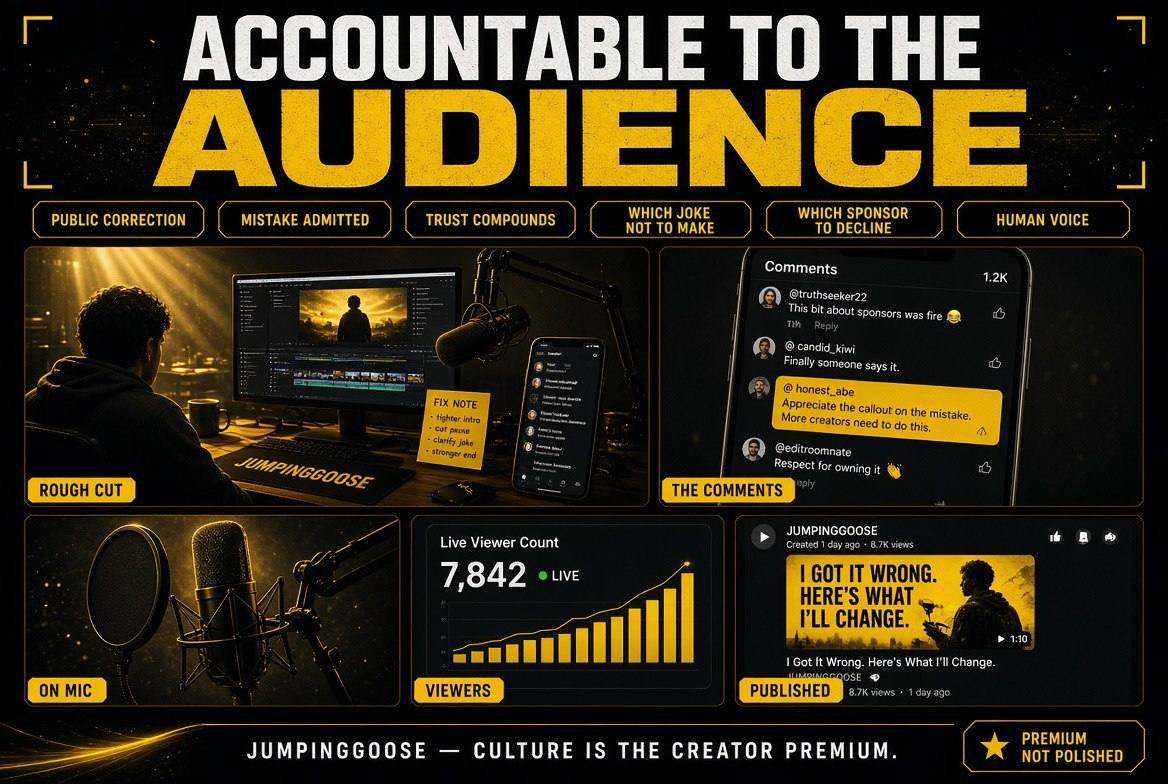
Accountability is the one behaviour a model cannot perform — and the reason audiences forgive a creator who corrects the record and abandon one who never does.
Five Moves That Put Culture to Work This Week
1. Write down what only you could say. Take your last five videos and mark every moment that depended on knowledge you had from lived experience — a local reference, a professional detail, an insider observation. If the answer is none, that is your diagnosis, and it explains any flatness in the numbers.
2. Stop using AI to fill the gaps that should be empty. The instinct when a scene feels thin is to generate filler. Resist it. A thin scene that is specific beats a full scene that is generic, every time, because specificity is the thing being repriced upward.
3. Choose one narrow audience and go all the way in. Broad channels compete with the entire internet plus every model output ever generated. Narrow channels compete with almost nobody, because the thing that qualifies you is not available for purchase. The narrower the niche, the fewer competitors have the standing to show up.
4. Build an accountability trail you can point to. When you get something culturally wrong, say so publicly and correct it. That is the exact behavior a model cannot perform, and it is the foundation of the trust that compounds. Audiences forgive a creator who admits a mistake and abandon one who ignores it.
5. Treat AI output as your baseline, not your ceiling. Let it get you a competent draft in a fraction of the time, then spend the saved hours on the part that the model handed you for free specifically because it cannot do it. That is the actual arbitrage in 2026.
Frequently Asked Questions
What does JUMPINGGOOSE mean by culture being the creator premium?
The studio’s argument is that as AI video generation becomes cheap and widely available, technical production quality loses its value as a differentiator, and cultural fluency — a specific, lived point of view that comes from belonging to an audience — becomes the scarce input that commands a premium.
Will AI models eventually just learn culture too?
They can imitate the surface markers of a culture using training data, and they already do at the edges. What they cannot do is participate in a culture or be accountable to it. The judgment about which joke to make, which sponsor to decline, and which trend to sit out comes from belonging, not from training data.
Should I stop using AI for video production entirely?
No. The practical move is to use AI for the parts where being indistinguishable from a competitor is harmless — assembly, b-roll, graphics, research, subtitle passes — and keep the scripting, argument, references, and voice choices in human hands, because that is where the premium now sits.
How do I know if my content has cultural specificity?
Audit your recent work for moments that depended on knowledge only you had. If you cannot find any, your content is competing on production polish alone, which is exactly the ground that AI is commoditizing fastest. Add at least one lived, specific detail per piece as a starting discipline.
Does this apply to creators outside Japan or outside any single culture?
Yes, and the principle is universal. The relevant culture does not have to be national — it can be a profession, a region, a hobby, a genre community. What matters is that you belong to it and your audience can tell, because that membership is the input no model can acquire on your behalf.

About Barak Schurr
Barak Schurr is a serial entrepreneur who built and exited a major ticketing platform before turning his attention to AI and content. He runs three AI-focused research sites and writes about the tools, workflows, and strategies that let solo creators build real channels — without a crew, a studio, or a Hollywood budget.
Email: [email protected]
More AI Video Resources