Fish Audio Drama 3: Directing AI Voice Like an Actor
Get The Faceless YouTube Blueprint — Free
The exact AI tool stack and workflow used to build a faceless YouTube channel from zero.
Fish Audio Drama 3: Directing AI Voice Like an Actor, Not a Text Box
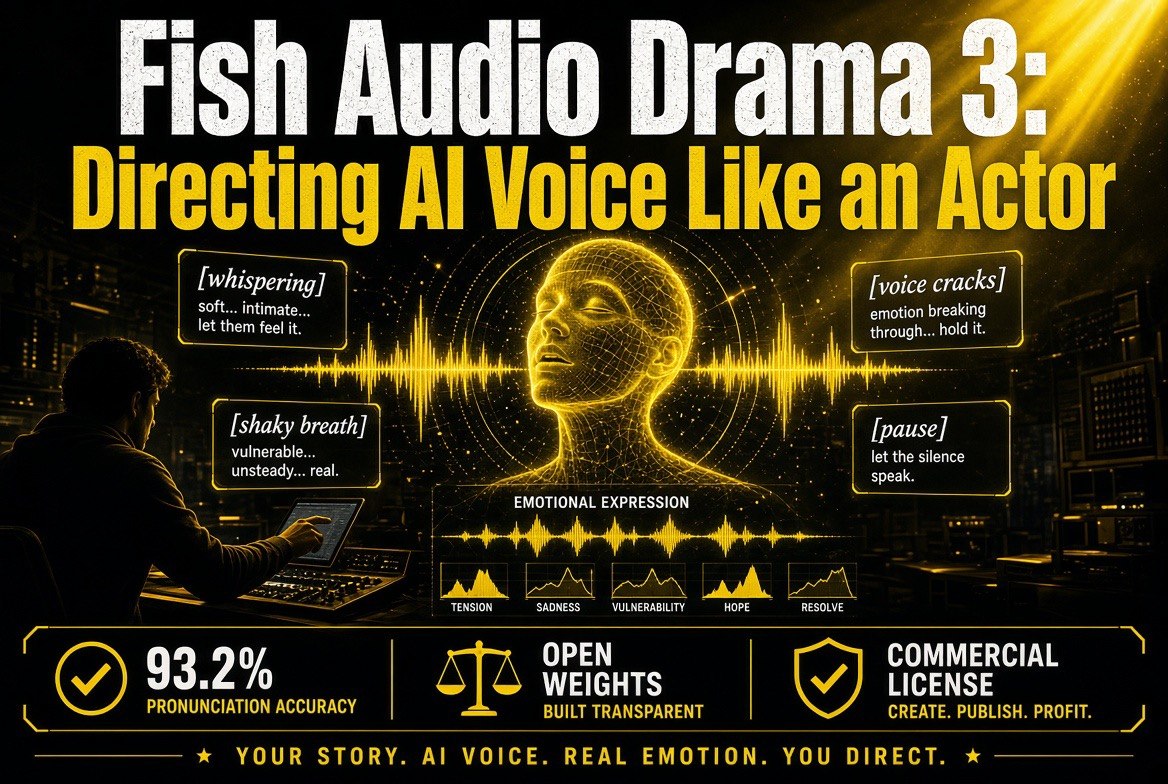
⚡ Expert Summary: Fish Audio released Drama 3 on October 13, 2026 — its most emotive text-to-speech model, live in the web app, the iOS and Android apps, and the API. You direct it the way you would direct an actor: plain-language notes in square brackets, placed mid-line, in any of 83 languages. It hit 93.2% on Artificial Analysis’ Pronunciation Robustness benchmark, the top score on the leaderboard, against 88.1% for S2.1 Pro. The weights are open, and the license is free for commercial use under US$500,000 in annual revenue. For solo creators, the interesting part is not the emotion. It is that both the directing and the licensing just became usable at the same time.
For three years the pitch for AI voice has been the same: type words, get audio. The output got cleaner, the accents got better, and the fundamental interface never moved. You were still filling a text box and pressing generate, which is why so much AI narration sounds like a press release read aloud by someone who has never met a human.
Drama 3 changes the interface before it changes anything else. You stop writing text and start writing direction — in the same breath, on the same line.
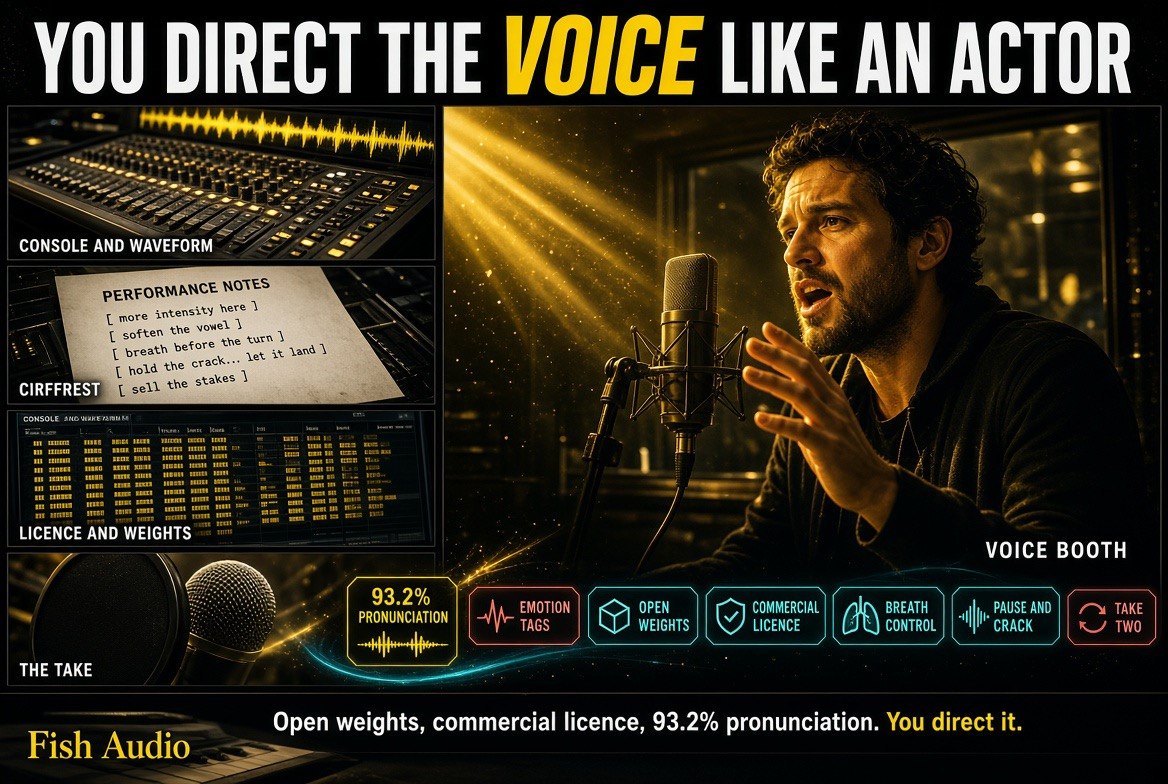
You direct it like a performance — emotion tags, breath control, pause and crack. Open weights, commercial licence, 93.2% pronunciation.
What Directing Actually Looks Like
Direction goes in square brackets, written the way you would say it to a performer. A single line can carry several directions, and the read turns exactly where you put them.
The clearest example from the launch is one sentence, same voice and same script, with each direction landing where it is written: [barely holding it together, forcing a smile] I’m fine. [shaky breath] Really. [small laugh] [whispering] Go on without me.
That is four separate performance beats inside one line of dialogue. Older models would flatten all four into a single uniform read, because the sentence itself never changes — the emotion is not in the words, it is in the delivery.
For longer passages, Fish Audio also supports paired tags. Wrapping words in <emphasis>…</emphasis> directs only the words between the tags, which means you can push a single phrase without touching the rest of the paragraph:
[breathless, speaking fast] Just turn off the lights. Stay away from the windows. [voice drops to a terrified whisper] And whatever you hear out there… [slow, deadly serious] <emphasis>do not open that door.</emphasis>
The practical difference for a solo creator is regeneration cost. Previously, when one line in a five-minute narration came out flat, the fix was to rewrite the sentence, re-roll the whole take, and accept whatever else changed. Now you add a direction to the line that failed and leave the rest alone.
Direction is not tied to the spoken language either. Fish Audio showed the same line directed in Chinese, Spanish, and Japanese — and confirmed you can write the direction in whatever language you think in, regardless of what the line is in. For anyone dubbing, that means the creative notes stay in the language you are actually creative in.
Tags, breath, pauses. That is direction, not synthesis — the control surface is the product.
The Benchmark That Matters More Than Emotion
Emotion demos are easy to fake with a lucky take. Pronunciation on hard words is not, and it is the failure mode that actually breaks long-form work.
Artificial Analysis runs an independent Pronunciation Robustness benchmark that places hard words inside ordinary English sentences — brand names, place names, technical terms, numbers, codes, and words whose reading depends entirely on context — and has human listeners check each one. Drama 3 scored 93.2%, the top score on the leaderboard. S2.1 Pro scored 88.1%.
| What Is Being Read | Drama 3 | S2.1 Pro |
|---|---|---|
| Names of brands, places and technical terms | 95.9% | 87.3% |
| Words whose reading depends on context | 95.3% | 86.1% |
| Shorthand: numbers, dates, units, notation | 93.6% | 92.7% |
| Exact sequences: codes, paths, emails | 86.3% | 79.4% |
| Overall | 93.2% | 88.1% |
Look at which categories moved most. Brand and place names jumped from 87.3% to 95.9%, and context-dependent words from 86.1% to 95.3%. Those are the two categories that ruin documentaries, product explainers, and anything mentioning a real company or a real city. Exact sequences — file paths, codes, email addresses — improved from 79.4% to 86.3%, which is real progress on the hardest category, but note that it is still the weakest row on the board.
That last number is the honest one to plan around. If your content reads out URLs, serial numbers, or email addresses, roughly one in seven still comes out wrong. Drama 3 is the best available at it, and it is not solved.
Why Drama 3 Can Laugh Without Losing the Words
Fish Audio published the technical reason, which is unusual and worth understanding because it explains the tradeoff you are actually buying.
Speech models — including Fish Audio’s own earlier S2 — are typically tuned with rewards for two things: being easy to transcribe, and sounding like the reference voice clip. Both of those rewards treat a laugh or a whisper as noise. A laugh is hard to transcribe, and a whisper does not match the reference. So the model learns, quietly, to flatten exactly the moments you wanted performed.
Drama 3 is tuned with a single reward instead: a model of which take human listeners preferred. That preference model also hears the script and the voice, so accuracy and voice likeness still count — but it does not punish a laugh you explicitly asked for.
That is the entire trick, and it reframes what you are shopping for. You are not buying a model with a bigger emotion library. You are buying a model whose training objective no longer actively works against performance.
Architecturally, Drama 3 is one large model that uses only a small part of itself at each step, with memory suited to long scripts and several voice clips at once. A new codebook-MTP decoder listens back over everything generated so far — including your voice clip — as it fills in the fine texture of each sound. Full details are in the technical report and on GitHub.
Open weights, commercial licence, self-hosted. You run it, you keep the take.
The Licensing Threshold Is the Real Story
This is the part that decides whether Drama 3 is a toy or a business tool, and it is the part most coverage skips.
Drama 3 ships as open weights under the Fish Audio Community License v1.0. The terms split three ways, and the middle one matters for solo creators:
| Who You Are | What You Can Do | What To Watch |
|---|---|---|
| Researcher or hobbyist | Free for research and non-commercial use, weights from Hugging Face, code on GitHub | No commercial output. Fine for testing quality before committing. |
| Creator or business under US$500,000 annual revenue (you and your affiliates) | Free for commercial use — monetised videos, audiobooks, client work | Threshold counts affiliates. Hitting it mid-project changes your rights for future releases. |
| Anyone offering Drama 3 as a service | Requires a license from Fish Audio, regardless of revenue | Reselling TTS, voice cloning, or inference as an API is explicitly out of the free grant. |
| Everyone | Cloning a real person’s voice without their consent is banned by the license | Get written permission before cloning anyone. The license is explicit, not implied. |
Two practical notes. First, the revenue threshold is on you and your affiliates combined — so a creator operating inside a larger company structure should check rather than assume. Second, the moment you want to offer Drama 3 to other people as a service, the free commercial grant stops applying no matter how small you are. That splits “using it in my videos” from “selling access to it,” which is the correct line and worth understanding before you build a product on top.
S2 remains under the older Fish Audio Research License, so if you are currently running S2 in production, the licence terms differ between the two models. Read both.
For a creator under the threshold, this is a genuinely better position than most commercial voice tools offer, where rights are typically tied to a per-seat or per-character subscription and the output licence shifts if you grow. Here the grant is tied to a number you can actually read off your own tax return.
What Drama 3 Is Actually Good For
Fish Audio is direct about the intended use case, and it lines up with where direction beats raw synthesis.
Audiobooks and narration. Read a chapter evenly, let the voice catch on the one line that should hurt, and still get “Chapter XVII” correct. That combination — sustained neutral delivery plus one precise emotional beat — is exactly what a single uniform read cannot do.
Audio drama and fiction podcasts. A single line can move from panic to a whisper to a threat. This is the format where mid-line direction stops being a gimmick and becomes the workflow.
Games and animation. Every line of dialogue gets its own direction: anger through gritted teeth, a laugh someone cannot hold in. Direction per line scales better than re-recording per line.
Short video. Story videos and comedy skits get tears and punchlines on cue, on the web or in the app.
CEO Rissa Cao framed the value precisely: “Voice AI has gotten very good at generating speech. The next step is directing a performance.” And pointed at where it pays off most — long-form projects like audiobooks and multilingual dubbing, “where one wrong word shouldn’t mean regenerating a whole chapter.”
That sentence describes the real cost structure of AI narration. The scarce resource is not generation, it is your attention across a long project. Anything that lets you fix one line without re-rolling a chapter is worth more than a marginal quality bump.
What to Do With This Week
Test the category you actually use. Do not benchmark emotion — benchmark your own hardest content. Read out your real product names, your city, your client names, and any code or URL you would need to speak aloud. The 95.9% on brand names is the number that decides your project, not the laugh demo.
Plan around the weak row. Exact sequences — codes, paths, emails — still fail about one time in seven. If your format depends on reading those aloud, script them as spoken words (“at” instead of “@”) rather than trusting the model to get them right.
Use the launch discount deliberately. The API is 80% off and new creator plans 50% off until November 12. That window is genuinely useful for testing the model on your real material at low cost — but do not let a discount drive you into committing to a plan before you have tested your own hard words.
Check your revenue position before you rely on the free grant. Under US$500,000 with affiliates, commercial use is free. Above it, or if you plan to offer Drama 3 as a service to others, you need a licence. Knowing which side of the line you are on before a project ships is a five-minute check that prevents a very expensive conversation later.
Get consent in writing before cloning anyone. The licence bans cloning a real person’s voice without consent, and Fish Audio demonstrated the correct approach in its own launch by having Uncle Roger direct an AI clone of his own voice, made and used with his permission. That is the standard to copy.
Frequently Asked Questions
What is Fish Audio Drama 3?
Drama 3 is Fish Audio’s most emotive text-to-speech model, released October 13, 2026. It is available in the Fish Audio web app, the iOS and Android apps, and the API. Its defining feature is plain-language performance direction written in square brackets inside the script, which lets you control delivery mid-line without rewriting the text.
Is Drama 3 free for commercial use?
Yes, if you and your affiliates have less than US$500,000 in annual revenue. Under the Fish Audio Community License v1.0, it is also free for research and non-commercial use. Above that revenue threshold, or if you offer Drama 3 to others as a TTS, voice-cloning, or inference service, you need a licence from Fish Audio.
How accurate is Drama 3 on hard words?
It scored 93.2% overall on Artificial Analysis’ independent Pronunciation Robustness benchmark, the top score on the leaderboard, compared with 88.1% for S2.1 Pro. Brand and place names reached 95.9%, context-dependent words 95.3%, and exact sequences such as codes and email addresses 86.3% — the weakest category, meaning roughly one in seven still fails.
Can I write the direction in a different language from the script?
Yes. Drama 3 speaks 83 languages, and Fish Audio confirmed you can write the direction in whichever language you think in. It does not need to match the language of the line being spoken, which is useful when dubbing or when your creative notes come more naturally in another language.
Should I switch from S2.1 Pro to Drama 3?
If your bottleneck is making one line land — audiobooks, fiction podcasts, character dialogue — Drama 3 addresses that directly and improves pronunciation accuracy on top. If your work is straightforward narration where tone is uniform, the difference is smaller, and note that S2 remains under a different licence, so check both before changing a production pipeline.

About Barak Schurr
Barak Schurr is a serial entrepreneur who built and exited a major ticketing platform before turning his attention to AI and content. He runs three AI-focused research sites and writes about the tools, workflows, and strategies that let solo creators build real channels — without a crew, a studio, or a Hollywood budget.
Email: [email protected]
More AI Video Resources