Fortnite Maker Epic Games Goes All In on AI: What It Means for Creators
Get The Faceless YouTube Blueprint — Free
The exact AI tool stack and workflow used to build a faceless YouTube channel from zero.
Fortnite Maker Epic Games Goes All In on AI: What It Means for Creators and Video Producers
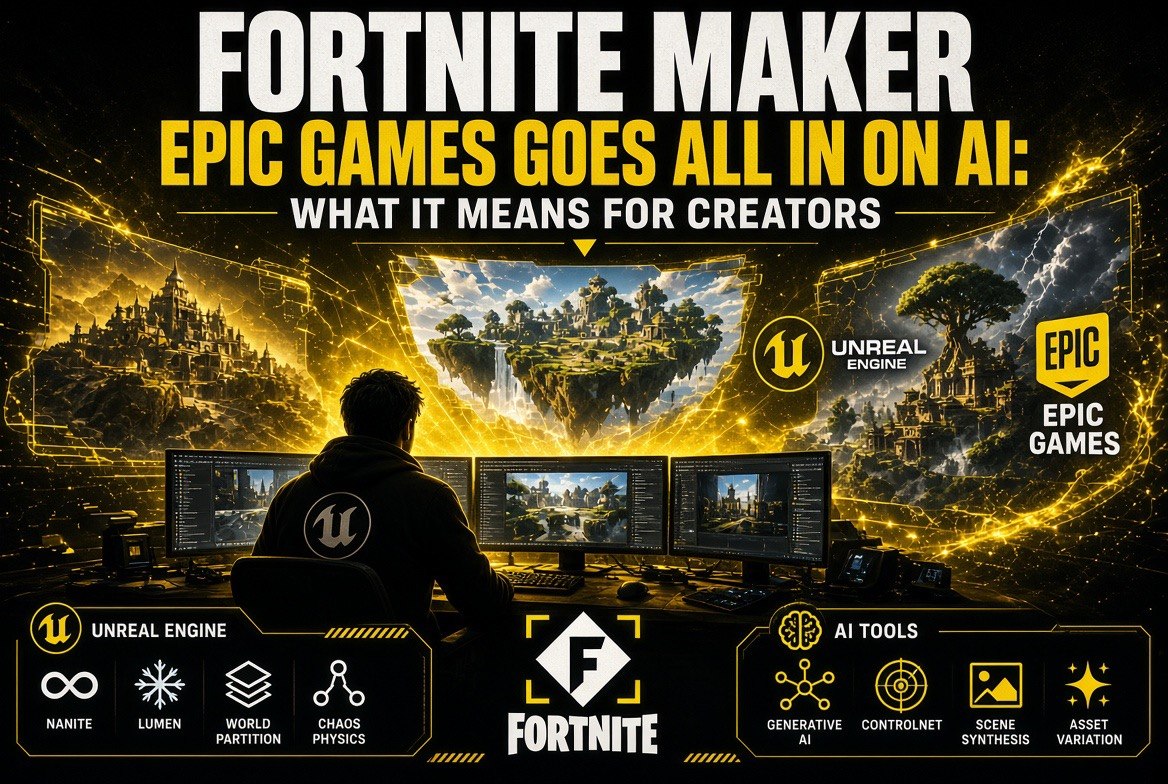
⚡ Expert Summary: Epic Games confirmed in October 2026 that it is rebuilding how it makes games around AI — with CEO Tim Sweeney saying the company wants “maximum AI acceleration” and that the goal is better games, not fewer people. That is a signal every creator working in video, games, and interactive media should read carefully. Epic owns Unreal Engine, Fortnite, and the tools a huge share of the visual production industry already runs on. When the platform vendor bets on AI, it changes the tooling, the pricing, and the job market you work inside.
When Epic Games moves, the visual production industry moves with it. Unreal Engine is not a niche tool — it is the renderer behind virtual production stages, TV backgrounds, architectural visualization, and a long list of the game industry””s biggest releases. Fortnite is a platform with its own creator economy. So when the company running both says it is rebuilding around AI, that is not a corporate press release. That is a vendor telling its entire ecosystem what the next hardware and software investment looks like.
The announcement landed in October 2026, and the details matter more than the headline.
[PENDING INLINE IMAGE 1]
What Epic Actually Announced
The core of the news is a pivot in how Epic builds. Tim Sweeney””s framing was specific: the company is moving to what it describes as maximum AI acceleration, with a stated goal of making better games rather than replacing people. That second half is doing a lot of work, and it is worth reading as a statement about how the company expects the change to be received rather than as a guarantee about headcount.
What we can say with confidence from the reporting is the direction: Epic is integrating AI deeply into its production process and its product line, and it is doing so loudly, without the hedging language most studios use. Sweeney has been publicly enthusiastic about AI for years, so this is less a change of heart than a change of scale.
For anyone whose income depends on visual production, the operative question is not whether Epic is right. It is what happens to your toolchain when the biggest vendor in your space rebuilds around AI.
Why Epic””s Bet Matters to Video Creators Specifically
The game industry and the video production industry have been quietly merging for years, and Unreal Engine is the seam. Virtual production stages — the LED-wall setups that replaced green screens on major film and TV productions — run on Unreal. Real-time rendering in advertising and music video work runs on Unreal. The same technology that renders a video game level renders a background plate.
That means an Epic pivot is not just a gaming story. It is a story about the rendering layer underneath a meaningful slice of professional video work.
| Production Area | How Epic””s AI Direction Touches It | What to Watch |
|---|---|---|
| Virtual production | Unreal-based LED stages gain AI-assisted asset and environment generation. | Whether pre-built AI environments reduce the art department hours per shoot. |
| Motion graphics and spots | Real-time rendering plus AI generation compresses iteration cycles. | Whether clients expect three concepts where they used to pay for one. |
| Game and interactive content | Epic””s own pipeline becomes the reference for what a studio can ship with a smaller team. | Whether asset and environment artist roles shift toward supervision and review. |
| Creator economy on Fortnite | In-platform creation tools get AI assistance, lowering the entry bar. | Whether the volume of published content rises faster than the payout pool. |
The virtual production row is the one to sit with. When environment generation becomes cheap and fast, the labor that used to go into building a set piece or a background plate does not disappear — it moves. It moves toward direction, selection, and quality control, which are jobs that require taste and judgment rather than software operation. That is a real shift in what a creator is paid for.
The Unreal Engine Question Every Studio Is Now Asking
Epic controls the engine. That gives it two levers that matter enormously to anyone building a business on top of its tools: what the software can do, and what it costs.
The historical pattern with Unreal has been generous. Epic made the engine free to use for most developers and took a royalty on success, which is how it became the default for so many independent studios. If Epic””s AI push makes AI-assisted asset creation a core engine feature rather than a separate subscription, that is a significant gift to small studios — capability that used to require a budget suddenly ships in the box.
The opposite is also thinkable. If AI features become a tier above the free engine, or if the company adjusts its royalty terms as AI makes production cheaper, the economics of building on Unreal change for everyone downstream. Studios should be reading the licensing terms of whatever ships next, not just the announcement.
This is the practical takeaway for a small production operation: the announcement is the headline, but the pricing page is the story.
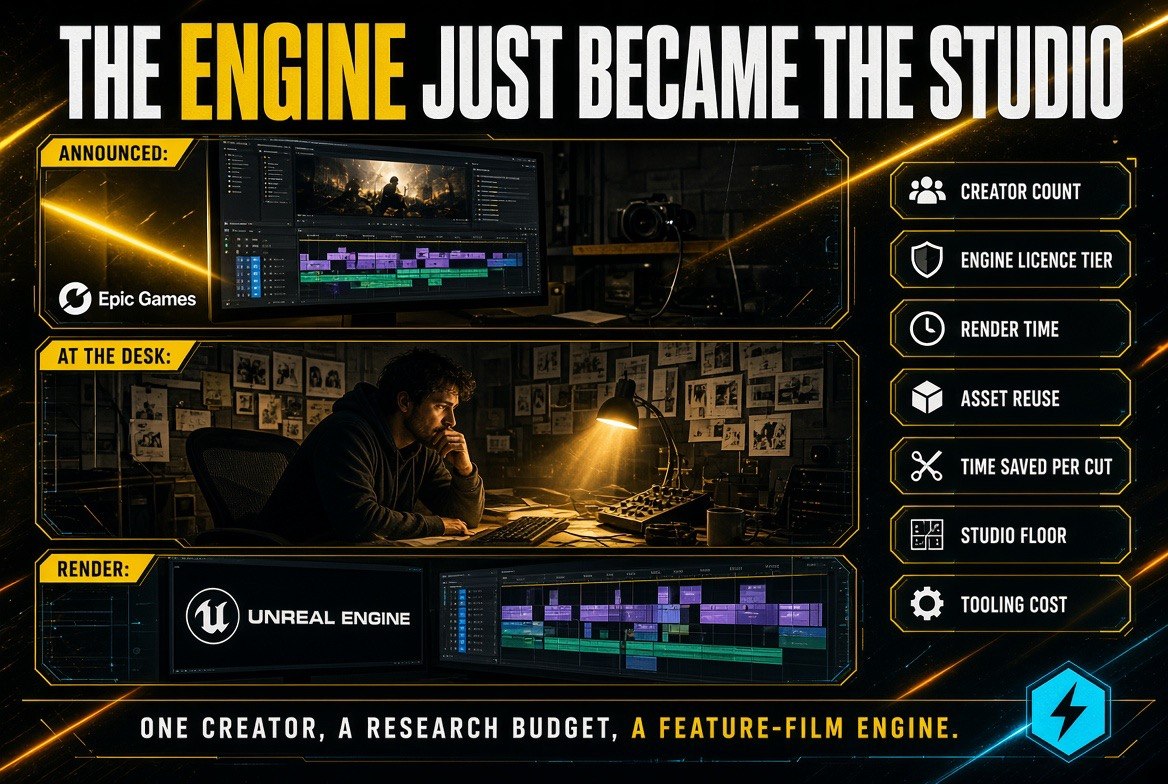
The engine stopped being a licensing line item. At this desk the announcement, the render and the finished cut all happen in the same room — one creator, a research budget, a feature-film engine.
What “Better Games, Not Fewer People” Actually Means
Sweeney””s phrasing is the most quoted part of the announcement, and it deserves an honest reading rather than a cynical one or a credulous one.
What is true: AI in production genuinely can raise output quality. Environment art, texture generation, placeholder asset creation, and iteration speed are areas where the technology is already useful, and a studio that uses it well can produce more polished work with the same team.
What is also true: the phrase “not fewer people” is the kind of assurance every technology transition in history has offered, and it has not always held. The honest version is that the composition of the team changes even when the headcount does not. Fewer people doing the mechanical work, more people doing review, direction, and integration.
For a creator, that is not a reason to panic. It is a reason to be the person who reviews rather than the person who is reviewed. Every AI-assisted pipeline needs someone with enough expertise to catch when the output is wrong, generic, or unusable — and that skill is currently in short supply relative to the demand.
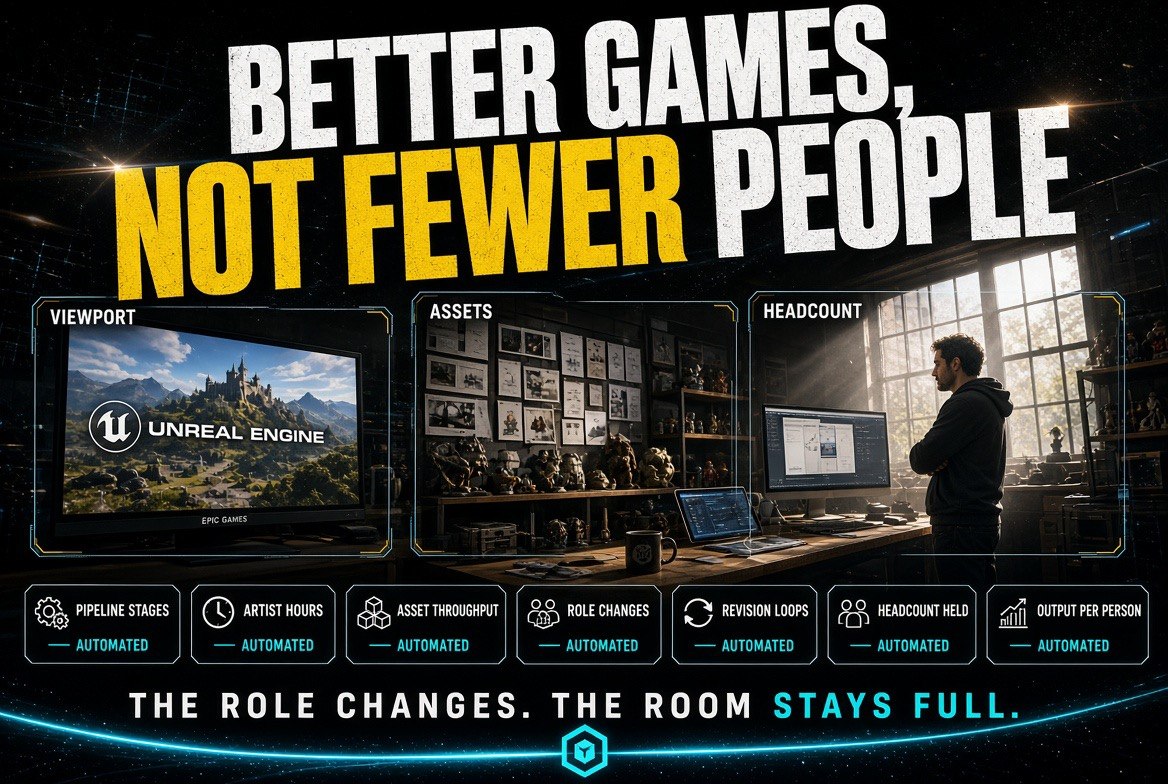
What “better games, not fewer people” has to mean in practice: the pipeline stages get automated, the role shifts up the stack, and the room stays full.
The Bigger Industry Signal
Epic is not the first company to make this move, but it is one of the loudest, and volume matters in a market where most studios have been quietly experimenting while saying nothing publicly. A major platform holder saying it outright changes what is safe to say in the industry.
| Signal | What It Indicates | Practical Implication |
|---|---|---|
| A platform holder says it out loud | Quiet AI use becomes publicly defensible across the industry. | Expect more studios to disclose rather than hide their pipelines. |
| Tooling shifts at the engine level | AI capability arrives inside the software you already pay for. | Fewer standalone AI subscriptions needed for basic tasks. |
| The creator bar drops | More people can publish competent-looking work. | Differentiation moves to taste, story, and reliability. |
| Roles recompose | Mechanical production hours fall; review and direction hours rise. | Position yourself on the judgment side of the pipeline now. |
The third row is where most working creators will feel this first. When competent-looking output gets cheaper, the market floods with it, and the thing that used to be your edge — being able to produce a clean render at all — stops being an edge. What remains valuable is knowing what is good, being able to direct a machine toward it, and being able to catch the ways it goes subtly wrong.
Why the Engine Vendor Owns the Conversation
There is a structural reason Epic””s move carries more weight than a studio announcement, and it is worth spelling out because it explains the whole dynamic.
Most AI video and game production tools live above Epic in the stack. They generate assets, textures, animations, and environments that then get imported into a real-time engine to be lit, composed, and rendered. Epic owns that destination layer. When the destination layer starts generating its own content natively, every tool above it has to justify why a creator would leave the engine to get something the engine now does.
That pressure is already visible in the wider market. Standalone AI generation tools have been proliferating for two years, and the strongest of them survive by being dramatically better at one narrow task, not by being a general-purpose stop along the pipeline. If Epic ships competent in-engine generation, the middle tier of the tool market — the tools that are merely convenient rather than exceptional — gets squeezed hardest.
For a working creator, that is a buying decision, not an abstract market observation. Every subscription you carry should be answering a question: does this do something my engine cannot? If the honest answer is no, that subscription is on borrowed time.
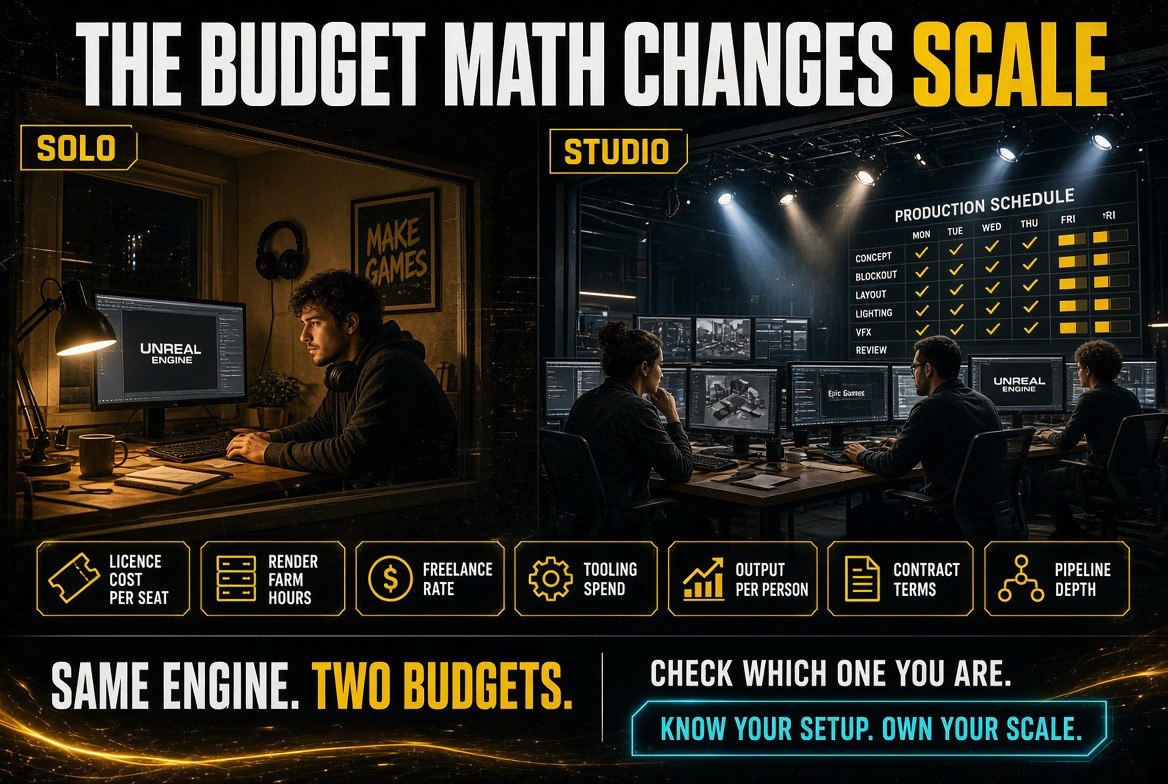
Same engine, two budgets. The line items that scale are the ones nobody quotes in the announcement — licence cost per seat, render farm hours, freelance rate, pipeline depth.
The Budget Math Creators Should Actually Run
Announcements about AI capability tend to get read as creative news. They are usually budget news, and the budget math is where the real change lands for a small operation.
Consider what a typical small production spends to build an environment for a shoot. There is concept work, asset sourcing or creation, lighting setup, and iteration time with the client. In a virtual production workflow, that pre-build can run into weeks of billable hours before anyone steps onto the stage. If AI-assisted environment generation compresses that to days, the line item does not vanish — it changes shape, and whoever is quoting the job has to decide whether to pass the savings through or bank them.
Most creators will be pressured to pass them through, because the client will eventually learn what the new baseline cost is. That is the same pattern that hit photography, then stock footage, then basic motion graphics. The timeline for the compression is unpredictable, but the direction is not.
The strategic response is not to refuse the tools. It is to be the person quoting the more ambitious job. When the floor cost of a competent render drops, the constraint on a project stops being budget and starts being imagination, and clients with real ambition will pay for someone who can execute a bigger idea rather than a cheaper version of the same one.
What Creators Should Do With This
Four moves, in order of leverage.
1. Learn the AI features in the tools you already own
You do not need a new workflow. Unreal, your NLE, your compositor, and your asset pipeline all have AI features shipping into them right now. Most working creators use a fraction of what they pay for. Spending a week learning what is already on your machine is the cheapest capability upgrade available to you.
2. Reposition toward judgment work
The tasks that are hardest to automate are the ones that require knowing what is wrong. Reviewing AI output for quality, brand fit, and continuity is a skill that is currently scarce and will remain scarce for a while. If you can be the person who reliably catches problems, you are on the durable side of this transition.
3. Watch the licensing terms, not just the announcements
If your business runs on a platform, the pricing and licensing terms matter more than the feature list. Read what changes when the next engine version ships. A capability that arrives free is a raise; the same capability arriving as a paid tier is a cost increase, and both have happened to creators before.
4. Do not rebuild your entire workflow on the announcement
Announcements precede products, and products take time to be good. Epic saying it is going all in on AI does not mean the AI features are mature today. Adopt as the tools prove themselves, not as the press releases arrive.
5. Track who is actually hiring for what
If you want an early read on where this goes, watch job postings rather than press releases. Studios that are genuinely rebuilding around AI start hiring differently before they talk about it publicly — pipeline engineers, technical artists with AI specialization, and roles that blend supervision with tool development. Those postings show up months before the strategic announcement, and they are a far better indicator of what the industry believes than any keynote.
For a freelancer or a small studio, that is also a map. The skills appearing in postings today are the skills that will be assumed baseline in two years, and the ones that are conspicuously absent are the ones being quietly automated.
Frequently Asked Questions
What did Epic Games actually announce about AI?
Epic Games confirmed in October 2026 that it is restructuring its production around AI, with CEO Tim Sweeney describing the direction as maximum AI acceleration and stating that the goal is better games rather than fewer people. The company plans to integrate AI deeply into both its development process and its product line.
Does this affect video creators who do not work in games?
Yes, if they use Unreal Engine or work in virtual production. Unreal is the rendering backbone of LED-stage virtual production, real-time advertising work, and a range of visual effects work outside gaming. A shift at Epic ripples into those workflows.
Will Unreal Engine AI features cost extra?
That is the open question. Epic has historically made Unreal free for most developers with a royalty on success. Whether AI capabilities ship as core engine features or as a paid tier is the detail studios should watch when the next version ships.
Should creators be worried about losing work?
The honest answer is that roles recompose rather than vanish outright. Mechanical production hours tend to fall while review, direction, and quality control hours rise. Being the person with the judgment to catch bad AI output is the more durable position.
What is the fastest thing a creator can do right now?
Learn the AI features already shipping in the software you own. Most creative professionals use a small fraction of the capabilities they are already paying for, and that gap is the cheapest available upgrade.
Is Epic the first major studio to do this?
No, but it is one of the most publicly direct. Epic is a major platform holder, and saying it loudly changes what other studios feel safe admitting about their own AI pipelines.

About Barak Schurr
Barak Schurr built and sold a major ticketing platform, ran global nightlife operations at Eventbrite, and now spends his time figuring out which AI video tools actually move the needle for creators and businesses — and which ones are just noise. No hype. No fluff. Just what works.
Email: [email protected]
More AI Resources for Your Business