Kling vs Google Veo vs Runway vs Seedance: Which AI Video Model Wins on Cost in 2026?
Get The Faceless YouTube Blueprint — Free
The exact AI tool stack and workflow used to build a faceless YouTube channel from zero.
Kling vs Google Veo vs Runway vs Seedance: Which AI Video Model Wins on Cost in 2026?
⚡ Expert Summary: On list price, Kling 3.0 is the cheapest of the four at $0.084 per second, then Seedance 2.0 at $0.10, Runway Gen-4.5 at $0.12, and Google Veo 3.1 at $0.15. But the model with the lowest sticker price is not always the cheapest video you actually ship — Veo 3.1 Fast is the only one of the four with a stable, fully documented enterprise API and no separate 4K tax, while Seedance’s 4K tier runs roughly 5x its base rate ($0.50/second, about $2.50 for a single 5-second clip) and Runway’s own docs list two different per-second credit rates that don’t reconcile. For a solo creator shipping 40 clips a month, the gap between the cheapest and priciest routing is about $21 a month. Get the routing wrong at volume and it becomes real money.
If you are paying for an AI video tool in 2026, you are almost certainly overpaying for it — not because the tool is bad, but because the pricing models are deliberately hard to compare.
Four models dominate the conversation among US creators right now: Kling 3.0 from Kuaishou, Google Veo 3.1, Runway Gen-4.5, and ByteDance’s Seedance line. Every one of them advertises a headline number, and every one of those headline numbers is measured differently. Some sell credits. Some sell per-second API units. Some sell monthly subscriptions with daily caps. Seedance charges one rate at 1080p and roughly five times that at 4K. Runway’s own documentation lists two different per-second credit rates in two different places.
That is the actual problem. It is not “which model is best” — there is a comparison article for that on every site on the internet, and they mostly argue about benchmark scores you will never notice in a finished edit. The problem is which model costs least for your workflow, at your volume, at your resolution. Those are three different answers.
This breakdown does the math the vendor pages avoid. All figures below are the publicly listed rates as of September 2026, sourced from vendor API documentation and the live Artificial Analysis leaderboards, and every place the vendors disagree with themselves is called out rather than smoothed over.
The Four Contenders and What Each One Actually Charges For
Before the math, the definitions — because “cost” means something different on each platform.
Kling 3.0 (Kuaishou, announced February 4, 2026) sells two things. Developers buy per-second API units starting at $0.084/sec for standard generation with no video input, rising to $0.168/sec for the Pro tier that accepts video input. Consumers buy credits: a free tier of 66 credits per day, Pro at $29.99/month for 3,000 credits, and Ultra at $59.99/month for 8,000 credits plus native 4K at 60fps. Kling also has a separate Avatar mode supporting up to 5 minutes of continuous talking-head generation — an outlier capability none of the other three match, and it is billed through a different path than standard text-to-video.
Google Veo 3.1 (released October 14, 2025) is the most conservative of the four on both capability and pricing. It charges $0.15/sec on the Fast tier and $0.40/sec on Standard, with no credit system and no consumer subscription tier to reconcile — you pay through the Gemini API or Vertex AI. Its model ID (veo-3.1-generate-preview) remains live and documented, which matters more than it sounds. Base clips run 4, 6, or 8 seconds, and scene extension can chain up to 20 clips past 140 seconds, though chained sequences drop to 720p.
Runway Gen-4.5 (December 1, 2025) is the most confusing pricing page of the four. Runway’s own documentation lists per-second rates as both 12 credits/second and 25 credits/second — roughly $0.12 to $0.25 depending on which page you read, likely tier- or resolution-dependent, with no single official figure that reconciles both. On the consumer side it sells subscription capacity rather than output. The API accepts 2–10 second generations, with 5s and 10s as the practical presets.
Seedance (ByteDance) is two products sharing one name, and that is where most creators get burned. Seedance 2.0 launched February 2026 with a native 4K tier added June 23, 2026 — true 3840×2160 at 10-bit, not an upscale. Base pricing runs roughly $0.10–$0.15/sec, but the 4K tier costs about 5x the base rate, so a single 5-second 4K clip lands near $2.50. Seedance 2.5 began rolling out July 16, 2026 with up to 30-second native clips and local region editing, but is not in full global release and has no finalized public pricing.
The Per-Second Rate Table
Here is what each model charges, side by side.
| Model | List Price / Second | Max Clip Length | Native Audio | Artificial Analysis Elo |
|---|---|---|---|---|
| Kling 3.0 | $0.084 (std) – $0.168 (Pro) | 15s (Avatar mode: 5 min) | Yes | 1,110 |
| Google Veo 3.1 | $0.15 (Fast) – $0.40 (Standard) | 8s base (chainable past 140s) | Yes | 1,094 |
| Runway Gen-4.5 | $0.12 – $0.25 (docs disagree) | 10s | Yes | Delisted from live board |
| Seedance 2.0 | $0.10–$0.15 base / ~$0.50 at 4K | 15s (10s at 4K tier) | Yes | 1,225 |
| Cheapest on list price | Kling 3.0 at $0.084/s | Seedance 2.5 at 30s | All four: Yes | Seedance 2.0 at 1,225 |
Artificial Analysis Elo figures are from the live Text-to-Video Arena as checked September 2026. Runway Gen-4.5 does not currently appear on that board — see the leaderboard section below.
What 40 Clips a Month Actually Costs
Per-second rates are abstract. Volume makes them concrete. Take a solo creator shipping 40 finished 8-second clips a month — roughly two videos a week plus variants, which is a normal output for a serious faceless channel or a small agency doing client social work.
| Scenario | Cost per 8s Clip | 40 Clips / Month | What You Give Up |
|---|---|---|---|
| Kling 3.0 standard | $0.67 | $26.88 | No video input (Pro tier costs double) |
| Seedance 2.0 base | $0.80 | $32.00 | standalone API rollout has faced delays |
| Seedance 2.0 at 4K | $4.00 | $160.00 | 4K tier caps clips at 10s, not 15s |
| Runway Gen-4.5 (at $0.12) | $0.96 | $38.40 | Rate may actually be $0.25 — docs conflict |
| Veo 3.1 Fast | $1.20 | $48.00 | Nothing — documented API, no hidden tier tax |
| Veo 3.1 Standard | $3.20 | $128.00 | Highest rate of the four on list price |
| The spread | $0.67 vs $4.00 | $26.88 vs $160.00 | 6x between cheapest and dearest |
Look at what happened there. Between Kling’s standard tier and Seedance’s 4K tier, the same 40 clips cost $26.88 or $160 — a 6x difference driven entirely by which resolution tier you left selected. And the gap between the two most commonly used developer options, Kling standard and Veo Fast, is $21.12 a month. That is one subscription you did not need to buy.
Two numbers in that table deserve a warning label. Runway’s 40-clip figure assumes $0.12/sec, but Runway’s own documentation lists $0.25/sec elsewhere, which would push the monthly total to $80. And Seedance’s 4K number is not a rounding error — the 4K tier is priced at roughly five times the base tier, so the resolution toggle is effectively a budget toggle.
Why the Cheapest Sticker Price Is Usually the Wrong Choice
If Kling 3.0 is cheapest on list price at $0.084/sec, why would anyone route anything else?
Because cost per second is not cost per usable second, and the four models diverge hard once you account for what you have to do after generation.
Retakes are the hidden line item. A model that nails prompt adherence on the first pass costs one generation. A model that needs three attempts costs three times its rate. In practice most creators do not regenerate at the raw rate either — they regenerate the same shot with a different seed, different camera language, or a slightly rewritten prompt, and every one of those is a full-price generation. A model priced 20% higher that lands the shot on attempt one beats a cheaper model that takes four passes. This is the single biggest reason cheap-per-second routing underperforms expectations.
Resolution tiers are where budgets actually die. Seedance 2.0 supports native 4K — genuinely impressive, and one of only a few models that does. But the 4K tier runs about 5x the base price and caps clips at roughly 10 seconds versus 15 seconds at base resolution. If your deliverable is 1080p YouTube or social, you are paying five times the rate for pixels your platform is going to re-compress anyway.
Documentation quality is a real cost. Veo 3.1 sits at a higher per-second rate than Kling, and for a lot of creators it still wins on total cost — because it is the model with a stable, documented, enterprise-ready API path through the Gemini API and Vertex AI, and because its base clip resolution is not gated behind a separate pricing tier. When you are building a pipeline, an undocumented rate that changes between two pages of the same vendor’s documentation is a liability. Runway’s conflicting 12-vs-25 credits/second listing is the clearest example: you cannot plan a production budget against a range that wide.
Max clip length quietly determines how many generations you need. A 30-second native clip is not just a bigger clip — it is one generation instead of four. Seedance 2.5’s 30-second single-pass output and its local region editing (change a character’s hair color without regenerating the full clip) attack cost from a completely different direction than per-second rates do. Neither is available yet in full global release, and pricing is unfinalized, but the direction is unmistakable: the industry is competing on generations-per-deliverable, not dollars-per-second.
Where Each Model Actually Wins on Cost
Kling 3.0 wins on raw per-second economics and long-form avatar work. At $0.084/sec standard it is the cheapest entry point of the four, and its separate Avatar mode supports up to 5 minutes of continuous talking-head generation — vastly longer than the 8–15 second ceiling on general video generation across all four models. If you produce presenter-led or spokesperson content, Kling is in a category of one, and the credit-based consumer plans ($29.99/month Pro, $59.99/month Ultra including 4K/60fps) are predictable. The catch: consumer pricing is credit-based, which makes cross-plan cost comparison genuinely harder, and the Pro API tier with video input doubles the rate.
Veo 3.1 wins on predictability and enterprise billing. $0.15/sec Fast with no credit system, no tiered resolution surcharge, a live documented model ID, and deployment through Google Cloud infrastructure your finance team already understands. It is not the cheapest per second and it does not pretend to be. For a US agency billing clients for production time, an invoice you can forecast is worth more than a rate that is 20% lower but impossible to project.
Runway Gen-4.5 wins on character consistency, not on cost. Runway remains widely regarded as best-in-class at maintaining character appearance across scenes without fine-tuning, using reference images to lock a subject through lighting and camera changes. That has real production value — it is the difference between a series that looks coherent and a series that looks assembled from four different tools. But pair that strength with a pricing page that lists two different rates for the same thing, an API that accepts 2–10 second generations, and a model that no longer appears on the live Artificial Analysis leaderboard it built its launch marketing around, and you have a tool you choose for a specific job rather than a default.
Seedance wins on output quality per clip — at a price. Seedance 2.0 holds #2 on the Artificial Analysis Text-to-Video board at 1,225 Elo, with independent testers rating its raw frame quality above even the top-ranked model. Native 4K at 10-bit color, up to 9 reference images plus 3 video clips and 3 audio files as multimodal input, and 15-second clips at base resolution. The catch is structural: the 4K tier’s ~5x price multiplier, and an availability picture where the model is broadly accessible through ByteDance’s consumer apps (Dreamina, Jimeng) but the standalone API rollout has reportedly faced rights-clearance and compliance delays. If you need it inside a production pipeline rather than a web app, verify availability before you commit.
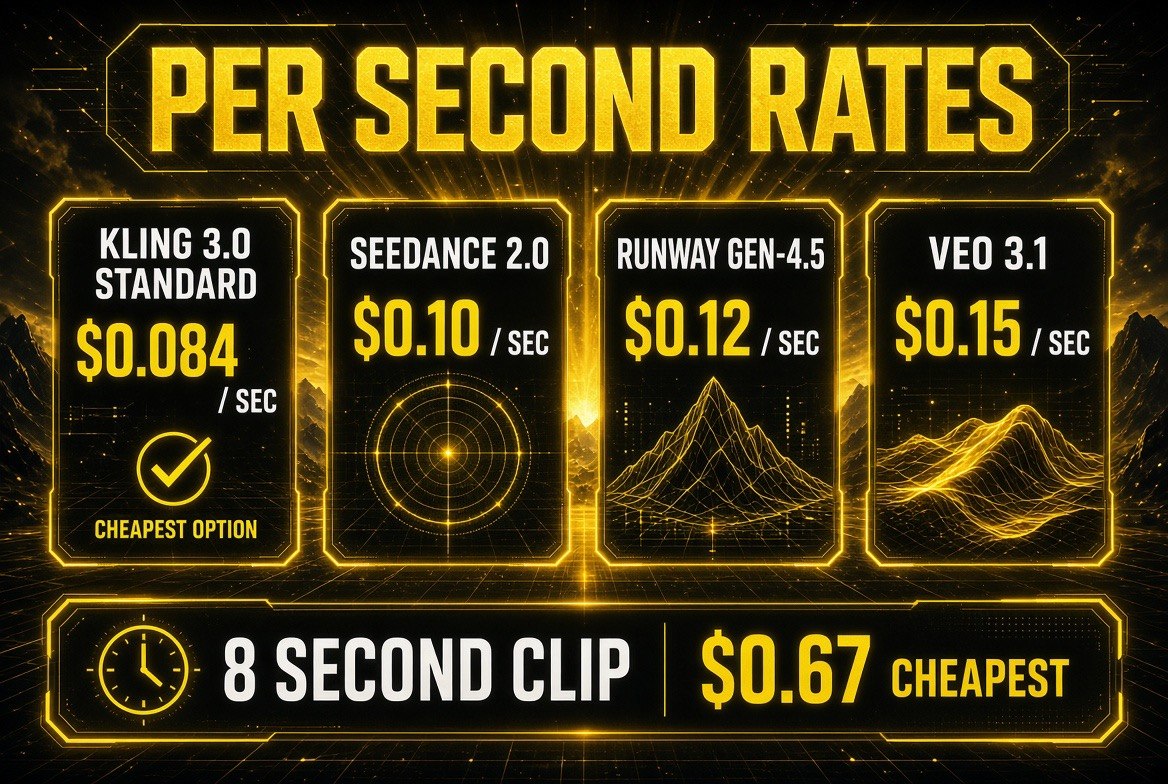
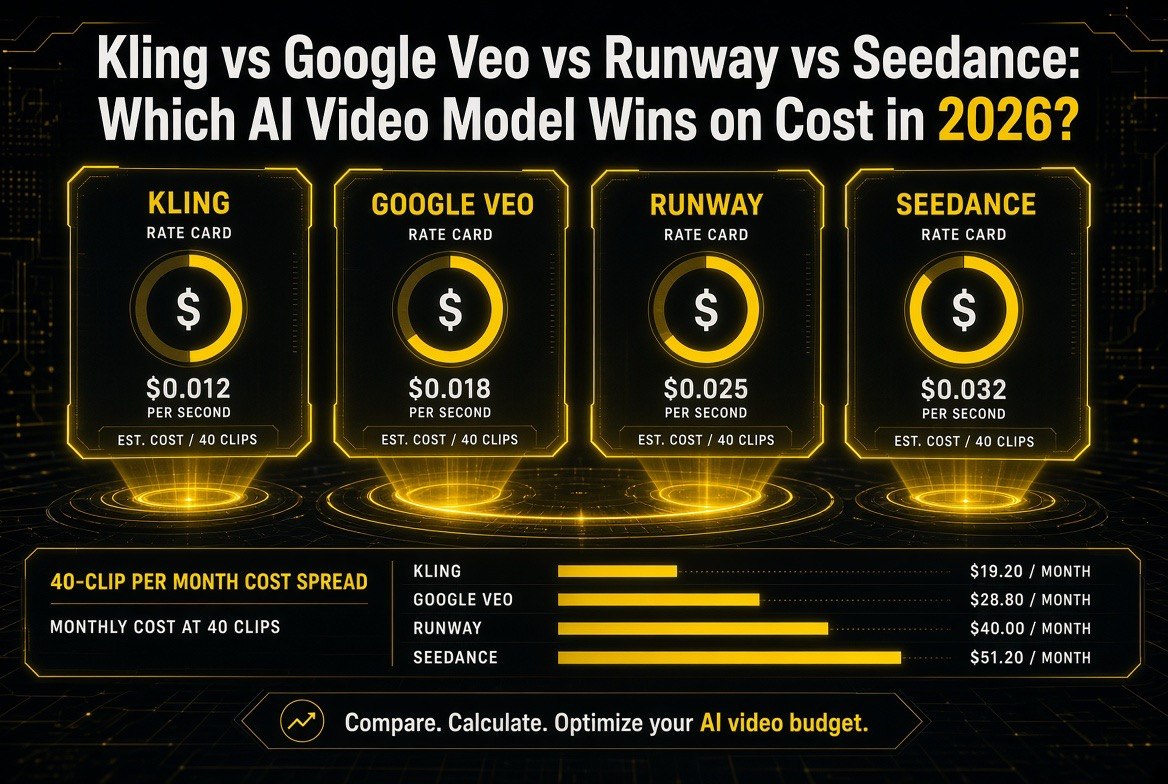
The per-second rate card is where the cost gap starts: Kling 3.0 is 79% cheaper per second than Veo 3.1 on list price. An 8-second clip runs $0.67 at the Kling rate.
The Leaderboard Caveat Nobody Mentions
Benchmark scores and cost decisions get tangled together in most comparison articles, so it is worth separating them cleanly.
As of September 2026, the live Artificial Analysis Text-to-Video Arena ranks Gemini Omni Flash first at 1,240 Elo, Seedance 2.0 second at 1,225, Wan 2.7 at 1,160, Kling 3.0 at 1,110, and Veo 3.1 at 1,094. Runway Gen-4.5 does not appear on that board at all.
Runway’s launch-day claim of 1,247 Elo was real at the time it was made, and it is the origin of the widely repeated line that Gen-4.5 is “the #1 AI video model.” It is no longer verifiable as current. Treat that 1,247 figure as a historical self-reported number from December 2025, not a live ranking — and if benchmark position is specifically what you are paying for, note that the two models currently holding the top two spots are Seedance 2.0 and Gemini Omni Flash, not Runway.
Here is the practical translation: a 1,094 vs 1,225 Elo gap is not the same thing as a 40% cost gap. Benchmark differences of that size are usually invisible to viewers of a finished, compressed, 1080p vertical clip. Cost differences of that size are extremely visible on a monthly card statement. Weight them accordingly.
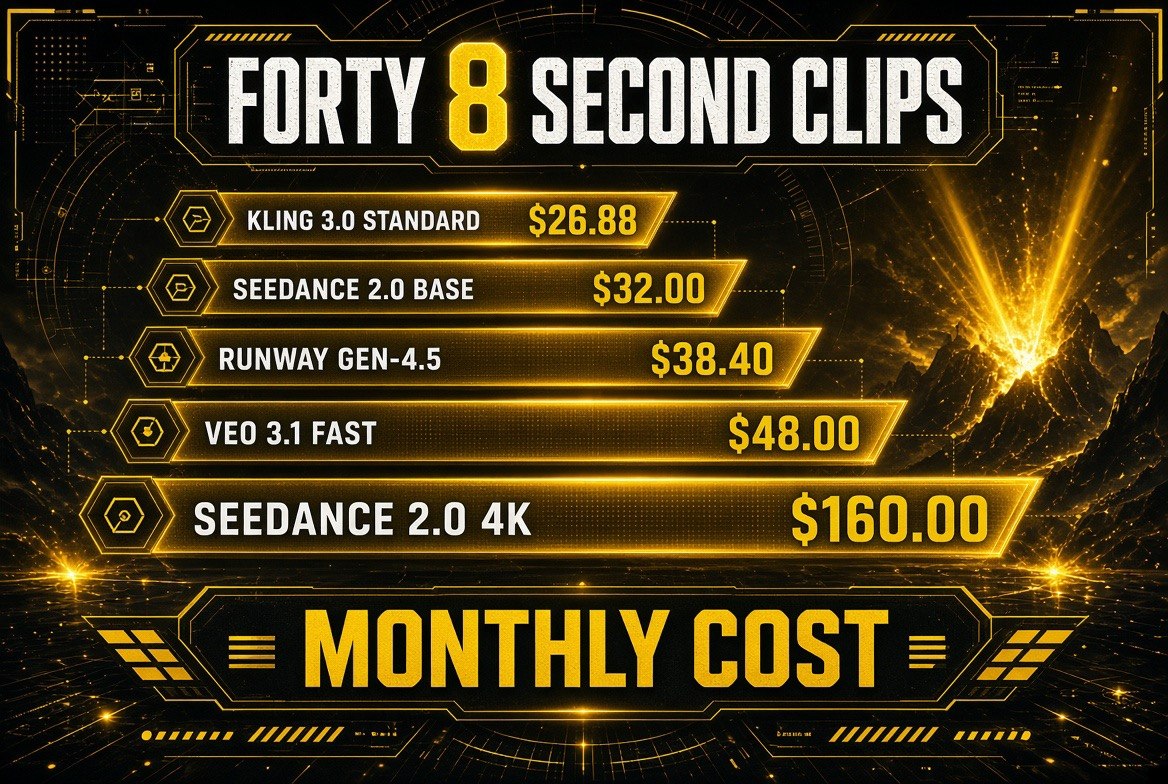
Same forty clips, same month: $26.88 at the Kling 3.0 standard rate versus $160.00 for Seedance 2.0 at 4K. The sticker price you pick is the single biggest cost decision on this page.
The Routing Strategy That Actually Saves Money
The creators getting this right in 2026 are not picking one model. They are routing by shot type, and the routing logic is boringly consistent.
Use Kling 3.0 standard for the bulk of B-roll, talking-head inserts, and anything short and simple where the cheapest adequate rate wins. Use Veo 3.1 Fast for hero shots and anything client-facing where predictability and a documented pipeline matter more than shaving cents. Use Runway Gen-4.5 specifically for multi-scene sequences with recurring characters, where its reference-image consistency saves you more in retakes than its rate costs. Reserve the expensive tiers — Seedance 4K, Veo Standard — for deliverables where the final output genuinely has to survive a big screen, and for nothing else.
The volume math on that approach is straightforward. If 60% of your clips route through Kling standard, 25% through Veo Fast, and 15% through Seedance at base resolution, your blended rate lands meaningfully below routing everything through one premium model — while the shots that actually need quality still get it. The alternative, defaulting to whichever model you signed up for first, is how creators end up on a $105/month plan posting six videos a month.
One more lever worth checking: several aggregator platforms now sell access to multiple models under one subscription rather than per-model billing. Whether that beats direct API access depends entirely on your volume — at 40 clips a month, direct per-second billing usually wins; at 400 clips a month inside a single subscription cap, the aggregator math can invert. Run your own numbers against your own output, because the vendor pages will not do it for you.
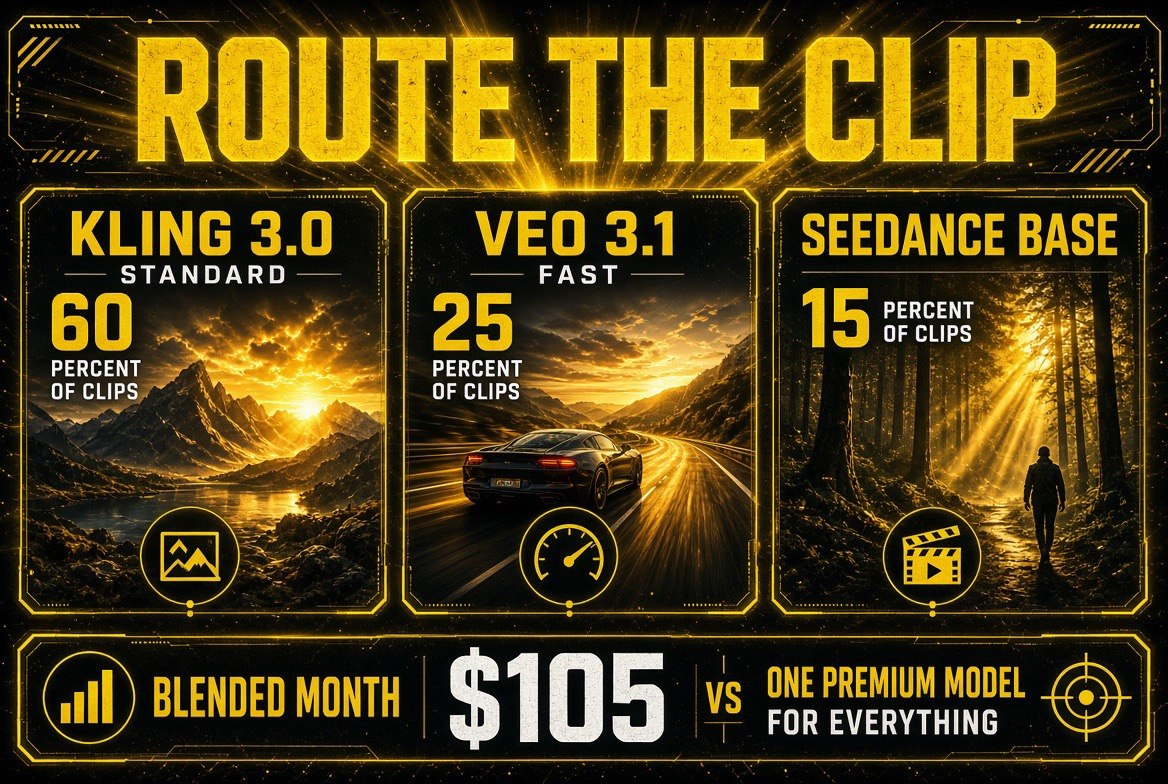
Routing by shot type is the whole savings mechanism: 60% of clips on Kling 3.0 standard, 25% on Veo 3.1 Fast, 15% on Seedance base. That blend lands near $105 a month, and the shots that need quality still get it.
Frequently Asked Questions
Which AI video model is cheapest in 2026?
On list price, Kling 3.0 is cheapest at $0.084 per second for standard generation, followed by Seedance 2.0 at roughly $0.10–$0.15 per second at base resolution, Runway Gen-4.5 at $0.12–$0.25, and Google Veo 3.1 at $0.15–$0.40. The list price ranking and the real-world cost ranking diverge once you account for retakes, resolution tiers, and clip length limits, which is why the cheapest rate is not automatically the cheapest workflow.
Is Veo more expensive than Runway?
It depends on the tier. Veo 3.1 Fast lists at $0.15 per second while Runway Gen-4.5 lists at $0.12 per second in one of Runway’s own documents and $0.25 per second in another. Veo 3.1 Standard at $0.40 per second is the most expensive rate of the four models compared here, but Veo is also the only one of the four with a fully documented, stable enterprise API and no separate resolution surcharge.
Why does Seedance cost so much at 4K?
Seedance 2.0’s 4K tier is native 3840×2160 at 10-bit color rather than an upscale, and ByteDance prices it at roughly five times the base tier — about $0.50 per second, so a single 5-second 4K clip runs near $2.50. The 4K tier also caps clips at about 10 seconds instead of the 15 seconds available at base resolution. If your destination platform compresses to 1080p anyway, that premium rarely survives to the viewer.
Should I still pay for Runway if it is not on the leaderboard?
Benchmark position is not the only reason to use a model. Runway Gen-4.5 remains widely regarded as best-in-class for cross-scene character consistency, which has real production value in any series with recurring subjects. The honest framing is that Runway is now a specialist tool rather than a default choice: use it where character locking matters, and do not pay its rate for simple B-roll that cheaper models handle fine.
What is the single biggest cost mistake creators make?
Leaving a premium resolution tier selected as the default. The difference between Seedance 2.0 base and Seedance 2.0 at 4K is a 6x swing on the same 40 clips — $32 versus $160 per month at 8-second durations. The second biggest mistake is routing everything through one subscription instead of sending simple clips to the cheapest adequate model.
Does clip length affect cost more than per-second rate?
For some workflows, yes. A 30-second native clip such as Seedance 2.5 generates in a single pass, replacing three or four shorter generations at the same per-second rate — so a model with a higher rate and longer native clips can cost less per finished deliverable. Always compare cost per deliverable, not cost per second, before switching tools.

About Barak Schurr
Barak Schurr is a serial entrepreneur who built and exited a major ticketing platform before turning his attention to AI and content. He runs three AI-focused research sites and writes about the tools, workflows, and strategies that let solo creators build real channels — without a crew, a studio, or a Hollywood budget.
Email: [email protected]
More AI Video Resources