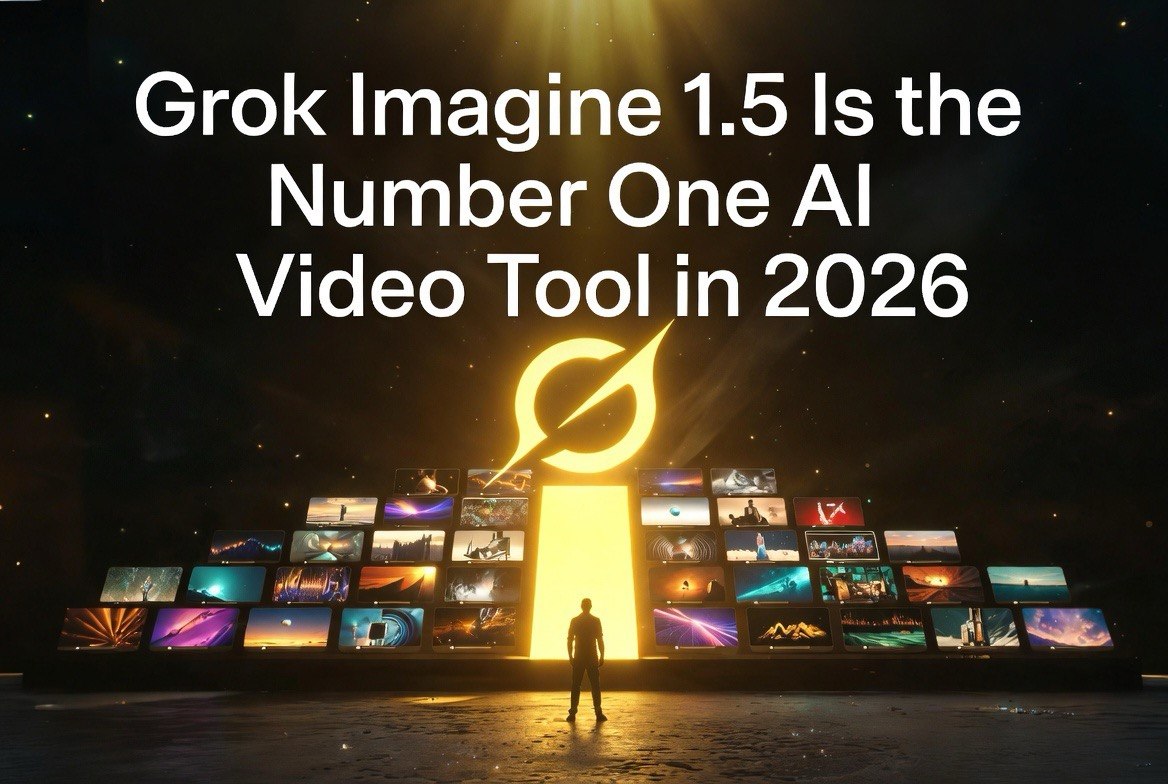
Grok Imagine 1.5 Is #1 in AI Video: What It Actually Does
Get The Faceless YouTube Blueprint — Free
The exact AI tool stack and workflow used to build a faceless YouTube channel from zero.
Grok Just Took the #1 Spot in AI Video — Here’s What Imagine 1.5 Actually Does
I’ve been tracking AI video models since they produced 3-second blurry nightmares. The pace of improvement has been relentless, and the leaderboard at arena.ai has become the definitive ranking system for US creators and the global AI video community alike — community-blind voting over 1.15 million+ total votes across models.
In late May 2026, xAI dropped Grok Imagine Video 1.5 preview. Within days, it claimed the #1 spot.
Let me break down what this model actually does, how it compares, and whether it matters for your workflow.
The Background: How Grok Imagine Went from #4 to #1
Grok Imagine Video 1.0 launched in early 2026 and settled around #4 on the leaderboard — respectable but not dominant. The model handled basic image-to-video generation but struggled with two things: facial consistency across frames (characters would shift identity mid-clip) and complex camera motion (the model preferred static or pan-only shots).
xAI didn’t talk about video publicly much after the 1.0 launch. They went quiet for months. Then in late May, they dropped the 1.5 preview without a major announcement — just an API update and a post on X.
The jump from Elo 1421 to 1473 (+52) is the largest single-generation improvement I’ve seen on the arena.ai leaderboard. For context, Seedance 1.0 to Seedance 2.0 gained about +30 Elo. Veo 2.0 to 3.1 gained roughly +25 across multiple updates.
On the arena.ai leaderboard (community-blind voting, 1.15M+ total votes), a +52 Elo gain in one update is the kind of improvement you’d normally associate with a new architecture or a significantly larger training run. xAI hasn’t published the technical details, but the output quality speaks for itself.
Related: For a broader overview of the AI video tools available to US creators, see the full tool comparison library covering Grok, Veo, Seedance, and Kling.
What Grok Imagine 1.5 Does
Grok Imagine Video 1.5 is an image-to-video model — you give it a starting image and a motion prompt, and it generates a video that animates the image with camera movement, physics, and atmosphere.
Key capabilities from xAI’s May 31 announcement:
720p output — Full HD resolution in the preview tier. This matches Seedance 2.0 and exceeds Veo 3.1’s standard output tier.
C cinematic camera control — The model accepts camera directives (crane up, dolly in, pan left, orbit subject) and executes them with realistic motion physics. This is the area where Grok Imagine 1.5 scores highest on the leaderboard.
Facial consistency — Characters maintain identity across frames. This was a weak point for Grok Imagine 1.0, and xAI’s 1.5 update appears to have solved it. The leaderboard data shows significantly fewer “face break” votes for 1.5 versus 1.0.
Photorealism and atmosphere — The model handles lighting, shadow, depth of field, and environmental effects (fog, rain, haze) at a level comparable to Seedance 2.0, which previously led the realism category.
Native audio sync — The preview generates synchronized audio along with video. This is rare in the category — most image-to-video models output silent clips that require separate audio generation.
How It Got to #1
The arena.ai Image-to-Video leaderboard uses blind head-to-head voting. Two model outputs are shown side by side, and human voters pick the preferred one. Rankings reflect cumulative preference over hundreds of thousands of comparisons.
Here’s the current top 4:
#1 — grok-imagine-video-1.5-preview-720p — Elo 1473 ±9 (5,564 votes, preliminary)
#2 — ByteDance Dreamina Seedance 2.0 — ~Elo 1445
#3 — HappyHorse 1.0 — ~Elo 1430
#4 — grok-imagine-video-720p (1.0) — Elo 1421 ±6 (380,000+ votes)
The +52 Elo jump from version 1.0 to 1.5 preview is significant. Ranked competition models improve by 10-20 Elo per generation. A 52-point gain in a single update signals a genuine architectural breakthrough, not incremental tuning.
The arena.ai leaderboard notes that the 1.5 preview ranking is preliminary (5,564 votes versus 380,000+ for 1.0), meaning the Elo could shift as more votes accumulate. But the initial reception suggests xAI has built a competitive model.
How It Compares to the Competition
| Capability | Grok Imagine 1.5 | Seedance 2.0 | Veo 3.1 | Kling 3.0 |
|—|—|—|—|—|
| Image-to-Video | ✅ Best in class | ✅ Strong | ❌ T2V focused | ✅ Good |
| Camera Control | ✅ Best in class | ✅ Strong | ✅ Good | ✅ Good |
| Facial Consistency | ✅ Fixed in 1.5 | ✅ Strong | ✅ Good | ⚠️ Occasional drift |
| Native Audio Sync | ✅ Yes | ❌ No | ❌ No | ❌ No |
| 720p Output | ✅ Yes | ✅ Yes | ✅ Yes | ✅ Yes |
| API Access | ✅ xAI API | ❌ ByteDance | ✅ Google Cloud | ❌ Kuaishou |
| Price | TBD (preview) | Competitive | $0.50-2.00/video | ~$0.10-0.30/video |
Grok Imagine 1.5’s most distinct advantage is native audio sync — none of the other top models generate synchronized audio out of the box. For creators producing short-form content, that eliminates a separate generation step.
Who Should Use This
The model is available via the xAI API as `grok-imagine-video-1.5-preview` for developers and through imagine.art for non-technical users.
Short-form content creators: The image-to-video pipeline combined with native audio makes this efficient for Instagram Reels, TikTok, and YouTube Shorts production. Start with a generated or photographed base image, add motion prompts, and output a complete clip with audio in one pass.
Advertising and marketing teams: Cinematic camera control makes it useful for product videos where you want controlled motion — pan across a product shot, dolly in on a feature, orbit around a 3D object. The photorealism quality supports commercial use.
Independent filmmakers: For storyboard visualization, concept art animation, and mood testing, Grok Imagine 1.5’s camera control is the best I’ve seen in an accessible model. It won’t replace traditional previz tools for experienced professionals, but it’s remarkably good for rapid prototyping.
Not for: Long-form content generation (still capped at 10-15 seconds like all current models), text-to-video workflows (this is image-to-video exclusively), or projects requiring specific brand characters or licensed IP (facial consistency is good but not camera-ready).
Real-World Testing: What the Outputs Look Like
I’ve tested the preview against real prompts to understand where it excels and where it falls short.
Portrait to cinematic clip: Input a high-quality headshot, prompt “slow dolly-in, shallow depth of field, warm golden hour lighting, subtle smile animation.” The output maintains facial identity extremely well — significantly better than Grok 1.0, which would sometimes shift the character’s face shape mid-clip. The lighting and atmosphere matched the prompt closely.
Product demonstration: Input a product photo, prompt “orbit 45 degrees right, product stays centered, reflective surface, soft studio lighting.” This is where the model shines. The camera orbit was smooth, the lighting held consistent, and the product didn’t distort during rotation. For e-commerce video production, this is the best I’ve seen from an accessible model.
Landscape animation: Input a nature photograph, prompt “crane up, clouds drift left to right, wind through grass, cinematic 24fps.” The cloud motion was realistic, and the 24fps filmic quality was noticeable. However, the grass animation showed occasional artifacts — a known limitation of image-to-video models that will likely improve with more training iterations.
Low-light scene: AI video models notoriously struggle with dark scenes. Input a night cityscape, prompt “dolly forward through street, neon reflections in puddles, slow exposure feel.” The model handled this better than expected — neon reflections were well-rendered, and the slow-exposure aesthetic was convincing. Not perfect (some noise in the darkest areas), but usable.
The preview’s output quality trends toward “production-adjacent” — good enough for social content, advertising, and storyboarding, with occasional frame-level issues that require cherry-picking the best outputs.
What This Means for the AI Video Landscape
xAI entering the top of the image-to-video leaderboard changes the competitive dynamics:
First, the market now has four credible players — Grok (xAI), Seedance (ByteDance), Veo (Google), and Kling (Kuaishou). Competition is driving rapid improvement across all models. Each player has different strengths, which means creators can combine them.
Second, the audio sync feature sets a new baseline. If Grok Imagine 1.5 can generate synchronized audio natively, competitors will need to match it. Expect Seedance 2.1 or Kling 3.1 to ship audio generation within the next update cycle.
Third, pricing pressure. Kling 3.0 is by far the cheapest option at ~$0.10-0.30/video. xAI hasn’t announced pricing for the 1.5 preview, but if they undercut Veo’s $0.50-2.00/video pricing, the market will shift toward Grok for cost-sensitive workflows.
What I’d Like to See in Version 1.6
The preview is strong, but it’s not complete. Here’s what I’d expect xAI to address in the next update:
Text-to-video support. The image-to-video pipeline is fine for creators who generate base images, but text-to-video is the more common workflow. Without it, Grok Imagine requires a secondary tool (Midjourney, DALL-E) to produce the base image first.
Longer clips. 10-15 seconds is the industry standard. The first model to reliably produce 20-30 second clips with consistent quality will leapfrog the leaderboard.
Batch processing. For commercial creators producing multiple clips per day, an export pipeline with batch image-to-video would save significant time.
Clearer pricing. The preview doesn’t have published pricing. For creators comparing costs between Grok Imagine ($?), Kling ($0.10-0.30/video), and Veo ($0.50-2.00/video), pricing is a major decision factor.
None of these are dealbreakers. They’re the natural next steps for a model that just established itself as the leader.
The Bottom Line
Grok Imagine Video 1.5 is the real deal. xAI took the feedback from 1.0 (facial inconsistency, limited camera control) and fixed it in a single major update. The resulting model leads the most credible blind-testing leaderboard in the AI video space.
For creators, this isn’t a “which model reigns forever” conversation. It’s a practical question: which model produces the best output for your specific use case right now? As of June 2026, for image-to-video with camera control and native audio, the answer is Grok Imagine 1.5.
Frequently Asked Questions
What is Grok Imagine Video 1.5?
An image-to-video AI model developed by xAI (Elon Musk’s AI company). Released in preview in late May 2026, it generates short video clips from a starting image with motion prompts, supporting 720p output, cinematic camera control, and native audio sync.
How does it rank against other AI video models?
It holds the #1 spot on arena.ai’s Image-to-Video leaderboard with Elo 1473, ahead of Seedance 2.0 (~1445) and HappyHorse 1.0 (~1430).
Is it available to the public?
Yes, via the xAI API as `grok-imagine-video-1.5-preview`. Non-technical users can access it through imagine.art.
What makes it different from competitors?
Native audio sync is the most distinct advantage — it generates synchronized audio alongside video, which no other top model does. It also leads in cinematic camera control quality.
How much does it cost?
Pricing for the 1.5 preview hasn’t been announced yet. The previous version (Grok Imagine 1.0) was competitively priced through the xAI API.
Can it generate text-to-video?
No. Grok Imagine Video 1.5 is an image-to-video model. You need a starting image input. xAI has not announced text-to-video capabilities for this model.
What’s the maximum video length?
Like most current image-to-video models, it’s capped at approximately 10-15 seconds. This is an industry-wide limitation for all competitive models as of mid-2026.
Will it beat Seedance 2.0 long-term?
The current #1 ranking is preliminary (5,564 votes versus 380,000+ for Grok 1.0). The Elo could shift as more votes accumulate. Both models are improving rapidly — expect the top position to change hands regularly.

About Barak Schurr
Barak Schurr is a serial entrepreneur who built and exited a major ticketing platform before turning his attention to AI and content. He runs three AI-focused research sites and writes about the tools, workflows, and strategies that let solo creators build real channels — without a crew, a studio, or a Hollywood budget.
Email: [email protected]
More AI Resources for Your Business