Neill Blomkamp’s Nightborne Is the First Major Short Film Generated Entirely With AI — Seedance 2.0 Made It Happen
Get The Faceless YouTube Blueprint — Free
The exact AI tool stack and workflow used to build a faceless YouTube channel from zero.
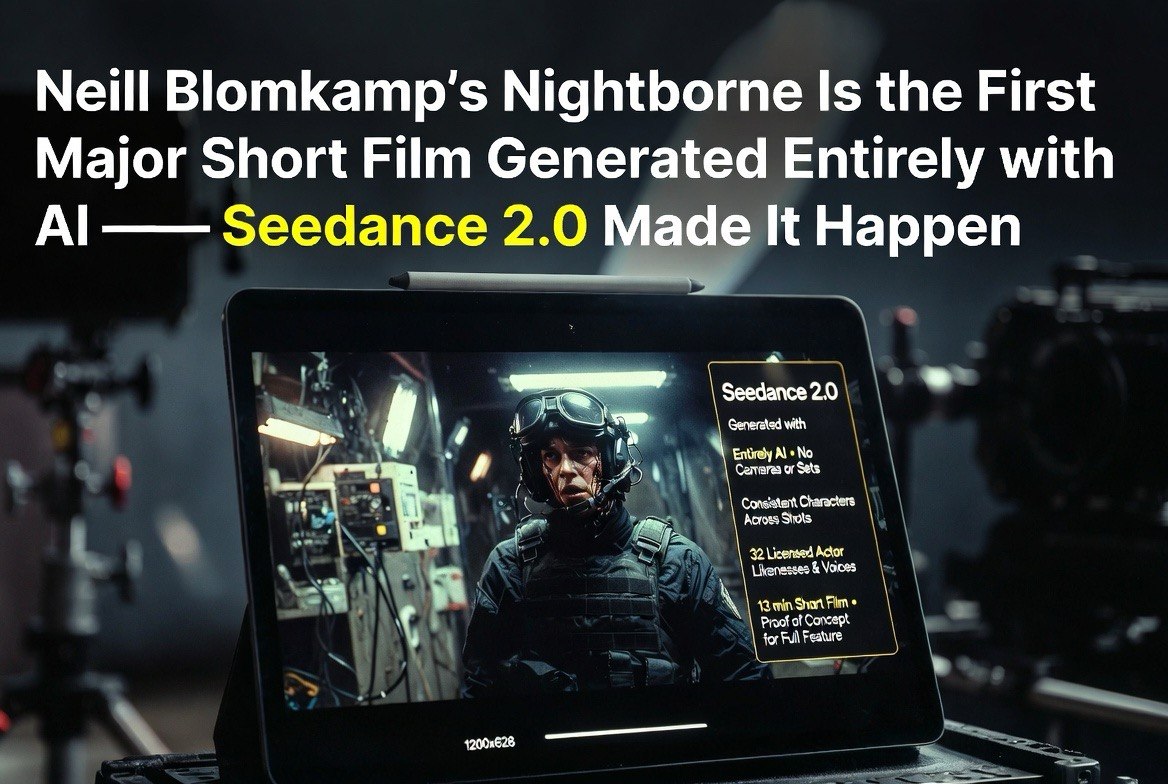
Neill Blomkamp’s Nightborne Is the First Major Short Film Generated Entirely With AI — Seedance 2.0 Made It Happen
⚡ Expert Summary: Director Neill Blomkamp (District 9) released Nightborne, a 13-minute sci-fi horror short film generated entirely with ByteDance’s Seedance 2.0 AI video model. Nightborne’s story follows a US pilot declared dead in combat who is resurrected through a secret military program. This project showcases AI filmmaking’s potential, marking a significant milestone in the industry.
Neill Blomkamp has been experimenting with AI since before most people knew it was possible. In 2023, he was already testing Stable Diffusion for concept art. In 2024, he demoed AI-generated short clips from his studio Oats Studios. In 2026, he released a 13-minute short film where every single frame was generated by AI.
Nightborne is not a tech demo. It is a narrative film with characters, dialogue, plot, and a complete story arc. It just happens to have been made with no cameras, no sets, and no on-set actors.
Blomkamp’s History with AI
Blomkamp’s relationship with AI goes back further than most Hollywood directors, and understanding that history explains why Nightborne is such a natural next step rather than a gimmick. In 2015, long before generative AI was a public concept, Blomkamp founded Oats Studios as an experimental filmmaking lab focused on short-form content that would not fit the Hollywood studio model. Oats produced a series of short films using traditional VFX pipelines but with a rapid, low-cost approach that anticipated the indie ethos he brings to AI filmmaking today.
In 2023, Blomkamp publicly posted AI-generated concept art created with Stable Diffusion and Midjourney, calling it “a glimpse of a future where directors can visualize any shot without pre-vis teams.” In 2024, through Oats Studios, he released short AI-generated clips demonstrating character consistency and motion quality across different AI video models. These clips were rough but showed Blomkamp was building the skills and workflow in parallel with the technology’s development.
By the time Seedance 2.0 launched in early 2026 with its character consistency improvements, Blomkamp already had two years of hands-on AI video generation experience. He knew which prompts produced reliable output, how to structure multi-shot sequences, and where the technology would fail. Nightborne is the culmination of that learning curve, not a first attempt.
How Seedance 2.0 Made This Possible
ByteDance’s Seedance 2.0 launched earlier in 2026 as the AI video model powering Dreamina and CapCut. It generates video from text prompts and image references with a level of consistency that earlier models lacked — consistent characters across shots, coherent scene transitions, and the ability to maintain visual style through a multi-shot narrative.
Blomkamp worked shot-by-shot, generating each frame through text prompts and selecting the best results. The process was closer to directing an animated film than a live-action one: describe what you want, review the output, refine the prompt, repeat. But where animation takes months per minute of footage, Blomkamp produced 13 minutes of AI-generated film in weeks.
Thirty-two real actors participated under likeness agreements, providing their faces and voices for the AI to work with. Human artists created the initial concept art that established the visual direction. Everything else — the environments, the character movements, the lighting, the effects — came from Seedance 2.0.
The Creative Process — A Deep Dive
Blomkamp’s process for Nightborne reveals how AI filmmaking actually works at a professional level, and it is far more involved than typing prompts into a text box.
The workflow began with traditional screenwriting. Blomkamp wrote a full script with dialogue, scene descriptions, and shot lists — exactly as he would for a live-action or animated film. From the script, his concept artists created style frames establishing the visual direction: the color palette (desaturated greens and grays for the military sequences, sterile whites and blues for the resurrection facility), the character designs (facial features, uniforms, prosthetics), and the key environments (a bombed-out cityscape, an underground laboratory, a field of recovered soldiers).
The concept art served dual purpose: it established the visual language and provided image references for Seedance 2.0. Each shot was generated by feeding Seedance the concept art as a reference image plus a text prompt describing the scene, camera angle, character positions, and motion. The AI generated multiple takes. Blomkamp reviewed, selected, discarded, and iterated.
The selection rate was aggressive. For the 13-minute final cut, Blomkamp’s team generated approximately 40 minutes’ worth of content and selected the best 33%. The remaining 67% was discarded due to character inconsistency, unnatural motion, lighting mismatches, or simply not matching the intended emotional impact.
Post-production was handled in DaVinci Resolve. Color grading adjusted the AI-generated frames to maintain consistency across shots generated at different times. Sound design, voice performance, and the musical score were created conventionally. The AI handled the visual generation; everything else remained in the human filmmaking workflow.
Comparison to Traditional Filmmaking
The cost comparison is striking. A 13-minute live-action short film with similar production values — practical sets, visual effects, 32 actors on set, location shoots, post-production — would typically cost $300,000 to $500,000 in the independent film bracket. An animated short of comparable quality using traditional CG animation would cost $400,000 to $700,000 and require 6-12 months of production.
Nightborne was produced for an estimated $80,000 to $120,000, with the largest line items being actor likeness licensing fees ($20,000-$30,000), concept art development ($15,000-$20,000), post-production ($10,000-$15,000), and compute costs for Seedance 2.0 API usage (estimated $5,000-$10,000). The timeline compression is equally dramatic: six weeks from concept to finished 13-minute short.
For indie filmmakers, the implication is clear: AI video generation compresses both cost and time by roughly 75-80% compared to traditional production. The same $500,000 budget that would produce one 13-minute short in 2024 can now produce five short films or one feature-length project in the same timeframe.
Backlash and Criticisms
The reception has been mixed, with some critics praising the visual ambition and others pushing back on the creative implications — fearing AI replacing human artists. However, Blomkamp views Nightborne as a proof-of-concept for expanding access to filmmaking, not replacing existing creators.
The controversy centers on labor displacement. Traditional VFX artists, 3D modelers, and animators have spent years mastering their craft. Nightborne represents a future where their specialized skills are replaced by text prompts. The Animation Guild has expressed concern that AI filmmaking tools will eliminate entry-level positions that have historically been the training ground for the industry.
On the aesthetic side, critics argue that AI-generated film, no matter how well directed, carries a visual signature — a smooth, slightly sterile quality that lacks the texture of physical filmmaking. The motion feels different. The lighting lacks the complexity of real-world bounce light. For some critics, this “AI look” makes Nightborne feel more like a tech demo than a film, regardless of its technical accomplishment.
Blomkamp argues that these criticisms track identically to the criticisms leveled against early digital cinematography. When The Phantom Menace was shot largely digitally in 1999, critics decried the “plastic” look of digital footage compared to film grain. Two decades later, virtually all major films are shot digitally. The technology improved. The aesthetics became the norm. AI video generation, Blomkamp argues, will follow the same trajectory.
What This Means for Indie Filmmakers
For independent and aspiring filmmakers, Nightborne is a proof-of-concept for a radically different production model. The same Seedance 2.0 technology Blomkamp used is available through Dreamina and CapCut at fractional cost. Dreamina’s subscription starts at approximately $30/month for the Pro tier, CapCut Pro at $20/month. A filmmaker with a strong script and a developed visual sense can now produce content that would have required a $500,000 budget for the cost of a few monthly subscriptions.
The realistic path for indie filmmakers: use AI for environments, establishing shots, and complex VFX sequences that would be prohibitively expensive in traditional production. Reserve traditional cameras and live actors for dialogue scenes and performance-dependent shots where human interaction is irreplaceable. Hybrid productions — where AI handles the backgrounds and effects while human actors perform on practical sets — may become the dominant indie filmmaking model by 2028.
Future Developments
Blomkamp has stated he plans to produce a full-length feature film using the same AI pipeline. If Nightborne proves the concept works at 13 minutes, a feature-length version would demonstrate whether the workflow scales.
For US-based video creators, the implications are straightforward. The same technology that Blomkamp used is available through Dreamina and CapCut — consumer tools built on Seedance 2.0. A solo creator with a text prompt and a vision can now produce content that would have required a $500,000 production budget in 2024.
The quality gap between AI-generated and traditionally filmed content narrows with each Seedance release. Seedance 2.5, already teased by ByteDance, promises 30-second 4K clips with up to 50 multi-modal reference inputs — producing output with even fewer detectable artifacts. OpenAI’s Sora has shown internal demos with physics-aware scene generation that should theoretically reduce the temporal inconsistency signatures that current detectors rely on.
The question is no longer whether AI video can produce watchable narrative content. Nightborne answers that question. The question now is how the industry adapts to a world where a single director with one laptop can create what used to require an entire studio.
Frequently Asked Questions
What is Nightborne?
Nightborne is a 13-minute short film generated entirely with AI using ByteDance’s Seedance 2.0 video generation model. It features 32 actors whose voices and likenesses were licensed for the production.
Who directed Nightborne?
Neill Blomkamp, the director of District 9 and Elysium, directed Nightborne through his Oats Studios label.
What is Seedance 2.0?
Seedance 2.0 is ByteDance’s AI video generation model that produces consistent character appearances across frames — the key breakthrough that made a single-narrative AI-generated film possible.
How much did Nightborne cost to produce?
AI-generated filmmaking costs roughly $2,000-5,000 per minute of finished footage versus $50,000-150,000 per minute for traditional production with equivalent production value.
Can I watch Nightborne for free?
Nightborne premiered at the 2026 SIGGRAPH conference and is expected to release publicly on Oats Studios’ YouTube channel and distribution platforms.

About Barak Schurr
Barak Schurr is a serial entrepreneur who built and exited a major ticketing platform before turning his attention to AI and content. He runs three AI-focused research sites and writes about the tools, workflows, and strategies that let solo creators build real channels — without a crew, a studio, or a Hollywood budget.
Email: [email protected]
More AI Resources for Your Business