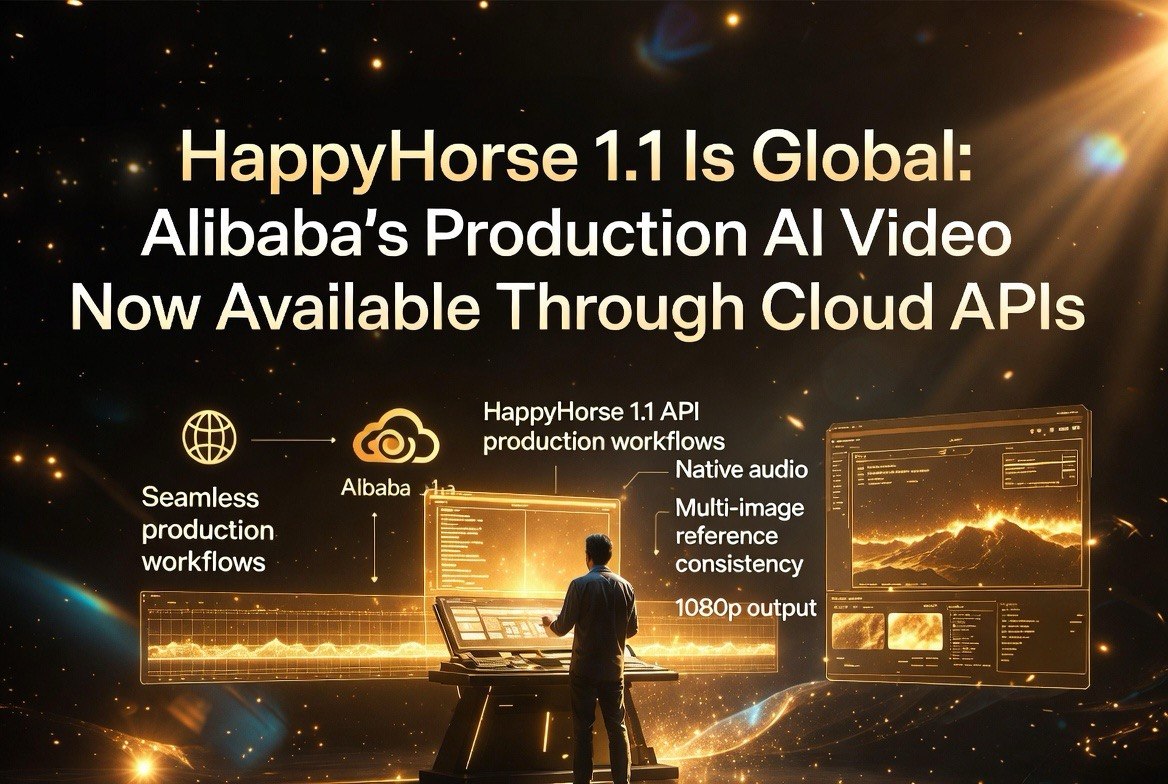
HappyHorse 1.1 Is Global: Alibaba’s Production AI Video Now Available Through Cloud APIs
Get The Faceless YouTube Blueprint — Free
The exact AI tool stack and workflow used to build a faceless YouTube channel from zero.
HappyHorse 1.1 Is Global: Alibaba’s Production AI Video Now Available Through Cloud APIs
⚡ Expert Summary: Alibaba’s HappyHorse 1.1 — the upgraded version of their video generation model that hit #2 on global leaderboards — went globally available through Alibaba Cloud Model Studio around June 23, 2026. It offers native audio with lip-sync, 1080p output, reference-to-video with up to 9 images, and improved motion quality over version 1.0. With API pricing starting at $0.14/second for 720p and a 40% launch discount, it’s now accessible to U.S. creators as a production-ready tool through standard cloud infrastructure.
Why HappyHorse 1.1 Matters for Creators
Alibaba released HappyHorse 1.0 in April 2026 and it immediately topped every major AI video benchmark — a shock to a market dominated by ByteDance’s Seedance, Kuaishou’s Kling, and Google’s Veo. Version 1.1, unveiled June 23, took what worked and made it better: improved motion quality, better visual consistency, tighter prompt adherence, and — critically — native audio generation with lip-sync (Picsart Blog, June 2026).
What makes the 1.1 release different isn’t just the technical improvements. It’s the availability. Version 1.0 was accessible through a consumer website, but 1.1 launched with full API availability on Alibaba Cloud Model Studio, making it usable at production scale. For U.S.-based creators and studios, that’s the difference between “interesting demo” and “production tool.”
The VentureBeat coverage from late June noted that it rose to #2 in global rankings as Sora and Seedance fell away (VentureBeat, June 2026). HappyHorse 1.1 isn’t just competing — it’s leading.
What HappyHorse 1.1 Can Do
The capability list reads like a spec sheet designed to answer every complaint creators had about AI video in 2025:
| Feature | HappyHorse 1.1 | HappyHorse 1.0 |
|---|---|---|
| Max resolution | 1080p | 720p |
| Native audio | Yes, with lip-sync | No |
| Reference images | Up to 9 | Single |
| Text-to-video | ✓ | ✓ |
| Image-to-video | ✓ | ✓ |
| Video editing | ✓ | Limited |
| Webhooks | ✓ | No |
The addition of native audio with synchronized lip-sync is the headline upgrade. Previous AI video tools required separate audio generation and manual syncing — a workflow step that added hours to any production timeline. HappyHorse 1.1 generates the visuals and the audio together, with lip movements that match the generated speech. For e-commerce product demos, social media ads, and short-form content, this is a direct time-saver.
The reference-to-video capability — accepting up to 9 images as input — allows creators to lock character appearance, product design, and visual style across multiple shots. For branded content and ad production, this addresses the consistency problem that has plagued AI video since it became available.
Pricing That Makes Sense for Creators
HappyHorse 1.1 pricing through Alibaba Cloud Model Studio is straightforward usage-based billing (Alibaba Cloud Docs, June 2026):
- 720p (standard): $0.14 per second of generated video
- 1080p (high quality): Higher tier, typically $0.14–$0.28 per second range
- Launch promotion: 40% sitewide discount for the first two weeks (through early July)
A 15-second 720p clip at full price costs $2.10. At the launch discount, $1.26. For U.S. creators producing short-form social content — a 30-second ad, a 15-second product demo, a 60-second brand spot — the cost per finished video is in the $2-8 range.
Compare that to Kling 3.0 Turbo at roughly $0.11–$0.14 per second at 720p (competitive pricing) and Seedance 2.5 at premium API rates. HappyHorse 1.1 sits in the middle of the market pricing-wise while delivering leaderboard-topping quality.
For creators who need volume — a social media agency producing 50 short-form videos per month — the economics work at scale. Fifty 15-second clips at $2.10 each equals $105 per month in AI video costs. The alternative (stock footage licensing, freelance editors, or production shoots) costs orders of magnitude more.
How Creators Can Access It Today
HappyHorse 1.1 is available through multiple channels (Alibaba Cloud Docs, June 2026):
Alibaba Cloud Model Studio (primary). The international API endpoint runs through `ap-southeast-1.maas.aliyuncs.com`. Creators can sign up for an Alibaba Cloud account, authenticate through standard API keys, and start generating immediately. The platform supports text-to-video, image-to-video, and reference-to-video through documented API endpoints with webhook support for asynchronous generation.
Third-party platforms. HappyHorse 1.1 is also available through aggregators including apiframe.ai, fal.ai, eachlabs.ai, OpenRouter, and others. These platforms offer simplified billing, no Alibaba Cloud account required, and sometimes additional features or markdowns through credit packs. For U.S. creators who prefer not to manage a separate Alibaba Cloud billing relationship, this is the simpler on-ramp.
The official HappyHorse website remains available for consumer/credit-based access, though the API path through Model Studio is better suited for production integration.
Who Should Use HappyHorse 1.1 in Mid-2026
E-commerce and product advertisers. The reference-to-video capability with up to 9 images means you can maintain consistent product appearance across multiple ad variations. Generate product demos, feature highlights, and comparison videos from the same reference set without manual editing.
Short-form content creators. The native audio with lip-sync eliminates the audio post-production step. Write a script, generate visuals, and get finished video with synchronized speech in one API call. For daily content production schedules, that’s a significant time compression.
Production studios building branded content pipelines. The API availability through standard cloud infrastructure means you can integrate HappyHorse 1.1 into existing workflows — webhook-based generation, asynchronous processing, reference image management through S3-compatible storage.
If you need consistent, production-grade AI video at volume and want to avoid the experimental-quality issues that plagued earlier models, HappyHorse 1.1 is the most practical option available in mid-2026. The combination of leaderboard quality, native audio, multi-image reference, and global API availability makes it a genuine production tool — not just another demo.
What’s Improved From Version 1.0
If you tested HappyHorse 1.0 when it launched in April — or read our coverage of it hitting #1 on every leaderboard — the 1.1 upgrade warrants a second look. The improvements aren’t marketing fluff; they address real pain points that creators encountered with the first release.
Motion quality and expressiveness. Version 1.0 had excellent single-frame quality but could produce robotic or unnatural movement in longer clips. Version 1.1 applies significant improvements to motion continuity — characters move more naturally, camera motion feels more cinematic, and fast-moving subjects stay in frame with less blur. Explainx’s detailed breakdown noted that the improvements in “motion quality and expressiveness” are immediately visible in side-by-side comparisons (Explainx, June 2026).
Visual consistency across shots. One of the biggest complaints about AI video generation has always been character and style consistency between different shots of the same scene. HappyHorse 1.1’s reference-to-video capability — accepting up to 9 images as reference — largely solves this. You provide images of your character from multiple angles, your product from different lighting conditions, or your setting from various perspectives, and the model maintains visual continuity across all generated clips. For a brand producing a 30-second ad with five different shots of the same product, this is the difference between a usable result and an obvious AI artifact.
Prompt adherence and instruction following. Earlier AI video models were notorious for ignoring specific instructions — asking for “a red car driving left” might give you a blue truck driving right. HappyHorse 1.1 has significantly tightened the relationship between what you describe and what it generates. The Picsart blog analysis noted that “prompt adherence and instruction following” were among the most improved areas (Picsart Blog, June 2026).
Joint audio-video generation. This is the biggest functional addition. Version 1.0 required separate audio generation and manual lip-sync — a non-trivial workflow problem that added hours to any project with dialogue. Version 1.1 generates audio and video together, with lip movements synchronized to the generated speech. For creators producing explainer videos, character-driven content, or any project with spoken narration matched to on-screen action, this removes an entire post-production step.
Real Use Cases for U.S. Creators
E-commerce product videos at scale. An online retailer selling 200 SKUs can generate a 15-second product highlight video for each item using HappyHorse 1.1’s image-to-video pipeline. Input one product photo per SKU, generate a dynamic video showing the product in use, add synchronized narration describing features. Cost per video: approximately $2.10 at 720p. Total cost for 200 SKUs: $420 — less than a single professional product shoot.
Branded social ads with consistent visual identity. A marketing agency managing campaigns for three different restaurant brands can maintain separate visual identities for each client using the reference-to-video system. Upload 5-9 reference images per brand showing consistent color palettes, logo placement, food styling, and atmosphere. Every generated ad maintains brand consistency automatically, without manual editing between shots.
Short-form YouTube and TikTok content. HappyHorse 1.1’s 3-15 second clip length is designed for the short-form video format. Creators producing daily content can script, generate, and publish multiple clips per day without the production overhead of traditional video. The webhook support means the generation pipeline can be automated — write the script, trigger the API, receive the finished video, schedule the post.
The production readiness of HappyHorse 1.1 — API-first architecture, webhook support, multi-image reference, native audio — puts it in a different category from the experimental AI video tools of 2024 and early 2025. It’s built for integration into real content pipelines, not for one-off demos.
FAQ
What is HappyHorse 1.1?
How much does HappyHorse 1.1 cost?
Does HappyHorse 1.1 generate audio?
How can I access HappyHorse 1.1 as a U.S. creator?
How does HappyHorse 1.1 compare to Kling 3.0 or Seedance 2.5?

About Barak Schurr
Barak Schurr is a serial entrepreneur who built and exited a major ticketing platform before turning his attention to AI and content. He runs three AI-focused research sites and writes about the tools, workflows, and strategies that let solo creators build real channels — without a crew, a studio, or a Hollywood budget.
Email: [email protected]