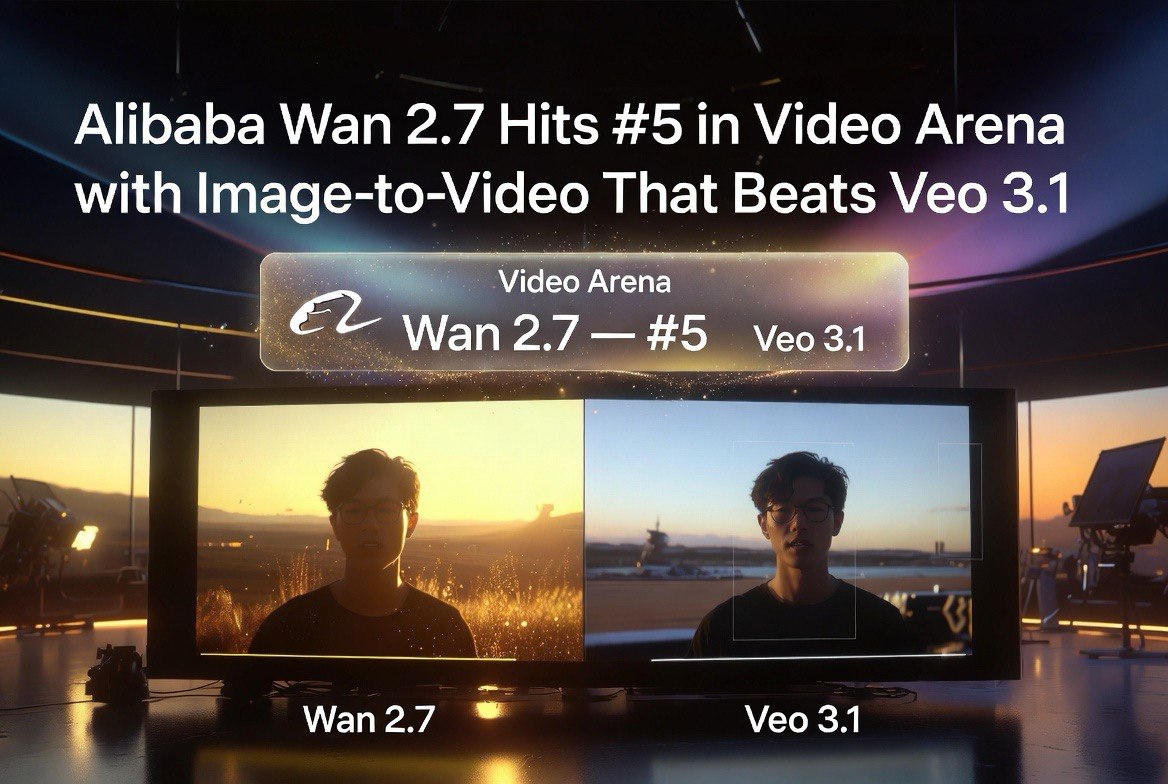
Alibaba Wan 2.7 Hits #5 in Video Arena With Image-to-Video That Beats Veo 3.1
Get The Faceless YouTube Blueprint — Free
The exact AI tool stack and workflow used to build a faceless YouTube channel from zero.
Alibaba Wan 2.7 Hits #5 in Video Arena With Image-to-Video That Beats Veo 3.1
⚡ Expert Summary: Alibaba’s Wan 2.7 has entered the Video Arena image-to-video leaderboard at #5, beating Google Veo 3.1 and Grok Imagine Video in community-ranked head-to-head battles. The model supports first-frame, first-and-last-frame, and 9-grid multi-image input, plus audio-driven animation with lip sync and music response. Native 1080p output, camera movement controls, and diffusion transformer architecture position it as a direct competitor to Runway Gen-4 and Kling 3.0 for creators who need consistent, controllable image-to-video generation.
The AI video generation landscape moves fast enough that leaderboard positions change week to week. But when a model enters the Video Arena at #5 in image-to-video rankings, beating established players like Google Veo 3.1 and Grok Imagine Video in blind user-voted comparisons, it’s worth paying attention to. For creators in the United States who are evaluating the current AI video landscape, Wan 2.7 represents a genuine option from a major global AI lab that’s been somewhat overshadowed by US-headquartered competitors like Runway, Google, and OpenAI.
Alibaba’s Wan 2.7, released in April 2026 as the latest iteration of the Tongyi Lab’s Wan video generation series, has quietly become one of the most capable image-to-video models available. Its Video Arena Elo score of 1,434 in the I2V category puts it ahead of Google’s flagship video model and Grok’s video offering, trailing only the current top tier of dedicated AI video platforms like Kling 3.0 Turbo Pro and Runway Gen-4.
For video creators using AI tools, Wan 2.7 matters because it fills a specific gap that many other models handle poorly: controlled, consistent animation from reference images. It’s not just about generating a video from a prompt — it’s about taking an existing image and animating it in ways that preserve the subject, the composition, and the intent.
What Makes Wan 2.7’s Image-to-Video Different
Most AI video models handle text-to-video well and image-to-video as an afterthought. You upload a reference image, write a prompt, and hope the model preserves your subject while generating motion. The results are often unpredictable — characters change appearance, objects morph, the connection between the source image and the generated video feels loose.
Wan 2.7 takes a different approach by offering multiple image-to-video modes that give creators explicit control over how the reference image is used:
First-frame animation uses your image as the starting frame and generates forward motion from it. This is the standard I2V approach, but Wan 2.7’s diffusion transformer architecture produces notably cleaner motion trajectories with fewer artifacts than earlier versions. The company claims approximately 30% reduction in visual artifacts compared to Wan 2.5, which aligns with the Video Arena results showing significant improvement in user preference.
First-and-last-frame control is where Wan 2.7 differentiates itself most clearly. You provide both a starting frame and an ending frame, and the model generates the transition between them. This gives creators precise control over scene composition — you can plan a shot’s beginning and end and let the AI handle the motion in between. For product showcases, scene transitions, and narrative sequences, this is substantially more useful than standard I2V generation that takes your image in an unpredictable direction.
Audio-driven animation synchronizes video output to audio input, including lip sync for dialogue and motion response to music. This is a relatively rare capability in the AI video space — most models generate video and audio as separate tracks. Wan 2.7 treats audio as a control signal that shapes the animation, producing lip movements that match spoken dialogue or visual rhythms that follow a music track.
9-grid multi-image reference allows up to nine reference images to be used simultaneously, maintaining character and scene consistency across multiple input angles or variations. For creators producing multi-shot sequences — a product demo from multiple angles, a character walking through different environments, a scene with consistent lighting across cuts — multi-image reference prevents the character drift that plagues single-image I2V workflows.
Video Arena Performance and Competitive Positioning
The Video Arena leaderboard (community-run blind user voting) ranks models based on head-to-head comparisons where users choose which output they prefer without knowing which model produced it. Wan 2.7’s #5 I2V ranking with a 1,434 Elo score places it ahead of Google Veo 3.1 and Grok Imagine Video — both heavily funded, high-profile entries in the AI video space. For an American creator evaluating tools, this ranking means Wan 2.7 isn’t just competitive with US-developed models — it’s beating several of them in direct user preference tests.
The ranking is particularly significant because the Video Arena uses blind comparison, which eliminates brand bias. Users aren’t choosing Alibaba’s model because of the brand name — they’re choosing it because the output looks better than Veo 3.1 and Grok Imagine Video in direct side-by-side comparisons. That’s a meaningful signal for creators who want the best possible image-to-video results, regardless of the company behind the model.
This is a stronger result than Alibaba’s previous entries in the video generation market. HappyHorse 1.1, also from Alibaba, performs well in text-to-video but doesn’t match Wan 2.7’s image-to-video capabilities. The two models serve different niches within the Alibaba ecosystem — HappyHorse for general T2V content, Wan 2.7 for controlled I2V production.
In text-to-video, Wan 2.7 ranks around #5 as well, with community Elo scores in the 1,368 range. It’s competitive but not dominant — Runway Gen-4, Kling 3.0 Turbo Pro, and Veo 3.1 all outperform it on T2V in user preference tests. The model’s clear strength is image-to-video, where its multi-mode reference system gives it a workflow advantage that users consistently prefer over single-reference competitors.
For a US-based creator deciding between AI video tools, the ranking matters less than the use case fit. If your work involves animating existing images — turning product photos into demos, concept art into motion, brand assets into video content — Wan 2.7’s I2V performance makes it a strong candidate. If you’re generating video from scratch with text prompts, Runway or Kling are likely better choices.
Native Resolution and Production-Ready Output
Wan 2.7 supports native 1080p output with clip lengths of 5-15 seconds depending on the configuration. While some competitors advertise 4K output (Kling 3.0 Turbo Pro, for instance), Wan 2.7’s 1080p output at its current level is clean enough for social media content, ad production, and most web video use cases. The model also supports camera movement controls — pan, dolly, zoom — specified through natural language prompts, which adds a layer of directorial control that many AI video tools lack.
The architecture uses a diffusion transformer with full attention, which is the same architectural direction that most state-of-the-art video models are moving toward. Full attention means the model considers all elements of the input simultaneously rather than processing them sequentially, which improves coherence across frames and consistency of complex scenes.
Availability is through multiple channels. Wan 2.7 is accessible via APIs on Atlas Cloud, Segmind, Kie.ai, and Replicate, as well as through Alibaba Cloud directly. Integrated tools like Imagine Art, OpenArt, and InVideo also offer access. Pricing varies by platform but generally follows the AI video market standard of per-generation credits or subscriptions starting at $10-20/month for entry-level access. For US-based creators, Segmind and Replicate offer the simplest onboarding — sign up with an email, no Chinese cloud account required, and you’re generating within minutes.
One practical consideration for American users: the model’s documentation and community resources are more developed in Chinese than in English. The Wan team publishes updates primarily through their WeChat channel and Chinese social media. However, the third-party platforms that host Wan 2.7 provide English-language interfaces and support, so the language barrier only matters if you’re digging into advanced configuration or troubleshooting directly with Alibaba’s team.
Who Should Use Wan 2.7
Three creator profiles will get the most value from Wan 2.7’s capabilities:
Product and e-commerce video producers who need to animate product photos into demonstration videos. The first-and-last-frame control is particularly useful here — you can show a product in its packaging state as the first frame and the product in use as the last frame, and Wan 2.7 generates the transition. For US-based e-commerce brands producing 10-50 product videos per month, this can reduce production time from hours to minutes per item.
Social media content creators who work with consistent visual styles across multiple posts. The 9-grid multi-image reference system means you can provide reference images for your brand’s visual identity — color palette, composition style, subject positioning — and the model maintains consistency across different videos. For creators who post daily to TikTok, Reels, or YouTube Shorts, this consistency is usually achieved through manual editing, not AI.
Video editors and motion designers who need to fill gaps in existing footage or create transition sequences. Audio-driven animation opens creative possibilities for music videos, rhythmic edits, and content that needs to sync to a specific audio track. The ability to generate video that responds to music beats or dialogue timing is something most AI video tools don’t offer at Wan 2.7’s quality level.
Creators who primarily generate video from text prompts and don’t have existing image assets to animate will find Wan 2.7 less differentiated. Its T2V performance is solid but not best-in-class. The model’s value proposition is specifically about image-to-video control — if that’s not your primary workflow, Runway Gen-4 or Kling 3.0 Turbo Pro may serve you better.
Getting Started With Wan 2.7
Accessing Wan 2.7 doesn’t require an Alibaba Cloud account unless you want direct API access. The model is available through several third-party platforms that handle the infrastructure:
Segmind offers a straightforward web interface for Wan 2.7 I2V with adjustable parameters for clip length, resolution, and guidance scale. No coding required. Upload an image, set your preferences, and generate.
Replicate provides API access for developers who want to integrate Wan 2.7 into existing workflows or applications. Pay-per-generation pricing with no monthly commitment.
Imagine Art and OpenArt bundle Wan 2.7 into broader AI creative suites that include image generation, editing, and other video models. If you’re already using these platforms, Wan 2.7 may be accessible without a separate subscription.
For best results, start with the first-and-last-frame mode if you have clear beginning and end compositions in mind. Use single-image first-frame generation for exploratory work where you want to see what the model produces. Add audio-driven animation when you need lip-sync or music-synced output — this is the feature that most competitors don’t match.
FAQs About Alibaba Wan 2.7
What is Alibaba Wan 2.7?
Wan 2.7 is Alibaba Tongyi Lab’s AI video generation model with strong image-to-video capabilities, supporting first-frame, first-and-last-frame, 9-grid multi-image, and audio-driven animation modes.
Where does Wan 2.7 rank in the Video Arena?
Wan 2.7 enters the Video Arena I2V leaderboard at #5 with an Elo score of 1,434, ahead of Google Veo 3.1 and Grok Imagine Video in blind user-voted comparisons.
What resolutions does Wan 2.7 support?
Wan 2.7 supports native 1080p output with clip lengths of 5-15 seconds. Some workflows may offer higher resolutions through third-party platforms.
How does Wan 2.7 compare to HappyHorse 1.1?
Both are from Alibaba but serve different niches. HappyHorse 1.1 excels at text-to-video generation, while Wan 2.7 is optimized for controlled image-to-video with multi-reference capabilities.
Where can I access Wan 2.7?
Avaliable through Segmind, Replicate, Atlas Cloud, Kie.ai, Imagine Art, and OpenArt, plus direct Alibaba Cloud API access. Pricing follows standard per-generation credit models.

About Barak Schurr
Barak Schurr is a serial entrepreneur who built and exited a major ticketing platform before turning his attention to AI and content. He runs three AI-focused research sites and writes about the tools, workflows, and strategies that let solo creators build real channels — without a crew, a studio, or a Hollywood budget.
Email: [email protected]