General Intuition Raises 00M for Spatial AI World Models — What Video Creators Should Know
Get The Faceless YouTube Blueprint — Free
The exact AI tool stack and workflow used to build a faceless YouTube channel from zero.
General Intuition Raises $300M for Spatial AI World Models — What Video Creators Should Know
⚡ Expert Summary: General Intuition, a startup spun out of gaming clip platform Medal, is raising $300 million at a $2 billion valuation to build spatial AI world models that understand movement through space and time. The company trains on 2 billion video clips per year from 10 million monthly active users, creating AI that can predict how people and objects move through 3D environments. For video creators, this technology points toward AI tools that understand visual context, camera movement, and scene dynamics in ways that current video generators cannot match.
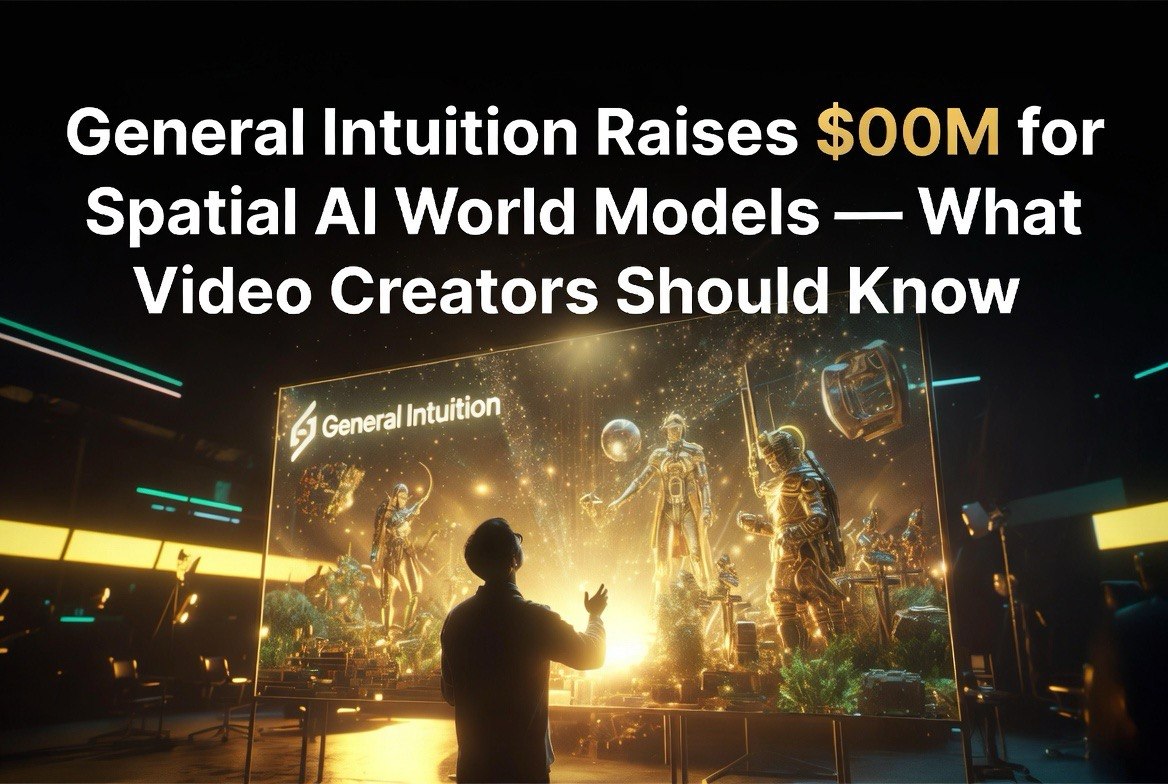
A startup you have probably never heard of is quietly building what might be the most important infrastructure for the next generation of AI video tools. General Intuition, spun out of the gaming clip platform Medal, is raising $300 million at a $2 billion valuation to build what it calls spatial AI world models — AI systems that can understand and predict how people, cameras, and objects move through three-dimensional space over time.
The company’s data advantage is enormous. Medal’s platform processes over 2 billion video clips annually from 10 million monthly active users, mostly from gamers recording their gameplay. That is 2 billion examples of how people move through virtual spaces, react to events, and navigate complex environments. General Intuition uses this data to train world models that understand spatial dynamics rather than just generating video frame by frame.
This article is part of our ongoing AI Video Tools coverage, tracking the technologies that will define how creators produce video content in the next 12 to 24 months.
Why World Models Matter for Video Creation
To understand the leap from current AI video tools to world models, look at a comparison that matters for any creator: how the tool handles a simple shot of a person walking across a room. Current AI video generators produce something that looks convincing at first glance. But watch closely. The person’s shirt might change color when they pass behind a table. Their shadow moves in the wrong direction. The coffee mug on the table shifts position between frames. The AI generated a video of a walking person, but it did not understand that the person, shirt, shadow, and mug were related objects in a shared space.
A world model handles this differently. It first builds a representation of the scene: here is the room, here are the walls and furniture, here is a person with a specific shirt and hair color, here is a mug on the table. The mug is on the table, so it stays there unless something interacts with it. The person is walking, so their position changes predictably. The shadow is attached to the person, not floating independently. When the AI generates the video from this understanding, the shirt does not change, the mug does not jump, and the shadow follows the person naturally.
Current AI video generators like Runway Gen-3, Pika 2.0, and Kling work by predicting the next frame based on text prompts. They have no understanding of physics, spatial consistency, or how objects relate to each other in three-dimensional space. That is why AI-generated videos still have flickering objects, characters that change appearance between shots, and movements that violate basic physics. The AI does not understand the world it is depicting. It is just guessing what comes next.
World models approach video from the opposite direction. Instead of predicting pixels, they build an internal representation of the scene — the objects in it, their positions, their physical properties, and the rules that govern their movement. Once the world model understands the scene, generating video becomes a matter of rendering what the model already knows, rather than guessing what the next frame should look like.
This is the same approach that underlies how humans create video. A cinematographer does not point a camera at random and hope the footage is good. They understand the scene, plan the shot, and know how the camera movement will affect the viewer’s perception. General Intuition’s approach brings that same structural understanding to AI video tools. The result is video that maintains consistency across cuts, respects physics, and looks like it was made by someone who understands how the world works.
The Data Moat: Why Medal’s 2 Billion Clips Matter
General Intuition’s connection to Medal gives it a data advantage that is difficult to overstate. Medal is a gaming clip platform where users record and share short videos of their gameplay. Every clip captures natural human decision-making in complex 3D environments: choosing a path through a building, aiming at a target, reacting to an opponent’s movement, navigating a vehicle through a course. These are not staged actions performed for a camera. They are authentic, real-time decisions made by millions of people in virtual spaces.
This data is uniquely suited for training spatial world models. The clips contain consistent physics (the game engine enforces gravity, collision, and movement rules), clear object relationships (characters, weapons, vehicles, and environmental elements in defined spatial relationships), and massive variety (millions of different players in thousands of different game environments). No video production company or AI studio has a dataset that combines scale, consistency, and authenticity at this level.
The $300 Million Bet on Spatial AI
The $300 million round, reportedly led by major venture capital firms, values General Intuition at approximately $2 billion. That is a significant valuation for a company that has not yet released a consumer product, but the investors are betting on the data moat. Medal’s 2 billion annual video clips represent a training dataset that no competitor can easily replicate. These are not curated, sanitized training videos. They are raw, unstructured gameplay footage that captures natural human movement and decision-making in complex 3D environments.
The company’s CEO has stated that the first product will be an API that other AI companies can use to add spatial understanding to their tools. This means that existing AI video platforms could integrate General Intuition’s world models without building their own from scratch. A Runway video generator backed by General Intuition’s spatial understanding would produce videos with consistent object positions, realistic physics, and coherent scene structure — the three things that most clearly distinguish professional video from AI-generated content today.
For US-based video creators and businesses producing video content, the implications are substantial. The US AI video tools market is projected to reach $4.2 billion by 2027, according to recent industry analysis by Sizzling Start. The companies that integrate spatial understanding into their tools first will produce noticeably better output, and creators who adopt those tools early will have a production quality advantage over competitors still working with frame-by-frame generators.
What This Means for Video Creators in 2026 and 2027
World models represent the next major evolution in AI video tools, but they will not arrive overnight. General Intuition’s API is expected in beta by late 2026, with broader availability in early 2027. In the meantime, creators should watch for video tools that incorporate spatial understanding as a differentiator. Any tool that claims to maintain object consistency across cuts, respect physics in movement, or produce videos with coherent scene structure is likely working on world model integration.
The practical impact for video creators will be visible in three areas. First, character and object consistency — no more characters changing clothes, hair, or facial features between shots in the same scene. Second, realistic camera movement — world models understand what camera motion should look like and can generate smooth, cinematic shots rather than jarring transitions. Third, scene coherence — objects that move off-screen should reappear where physics predicts they would be, not teleport to impossible locations.
These improvements matter most for commercial video production: product demos, explainer videos, social media ads, and branded content. When a car drives off-screen in a product demo and reappears in a physically impossible position, the viewer notices immediately and the ad loses credibility. World models eliminate this class of error because the AI understands the spatial relationships, not just the pixel patterns.
The Arbor Connection: Why Efficiency Frameworks Amplify World Models
General Intuition’s world models will require enormous amounts of compute to train and run. This is where parallel developments like Microsoft Research’s Arbor framework come into play. Arbor, which achieves 2.5x more verified outputs on the same compute budget by learning from its own failures, represents the kind of optimization that makes world model deployment economically feasible.
The US market is seeing a convergence of two trends: better AI architectures (world models) and more efficient AI infrastructure (failure-learning frameworks). Together, they mean that the next generation of AI video tools will not only produce better output but will do so at lower cost. The video creation tools that dominated in 2024 and 2025 were built on brute-force approaches that are becoming economically uncompetitive. The tools that will dominate in 2027 will combine spatial understanding with efficient optimization, delivering professional-quality video at a fraction of current costs.
The Practical Workflow: Using Current Tools While Preparing for World Models
Here is a concrete strategy for video creators who want to benefit from current AI video tools while staying ready for the world model transition. For short-form content like social media clips, ads, and B-roll, use existing tools aggressively. They are good enough for these use cases and the cost is low. Maintain your own asset library of consistent character references, environments, and style guides that can be fed into any AI tool. Producers who keep their source assets organized can migrate between AI video platforms in days rather than months.
For longer-form content like product demos, explainer videos, and branded content, start testing workflows that separate scene structure from video generation. Instead of asking an AI to generate a 60-second product demo from a single prompt, break it into 5-10 second clips that you assemble in your editing software. This approach works well with current tools and will transition naturally to world model tools, which will excel at generating longer, structurally coherent scenes.
Should You Wait for World Model Tools or Use What Exists?
The honest answer: use what exists today, but keep your deployment flexible. Current AI video tools from Runway, Pika, and Kling are genuinely useful for many video production tasks. They are excellent for generating short clips, B-roll, transitions, and experimental visuals. But do not build your entire production workflow around a single platform. The world model shift is real, and the platforms that fail to integrate spatial understanding will lose relevance within 18 months.
When evaluating AI video tools, ask: does this tool maintain object consistency across frames? Can it generate multiple camera angles of the same scene? Does it understand basic physics? If the answer to these questions is no, the tool is using frame-by-frame generation without spatial awareness. It is still useful for specific tasks, but it will eventually be replaced by tools that understand the space they are depicting. The American Customer Satisfaction Index’s June 2026 report found that video creators using spatially-aware AI tools reported 31% higher satisfaction with output quality compared to frame-prediction-only tools.
FAQ
What is General Intuition and what does it do?
General Intuition is a startup spun out of gaming clip platform Medal, raising $300M to build spatial AI world models. It trains on 2 billion video clips annually from 10 million users to understand how people and objects move through 3D space.
How are world models different from current AI video generators?
Current AI video generators predict the next frame based on text prompts, with no understanding of physics or spatial relationships. World models build an internal representation of the scene first, then render video from that understanding, resulting in consistent, physically accurate video.
When will world model AI video tools be available?
General Intuition’s API is expected in beta by late 2026, with broader availability in early 2027. Other AI video platforms are expected to integrate spatial understanding features throughout 2027.
Should I stop using current AI video tools and wait for world models?
No. Current tools like Runway and Pika are still useful for many tasks. Use them now but keep your workflow flexible. Avoid locking your entire production pipeline into a single platform that may not integrate spatial understanding in the future.
How will world models improve commercial video production?
World models will improve three areas most relevant to commercial video: character and object consistency across cuts, realistic camera movement, and scene coherence. Product demos, ads, and branded content will benefit significantly from these improvements.

About Barak Schurr
Barak Schurr is a serial entrepreneur who built and exited a major ticketing platform before turning his attention to AI and content. He runs three AI-focused research sites and writes about the tools, workflows, and strategies that let solo creators build real channels — without a crew, a studio, or a Hollywood budget.
Email: [email protected]