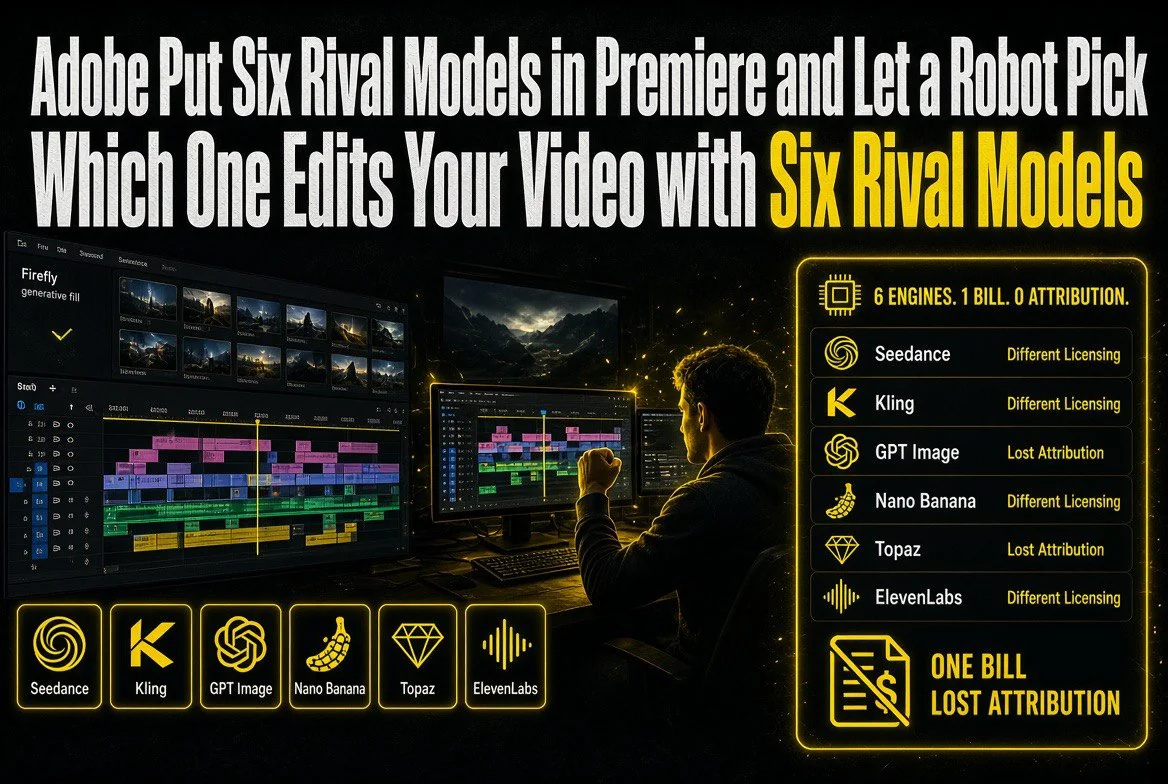
Adobe Put Six Rival Models in Premiere and Let a Robot Pick Which One Edits Your Video
Adobe Put Six Rival Models in Premiere and Let a Robot Pick Which One Edits Your Video
⚡ Expert Summary: On 10 November at Adobe MAX, Adobe put its competitors’ models inside Premiere and shipped an agent to choose between them. Seedance, Kling, GPT Image and Nano Banana now sit in the same Firefly panel as Adobe’s own models, and a Creative Agent takes a goal in plain language, picks the tools and models, shows a plan, and can keep working in the background. Adobe wins whichever engine the agent picks. You get the fastest edit of your life and lose the ability to say, with certainty, what made any given shot. The work gets faster. The credit gets harder to claim. Nobody can tell you which model produced which frame — including the person who billed the client for it.
Adobe just did the thing every editor said could not happen, and almost nobody noticed the size of it.
The company that spent a decade telling you Firefly was the safe, licensed, commercially clean way to make AI images has now put its rivals inside its own editor. Kling. Seedance. GPT Image. Nano Banana. Alongside its own models, in one panel, on one timeline.
Then it added an agent that picks which one to use, based on a sentence you typed.
That is not a feature update. That is Adobe admitting that the model is not the product. The timeline is. And if you edit for a living, the ground you have been standing on since the first Firefly announcement just moved.
What Actually Shipped on 10 November
Two separate things landed at Adobe MAX, and they only become dangerous when you put them together.
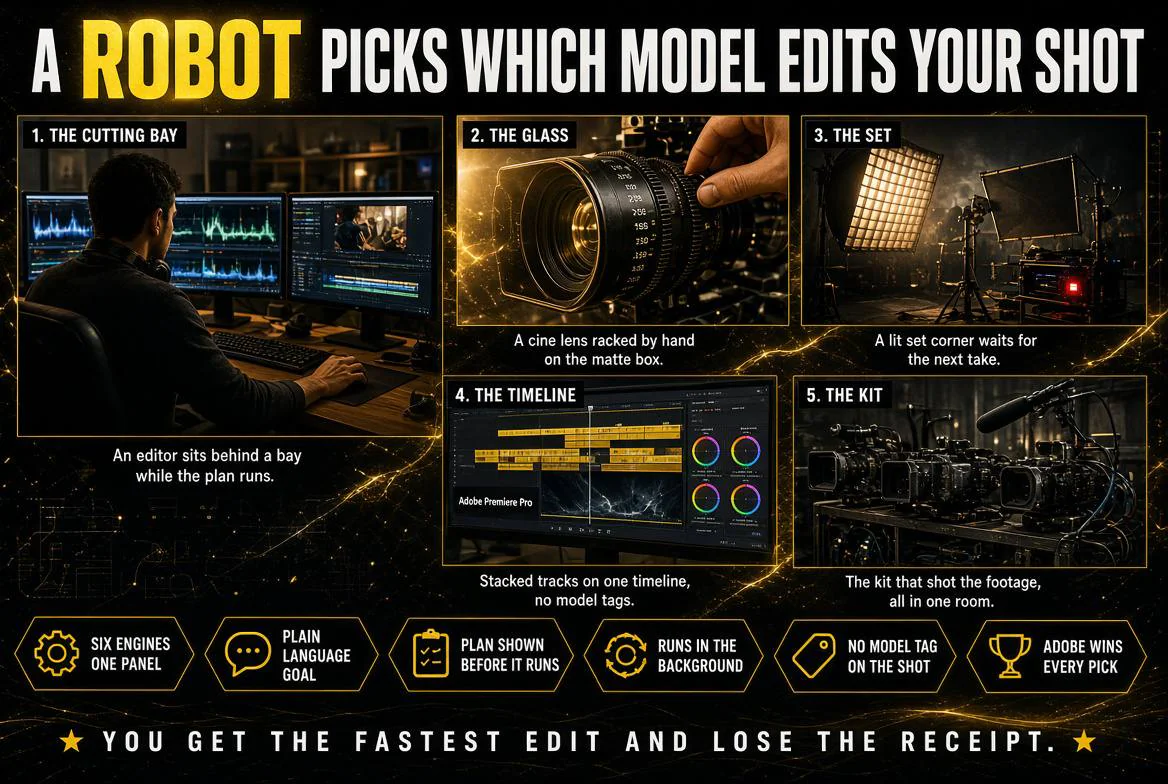
The first is the model shelf. Firefly now carries partner models alongside Adobe’s own: Seedance 2.5, Kling 4.0, GPT Image 2.6, Nano Banana, with Topaz and ElevenLabs in the surrounding workflow. The promise is obvious and genuinely useful — one bill, one interface, no subscriptions to five separate sites, and the best model for each specific job instead of the one model your tool happens to have.
The second is the Creative Agent. Adobe’s own description is precise, and worth reading slowly: it takes a goal in plain language, picks tools and models, shows a plan before it runs and can keep working in the background.
Read the middle clause again. Picks tools and models.
You are no longer choosing the engine. The agent is. You supply an intention, it supplies a plan, and the plan is executed across effects, masked subject tracking, and full-sequence regrades while you watch the result appear.
The Part Where Your Craft Disappears
Here is what that feels like from the chair.
For twenty years the value of an editor was measurable in decisions. Which take. Where to cut. How long to hold. What to lose. Every one of those was a judgement, made by a person, defensible in a client meeting, and visible in the final frame.
The Creative Agent does not take those decisions away in one dramatic sweep. It takes them in a way you will not notice until it is too late — quietly, competently, in a plan you approved without reading closely because you were on deadline and the plan looked reasonable.
The clip comes back graded. The masked subject is tracked. The effect is applied across the sequence. It is good work. And you cannot say, from memory or from the project file, which engine performed which part of it.
That last sentence is the whole story. Attribution does not exist in this workflow by design, because the design treats model selection as plumbing.
The Two Costs Nobody Quoted You
| What you get | What it quietly costs | Who notices first |
|---|---|---|
| Six engines in one panel, one bill | Six different licence terms you now have to know, per shot | The client’s legal team, six months later |
| An agent that picks the best model per job | No record of which model produced which frame | You, when the delivery is challenged |
| Background execution while you do other work | Approvals you signed without reading the plan | The colorist who inherits an untraceable sequence |
| Effects, tracking and regrades automated | The craft skill you were paid for, now a checkbox | Your day rate, at the next negotiation |
| Adobe earns whichever model the agent chooses | The incentive to pick the best engine is not the incentive to pick the cheapest | Your credit balance, at the end of the month |
The last row is the one nobody in the announcement addresses. When one company hosts six competing models and also operates the agent that chooses between them, the choice is not neutral. It does not have to be malicious. It only has to be optimised for something other than the shot.
The Client Question You Cannot Answer
Ask yourself what happens the first time a brand or a broadcaster asks the simple question: which model made this shot?
If the answer is “Seedance, I think, or Kling — the agent chose,” you have a problem, and it is not a technical one. It is a contract problem. Licensing terms differ between model families. Some partner models carry restrictions on commercial use, on duration, on resolution, on what happens to output when the account stops paying. A sequence assembled by an agent across six engines can carry six different sets of terms in a single thirty-second spot.
Adobe’s commercial-clean positioning built its whole reputation on avoiding exactly this. Firefly’s pitch was indemnification: make it with our model, and the legal exposure is ours. Put Kling and Seedance and GPT Image inside the same panel, and the shield has holes in it that nobody has mapped yet.
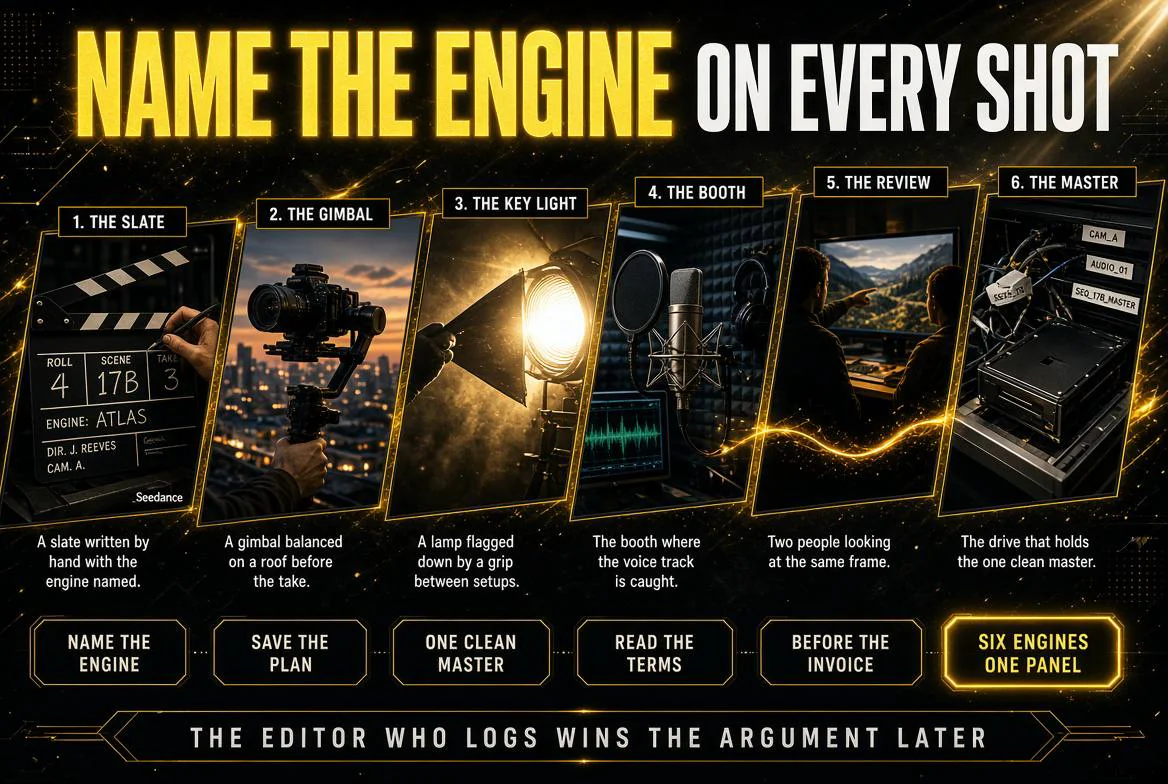
That is not a reason to refuse the tools. It is a reason to know, per project, what you actually delivered. Which means a log. Which means the agent needs to write one, and you need to keep it.
The Honest Case for All of This
Because it is strong, and pretending otherwise would be the same lazy contrarianism the industry already has enough of.
Before this, working across models meant five subscriptions, five interfaces, five sets of export settings and five billing relationships, all held together by downloading files and dragging them into a timeline. That is not craft. That is admin, and it was eating days that should have gone to the edit.
One panel, one bill, best tool per shot is a real improvement, and any editor who has spent a Friday reconciling credit balances across four AI sites knows it. The agent doing sequences of mechanical work — the regrade, the tracking, the effect pass — is work that was never anyone’s favourite part of the job. Getting it back as time is a genuine gain.
The people who benefit most are the ones with the least support: solo creators, small shops, the editor who is also the motion designer and the colorist. For them, an agent that handles the mechanical 60% is the difference between shipping and not shipping.
What It Means for the Money
The commercial story is not about the subscription. It is about what a client is now buying.
When the tool does the regrade and the tracking and the effect pass, a client who used to be told “that’s three days” starts hearing “that’s one.” Which is honest, and which compresses the invoice. The editor who keeps charging the old rate because the output looks like three days of work is on borrowed time, and the one who reprices around judgement — selection, structure, taste, the decisions the agent does not make — survives the transition.
That repricing is already happening in the wider market for AI-assisted production, and it is uneven. The editors who will lose are the ones whose entire value was execution speed. The ones who will gain are the ones whose value was knowing what should exist in the frame.
Be careful with any specific rate figure you read this month. Vendor pricing pages change weekly, credit costs per model differ and are revised without notice, and no credible published benchmark for agent-assisted edit times has appeared yet. Anyone quoting you a precise number is quoting a marketing slide.
The Practical Playbook for This Week
| Action | Why it matters |
|---|---|
| Log the model behind every generated shot, manually if you have to | It is the only thing that answers a client question in six months |
| Read the plan before approving background work | Approval is the last moment you are accountable for the output |
| Check partner-model licence terms per project, not per account | Six engines means six sets of terms in one delivery |
| Price the judgement, not the render | The render is now cheap. Knowing what to render is not |
| Keep one job a month fully manual | The day the agent is unavailable, your hands still work |
None of that is resistance. All of it is the minimum a professional does when a supplier changes the terms of a job without saying so out loud.
The Thing Worth Arguing With
The claim being made, implicitly, by putting six rival models in one panel and an agent in front of them, is that the model does not matter any more. Only the workflow does. Only the seat at the table.
They might be right. That is the frightening part.
If the model does not matter, then the thing that makes your video good is not the engine — it is the intention you typed, the plan you approved, and the taste you applied after. Which means the editor’s value is entirely in the part of the job that has never had a button: knowing what the piece should be.
That is either the most liberating thing that has happened to post-production in a decade, or it is the moment the invoice stopped being about the work and started being about the seat.
You will know which one by what your next client asks for. If they ask for a faster turnaround, you are being repriced. If they ask what you think the cut should be, you are being kept.
Frequently Asked Questions
Can I tell which model made a shot in the Creative Agent workflow?
The agent selects tools and models on your behalf and shows a plan before it runs, but attribution across six engines is not how the workflow is described. The practical answer is that you cannot rely on the project telling you. Log it yourself if a client may ask.
Does this replace my editing skill?
No. It replaces the mechanical portion — regrades, masked subject tracking, effect passes applied across sequences. Selection, structure, pacing and taste remain the decisions the agent does not make, and those are what a client is paying for.
Is Adobe making money whichever model the agent picks?
Adobe earns from the subscription and the credit-based usage regardless of which engine the agent selects. That is the incentive structure the announcement does not discuss, and it is worth knowing when you are asked to trust the agent’s recommendation.
What about the licensing on partner models?
Different model families carry different commercial terms, including restrictions on use, duration and resolution, and different positions on indemnification. Adobe’s Firefly indemnification positioning does not automatically extend across every partner model now sitting in the same panel. Check per project.
Should I stop using premiere because of this?
No. One panel, one bill and the best model per task genuinely saves real time, especially for solo creators. Use it, then do the thing the tools do not do for you: keep a record of what produced what, and price the judgement rather than the render.
How much does the partner model usage cost?
Credit costs differ by model and are revised frequently, and Adobe bills partner-model generations through its own plans and credit system. There is no stable public benchmark yet, so treat any precise figure quoted to you as a marketing number until you see your own bill.
Does this make AI video cheaper for clients?
It makes render time cheaper, which flows into turnaround, which flows into what clients expect to pay. Whether your invoice shrinks depends on whether you have repositioned your rate around decisions and judgement rather than hours of mechanical work.
About Barak Schurr
Barak Schurr is a serial entrepreneur who built and exited a major ticketing platform before turning his attention to AI and content. He runs three AI-focused research sites and writes about the tools, workflows, and strategies that let solo creators build real channels — without a crew, a studio, or a Hollywood budget.
Email: [email protected]
More AI Video Resources