AI Is Now Completing Classic Films: What Creators Need to Know
Get The Faceless YouTube Blueprint — Free
The exact AI tool stack and workflow used to build a faceless YouTube channel from zero.
AI Is Now “Completing” Classic Films — and Hollywood Is Fighting About It
⚡ Expert Summary: Generative AI has moved from short clips to altering and completing films made decades ago. The Sphere’s AI-enhanced Wizard of Oz has sold more than 2.2 million tickets since August, and a team is now re-creating the lost footage of Orson Welles’ The Magnificent Ambersons — without Warner Bros. on board. This is the colorization fight of the 1980s repeating with far more at stake, and it changes what every creator needs to understand about who owns a finished film.
In 1986, the New York Times ran an essay attacking a film-restoration trend. Critic Vincent Canby argued that colorizing black-and-white classics “desecrated” them, that nobody connected with the original films “had anything to do with this artistic revisionism,” and that of the half-dozen he had seen, “all but one were virtually unwatchable.”
Forty years later, that fight is back — with better tools, bigger money, and a much harder question. Generative AI is now being used to expand upon, alter, and simply “complete” movies made decades before anyone reading this was born. And unlike colorization, this one is not dying quietly.
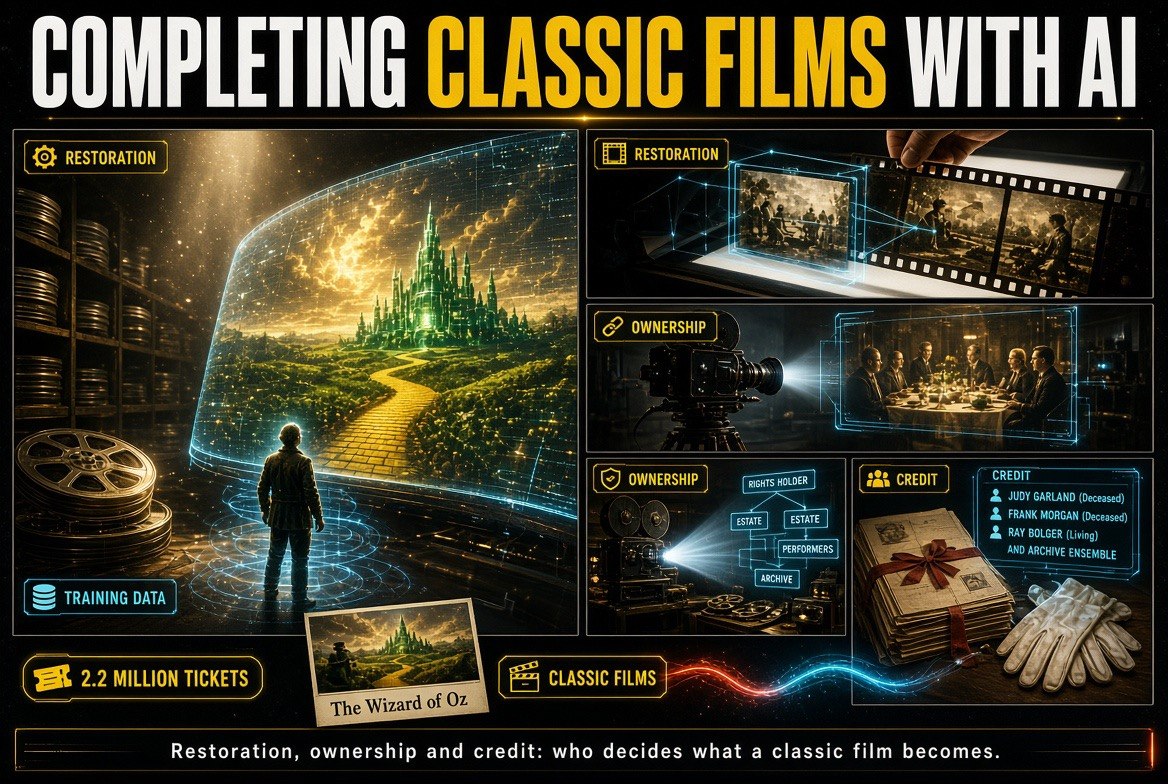
The argument in one frame: restoring a classic film is now partly a generative act, and the archive, the rights papers and the credit line decide who gets to say what the finished film is.
The Sphere’s Wizard of Oz and the Number That Changed the Argument
The moment this went mainstream was the Sphere in Las Vegas, which used AI-assisted techniques on 1939’s The Wizard of Oz to fill its 160,000-square-foot interior display plane. Critics were largely appalled. New York Times critic Alissa Wilkinson wrote that the process “suggests that in the future, every artist’s choices could be reversed, altered or ripped to shreds, then presented by their corporate owners as if they’re essentially the original, just zhuzhed up a bit for a new century.”
Then the ticket number came in. Since its August opening, the Sphere’s Oz has sold more than 2.2 million tickets — a staggering figure for what remains, enhancements and all, an edited presentation of a film first released nearly 90 years ago.
That gap is the whole story in one line. The critical class says desecration; the public bought 2.2 million tickets. Colorization never had a number like that, which is exactly why colorization died and this probably will not.
Why Colorization Died and This Might Not
Dr. Charles Acland, a distinguished professor of cultural theory and film studies at Concordia University, explains the difference better than any think piece could.
“In moving-image history, these debates about technological change and its impact on creativity or labor or our understanding of the past have resurfaced at various times,” Acland says. “But we also live in an economy where there is such extraordinary hype around what gets called AI … that it puts a different kind of pressure on these discussions and debates. Colorization is a good comparison, but it didn’t have the same sweeping social and economic impact of something like generative AI — so there’s more at stake in how we sort through what we’re going to accept and valorize.”
That is the sharpest framing available. Colorization was an aesthetic and ethical argument. This is an aesthetic, ethical, and economic argument — because the same technology that can finish a dead director’s film can also generate a new one, and the industry has to decide where that line sits.
The Magnificent Ambersons: Re-Creating a Film Nobody Has Seen
Here is where this stops being a debate about a theme-park attraction and becomes something stranger.
The only existing version of Orson Welles’ 1942 family drama The Magnificent Ambersons was cut down and partly reshot by RKO against the director’s wishes. More than an hour of footage was eventually destroyed. Welles spoke for decades about his desire to reshoot the original ending — RKO’s version was decidedly sunnier — and revive the dismantled final act. The film is considered among the great lost pictures, even though the surviving version is itself revered.
A trail of evidence kept the idea alive: set photos, the “cutting continuity” document describing how each shot leads into the next, and the director’s own comments over the years. From that, filmmaker Brian Rose spent years meticulously re-creating the lost scenes through animation. As Rose puts it, the thought was always in the back of his mind that “maybe technology — AI — could do a seamless re-creation. The only thing that I completely missed the ball on was how quickly the technology would come around.”
Edward Saatchi, founder of Fable Studios, has been obsessed with Ambersons since childhood and now runs a generative AI company. He reached out to Rose to combine forces — because the technology did come around.
Their operation is already deep in production. One “shoot” with real actors is complete, with the missing shots re-created. Two further filming sessions with performers are planned, drawing on lessons from the first, and that work will be superimposed onto the original actors’ likenesses with the help of AI. The hope is to finish the final filming portion within about a year.
And here is the detail that matters most for anyone who plans to work this way: they have been operating without the participation of Warner Bros., the owner of the property and much of RKO’s back catalog.
The Comparison: What AI Restoration Actually Costs You
If you are a creator eyeing this technique for your own work, the honest question is not whether it is possible — it obviously is. It is what you are taking on.
| Factor | Traditional Restoration | Generative AI Restoration |
|---|---|---|
| Source material | Surviving prints, negatives, existing footage | Set photos, continuity docs, and the director’s notes as prompts |
| Rights requirement | Rights holder engaged, usually licensing the restoration | Can proceed without the owner — as the Ambersons team has done |
| Time to finish | Months to years, mostly physical scanning and cleanup | Years of combined real shoots plus AI compositing |
| Who is credited | Restoration team, original filmmaking team | Unsettled — the finished piece mixes living performers, dead actors’ likenesses, and generated frames |
| Audience reaction | Generally accepted as preservation | Split — critics object, but the Sphere sold 2.2 million tickets |
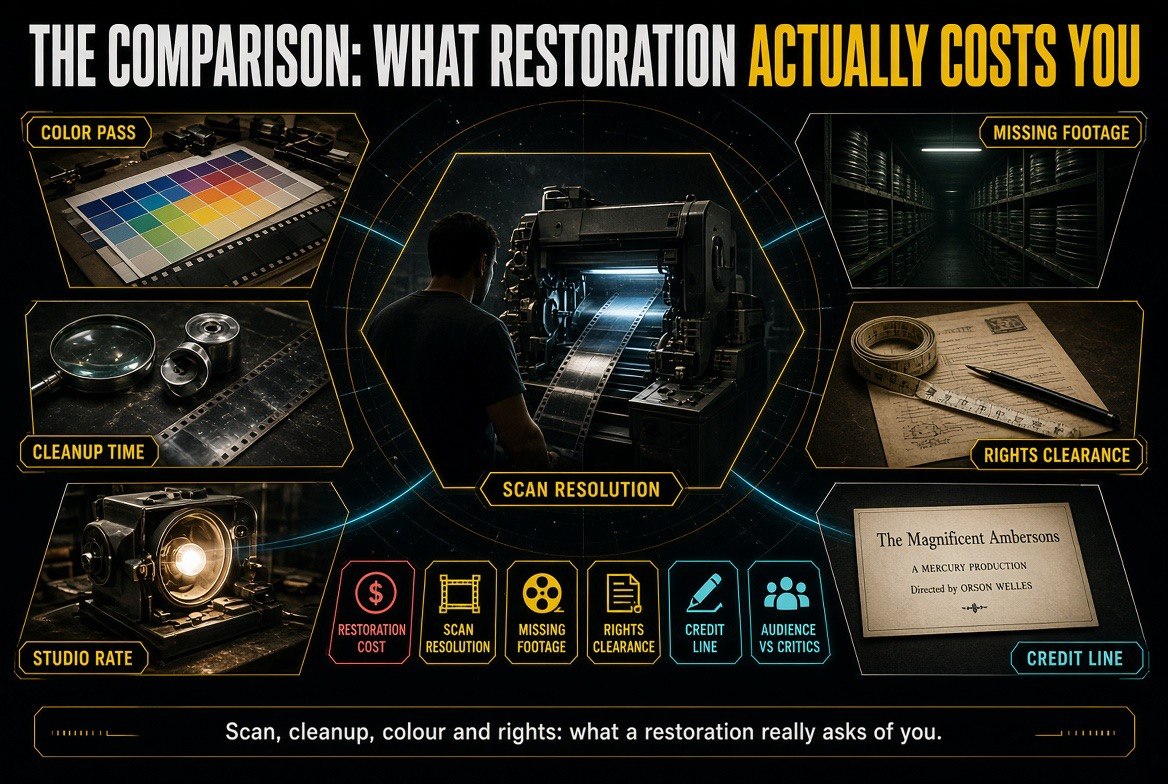
What a restoration actually asks of you: the scan sets the ceiling, the cleanup and colour pass eat the hours, and the missing footage and rights clearance decide whether the film can be finished at all.
What You Can Actually Do With This Today
You are not Orson Welles and you are not working with a 1942 RKO film. But the same techniques are available to any creator, and the studio-grade tools have moved fast. If you want to understand what is now possible on a normal budget, this is a reasonable order to learn it in.
- Learn motion and physics first. The failure of early AI video was always the physics — hands, weight, momentum. Modern generators have largely solved the obvious tells, and knowing which ones still fail is what separates usable output from a mess.
- Test likeness work legally before you test it artistically. Re-creating a performer’s likeness is the part with actual legal exposure. Understand the permission you need before the renders look good enough to matter.
- Restoration is a different discipline than generation. Cleaning and stabilizing existing footage is a solved problem with mature tools; inventing the missing shot is where the creative and legal risk lives. Do not confuse the two.
- Decide your credit convention before you publish. The hardest question in this entire story is who is credited when a finished film mixes living performers, a dead director’s intent, and generated frames. Pick a convention and state it.
None of this requires a studio. It requires deciding what you are willing to put your name on.
What This Means for the Tools You Already Use
The studio-grade capability on display here is not locked behind a Hollywood gate. The same category of tool that re-creates a missing 1942 shot is the category you use to build a channel without a crew, and the gap between the two has narrowed every quarter since 2024.
What has not narrowed is the judgment. The Ambersons team spent years with set photos and a continuity document before generating a single frame — the AI executes a decision that humans already made. That is the pattern worth copying: research first, generate second.
| Creator Type | What This Story Means for You | Your Next Move |
|---|---|---|
| Solo video creator | Frames you could not shoot are now producible — backgrounds, impossible shots, period detail | Learn the physics limits of your generator before you build a project on it |
| Archivist or historian | Restoration is now split into cleanup (safe) and re-creation (contested) | Label re-created material visibly and separately from restored material |
| Brand or agency | Likeness work on real people is the highest-risk area you will be asked for | Get written permission before you render, not after |
| Curious beginner | The public and the critics disagree, and the public is buying tickets | Watch the Sphere Oz and form your own view — it is the clearest case study yet |
The Question Nobody Has Answered
Wade through the ethics and one practical hole remains: who is credited?
The Ambersons project involves real performers shot this year, the likenesses of original actors from 1942, generated frames, and the reconstructed intent of a director who died in 1985 — all assembled into one piece of work. There is no established convention for that credit block, and the project is proceeding without the rights holder’s participation, which means the answer may end up decided by lawyers rather than by the people making it.
Saatchi’s own read, given to The Hollywood Reporter, is that reactions will split sharply — some people will call it terrible, others will ask why we should defend the butchering of a filmmaker’s vision rather than try to show what he intended. Both of those people are making a reasonable point. That is precisely why this fight will not be settled quickly.
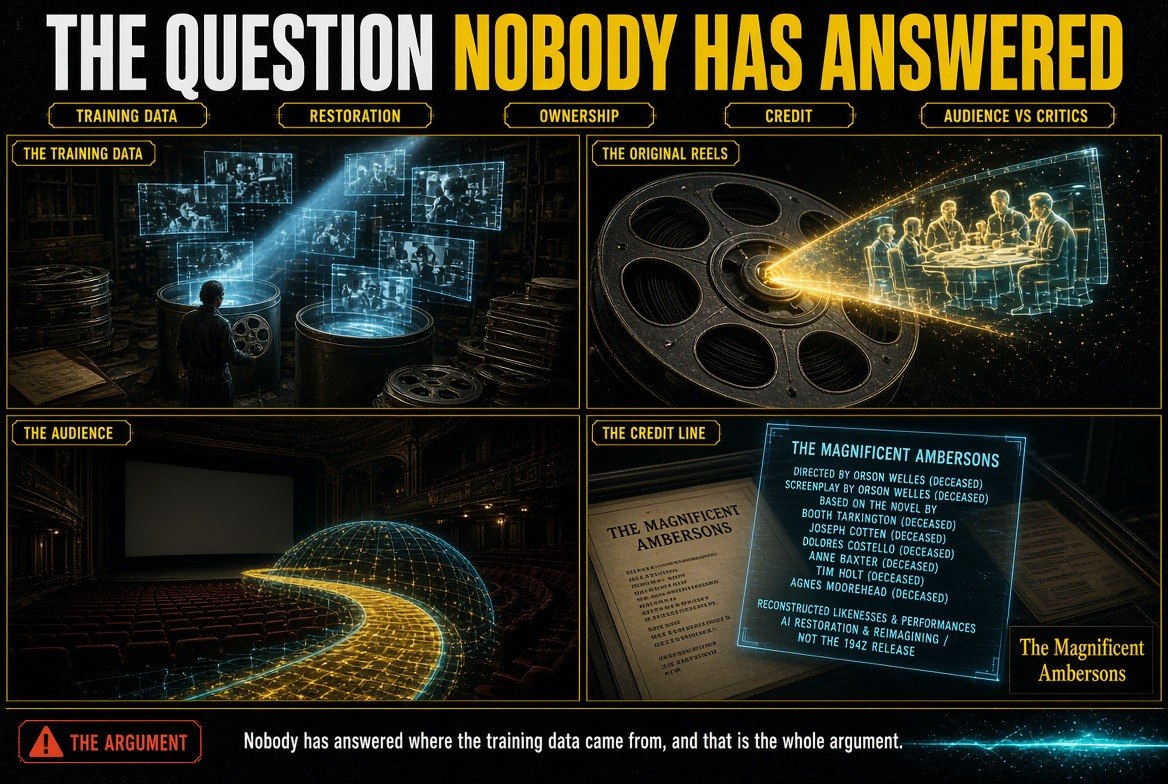
The question nobody has answered: nobody has said which films the restoration models were trained on, and the credit line now has to decide whether the technology is a tool or a co-author.
The Practical Takeaway
Strip the philosophy out and here is what changed this year: AI video tools crossed from generating new material into reconstructing and completing existing material. The public paid 2.2 million tickets to see it done to a 1939 classic. A team is doing it to one of cinema’s most famous lost films, right now, without permission from the studio that owns it.
You do not have to have an opinion on whether that is beautiful or vandalism — though you will probably form one. What you have to understand is that the capability is now available at your budget level, and the only thing standing between you and using it well is knowing which decisions are yours to make and which ones somebody else gets to make for you.
Frequently Asked Questions
What is AI film restoration?
AI film restoration uses generative artificial intelligence to clean up, alter, extend, or complete footage from films that were made decades ago. It covers a wide spectrum, from stabilizing and cleaning existing material — which is broadly uncontroversial — to generating missing scenes and superimposing performers’ likenesses onto original footage, which is heavily contested.
How much money did the Sphere’s AI Wizard of Oz make?
The Sphere’s AI-enhanced version of the 1939 film The Wizard of Oz has sold more than 2.2 million tickets since its August opening. That figure is striking because the source film is nearly 90 years old and widely available, which suggests the public’s appetite for immersive, event-ized versions of classic films is significant.
Who owns an AI-restored film?
This is unsettled. The team re-creating Orson Welles’ The Magnificent Ambersons has been working without the participation of Warner Bros., which owns the property and much of RKO’s back catalog. How ownership and credit resolve when a finished work mixes living performers, deceased actors’ likenesses, and generated frames has not been established by any convention or ruling.
Is AI film restoration the same as colorization?
Not quite. Colorization in the 1980s was primarily an aesthetic and ethical dispute, and it largely died out. Film studies professor Dr. Charles Acland notes that generative AI carries the same kind of debate but with far greater social and economic impact, which puts more at stake in what the industry accepts and valorizes.
Can individual creators use AI restoration techniques?
Yes. The tools that re-create missing footage for studio projects are the same category of AI video tools available to solo creators. The practical constraints are less about access and more about permission for likeness work and about clearly labeling re-created material separately from genuine restoration.
What is the Magnificent Ambersons AI project?
Edward Saatchi of Fable Studios and filmmaker Brian Rose are combining forces to re-create the lost footage of Orson Welles’ 1942 film The Magnificent Ambersons. RKO cut and partly reshot the film against Welles’ wishes and destroyed more than an hour of footage. One filming session with real actors is complete, with two more planned, and the re-created shots will be superimposed onto the original actors’ likenesses using AI.

About Barak Schurr
Barak Schurr is a serial entrepreneur who built and exited a major ticketing platform before turning his attention to AI and content. He runs three AI-focused research sites and writes about the tools, workflows, and strategies that let solo creators build real channels — without a crew, a studio, or a Hollywood budget.
Email: [email protected]
More AI Video Resources