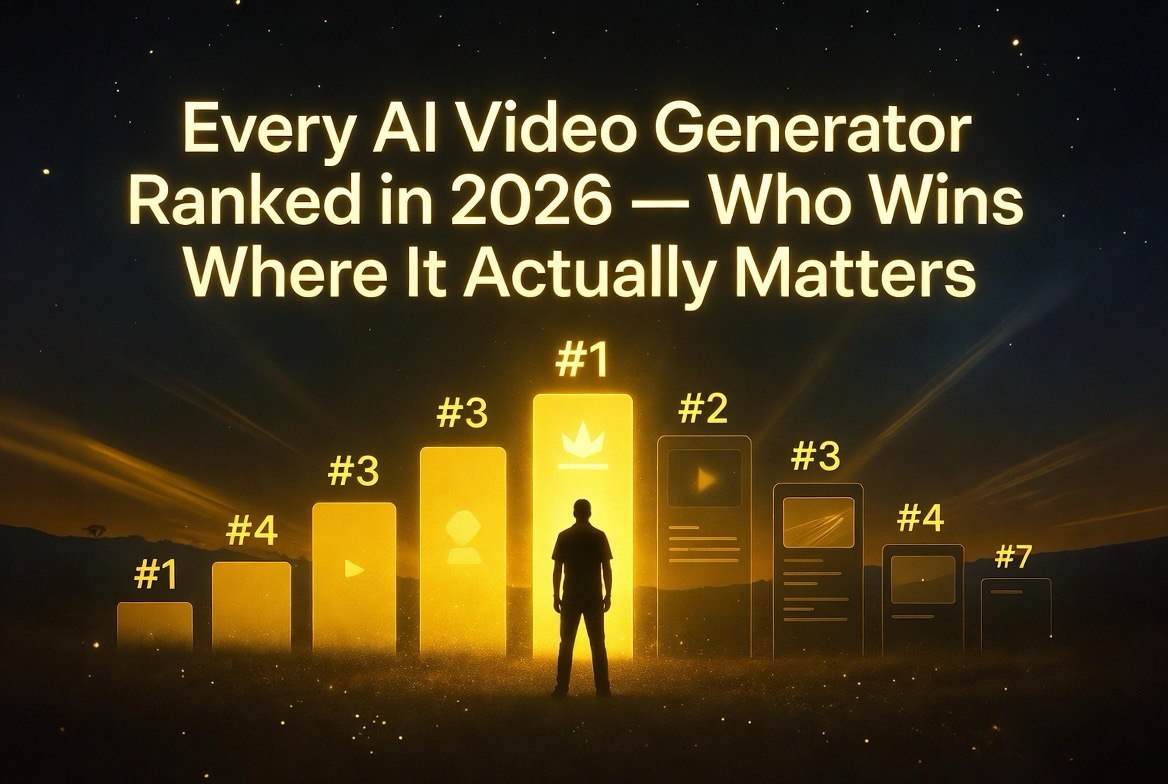
Every AI Video Generator Ranked in 2026 — Who Wins Where It Actually Matters
Get The Faceless YouTube Blueprint — Free
The exact AI tool stack and workflow used to build a faceless YouTube channel from zero.
Every AI Video Generator Ranked in 2026 — Who Actually Wins?
⚡ Expert Summary: No single AI video model dominates all categories in 2026. Google Veo 3.1 wins on visual quality and native audio. Kling 3.0 wins on character consistency and value per dollar. Runway Gen-4.5 wins on creative control and editing features. Seedance 2.0 wins on multimodal reference input and narrative coherence. The best choice depends entirely on what you are creating, and the smartest creators use multi-model aggregators to access all four without committing to a single platform.
The Era of One Best Model Is Over
In early 2025, the answer to “which AI video generator is best” was simple. Sora was the clear leader. One platform dominated the conversation, the benchmarks, and the creator workflows. Everyone else was chasing OpenAI.
By mid-2026, that simplicity is gone. Sora’s consumer product has been shut down. In its place, at least four serious competitors have emerged, each with distinct strengths and meaningful weaknesses. The question is no longer “which model is best” but “which model is best for what I am trying to do.”
This post ranks every major AI video generator in 2026 across the categories that actually matter for content creators. Not a single winner. A breakdown of who wins where, so you can choose the right tool for each project.
Google Veo 3.1: The Quality King
Veo 3.1 from Google is the current leader in raw visual fidelity. Its output looks closer to professionally shot footage than anything else available in 2026. Landscapes, textures, fabric movement, and lighting physics are consistently more realistic than what Kling, Seedance, or Runway produce.
Where it wins: Veo 3.1 produces the most photorealistic clips of any AI video model. Its native audio generation is also best-in-class, producing synchronized dialogue at up to 48kHz quality. For cinematic shots where visual polish is the primary requirement, Veo 3.1 is the clear choice.
Where it falls short: Clip length is limited to approximately 8 seconds in the standard tier. Longer generations are possible through the API but require more credits per second. Access requires a Google Cloud account or Google One AI Premium subscription, which adds friction for casual creators. The pricing per generation is higher than Kling or Seedance.
Best for: High-production-value marketing videos, cinematic sizzle reels, product hero shots, and any project where visual quality matters more than length or volume.
Kling 3.0: The Value and Consistency Champion
Kling 3.0 from Kuaishou has emerged as the strongest all-around option for most content creators in 2026. It does not win every category, but it scores highly across all of them, and its pricing makes it accessible for volume production.
Where it wins: Kling 3.0 leads in character consistency across shots. If you need the same person or object to appear consistently across multiple clips within a project, Kling handles this better than Veo or Runway. Its motion physics are excellent for action sequences, sports, dance, and any content where realistic movement matters. It supports longer clips than Veo — up to 15 seconds in native 4K at 60fps with optional audio.
Where it falls short: Overall visual polish is slightly below Veo 3.1. The models can produce artifacts in complex scenes with multiple characters or rapid camera motion. The user interface is functional but less polished than Runway’s creative tools.
Best for: Content creators producing regular video output who need consistent characters, good motion quality, and reasonable pricing. Social media content, YouTube shorts, and product demonstrations are Kling’s sweet spot.
Runway Gen-4.5: The Creative Control Standard
Runway has always positioned itself as a creative tool for filmmakers rather than a simple text-to-video generator, and Gen-4.5 reinforces that positioning. It is the only model on this list that doubles as a full video editing platform.
Where it wins: Runway’s motion brush lets you control exactly which parts of a scene move and how. Its frame propagation feature — edit one frame and the change ripples across the entire video — is unique among the major models. For creators who need to iterate on generated content rather than treating each generation as a finished piece, Runway offers control that no other platform matches.
Where it falls short: Raw generation quality lags behind Veo 3.1 and Seedance 2.0 in blind tests. The credit system makes volume generation expensive compared to Kling. Some reviewers describe Runway’s output as “sterile” compared to the more organic results from Veo and Seedance.
Best for: Professional video editors, marketing teams producing branded content, and any workflow where editing and iteration matter more than one-shot generation quality.
Seedance 2.0: The Multi-Modal Director
Seedance 2.0 from ByteDance is the fastest-improving model on this list and arguably the most technically impressive in terms of input flexibility. It accepts text, up to nine reference images, video clips, and audio references as inputs, giving creators more control over the output than any other model.
Where it wins: Seedance 2.0 excels at multimodal reference generation. If you have a specific character look, camera angle, lighting setup, or motion pattern in mind, Seedance lets you provide examples for each element and combines them into a coherent output. Its narrative coherence across multiple clips is the best in class — characters, settings, and objects remain consistent across an entire project, not just within a single clip.
Where it falls short: Free tier quality is noticeably lower than paid tiers, so the best Seedance requires a subscription. Visual polish in the free tier trails Veo 3.1 significantly. The platform is less polished than Runway for iterative editing workflows.
Best for: Narrative projects that require consistency across clips, creators who need precise control over visual style through reference images, and filmmakers building structured multi-shot sequences.
How the Top Four Compare in Real World Use
Rankings and feature lists are useful, but what matters is how these models perform when you actually sit down to produce something. Here is a practical breakdown based on real creator workflows in 2026.
For a 15-second social media ad: Kling 3.0 is the most efficient choice. It generates acceptably high quality in a single pass, handles longer clips natively, and costs less per output than the other top models. A creator producing 30 social ads per month can do it on Kling for under $50. The same volume on Veo would cost two to three times more.
For a 60-second product launch video: The optimal workflow is layered. Use Seedance 2.0 for the initial concept visualization because its multimodal reference system lets you show the product from multiple angles consistently. Then use Veo 3.1 for the hero shots where visual polish matters most. Bring everything into Runway Gen-4.5 for editing and frame-level refinements. This layered approach is what professional studios are using in 2026, and it is made practical by multi-model hubs that handle the switching between platforms automatically.
For a narrative short film: Seedance 2.0 is the strongest single model because of its character and scene consistency across multiple clips. No other model maintains visual coherence across as many generations. Paired with Runway for post-production editing, Seedance produces the most cohesive multi-scene output of any option available.
For batch social media content: Kling 3.0 or a multi-model hub with Kling as the primary engine is the most practical setup. The combination of reasonable quality, fast generation, and low cost makes it the volume leader for creators who need to publish multiple times per day.
Where the Others Land
Beyond the big four, several other platforms are worth knowing about for specific use cases.
Pika remains the best option for quick, shareable social media clips with a distinct artistic style. It does not compete with the big four on realism, but its aesthetic has a loyal following among creators who want their AI video to look like AI video rather than trying to pass for live footage.
HeyGen and Synthesia lead the avatar and talking-head category. If you need a consistent spokesperson delivering scripted content in multiple languages, these platforms outperform the general-purpose generators. They are not replacements for Veo or Kling, and they should not be used as such.
Luma Dream Machine remains a strong option for creative ideation and image-to-video generation. It is not competitive with the top tier for production-quality output, but its generation speed and ease of use make it a good tool for rapid prototyping.
Multi-model hubs like Pollo AI and Higgsfield are increasingly the preferred way to access all of the above. A creator subscribes to one platform and gets access to Veo, Kling, Seedance, Runway, and others through a single interface. This is the most practical solution for most creators in 2026 because it eliminates the question of which model to commit to.
How to Choose Your 2026 AI Video Stack
Based on testing and community feedback across dozens of creator workflows in mid-2026, here is a practical decision framework:
If you prioritize visual quality above everything else and have the budget, use Veo 3.1. It is the best model for clients who care about production value.
If you produce content regularly and need reliable quality at reasonable cost, use Kling 3.0. It is the best all-around value.
If you edit as much as you generate, use Runway Gen-4.5. Its editing tools make it the most productive platform for professionals.
If you are building narrative projects that require consistency across scenes, use Seedance 2.0. Its multimodal reference system is unmatched for structured storytelling.
If you cannot decide or want flexibility, subscribe to a multi-model hub. Pollo AI and Higgsfield both offer access to all major models for a single monthly fee. This is the approach I recommend for most creators in the United States because it hedges against the risk of any single model shutting down or degrading in quality.
The important takeaway is that there is no wrong answer among the top four. Each model serves a legitimate use case well. The wrong answer is committing to one model without understanding what it optimizes for, then struggling with its weaknesses for projects that would have been better served by a different platform. Know what you are trying to build, then pick the tool that was designed for that purpose.
For a complete comparison of AI video generation tools in 2026, including pricing tables and performance benchmarks, visit our AI video tools guide.
FAQ
What is the best AI video generator in 2026?
There is no single best AI video generator in 2026. Google Veo 3.1 leads in visual quality, Kling 3.0 leads in value and character consistency, Runway Gen-4.5 leads in creative control and editing, and Seedance 2.0 leads in multimodal reference input and narrative coherence. The best choice depends on your use case.
Is Veo 3.1 better than Kling 3.0?
Veo 3.1 produces higher visual quality and better native audio. Kling 3.0 offers better character consistency across shots, longer clip lengths, and better value per generation. One is not objectively better than the other. Choose Veo for polish and Kling for volume and consistency.
What happened to OpenAI Sora?
OpenAI discontinued Sora’s consumer web and app experiences on April 26, 2026. The API remains active until September 24, 2026, after which all user data will be permanently deleted. The shutdown was driven by high compute costs, competitive pressure from Veo, Kling, Seedance, and Runway, and a strategic shift toward enterprise API products.
Should I use one AI video model or a multi-model hub?
For most creators, a multi-model hub like Pollo AI or Higgsfield is the better choice. Hubs provide access to all major models through a single interface, let you pick the best model for each specific task, and insulate you from platform dependency risk. The Sora shutdown demonstrated the danger of building workflows around a single model.
Which AI video model is best for marketing content?
Marketing content benefits from Runway Gen-4.5 for its editing and brand consistency features, and Veo 3.1 for the highest production value. Many marketing teams use both — Veo for hero shots and Runway for editing and iteration throughout the production process.

About Barak Schurr
Barak Schurr is a serial entrepreneur who built and exited a major ticketing platform before turning his attention to AI and content. He runs three AI-focused research sites and writes about the tools, workflows, and strategies that let solo creators build real channels — without a crew, a studio, or a Hollywood budget.
Email: [email protected]
More AI Resources for Your Business