Google SynthID Detector Goes Public: What It Means for AI Video Creators
Get The Faceless YouTube Blueprint — Free
The exact AI tool stack and workflow used to build a faceless YouTube channel from zero.
Google SynthID Detector Goes Public: What It Means for AI Video Creators
\n\n
⚡ Expert Summary: Google has opened public access to a tool that checks whether images and video were made or edited with AI, built on its SynthID watermark. For the first time, anyone a creator sends work to can ask a machine whether that work is synthetic. The detector is useful, imperfect, and — for working creators — a reason to stop treating provenance as somebody else’s problem.
\n
\n\n
Until now, the question “was this made with AI?” was answered by vibes, watchdog accounts, and whichever person in the thread was most confident. Google has just made it a checkbox.
\n\n
The company has opened public access to its SynthID detection tool, which checks whether an image or video carries Google’s SynthID watermark — the invisible signature its generative models embed in the media they produce. The tool is aimed at journalists, platforms, and the generally curious. The press coverage has mostly framed it as a media-literacy story.
\n\n
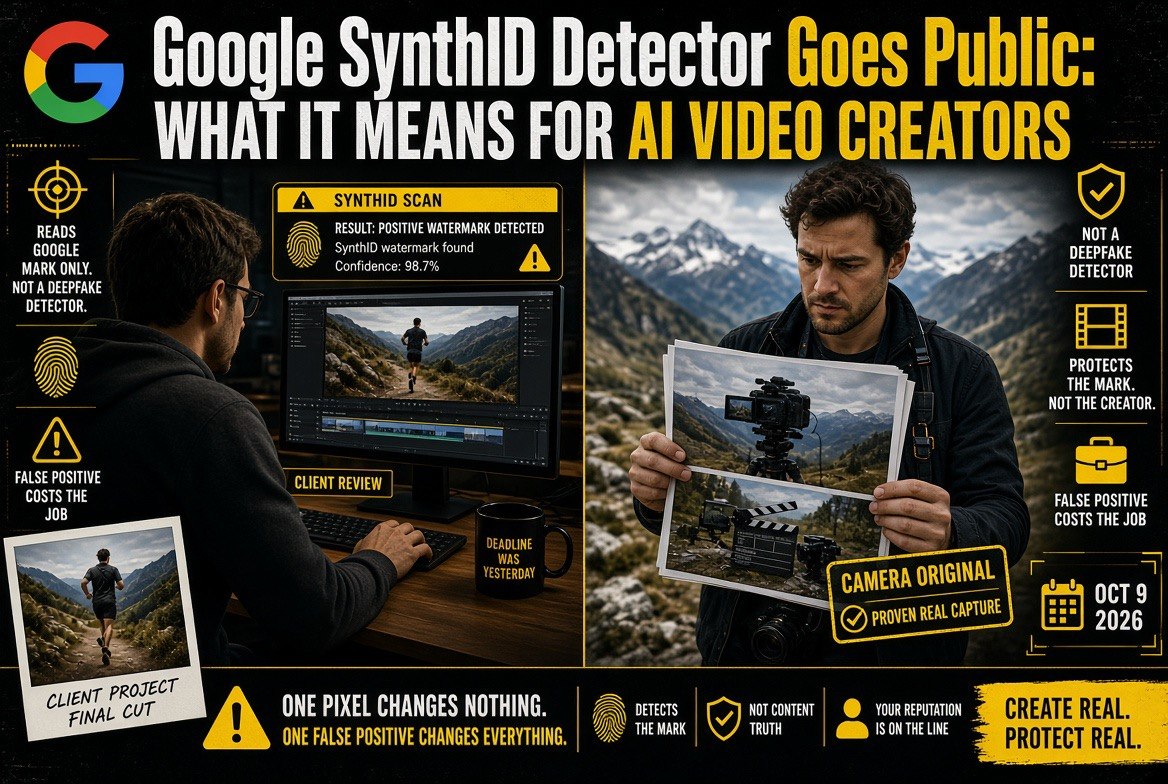
If you make video for a living, the framing that matters is narrower and more uncomfortable. Someone in your client chain can now run your deliverable through a detector and get an answer. That answer may be wrong. And it may be wrong in the direction that costs you money.
\n\n
\n\n
What SynthID Actually Is
\n\n
SynthID is a watermarking system, and the important word is watermark rather than detector. Google’s generative models — image and video — embed an imperceptible signal into the pixels they produce at generation time. The signal is designed to survive common transformations: crops, compression, resizing, a reasonable amount of color grading.
\n\n
The detector is the reader. You feed it a file, and it returns a probability that the file carries that embedded signal. It is not an analysis of how authentic the content looks. It is not a deepfake detector trained on the visual tells of synthetic media. It answers exactly one question: does this file carry Google’s mark?
\n\n
That distinction is the single most important thing to understand about the whole story, and it is the thing most coverage skips. SynthID can tell you a Google model made something. It cannot tell you a Midjourney image is fake, a Runway clip was generated, or that a video was manipulated with tools from anyone else. A detection result of “no watermark found” is not a certificate of authenticity. It is the absence of one specific signature.
\n\n
| What the Detector Answers | What People Assume It Answers | Gap That Costs Creators |
|---|---|---|
| Does this file carry Google’s SynthID watermark? | Was this video made with AI? | Non-Google AI tools leave no mark — clean results get over-trusted |
| Is there a detectable signature embedded at generation time? | Is this content trustworthy and real? | Authenticity is a judgment; the tool returns a probability |
| Did the mark survive this specific file’s processing? | Is the mark always present if AI was used? | Heavy re-encoding or regeneration strips marks — false negatives are normal |
| A machine-readable signal in the pixels | A verdict a client can act on | Clients treat a probability as a conclusion and withhold payment or contracts |
\n
\n\n
Read the right-hand column again. Every item in it is a situation where a creator gets harmed by a tool working exactly as designed, because the person reading the output believes it means something it does not.
\n\n
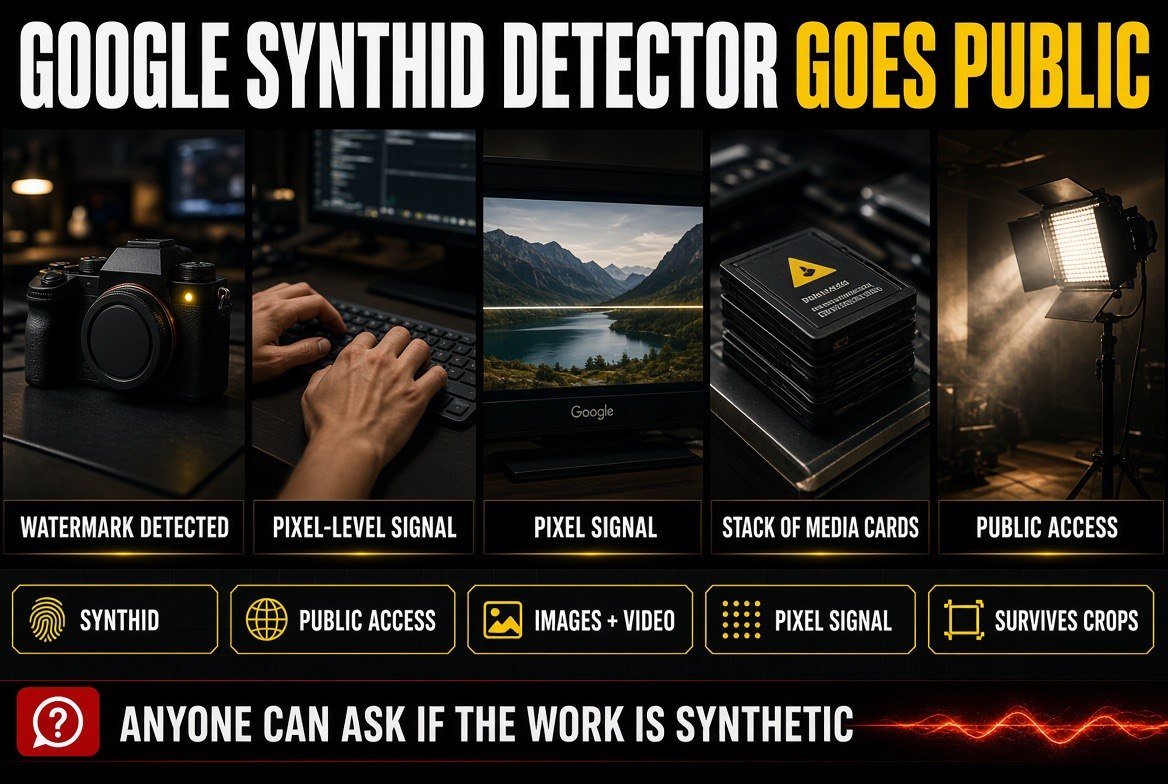
The detector runs on a pixel-level signal Google’s own models embed at generation time – public access means anyone the work is sent to can now ask.
Why the Detection Rollout Is Good News and Bad News
\n\n
The good half is genuine. Harmful synthetic media — fabricated statements, non-consensual imagery, fake evidence — gets harder to pass off once a public tool exists that can flag the most common generators. Platforms gain a cheap first-pass filter. Journalists gain a fast sanity check. Google has also previously committed to watermarking across its generative stack, which means the mark’s coverage grows as more creators use its tools.
\n\n
The bad half is that detection creates a new kind of risk for legitimate creators, and the risk is asymmetric. A false positive — your genuinely shot footage flagged as synthetic — can end a client relationship before you get a chance to explain. A false negative simply means nobody notices. The tool’s errors are not evenly distributed across the people using it.
\n\n
There is a second asymmetry that matters more. Coverage of SynthID has trained clients to associate “watermarked” with “AI-generated.” But a creator using Google’s models for part of a legitimate workflow — an upscale, a color pass, a background plate, a generative fill — will produce output that carries the mark. To a client with a shallow understanding of what the tool does, that is indistinguishable from “you faked the whole thing.”
\n\n
The Provenance Problem Nobody Wants to Own
\n\n
SynthID is Google’s answer to a problem the entire industry has been circling for two years: who certifies that media is what it claims to be?
\n\n
There have been several attempts. The Content Authenticity Initiative, backed by Adobe, has pushed C2PA metadata — cryptographically signed provenance records that travel with a file and record its edit history. The EU AI Act added disclosure obligations for synthetic content, with deadlines that have already prompted creators and platforms to think about labeling. Other vendors have built their own watermarking schemes.
\n\n
The result is a fragmented landscape with no interoperability. Google’s detector reads Google’s marks. C2PA records are ignored by most consumer tools and stripped by many platforms. There is no single standard that a client, a platform, and a creator can all agree on — which means “verified” is a word with at least four incompatible meanings depending on who says it.
\n\n
| Approach | How It Works | Survives Editing | Who Can Read It |
|---|---|---|---|
| SynthID (Google) | Invisible pixel-level watermark embedded at generation | Yes, to a point — crops, compression and moderate grading | Google’s detector, now public |
| C2PA / Content Credentials | Cryptographically signed metadata attached to the file | Often not — stripped by many platforms and exporters | Any tool that supports the standard, including Adobe |
| EU AI Act disclosure | Legal labelling obligation on synthetic content | Not applicable — it is a duty, not a technology | Regulators and anyone reading the label |
| Platform classifiers | Statistical detection of synthetic-looking output | Inconsistent — degrades as models improve | The platform alone; creators rarely see results |
\n
\n\n
Four approaches, four different answers, and a creator caught in the middle of all of them. This is the real story behind the SynthID rollout: not that detection now exists, but that detection now exists in a form that is unstandardized, incomplete, and easy for a client to misread.
\n\n
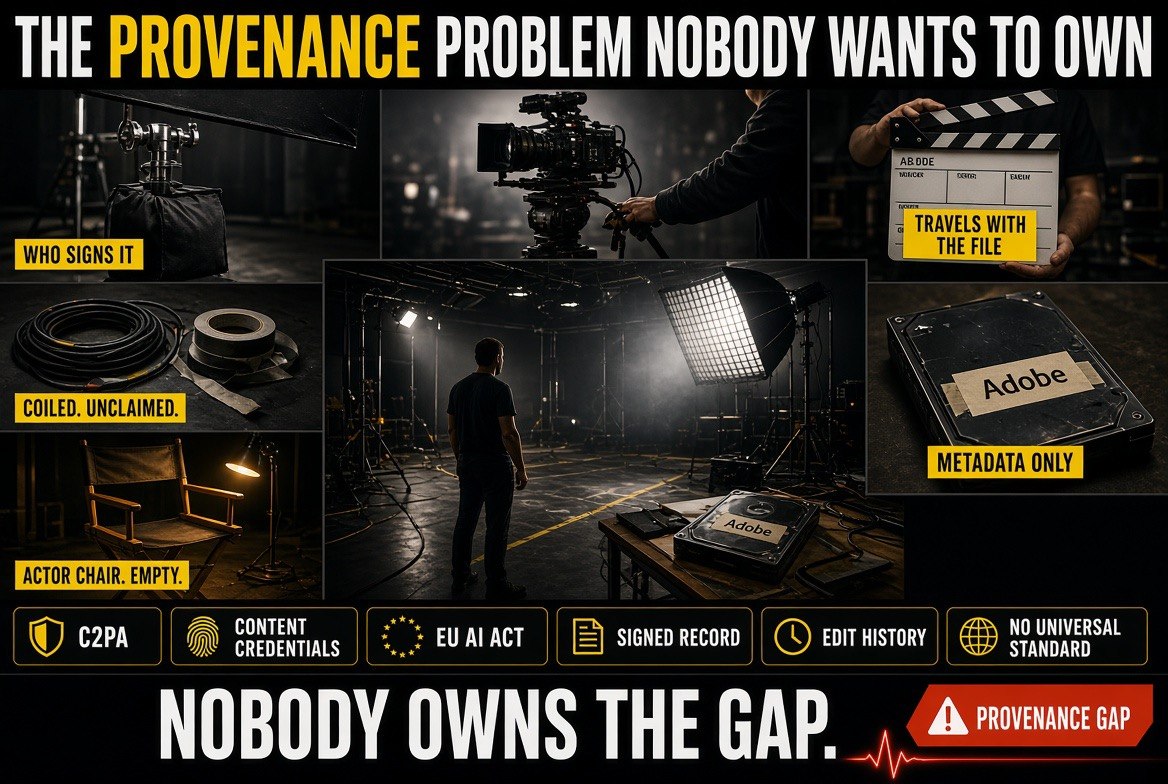
Provenance standards compete for the same job – signed metadata that travels with the file versus an invisible pixel signal, and nobody owns the gap.
What This Changes for Working Creators
\n\n
The practical consequences are already visible, and they are mostly about relationships rather than technology.
\n\n
Your deliverables are now inspectable by default. A client with a link to a public detection tool no longer needs an expert to raise the AI question. The conversation shifts from “is this AI?” to “prove it is not,” and the burden of proof has quietly changed hands.
\n\n
Partial AI use becomes a liability without disclosure. If your pipeline includes any Google generative step, the mark follows the output. A clean, honest workflow — a shot you filmed, upscaled with a Google model — can now return a positive detection. Without a pre-agreed explanation, that looks like concealment.
\n\n
Documentation becomes a deliverable. Project files, capture logs, camera originals, and edit timelines are the only robust answer to a detection flag, because they establish the content’s actual origin rather than arguing about a watermark. Creators who already archive this material are fine. Creators who delete it after delivery now have a reason to stop.
\n\n
Contract language will need to catch up. Detection results are probabilities, and many client agreements written in an earlier era have no defined standard for what counts as proof either way. Getting that defined before a dispute is cheaper than arguing it during one.
\n\n
A Practical Way to Handle Provenance in 2026
\n\n
Know which parts of your pipeline are watermarked. Make a list: which tools you use for generation, which for enhancement, and which are outside the Google stack entirely. Most creators have never written this down and cannot answer the question under pressure.
\n\n
Keep originals and project files for every delivery. The best defense against a false positive is not an argument about detectors — it is the raw material that shows the work was shot, edited, and finished by you.
\n\n
Disclose AI-assisted stages up front. A one-line note in the delivery — “background plate generated, subject shot in-camera” — removes the ammunition before anyone finds it. Disclosed enhancement is a workflow choice; discovered enhancement looks like a lie.
\n\n
Do not treat a clean detection as proof of anything. If you are the one checking, remember the tool reads one specific watermark from one specific company. A clean result from another AI platform across the market means nothing.
\n\n
Put a provenance clause in your contracts. Define what documentation counts as evidence of origin, and make clear that detection-tool output is a signal rather than a verdict. Five lines of contract text is cheaper than one withheld invoice.
\n\n
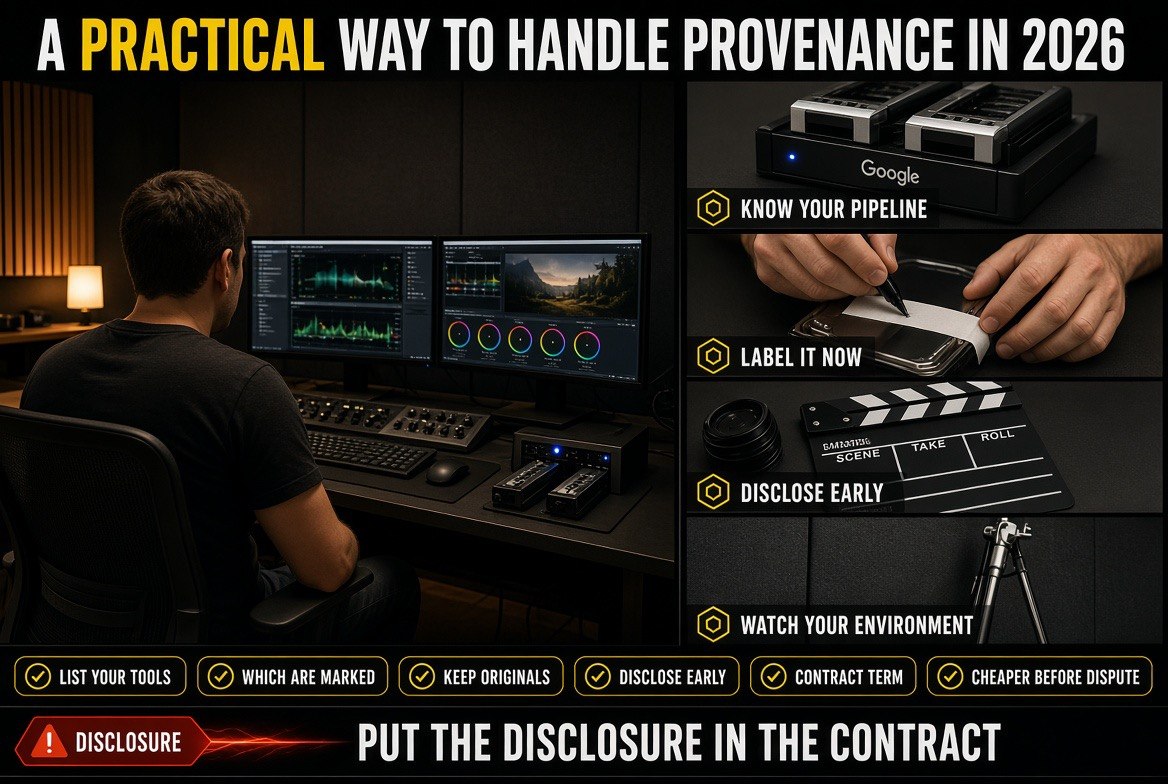
The creator-side version: know which tools watermark your pipeline, label the deliverables, and put the disclosure in the contract before a dispute starts.
The Bottom Line for AI Video Creators
\n\n
Google’s SynthID detector does exactly what it says: reads a Google watermark, in public, for anyone who asks. That is a genuine step forward for flagging the most common synthetic media. It is also a tool that answers a much narrower question than most people will assume it answers.
\n\n
For creators, the risk is not that the tool exists. It is that clients will treat a probability as a verdict, and that legitimate AI-assisted work will read as concealed fakery because nobody explained the pipeline in advance. The defense is boring and effective: know your tools, keep your originals, disclose the stages, and define the standard before a client defines it for you.
\n\n\n\n
Frequently Asked Questions
\n\n
What is Google SynthID?
\n
SynthID is an invisible watermark Google embeds into images and video generated by its AI models. The mark lives at the pixel level and is designed to survive crops, compression, resizing and moderate color grading, so it can later be detected in a finished file.
\n\n
Can the SynthID detector tell if a video was made with AI?
\n
Only for Google-generated content. The detector reports whether a file carries Google’s specific watermark. It cannot identify output from Midjourney, Runway, Kling or other competitors, and it does not assess whether content is authentic. A clean result means one specific signature is absent, not that the video is real.
\n\n
Does the SynthID watermark survive editing?
\n
It is designed to survive realistic processing such as cropping, compression, resizing and moderate grading. Heavy re-encoding, re-generation, or aggressive processing can strip it, which is why false negatives are expected and detection results should be treated as signals rather than proofs.
\n\n
Should AI video creators disclose AI-assisted work to clients?
\n
Yes. If any stage of your pipeline uses a Google generative model, the output may carry a detectable mark. A short disclosure in the delivery removes the risk that a client discovers the mark later and reads it as concealment. Disclosed enhancement is a workflow choice; discovered enhancement looks like deception.
\n\n
What should a creator do if a client claims their video is AI-generated?
\n
Respond with origin documentation rather than an argument about the detector. Camera originals, project files, capture logs and edit timelines establish actual origin and are far more persuasive than debating a probability score. This is why archiving source material for every delivery matters.
\n\n
Is there a universal standard for AI content provenance?
\n
No. Google uses SynthID, Adobe and others push C2PA Content Credentials metadata, the EU AI Act imposes labelling duties, and platforms run their own classifiers. These approaches do not interoperate and often disagree, which is why contract language defining acceptable proof of origin is now worth having.
\n\n
 \n
\n
About Barak Schurr
\n
Barak Schurr is a serial entrepreneur who built and exited a major ticketing platform before turning his attention to AI and content. He runs three AI-focused research sites and writes about the tools, workflows, and strategies that let solo creators build real channels — without a crew, a studio, or a Hollywood budget.
Email: [email protected]
\n
\n
\n\n
More AI Video Resources
\n
 \n
\n\n
 \n
\n\n
\n
\n\n\n