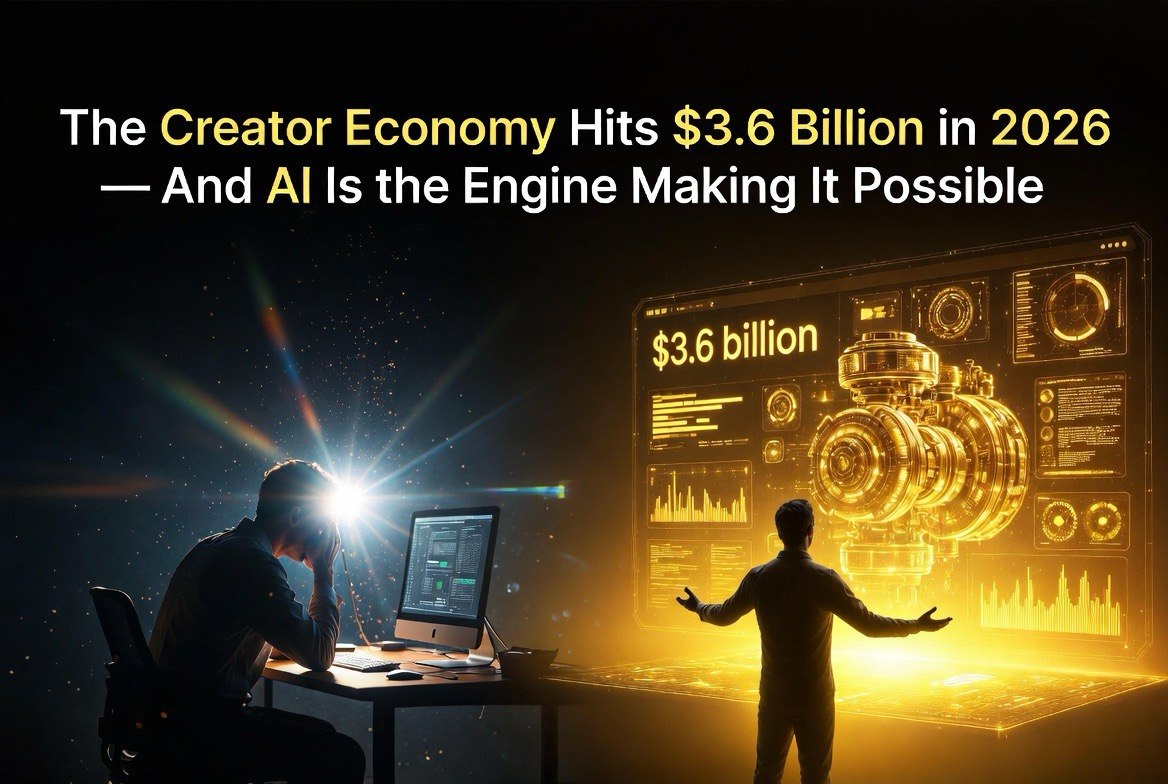
The Creator Economy Hits 03.6 Billion in 2026 — And AI Is the Engine Making It Possible
Get The Faceless YouTube Blueprint — Free
The exact AI tool stack and workflow used to build a faceless YouTube channel from zero.
The Creator Economy Hits $203.6 Billion in 2026 — And AI Is the Engine Making It Possible
⚡ Expert Summary: Key Takeaways
- The creator economy is projected to reach $203.6 billion in 2026 — encompassing creator platforms, tools, and monetization ecosystems, with AI as the primary growth driver.
- 84% of creators now use generative AI tools in their production workflows, with more than half reporting meaningful time savings averaging 53.7%.
- AI handles the full content pipeline: outlining, editing, repurposing, captioning, thumbnail generation, and multi-platform distribution — all from a single source asset.
- Creator monetization is shifting toward diversified income streams: sponsorships, platform payouts, affiliate marketing, and subscriptions, all powered by AI-driven performance data.
- Platform dependency remains the biggest risk — creators who build owned audiences (email, memberships, stores) alongside platform followings weather algorithm changes better.
This post breaks down the $203.6 billion creator economy and shows how AI tools are reshaping the economics of content creation for independent creators and small teams.
Bottom line: The creator economy is growing because AI has removed the production bottleneck. Creators who adopt AI tools across their full workflow will capture a disproportionate share of that growth.
The creator economy is now a $203.6 billion market. That figure, projected for 2026, encompasses the platforms creators use, the tools they depend on, and the monetization systems that turn audiences into income. More importantly, it represents a fundamental shift in how content is produced. AI is not just a tool within this economy — it is the infrastructure underneath the entire thing.
For individual creators, solopreneurs, and small content teams, this matters because the barriers that used to separate amateurs from professionals have collapsed. The production bottleneck that once required a team of editors, designers, and strategists has been replaced by AI tools that do the same work in a fraction of the time.
Here is what the data shows and how creators can position themselves to capture a share of the $203.6 billion opportunity.
The $203.6 Billion Number — What It Actually Means
Industry projections for the 2026 creator economy cover three main categories: creator platforms (YouTube, TikTok, Instagram, Substack, Patreon), creator tools (AI video platforms, editing software, graphic design tools), and monetization ecosystems (sponsorships, affiliate networks, platform payout programs, membership platforms).
The growth trajectory is steep. The creator economy was valued at roughly $100 billion in 2022. By 2025, it had crossed $180 billion. The projected $203.6 billion for 2026 reflects continued expansion, but the nature of that growth has shifted. Early years were driven by platform payouts and advertising revenue. The 2026 growth is driven by tool adoption and diversified monetization.
The key driver: 84% of creators now use generative AI tools, according to industry surveys. That adoption rate means the majority of professional content being produced today — across video, audio, written, and visual formats — passes through an AI tool at some point in the workflow.
How AI Changes the Economics of Content Creation
Before AI, a content creator producing a single video faced a production timeline that looked like this: 2 hours for scripting, 1 hour for filming, 3-4 hours for editing, 30 minutes for thumbnail and captions, and another 30 minutes for publishing and promotion. Total: 7-8 hours for one piece of content.
AI tools have collapsed that timeline. Industry surveys, including the Artlist Creative Trend Report, found that creators using AI report an average 53.7% reduction in production time. The same video that took 8 hours now takes under 4. A creator producing two videos per week saves a full workday every week.
The time savings are distributed across the pipeline. AI scripting tools handle outlining and first drafts in minutes. AI video editing tools like Descript and Runway let creators edit by text, removing hours of timeline scrubbing. AI captioning tools generate subtitles in seconds. AI thumbnail generators produce click-optimized cover images without graphic design skills.
But the biggest shift is in repurposing. A single AI-generated video can be exported as a 15-second Reel, a 90-second TikTok, a 3-minute YouTube Short, and a full-length YouTube video — all from the same source material. What used to require separate production runs now happens in one workflow.
The Monetization Shift — Diversification Is Survival
Creator monetization in 2026 looks fundamentally different from 2022. Platform payouts — YouTube AdSense, TikTok Creator Fund, Instagram bonuses — have declined as a share of total creator income. They have been replaced by sponsored content, affiliate marketing, memberships, and digital product sales.
AI tools support this diversification directly. Affiliate marketers use AI to generate product comparison videos, write optimized copy, and test variations of calls-to-action. Subscription creators use AI to produce content at the volume required to keep members engaged without burning out. Sponsored content creators use AI to fast-track the pitch-to-delivery cycle, producing client deliverables faster and taking on more campaigns.
The data backs this up. Creators who use AI tools across their workflow report higher engagement per post and more consistent publishing cadences — both of which directly correlate with higher sponsorship rates and stronger affiliate conversion.
Platform Dependency — The Risk AI Cannot Solve
There is one risk that AI tools cannot address: platform dependency. The 2026 creator economy is still largely built on platforms that creators do not control. Algorithm changes, policy updates, and shifting audience behavior can tank a creator’s income overnight, regardless of how efficient their production workflow is.
The solution is owned audiences. Creators who build email lists, membership communities, and direct-to-consumer sales channels alongside their platform presence are significantly more resilient. AI tools help here too — email marketing automation, membership site management, and product distribution can all be AI-assisted — but the strategy must come from the creator.
The most successful creators in 2026 are treating platforms as acquisition channels and owned channels as revenue centers. AI accelerates the content production that feeds both, but it does not replace the strategic decision to diversify income streams.
AI Tools Every Creator Should Use in 2026
Synthesia — Best for AI avatar videos. Turn a script into a professional presenter video with 140+ AI avatars. No camera, no studio, no filming. Starting at $29/month. Use it for brand content, tutorials, and sponsorship deliverables that require a consistent visual presence. Try Synthesia.
Descript — Best for AI-powered video and audio editing. Edit video by editing text. Includes AI voice cloning, filler word removal, eye contact correction, and studio sound. Starting at $24/month. Use it for podcasts, talking-head videos, and any content where speed of editing matters more than timeline control.
InVideo — Best for turning content into multi-platform video. 5,000+ templates, AI script generator, and one-click export for Reels, TikTok, Shorts, and YouTube. Starting at $20/month. Use it to repurpose a single blog post or script into 10+ video assets. Try InVideo.
Runway — Best for AI-generated video effects and generation. Tools for text-to-video, image-to-video, motion tracking, and color grading. Pricing starts at $15/month. Use it for creative effects, B-roll generation, and experimental content that stands out in crowded feeds.
How Creators Can Capture Share of the $203.6 Billion Opportunity
The 2026 creator economy rewards speed, consistency, and diversification. AI tools solve the speed and consistency problems directly, enabling creators to produce more content in less time. The diversification challenge requires strategy — but AI supports it by making it easier to produce content for multiple platforms, test multiple monetization approaches, and measure what works.
The creators who will capture the most value are not necessarily the most talented or the most charismatic. They are the ones who build systematic production workflows powered by AI, maintain audience relationships across owned and platform channels, and adapt quickly as the tools and monetization models continue to evolve.
The $203.6 billion market is growing, but it is not evenly distributed. The tools to claim your share are accessible. The question is whether you will build the pipeline.
Frequently Asked Questions
Industry projections estimate the creator economy at $203.6 billion in 2026, covering creator platforms, production tools, and monetization ecosystems. AI tools are the primary driver of growth.
Creators using AI report an average 53.7% reduction in production time, based on Artlist’s 2026 Creative Trend Report. A video that took 8 hours now takes under 4 hours from scripting to publishing.
84% of creators now use generative AI tools in their workflows, according to industry surveys. AI adoption is the standard, not the exception, for professional content creation.
Income sources have diversified beyond platform payouts. The main revenue streams are sponsored content, affiliate marketing, memberships and subscriptions, digital product sales, and platform-specific monetization programs. Successful creators combine multiple streams.
Platform dependency. Algorithm changes, policy updates, and audience shifts on any single platform can significantly impact income. The most resilient creators build owned audiences through email lists, membership communities, and direct sales channels alongside their platform presence.

About Barak Schurr
Barak Schurr is a serial entrepreneur who built and exited a major ticketing platform before turning his attention to AI and content. He runs three AI-focused research sites and writes about the tools, workflows, and strategies that let solo creators build real channels — without a crew, a studio, or a Hollywood budget.
Email: [email protected]
More AI Resources for Your Business