Katzenberg Just Bet on AI Video: What It Means for YouTube Creators
Get The Faceless YouTube Blueprint — Free
The exact AI tool stack and workflow used to build a faceless YouTube channel from zero.
Katzenberg Just Bet on AI Video: What It Means for YouTube Creators
⚡ Expert Summary: On September 9, 2026, reports surfaced that DreamWorks co-founder Jeffrey Katzenberg is building a new AI video startup through WndrCo — with Bill Peebles, the former head of OpenAI’s Sora project, and ex-Dropbox CFO Sujay Jaswa. It’s aimed at professional film production, and Andreessen Horowitz is reportedly in talks. Here’s why a solo YouTube creator should care: when Hollywood-grade AI video tools get built by people with studio relationships, those tools eventually reach your desktop. The gap between a $10,000-per-minute production and a $200 one keeps closing.
Most AI video news in 2026 has been about model releases — a faster generator, a longer clip length, better camera control. This story is different in a way that matters more for anyone building a channel: it’s about where the money and the talent are going. When the guy who built DreamWorks pairs with the guy who ran Sora, the message isn’t “another video tool is coming.” It’s that the most experienced people in filmed entertainment have decided AI video production is the next platform shift, not a gimmick.
If you’re running a YouTube channel — or building one — that’s a signal worth reading carefully. Not because you’ll use Katzenberg’s product, but because of what its existence does to the tools you already use.
What’s Actually Being Reported
The reporting comes from The Information on September 9, 2026, and spread across tech and entertainment press the following day. The details, as currently known:
- Who: Jeffrey Katzenberg, co-founder of DreamWorks and the producer behind Shrek and Kung Fu Panda, through his investment firm WndrCo.
- Who else: Bill Peebles, the former head of OpenAI’s Sora video model, and Sujay Jaswa, formerly CFO of Dropbox.
- What: A new venture training advanced AI video models specifically for the film industry — not a consumer editor, not a social clip tool.
- Funding: Actively raising, reportedly in discussions with major investors including Andreessen Horowitz.
- Status: Early. No public name, no product, no launch timeline.
The most striking part of that list is context, not content. Hollywood has spent the last three years fighting generative AI over copyright, compensation, and control. Now a founding figure of modern animation is building the tooling himself. That’s not a reversal of principle — it’s a bet on who gets to define how the technology is used in production.
Why a YouTube Creator Should Care
Here’s the honest case for paying attention, and it’s not about the premise that you’ll subscribe to this product.
1. Pro-grade tooling trickles down. Every capability that lands in professional workflows eventually arrives in consumer tools. Pro cameras, nonlinear editing, color grading, motion graphics — all of it started in facilities with six-figure rooms and ended up on laptops. A startup built to serve film production will push model quality, temporal consistency, and character control forward. Those advances show up in your tools within a couple of years.
2. It validates the direction you’ve already taken. If the speculation about a studio-ready AI video pipeline is right, it confirms the core assumption behind every faceless channel, explainer operation, and solo creator using AI: video production is becoming a software problem, not a crew problem.
3. It raises the quality bar. This is the uncomfortable one. When AI video gets good enough that studios use it, the baseline for “good enough” rises everywhere. Channels shipping obvious AI slop are already getting punished by platforms. A rising quality ceiling makes that punishment sharper.
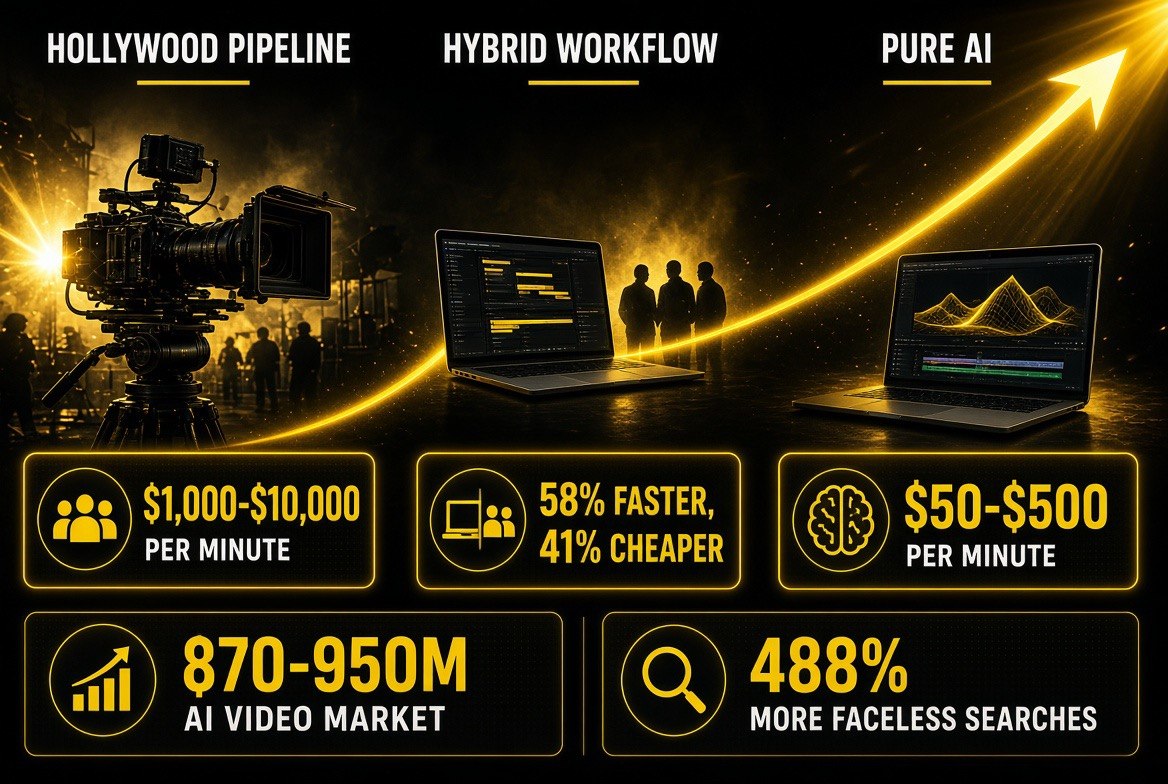
The cost gap is the whole story. A Hollywood-grade pipeline runs $1,000 to $10,000 per finished minute, a hybrid workflow cuts time by roughly 58% and cost by about 41%, and a pure AI workflow lands between $50 and $500 per minute. Katzenberg’s startup is aimed at the top of that range, but the tooling it normalizes is what keeps pushing the bottom down.
The Numbers Behind the Shift
The creator economy data for 2026 shows how far this has already gone.
| Metric | 2026 Figure |
|---|---|
| Creators calling AI integrated or essential to their work | 75% |
| Creators reporting AI accelerated audience or business growth | 87% |
| YouTube Shorts in recommendations that are AI-generated | About 21% |
| AI video share of all digital video (projected) | About 10% |
| Channels using YouTube’s own AI creation tools daily | Over 1 million |
| AI video generator market size | $800–950 million |
| Surge in Fiverr searches for faceless YouTube creation | Up 488% |
Now the cost side, because this is where the story stops being abstract:
| Production Approach | Cost per Finished Minute | Typical Use Case |
|---|---|---|
| Traditional professional production | $1,000 to $10,000+ | Brand films, commercials, scripted content |
| AI-assisted hybrid | $200 to $1,000 | YouTube channels, explainers, tutorials |
| Pure AI generation | $50 to $500 | Faceless channels, short-form, rapid testing |
| Full solo creator AI stack | $50 to $140 per month | Multiple videos weekly, one person |
That last row is the one to sit with. A solo creator running a stack of ChatGPT or Claude for scripting, ElevenLabs for voiceover, and an AI video tool plus CapCut for assembly can put out multiple videos a week for under $140 a month. The equivalent output from freelance editors, voice actors, and production help would run into the thousands.
Hybrid workflows — human strategy, AI execution — show about 58% faster production and 41% lower costs with minimal quality impact. That’s the formula that works today. Pure AI output is priced 40–60% below human-made equivalents, and buyers notice: it converts worse when it’s obviously cheap. The creators winning right now are running hybrid.
Yours
Notice what the cost table doesn’t include, because it’s the real difference between you and a studio. Katzenberg’s venture is chasing film production — a world of union crews, insurance requirements, and release windows. Your bottleneck was never a $10,000-per-minute budget. It was having enough hours in a week to script, record, edit, and publish.
That’s the asymmetry. Studios are adopting AI to cut costs on projects that were always going to be made. Solo creators are adopting AI to make projects that were previously impossible — because there was no crew, no budget, and no time. A faceless channel with 400 videos and a monthly AI bill under $140 is a business that could not have existed in 2020.
The Katzenberg news doesn’t change your workflow this month. What it does is confirm that the tooling you depend on is being pushed forward by enormous investment. When capital flows into a technology, quality rises and prices fall. You’ve been on the right side of that curve already.
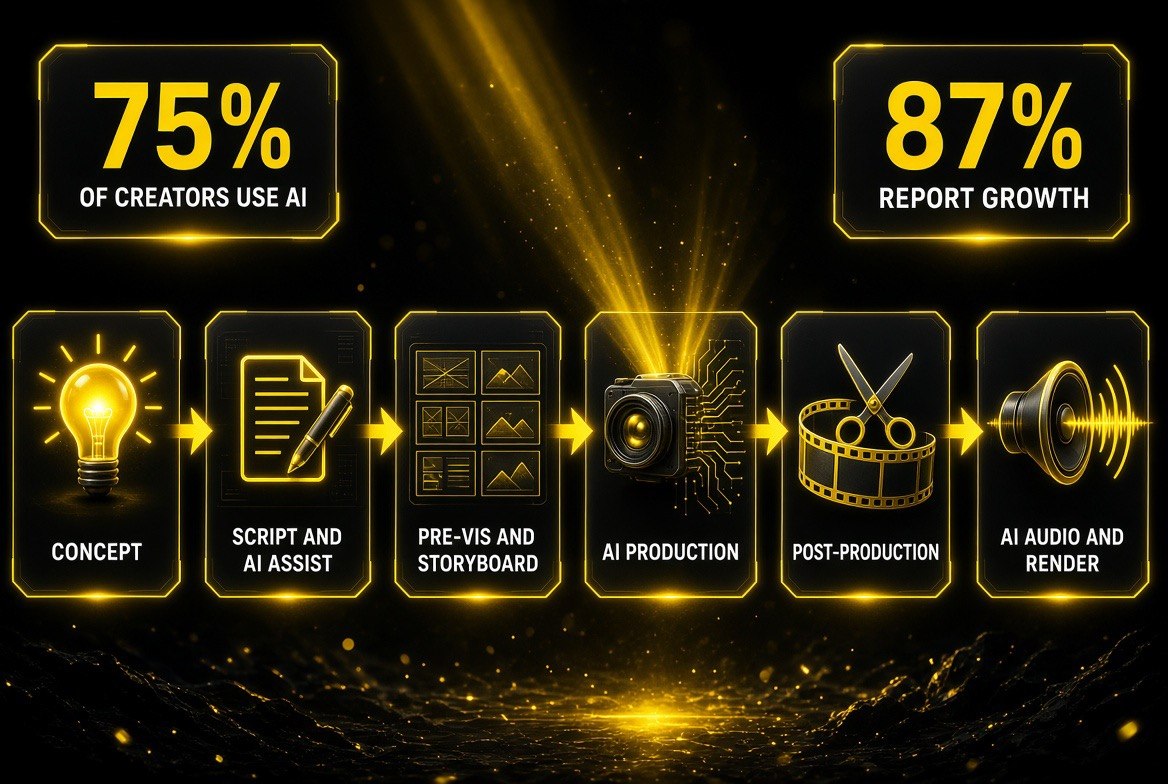
The full pipeline, stage by stage. Concept, script assist, pre-vis and storyboard, AI production, post, then AI audio and render. Katzenberg’s reported ambition is to build professional tooling across that whole chain, and every one of those stages already has a consumer-priced equivalent a solo creator can plug in today.
What to Actually Do
Stay hybrid
The data is unambiguous. Fully automated channels get flagged and demonetized. Channels where a human sets the strategy, writes the script’s spine, and directs the AI execution are growing. Keep yourself in the loop on the parts that carry your voice.
Invest in what AI can’t replicate
Your taste, your point of view, your audience relationship, and your on-camera presence if you have one. As generation quality rises for everyone, the differentiator moves from “can you produce this” to “should this exist, and does anyone care about your version of it.”
Watch labeling and disclosure rules
YouTube now applies automatic synthetic-content labeling in many cases and has been terminating channels for repetitive low-effort content. Disclose AI use where required, and never build a channel whose entire value proposition is volume for its own sake. The platform is actively policing that model.
Keep your stack portable
Tools fold, get acquired, and repriced constantly. OpenAI shut down Sora 2’s consumer product and left hundreds of thousands of creators scrambling. Keep your scripts, assets, and voice profiles in formats you control, so a shutdown is an inconvenience rather than an extinction event.
Read studio adoption as your leading indicator
When professional production pipelines adopt a capability, consumer versions arrive within about two years. Watch what studios start using for pre-visualization, storyboards, and effects. That’s your roadmap for what you’ll have on a laptop soon.
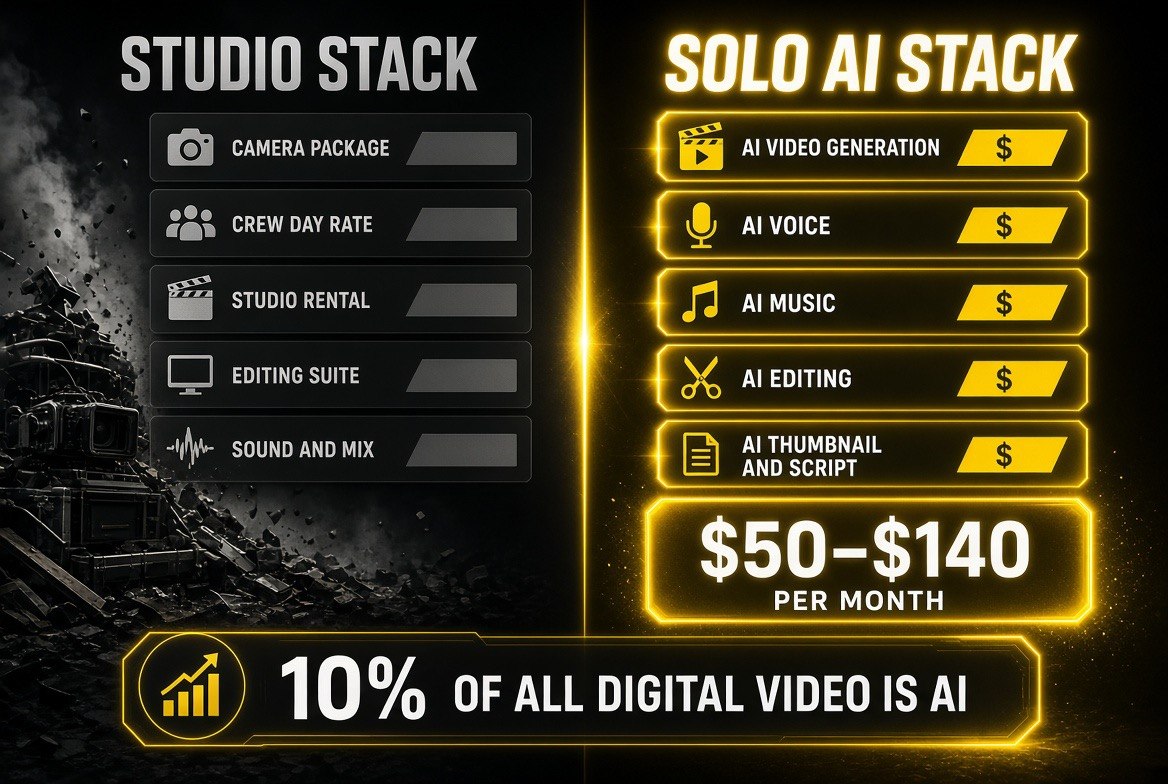
Studio stack versus solo stack. Camera package, crew day rates, studio rental, edit suite, sound and mix on one side; AI video generation, AI voice, AI music, AI editing, AI thumbnail and script on the other. The solo version runs roughly $50 to $140 a month, and AI already accounts for about a tenth of all digital video.
The Bottom Line
The Katzenberg venture is early, unnamed, and unproven. It’s a funding story, not a product story. But the direction is clear: the most experienced people in filmed entertainment believe AI video is the next production platform, and they’re building for it with serious capital behind them.
For a YouTube creator, the play doesn’t change. Stay hybrid, own your voice, keep your stack portable, and let the tooling arms race work in your favor. The gap between a Hollywood budget and a solo operation has been closing for three years. This is one more sign it keeps closing.
Frequently Asked Questions
What is Jeffrey Katzenberg’s new AI video startup?
Reported on September 9, 2026, it’s a venture being developed through his firm WndrCo to train advanced AI video models for professional film production. Collaborators include Bill Peebles, former head of OpenAI’s Sora video model, and Sujay Jaswa, ex-CFO of Dropbox. The company has no public name or launch date yet.
Will this AI video tool be available to YouTube creators?
Not directly, and probably not soon — it’s aimed at film production, not consumer editing. What matters for creators is the downstream effect: advances in professional video generation push the underlying models forward, and those improvements reach consumer tools within roughly two years.
What does this mean for faceless AI YouTube channels?
It confirms the direction, but it also raises the quality bar. As AI video gets better, audiences and platforms both get less tolerant of obvious low-effort AI content. Hybrid channels, where a human directs strategy and AI handles execution, are the ones growing and staying monetized.
How much can a solo creator save using AI video tools?
Traditional professional production often runs $1,000 to $10,000+ per finished minute. Pure AI generation runs $50 to $500. A full solo creator stack — scripting, voiceover, video, editing, thumbnails — typically costs $50 to $140 a month for someone producing multiple videos weekly.
Is fully automated AI video content safe for monetization?
Not reliably. YouTube applies automatic synthetic-content labeling in many cases and has terminated channels for repetitive low-effort output. Keep human oversight in scripting, direction, and editorial judgment, and disclose AI use where the platform requires it.
Why is Hollywood suddenly embracing AI video?
The same reason any industry adopts a technology that cuts cost: the economics become impossible to ignore. Katzenberg bringing studio credibility to an AI video venture signals a shift from resistance to participation — and when experienced producers build the tooling, adoption accelerates industry-wide.
Should creators wait for better AI video tools before starting?
No. The tools available today are already enough to build a channel. Waiting for the next generation means shipping nothing. Start with a hybrid workflow, learn what your audience responds to, and upgrade your tooling as it improves.

About Barak Schurr
Barak Schurr is a serial entrepreneur who built and exited a major ticketing platform before turning his attention to AI and content. He runs three AI-focused research sites and writes about the tools, workflows, and strategies that let solo creators build real channels — without a crew, a studio, or a Hollywood budget.
Email: [email protected]
More AI Resources for Your Business