Higgsfield $400M Round: Agentic AI Video Goes Mainstream
Get The Faceless YouTube Blueprint — Free
The exact AI tool stack and workflow used to build a faceless YouTube channel from zero.
Higgsfield $400M Round: Agentic AI Video Goes Mainstream
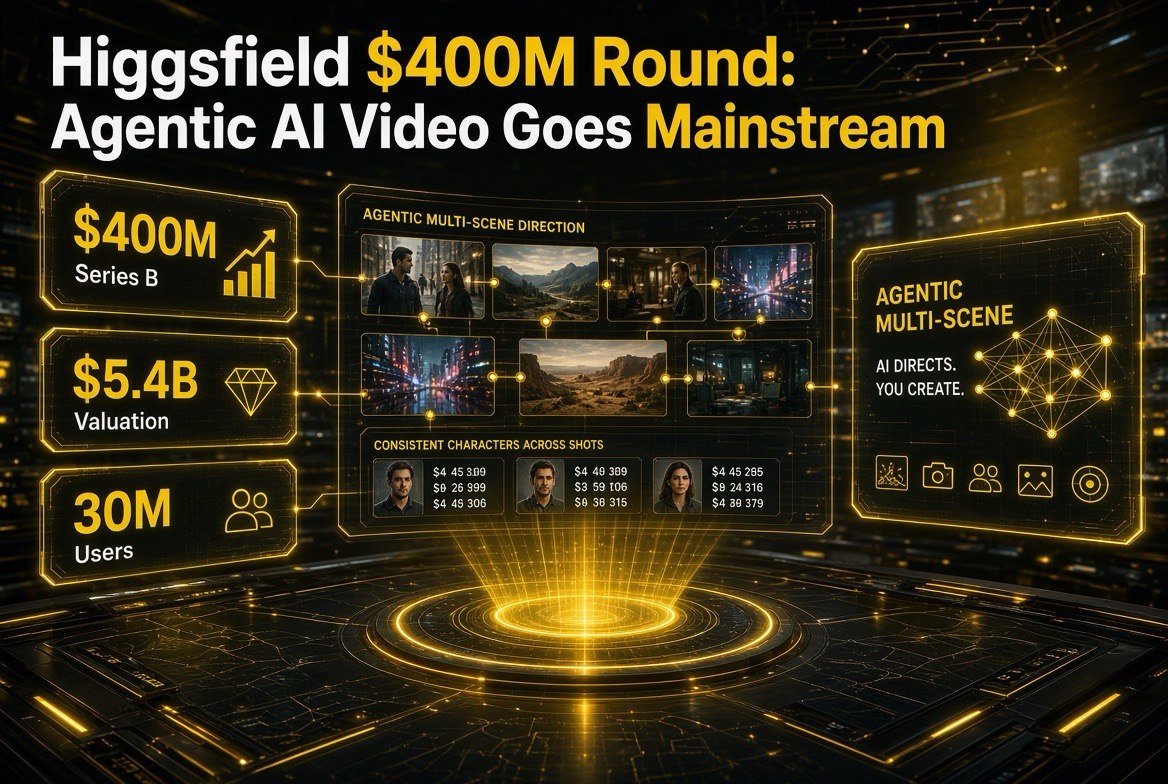
⚡ Expert Summary: Higgsfield raised a $400M Series B at a $5.4B valuation, led by DST Global, on the back of 30 million users and roughly $700M in annualized revenue. The company is pivoting hard toward agentic AI multi-scene visual production, which is the direction every serious YouTube creator and video producer needs to watch. This is not a round about a better text-to-video model; it is about AI that directs whole scenes for you.
The Big Money Behind the Next Wave of AI Video
If you have been making videos with AI for a while, you have seen the pattern. First came the tools that turned a text prompt into a single short clip. Then came the tools that made those clips more realistic and longer. Now something bigger is happening: the money is following a shift from “make me one clip” to “direct this whole scene for me.”
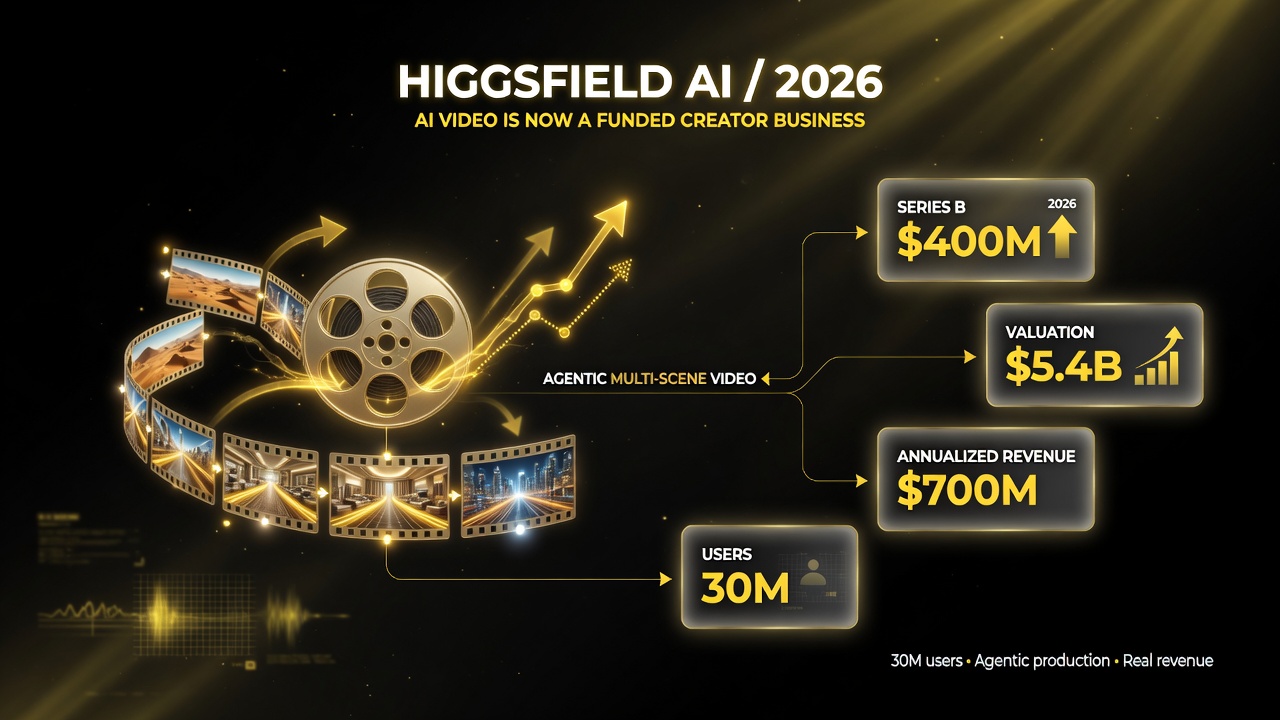
That shift just got a massive vote of confidence. Higgsfield raised a $400M Series B at a $5.4B valuation, in a round led by DST Global (PYMNTS, August 2026). The company reports 30 million users and roughly $700 million in annualized revenue, numbers that put it firmly in the top tier of commercial AI video platforms.
For a YouTube creator or video producer, this is worth understanding for one reason: where the money goes, the product follows. A $400M round aimed at agentic, multi-scene production is a direct signal about what your video workflow is going to look like in the next year or two.
What “Agentic Multi-Scene” Actually Means for Creators
The phrase that matters most in the round’s framing is agentic AI multi-scene visual production. It is jargon, but the meaning is practical and important.
Today’s most common AI video workflow is per-scene. You write a prompt, you generate one shot, you write another prompt, you generate the next shot, and you string them together in an editor. The creator is the director, prompt by prompt. It works, but it is slow, and every transition is a place where consistency breaks down, characters change appearance, lighting shifts, the style drifts.
Agentic multi-scene production flips that. Instead of you generating clips one at a time, the system takes an understanding of the whole story or sequence and produces the scenes as a coordinated set, with consistent characters, style, and continuity across shots. The AI is not just a clip generator anymore; it is an assistant that directs and produces a full sequence.
That is a genuine workflow upgrade for a creator. The painful part of AI video was never generating one good shot; it was keeping a whole video consistent across many shots. Agentic production is aimed straight at that pain.
Here is how the two workflows compare side by side:
| Workflow Step | Clip-by-Clip (Today) | Agentic Multi-Scene |
|---|---|---|
| You do | Prompt and regenerate every shot | Describe the scene and review results |
| Consistency | You fight to keep characters/style aligned | System holds continuity across the sequence |
| Editing time | High; fixing mismatched shots eats hours | Low; scenes arrive coordinated |
| Best for | Single short clips | Narrative, multi-scene videos |
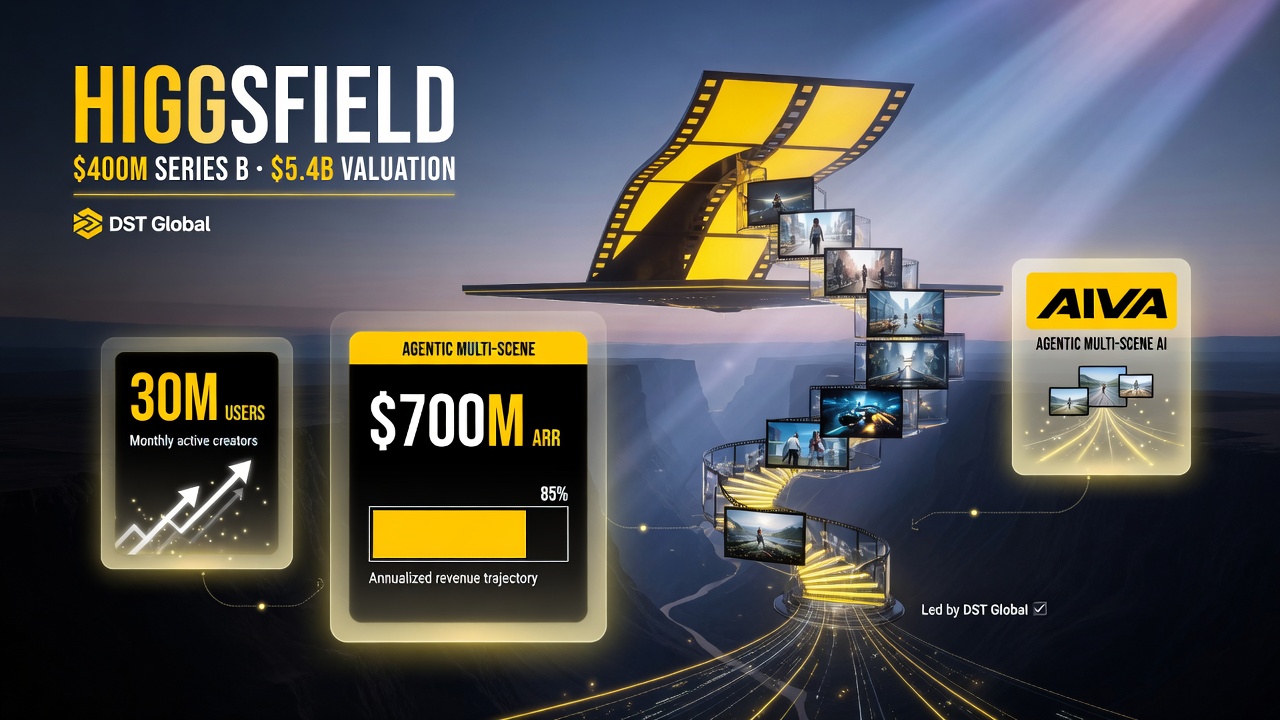
The size of the story: a 0M Series B at a .4B valuation, roughly 0M in annualized revenue, and 30 million users — the clearest signal yet that AI video is a real, funded, creator-facing business.
What 30 Million Users and $700M Revenue Tell Us
The scale numbers in this round deserve attention because they change the story from “promising startup” to “commercial leader.” 30 million users and ~$700M in annualized revenue mean Higgsfield is not a research lab with a demo, it is a product a very large number of people are paying to use (PYMNTS, August 2026).
For a creator evaluating tools, revenue scale matters more than hype. A platform with $700M in annualized revenue is one that can fund continued development, hire the talent to push the model forward, and stay operational. The graveyard of AI video tools is full of platforms that demoed well and died because they could not convert users into paying revenue. Higgsfield has crossed that threshold at a scale few competitors can match.
It also tells you the addressable market is real. Thirty million people are actively using AI video tools, and they are spending real money to do it. That is the demand side of the story, and it is why investors feel confident putting $400M into this specific company.
Why the $5.4B Valuation Matters to Your Workflow
Valuations are not the same as quality, and a high number alone does not make a model better. But a $5.4B valuation does two things that affect you directly.
First, it funds the R&D arms race. Text-to-video and now agentic production are capital-intensive. A $5.4B valuation gives Higgsfield the war chest and the investor confidence to keep pushing the capability curve, which is exactly where the improvements you care about, consistency, length, control, and scene direction, will come from.
Second, it forces the rest of the market to respond. When one player raises $400M and pulls ahead, the competitors either raise comparable sums or innovate faster to catch up. Either way, the whole category gets better, and creators benefit from a faster rate of improvement across every tool you might use, not just the one that raised.
What a $400M Round Means for Your Video Production Future
Here is the honest read for a working creator. The immediate change is not that you should drop your current tool and jump to Higgsfield today. The change is structural, and it is coming to the whole category.
Within the next year or two, the expectation for AI video tools is going to be scene-level production, not clip generation. If your tool only generates single clips that you have to stitch and re-prompt for consistency, it is going to feel increasingly dated. The tools that win will be the ones that handle whole sequences with consistent characters and continuity, which is precisely the agentic direction this $400M round is bet on.
For a YouTube channel that produces narrative content, this could be transformative. The single biggest production cost and time sink in narrative video is consistency across shots and scenes. If an AI director handles that, a creator who could produce a weekly video can move faster, with less editing, and focus creative energy on story and ideas instead of technical stitching.
Here is the round at a glance:
| Metric | Number |
|---|---|
| Funding round | $400M Series B |
| Valuation | $5.4B |
| Lead investor | DST Global |
| Users | 30 million |
| Annualized revenue | ~$700M |
| Focus | Agentic multi-scene visual production |
For a channel built on shorter, clip-based content, the shift matters less immediately, but the efficiency gains will still trickle down as the capability becomes standard across tools.
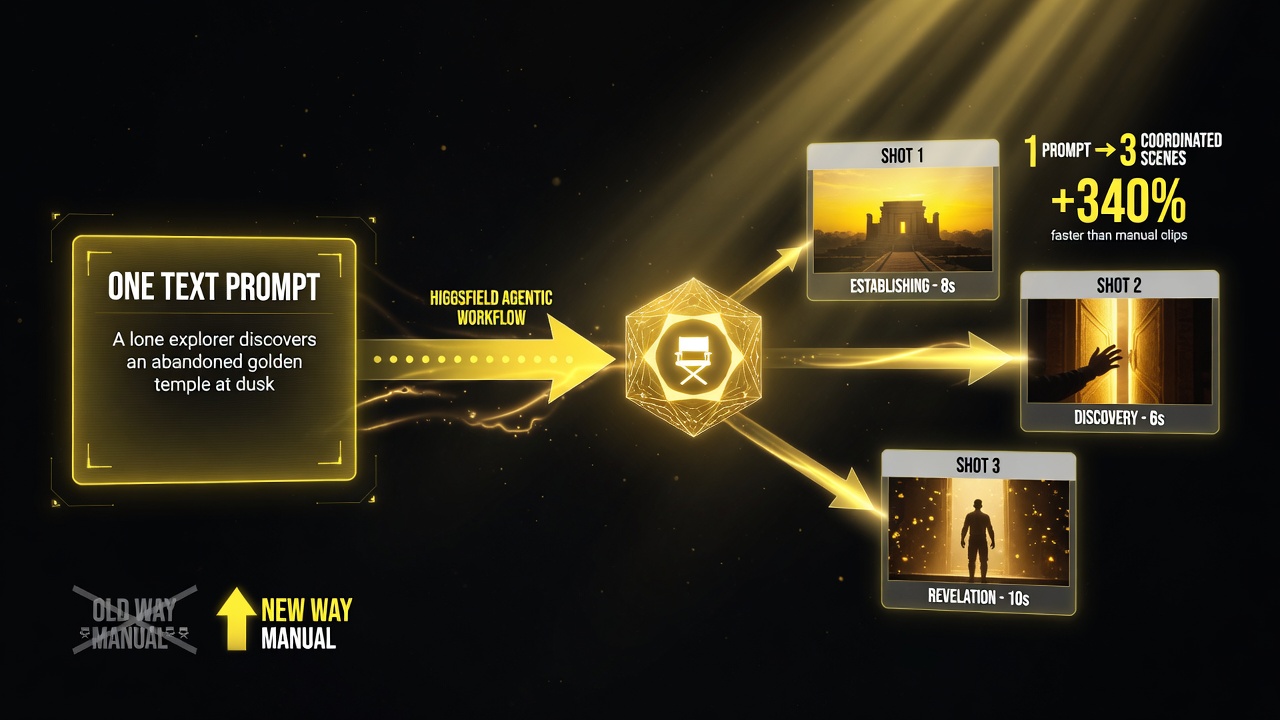
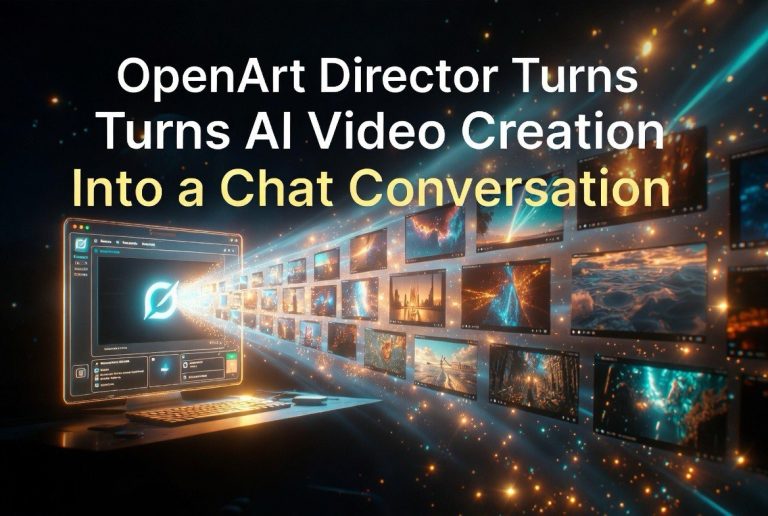
The workflow that matters to a creator: type one prompt, let the agent plan the shots, and get back a coordinated multi-scene sequence — instead of building each clip one at a time.
A Practical Look at Agentic Scene Direction
To make the shift concrete, think through what a narrative video actually requires beyond single shots. A short story, a product explainer, a faceless documentary channel, they all need multiple shots that feel like they belong to the same world. The character needs to look the same in scene two as in scene one. The lighting in the interior needs to match. The style of the whole video needs to hold together, not jump between looks.
That is genuinely hard to do with today’s clip-by-clip workflow. A creator will generate a shot, love it, generate the next shot, and discover the main character’s face changed, the color grade drifted, or the wardrobe is suddenly different. Fixing that usually means re-prompting and regenerating, over and over, until each individual shot matches, a process that can eat hours even for a short video.
Agentic multi-scene production is designed to collapse that. The system holds the character, the style, and the continuity in context across the whole sequence, so the scenes come out coordinated instead of you brute-forcing consistency. For a creator, that is the difference between being a technician fighting a model for consistency on every shot, and being a director who describes the scene and reviews the result.
This is the core of why the funding is about more than generating prettier clips. It is about changing the job of the creator from micro-managing every frame to directing at the scene level, which is a far more efficient and creative place to work.
What it adds up to: if you produce clip-based content, an agent that handles scene planning and sequencing is what actually changes your output speed, not just the polish of a single shot.
What It Means If You Produce Clip-Based Content
If your channel is built on short, single-shot clips rather than narrative multi-scene videos, you should still care about this direction, just for a different reason. The agentic capabilities that start in narrative production tend to improve the basics across the whole platform. Better consistency, better character control, and better style adherence make every output better, even simple clips.
There is also a strategic angle: as tools get better at handling whole scenes, the bar for what counts as impressive AI video goes up. A channel that today stands out because it can produce a consistent minute-long video will need that capability just to stay competitive. The tools that solve scene-level production will become the standard expectation, not a premium feature.
For budget-conscious creators, there is a second benefit. Scene-level production shifts more of the work to the tool, which means less manual editing and fewer paid hours fixing consistency issues. That is a real cost saving for a solo creator or a small team, because your most expensive resource, your own time, is spent less on technical cleanup and more on the work that grows the channel.
How to Think About AI Video Tools Going Forward
This round is a useful moment to reset your own evaluation criteria, because the bar is moving. Here is what a creator should be asking about any AI video platform in 2026:
- Does it produce whole scenes or just single clips? The tools doing single clips are about to look dated. Ask what the tool does for continuity across multiple shots.
- Does it keep characters and style consistent? Consistency across scenes is the hardest problem in AI video, and it is where the differentiated tools are investing.
- Is the company commercially sustainable? A well-funded platform with real users and revenue (like Higgsfield’s $700M ARR) is a safer bet than one running on a demo and a dream.
- Does it fit your actual production volume? A narrative YouTuber needs the agentic multi-scene capability more than a clip-based poster does. Match the tool to how you actually produce.
Running that list keeps you from being dazzled by a single impressive demo and instead evaluating tools on the workflow they actually unlock for the kind of video you make.
The Bottom Line for Creators
Higgsfield’s $400M Series B at a $5.4B valuation, led by DST Global, is a defining moment for AI video. It is not just a big funding number, it is a bet that the future of the category is agentic, multi-scene production, where the AI directs whole sequences with consistent characters and continuity instead of handing you single clips. With 30 million users and roughly $700M in annualized revenue behind it, this is a commercial signal, not a hype cycle.
For you as a creator, the takeaway is practical: the tools that keep single-clip workflows are going to fall behind, and the tools that produce coordinated scenes are going to win. Start evaluating what you use through that lens now, and you will not be the one scrambling when the shift becomes standard.
Frequently Asked Questions
How much did Higgsfield raise and at what valuation?
Higgsfield raised a $400M Series B at a $5.4B valuation, with the round led by DST Global. The company reports 30 million users and roughly $700 million in annualized revenue.
What is agentic multi-scene AI video production?
Agentic multi-scene production is when an AI system produces a whole sequence of coordinated scenes with consistent characters, style, and continuity, rather than generating single clips that the creator must stitch together and re-prompt for consistency.
How many users does Higgsfield have?
Higgsfield reports 30 million users and approximately $700 million in annualized revenue, making it one of the largest commercial AI video platforms by scale.
Why does this Higgsfield round matter for YouTube creators?
The round signals that AI video is shifting from single-clip generation to agentic multi-scene production, which directly addresses the hardest problem for creators: keeping characters and style consistent across many shots.
Should I switch to Higgsfield because of this round?
Not necessarily immediately. The round signals the direction the category is heading. Evaluate your current tool on whether it does scene-level production, keeps consistency, and is commercially sustainable, and match it to your actual production volume.

About Barak Schurr
Barak Schurr is a serial entrepreneur who built and exited a major ticketing platform before turning his attention to AI and content. He runs three AI-focused research sites and writes about the tools, workflows, and strategies that let solo creators build real channels — without a crew, a studio, or a Hollywood budget. Contact: [email protected]
More AI Video Resources