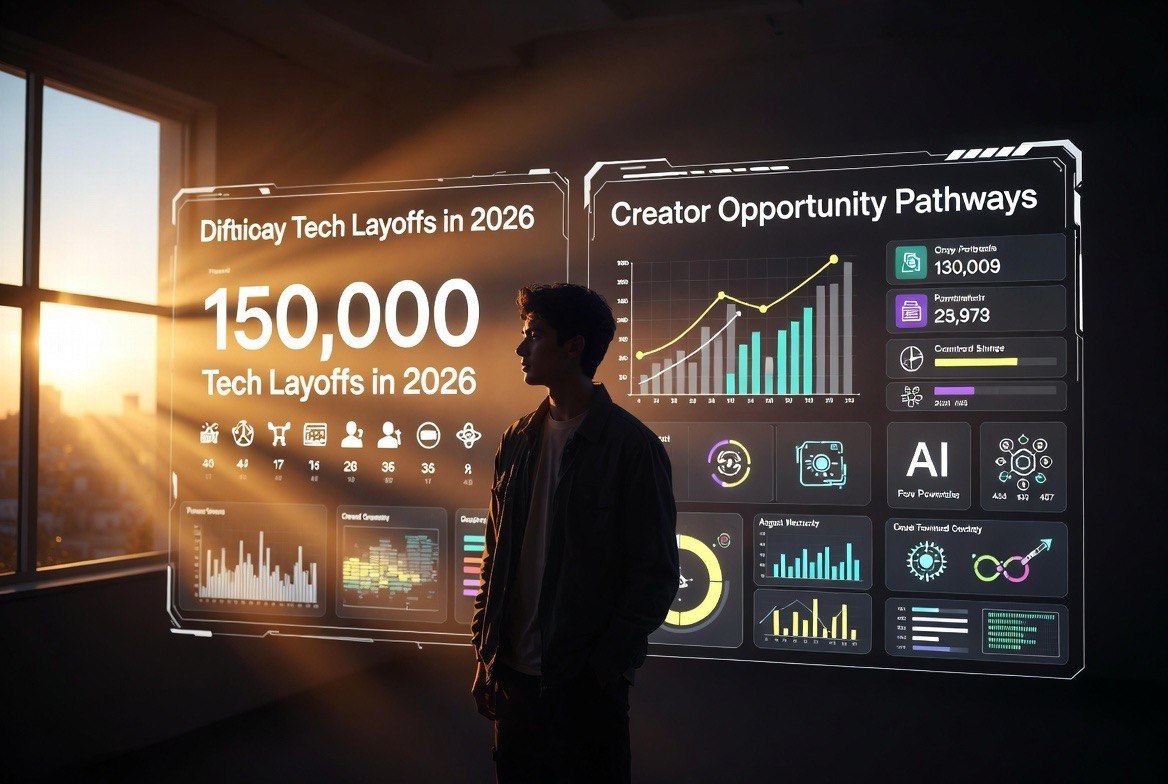
150,000 Tech Workers Were Laid Off in 2026 — What the AI Job Crisis Means for Creators
Get The Faceless YouTube Blueprint — Free
The exact AI tool stack and workflow used to build a faceless YouTube channel from zero.
150,000 Tech Workers Were Laid Off in 2026 — What the AI Job Crisis Means for Creators
⚡ Expert Summary: 363 tech companies laid off 150,000+ workers in 2026 — 44% faster than the previous year — with AI cited as the most common reason. For creators who depend on AI video tools, this matters: the platforms you build your workflows on are run by companies in a volatile industry. Understanding which AI video companies are stable versus burning cash is now part of production planning.
Something strange is happening in American tech right now. Companies across the United States are laying off workers at record rates — and citing AI as the reason — while simultaneously investing billions in AI development.
The numbers from TrueUp, which tracks tech layoffs, paint a stark picture: 363 tech companies have conducted layoffs in 2026, affecting 150,000+ workers. That’s 44% faster than 2025’s pace. AI is the single most-cited cause of job cuts across every industry sector.
Inside the AI companies themselves, the picture is darker. A recent TechCrunch investigation into Meta’s months-old AI unit described it as “a soul-crushing gulag” according to engineers stuck inside it. The same company that’s spending $65 billion on AI infrastructure this year is also cutting teams and burning out the engineers building the products.
For creators using AI video tools, this contradiction matters. The platforms you rely on — Runway, Pika, Kling, Veo, Synthesia — are built by companies operating in this environment. Some are well-capitalized with clear paths to profitability. Others are burning cash and hoping the market catches up. Knowing which is which affects your production planning.
Which AI Video Companies Are Stable vs at Risk
Not all AI video companies are in the same position. The 150,000 layoffs are concentrated in companies that raised too much money, grew too fast, and now face the reality of needing to generate revenue. Some platforms are in strong positions. Others are not.
Here is how the major AI video platforms stack up based on publicly available funding, revenue, and burn rate data:
- Runway: Raised $300M+ at a $4B valuation. Revenue estimated at $75-100M annually with a focus on enterprise and creator subscriptions. Multiple product lines (Gen-4, Aleph, Seedance) provide diversification. Runway has been operating since 2018 and has survived multiple market cycles. They laid off staff in 2024 but stabilized after restructuring. Their enterprise tier protects them from consumer-market volatility. Stability: high.
- Pika: Raised $135M at a valuation over $1B. Revenue estimates are not publicly available, which is a significant yellow flag. The company is still pre-revenue or early-revenue on a consumer-focused model that has historically been hard to monetize. Pika team is lean — about 30 people — which limits burn but also limits capacity for product development and support. In a consolidation environment, Pika would be an acquisition target rather than a survivor on its own. Stability: moderate-to-low.
- Kling (Kuaishou): Backed by Kuaishou, a publicly traded Chinese tech company with $12B+ in annual revenue. Kling is a product line within a larger company, not a standalone startup. It does not need to be profitable independently. This structural advantage means Kling can outlast almost any startup competitor on the market. Stability: high.
- Veo (Google): Part of Alphabet, a $300B+ market cap company. Veo does not have its own P&L. It exists because Google needs a competitive AI video offering, not because it needs to generate immediate revenue. Google can afford to run Veo at a loss for years if necessary. Stability: very high.
- Synthesia: Raised $180M at a $2.1B valuation. Revenue estimated at $50-70M annually from enterprise subscriptions. Founded in 2017, profitable or near-profitable per industry reports. Focus on enterprise AI avatars provides recurring revenue from long-term contracts. Stability: high.
- Vidu (Shengshu AI): Chinese startup with $150M+ in funding. Revenue unclear. Dependent on Chinese market dynamics and regulatory environment. Benefits from China domestic market but faces export restrictions that limit international growth. Stability: moderate.
- Topaz Labs: Bootstrapped and profitable for over a decade. The only major player that has never taken VC funding. Topaz Video AI generates consistent revenue from a loyal customer base of professional editors who depend on the tool for daily work. No investor pressure to grow fast or cut costs. Stability: very high.
The pattern is clear: platforms backed by large, profitable parent companies (Google, Kuaishou) or with sustainable independent revenue (Runway, Synthesia, Topaz) are well-positioned for the consolidation ahead. Platforms that depend on venture capital and have not demonstrated revenue viability are the ones at risk.
Not all AI video companies are in the same position. Here is how the major platforms stack up based on publicly available funding, revenue, and burn rate data:
- Runway: Raised $300M+ at a $4B valuation. Revenue estimated at $75-100M annually with a focus on enterprise and creator subscriptions. Multiple product lines (Gen-4, Aleph, Seedance) provide diversification. Runway has been operating since 2018 and has survived multiple market cycles. Stability: high.
- Pika: Raised $135M at a valuation over $1B. Revenue estimates are not publicly available, which is a yellow flag. The company is still pre-revenue or early-revenue on a consumer-focused model that has historically been hard to monetize. Pika’s team is lean — about 30 people — which limits burn but also limits capacity. Stability: moderate.
- Kling (Kuaishou): Backed by Kuaishou, a publicly traded Chinese tech company with $12B+ in annual revenue. Kling is a product line, not a standalone company. It does not need to be profitable independently. Stability: high.
- Veo (Google): Part of Google’s $300B+ parent company Alphabet. Veo does not have its own P&L. It exists because Google needs a competitive video offering. Stability: very high.
- Synthesia: Raised $180M at a $2.1B valuation. Revenue estimated at $50-70M annually from enterprise subscriptions. Founded in 2017, profitable or near-profitable according to industry reports. Focus on enterprise AI avatars provides recurring revenue. Stability: high.
- Vidu (Shengshu AI): Chinese startup with $150M+ in funding. Revenue unclear. Dependent on Chinese market dynamics and regulatory environment. Stability: moderate.
- Topaz Labs: Bootstrapped and profitable for over a decade. The only major player that has never taken VC funding. Topaz Video AI generates consistent revenue from a loyal customer base of professional editors. Stability: very high.
The Creator Impact Is Real
When an AI video company runs into trouble, creators feel it immediately.
OpenAI’s Sora 2 shutdown in 2026 is the most visible example. Over 500,000 creators built workflows and content around Sora. When OpenAI announced the shutdown, those creators had to migrate to alternative platforms — losing prompt libraries, workflow templates, and production momentum. The companies that survived the Sora refugee wave (Runway, Kling, Veo) gained users, but the transition cost was paid by creators.
This pattern repeats every time an AI company fails or pivots. The cost of switching platforms is asymmetrical: the company bears a small cost (shutting down a product line), while its users bear a large cost (rebuilding workflows, retraining teams, re-creating assets).
The layoff wave makes this risk larger, not smaller. Companies under financial pressure cut product lines that aren’t profitable. They deprioritize creator tools. They raise prices or reduce free tiers. They change APIs without backward compatibility. Every one of these actions hurts creators who depend on the platform.
For professional creators in the United States who rely on AI video tools for client work, the risk is compounded: a platform shutdown means not just rebuilding your workflow — it means explaining to clients why you can’t deliver on existing commitments, renegotiating deadlines, and absorbing the cost of migration.
How to Build Platform-Agnostic Workflows
The best hedge against platform instability is a workflow that doesn’t depend on any single AI video company. Here is how professional creators are building durable production pipelines:
- Keep prompts and assets platform-agnostic. Store your prompts, reference images, and style guides in a format that works across multiple tools. A well-structured prompt for Runway Gen-4 can be adapted to Kling or Veo with minor changes. The same prompt locked into a single platform’s proprietary format is a migration risk.
- Maintain at least two platform subscriptions. The cost of maintaining active accounts on two AI video platforms ($30-80/month each) is an insurance premium against platform failure. When Sora 2 shut down, creators with active Runway or Veo accounts migrated in hours instead of days.
- Build a modular post-production pipeline. Separate your generation tools from your editing tools. If you use one platform for generation and another for post-processing, losing the generation platform doesn’t break your entire workflow. DaVinci Resolve, Premiere, and CapCut are independent of which AI tool generated the footage.
- Monitor company health signals. Track funding rounds, layoff announcements, and pricing changes for the platforms you depend on. A platform that raises prices sharply or cuts its free tier is signaling financial pressure. A platform that loses key engineers is signaling operational risk. Treat these as migration triggers.
What the Layoff Wave Really Says About AI
The 150,000 layoffs in 2026 are not a sign that AI is failing. They are a sign that the AI industry is maturing — and maturation means consolidation.
Companies that cannot demonstrate a path to profitability are cutting costs to survive. Companies that can demonstrate profitability are gaining market share. The companies that survive this consolidation will be stronger, more stable, and better positioned to invest in creator tools over the long term.
The risk is not that AI video tools will disappear. It’s that the tools you’re using today might not be the tools available tomorrow — and the cost of switching is paid by you, not the platform.
For creators, the lesson is not to abandon AI tools. It’s to build workflows that survive platform turnover. Keep your skills portable. Keep your assets in open formats. Keep at least one alternative platform ready.
The AI video industry is not going away. But it is going through a shakeout that will separate the sustainable platforms from the ones that burn out. The creators who plan for that separation are the ones who keep producing through it.
Frequently Asked Questions
How many tech layoffs happened in 2026?
According to TrueUp, 363 tech companies laid off over 150,000 workers in 2026. The pace is 44% faster than the same period in 2025, with AI cited as the most common reason for job cuts across every industry sector. TechCrunch reported the data on June 15, 2026.
Which AI video companies are most at risk of shutdown?
Companies with the highest risk profile are those that are pre-revenue or early-revenue with high burn rates and no clear path to profitability. Pika is the most notable example — a $1B+ valuation with limited public revenue data and a consumer-focused model that has historically been hard to monetize. Companies backed by larger parent corporations (Veo by Google, Kling by Kuaishou) carry the lowest risk.
Should creators stop using AI video tools because of layoffs?
No. The layoffs reflect industry consolidation, not industry decline. The surviving platforms will be stronger. The risk is platform-specific failure, not a collapse of the AI video category. Build platform-agnostic workflows, maintain backups, and monitor company health — but continue using the tools that generate value for your work.
How can creators protect themselves from platform shutdowns?
Keep prompts and assets in portable formats, maintain subscriptions on at least two platforms, build modular post-production pipelines that separate generation from editing, and monitor company financial health signals. The cost of maintaining a backup platform ($30-80/month) is negligible compared to the cost of rebuilding workflows from scratch.
What happened with Sora 2’s shutdown?
OpenAI shut down Sora 2 in early 2026, affecting over 500,000 creators. Users had to migrate to alternatives like Runway, Veo, and Kling. Many lost prompt libraries, workflow templates, and production momentum. The shutdown demonstrated the risk of building workflows around a single AI video platform and accelerated the trend toward multi-platform strategies. For ongoing coverage of AI video tools and the companies building them, visit the AI video tools section at AI Video Advisor.

About Barak Schurr
Barak Schurr is a serial entrepreneur who built and exited a major ticketing platform before turning his attention to AI and content. He runs three AI-focused research sites and writes about the tools, workflows, and strategies that let solo creators build real channels — without a crew, a studio, or a Hollywood budget.
Email: [email protected]
More AI Resources for Your Business