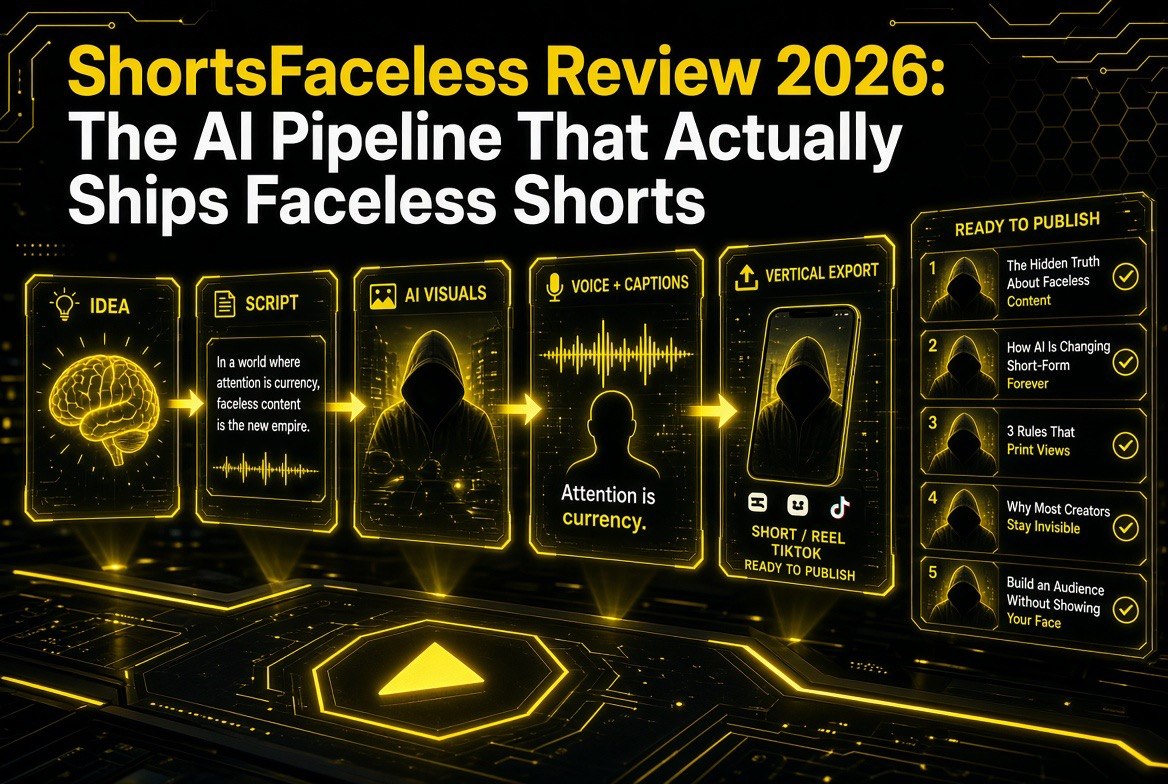
ShortsFaceless Review 2026: The AI Pipeline That Actually Ships Faceless Shorts
Get The Faceless YouTube Blueprint — Free
The exact AI tool stack and workflow used to build a faceless YouTube channel from zero.
ShortsFaceless Review 2026: The AI Pipeline for Faceless Shorts That Actually Ships Videos
⚡ Expert Summary: ShortsFaceless is a browser-based, single-purpose tool that turns a faceless short-form video idea into a finished, captioned, voiced clip in one pipeline — script generation, AI-generated imagery, scrolling-caption styling, and 40+ voices across 10+ languages. At $19 to $29 a month, it undercuts the generalist suites on price and removes the tool-hopping that kills most solo creators. It is not the deepest editor on the market, but it is one of the fastest paths from idea to a publishable Short, Reel, or TikTok.
Why faceless shorts are the most achievable channel for a solo creator
There is a reason faceless content is the entry point for so many first-time creators. You do not need to be on camera, you do not need a studio, and you do not need to spend money on a film crew. The raw material is the script and the idea — everything else can be handled by the right stack. That is what makes the format genuinely achievable for someone working alone after a day job.
The problem is that a lot of creators never ship anything. They collect the tools — one for scripts, one for voice, one for captions, one for stock — and lose hours stitching them together, exporting, fixing orphans, and redoing voice takes. The pipeline approach exists precisely to kill that friction. One tool carries the idea from a prompt to a finished uploadable short before the motivation fades.
What ShortsFaceless actually is
ShortsFaceless is a browser-based AI platform built around one workflow: turning a faceless short-form video idea into a published clip fast. It is not trying to be a full video editor or a general AI suite. It is laser-focused on the faceless shorts format — most often history, motivational, finance, true crime, and educational niches — and it automates every step between the idea and the export button.
You feed it a topic or a one-line idea, and it assembles the project. It generates the script, picks or creates visuals, adds an AI voice, lays in scrolling captions matched to the spoken words, and packages it into the vertical short-form format. The pitch is simple: fewer apps, fewer exports, fewer abandoned projects.
The end-to-end creation pipeline
Walking through the flow shows why the single-tool design matters. You start with a topic or prompt. ShortsFaceless turns that into a short-form script structured for retention — a hook up front, tight pacing, and a payoff that fits the 30-to-60-second window most shorts live in.
From there it generates the visuals. Rather than forcing you to hunt for stock clips that never quite fit, the platform creates AI-generated imagery matched to the script’s scenes and keywords. This keeps the look consistent — which matters in faceless niches where a coherent visual style is what separates a channel that looks intentional from one that looks assembled.
The final assembly layers in an AI voice-over and scrolling captions that track the words being spoken. Captions are the single biggest driver of short-form watch time, because a large share of viewers watch muted. Having them baked in at generation time — rather than added as an afterthought — is where the platform saves you the most time.
| Pipeline Step | What ShortsFaceless Does |
|---|---|
| Script | Turns a topic or idea into a retention-structured short-form script |
| Visuals | Generates AI imagery matched to each scene and keyword for a consistent look |
| Voice-over | Narrates from a 40+ voice, 10+ language library |
| Captions | Adds scrolling captions synced to the spoken words automatically |
| Export | Packages the vertical short ready for Shorts, Reels, or TikTok |
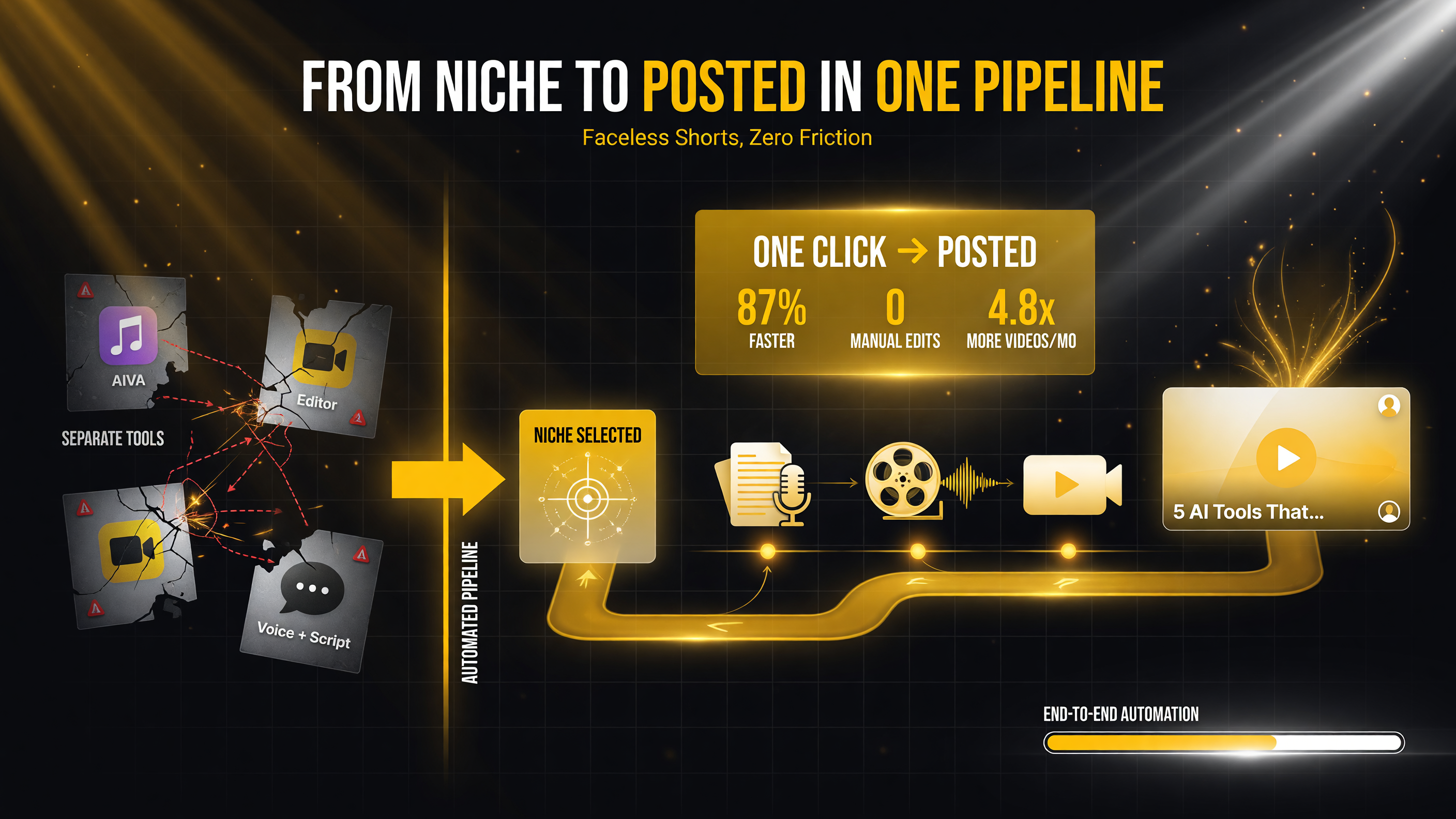
The whole job in one flow: niche picked, script and voice built, visuals cut, and a finished short posted — where most creators lose momentum is the gap between each separate tool.
Audio and language options
Voice choice is a bigger deal than most first-time creators expect, because the voice carries the entire on-screen personality in faceless content. ShortsFaceless offers a library of 40+ AI voices across 10+ languages, which covers the main English speaker niches plus expansion into Spanish, Portuguese, Hindi, and other language markets without needing separate tools or separate channels of voice assets.
For a creator testing niches, this breadth is useful in two ways. First, it lets you A/B the voice on the same script to find which one holds retention longer — voice fatigue is real in faceless niches, and the same script can perform very differently with a different narrator. Second, it removes the multi-language barrier entirely if you want to repurpose a winning English short into other language markets.
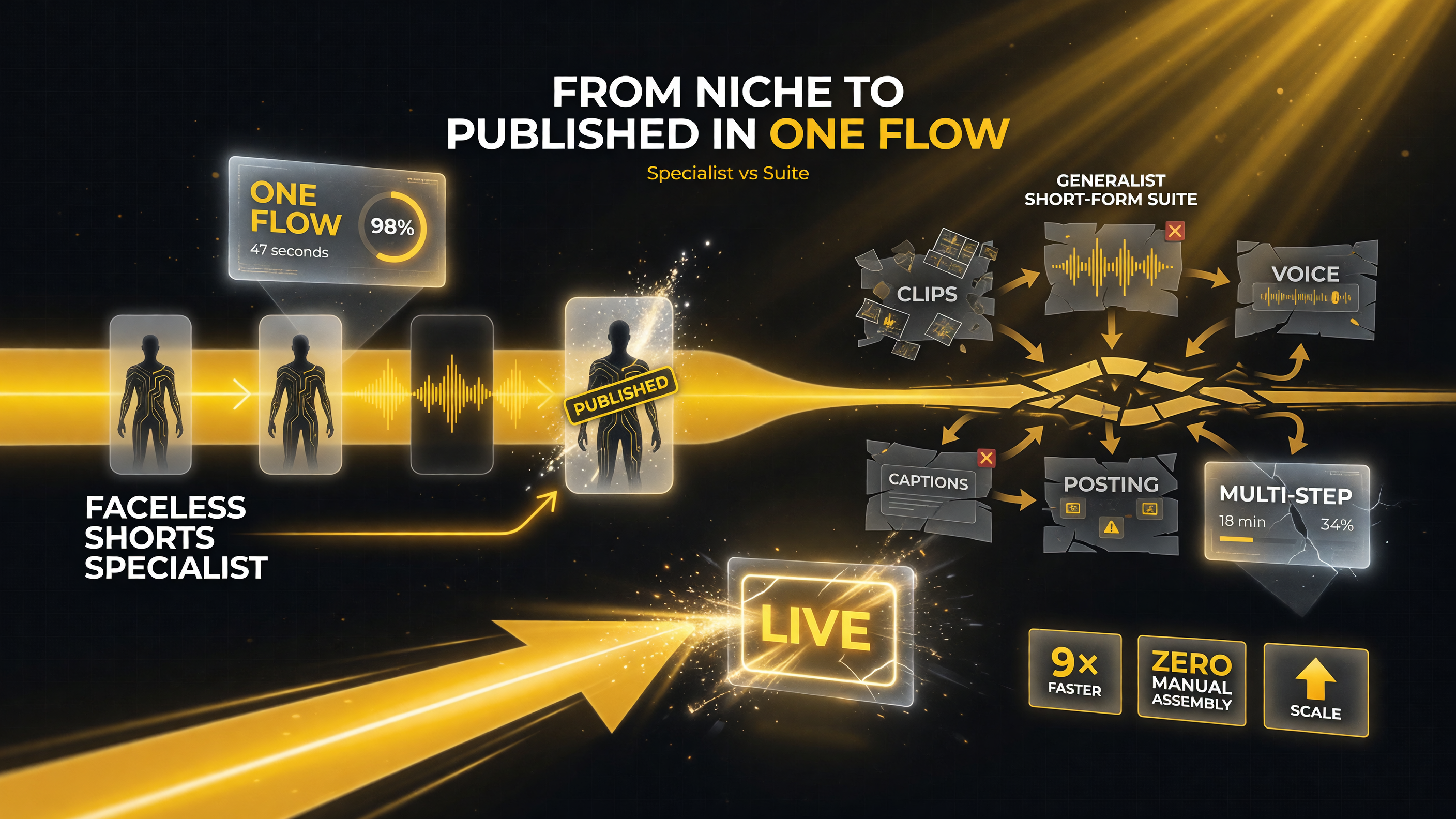
Specialist beats generalist for this job: one continuous flow from idea to a live short, where a broad suite leaves you stitching clips, voice, captions, and publishing together yourself.
ShortsFaceless vs the generalist short-form suites
It helps to position ShortsFaceless against the broader category. Tools like Magic Hour and similar generalist platforms bundle short-form creation alongside a much wider feature set. That breadth is great if you already have footage and want an editing powerhouse, but it can be overwhelming and more expensive for a creator whose whole operation is faceless shorts.
ShortsFaceless takes the opposite bet: it does one format deeply and prices accordingly. You trade the extra editing power you were probably not using for a simpler, cheaper path that carries the faceless workflow end to end. For a solo creator whose goal is consistent output rather than maximum creative control in an editor timeline, that trade wins.
| Factor | ShortsFaceless | Generalist Short-Form Suite |
|---|---|---|
| Core focus | Faceless shorts end to end | Broad video editing + many features |
| Idea to video | Prompt → finished short in one flow | Higher manual assembly in the editor |
| Pricing | $19–29 per month | Often more, or credit-based per render |
| Captions | Scrolling captions baked into generation | Available, often needs manual application |
| Voice & language | 40+ voices, 10+ languages built in | Varies; some route you to separate tools |
| Best for | Solo creators shipping faceless shorts consistently | Creators who edit existing footage heavily |
The pricing structure
ShortsFaceless runs on flat monthly plans rather than per-render credits, which removes the anxiety of running out of generations mid-week. The reported range lands at roughly $19 to $29 a month depending on the tier you pick. The entry tier covers the core pipeline — script, visuals, voice, and captions — while higher tiers add more rendering volume, more voices, and faster queue priority.
For a solo creator, flat pricing is a meaningful advantage. Credit-based tools punish experimentation — every rejected render and every wrong voice choice costs a unit. ShortsFaceless encourages you to iterate because a flat plan does not punish a bad take. That is exactly the incentive a beginner needs to actually finish and publish.
Where ShortsFaceless shines
The clearest use case is the creator starting from zero who wants consistent faceless output without assembling a five-tool stack. If you have been planning to start a shorts channel but keep stalling at the setup stage, this is the tool that removes the setup entirely — you open a topic, and the pipeline does the rest.
It is equally strong for niche experimentation. Because the tool handles a full short so quickly, you can test several niches in a week — history, motivation, finance, true crime — and let the data tell you which one holds retention, instead of committing hours of manual production to a niche that flops. Speed to output is the invisible superpower here.
The honest limits
Short-form and faceless video depend heavily on visual variety and pacing, and AI-generated imagery can drift toward a similar look between videos. Over time a savvy viewer may notice the pattern. The fix is to keep your hooks strong and your scripts tight, but it is a real ceiling if you are trying to build a channel where the visuals themselves are the draw.
The second limit is that this is not a full editor. If you eventually want fine-grained control over every cut, transition, or overlay, you will outgrow the tool and move to a proper editor. For most faceless shorts the generated output is sufficient, but know that you are trading deep creative control for speed.
Finally, the quality of your niche research and script hooks still carries the video. A tool that assembles fast does not rescue a weak hook or a topic nobody searches for. The pipeline removes the production bottleneck, not the need to understand what your audience actually watches.
A three-step trial plan
Before you commit, run a disciplined test rather than judging on the marketing. First, produce three shorts in three different niches over one week and publish them, tracking views and retention honestly instead of getting attached to any single idea.
Second, test the captions on a muted viewing — open one on your phone with the sound off and confirm the captions carry the entire story. That is the make-or-break detail in short-form, and the tool only wins here if the text timing is genuinely clean.
Third, test voice swapping on the same script. Generate the identical short with two or three different voices and compare engagement. The voice is the personality in faceless content, and finding the narrator your audience sticks with is worth the extra few minutes.

Consistency is the whole game with shorts: an automated pipeline lets one person keep a real daily cadence, where hand-making every video tends to stall out after a few strong weeks.
A consistency check that most creators skip
Shipping once is easy; shipping every week is where channels are actually built. The real advantage of a pipeline tool is that it makes a rhythm possible without a production team behind you. Set a realistic cadence you can hold for eight weeks — two to three shorts a week is a strong starting point for a solo creator with a day job — and treat the tool as the thing that lets you keep that promise.
Batch your ideation the same way you batch production. Reserve one focused hour to write down fifteen to twenty topic ideas mapped to what your audience searches and what your niche competitors are winning with. Then feed those ideas through the pipeline in a single sitting rather than starting from a blank prompt each time. Creators who batch a week of topics in advance publish far more consistently than those who create on the spot, and consistency is what the algorithm ultimately rewards.
The bottom line
ShortsFaceless is a solid, focused pick for any solo creator whose goal is to actually ship faceless shorts instead of endlessly collecting tools. It compresses the whole workflow — script, visuals, voice, captions, export — into one browser tab, prices it at a flat $19 to $29 a month, and removes the friction that kills most first-time channels before the first post.
It is not the deepest editor available, and it will not compensate for a weak hook or a niche nobody wants. But if the gap between you and a publishing channel is production friction rather than creativity, this is one of the fastest ways to close it. Start with three test shorts across different niches, read the retention data, and let the tool earn its keep.
Frequently Asked Questions
What is ShortsFaceless?
ShortsFaceless is a browser-based AI platform built for faceless short-form video. You give it a topic or idea, and it generates the script, creates AI visuals, adds an AI voice-over, layers in scrolling captions, and packages it into a finished vertical short ready to upload to YouTube Shorts, Instagram Reels, or TikTok.
What does ShortsFaceless cost?
ShortsFaceless uses flat monthly plans, reported at roughly $19 to $29 per month depending on the tier. Higher tiers add more rendering volume, more voices, and faster queue priority. There are no per-render credit charges, so you can iterate on bad takes without penalty.
Is ShortsFaceless good for beginners with no video experience?
Yes. The tool removes the multi-tool setup that stops most beginners. You enter a topic and the pipeline handles script, visuals, voice, and captions, so you can publish your first faceless short without learning a full video editor.
How is ShortsFaceless different from general short-form tools like Magic Hour?
ShortsFaceless is single-purpose: it focuses deeply on the faceless shorts workflow end to end and prices it flat at $19 to $29 a month. Generalist suites offer much broader editing but can be more expensive and require more manual assembly. If your whole operation is faceless shorts, the focused tool is simpler and cheaper.
Does ShortsFaceless generate the voice and captions automatically?
Yes. ShortsFaceless includes 40+ AI voices across 10+ languages and bakes scrolling captions into the generation, matched to the spoken words. Captions are applied automatically rather than added as a manual afterthought, which saves significant time.
How many niches can ShortsFaceless handle?
Because the pipeline produces a full short this quickly, it is well suited to niche experimentation. You can test several topics — history, motivation, finance, true crime, education — in a week and let the retention data tell you which to double down on.

About Barak Schurr
Barak Schurr is a serial entrepreneur who built and exited a major ticketing platform before turning his attention to AI and content. He runs three AI-focused research sites and writes about the tools, workflows, and strategies that let solo creators build real channels — without a crew, a studio, or a Hollywood budget.
Email: [email protected]
More Resources for Creators