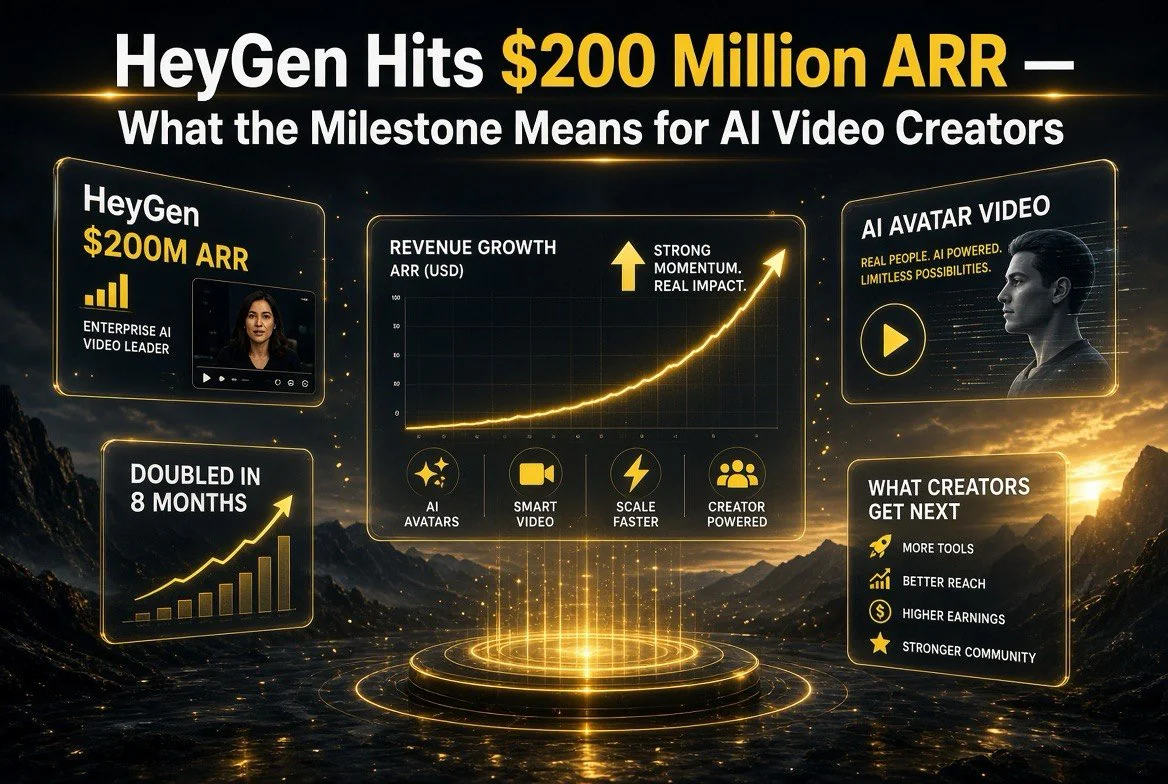
HeyGen Hits $200 Million ARR — What the Milestone Means for AI Video Creators
HeyGen Hits $200 Million ARR — What the Milestone Means for AI Video Creators
⚡ Expert Summary: HeyGen crossed $200 million ARR in June 2026, doubling from $100 million in eight months. It claims 30+ million users across 196 countries and 85% of the Fortune 100 as customers. For creators, the milestone signals that AI avatar video is a proven, durable market — and that HeyGen has the revenue engine to keep funding faster, cheaper avatar tools.
Here’s the number that matters: HeyGen just crossed $200 million in annual recurring revenue up from $100 million just eight months earlier. That’s not a funding round or a press-friendly projection. It’s recurring revenue, the metric investors and operators treat as the closest thing to ground truth for a software company. The company confirmed the milestone in late June 2026, after closing out a period where it went from roughly $100 million to $200 million ARR in roughly eight months.
For US-based creators and marketing teams, the timing matters. The boom in AI-generated short-form video — captions, avatars, and one-click editing tools — has made video production cheaper, but it has also flooded the market with tools that may not survive the next eighteen months. A revenue number like HeyGen’s is one of the few reliable filters you can use to separate durable platforms from quick exits. When a company is cash-flow break-even at $200 million ARR, it is not dependent on the next venture round to keep its servers online and its avatar models trained.
For video creators, this matters more than the headline. HeyGen is the AI video platform that makes a talking avatar deliver your script in 40+ languages. Its growth to $200 million ARR tells you the market for AI avatar video is no longer experimental, and that the vendors you pick today are likely to survive the shakeout. In this post, we break down what the number actually means, how HeyGen got there, and what it changes for anyone producing video with AI.
Why $200 Million ARR Is a Genuine Milestone, Not a Vanity Metric
ARR stands for annual recurring revenue, and it’s the metric SaaS investors quote when they want a real picture of a business’s health. Unlike total revenue — which can be inflated by one-off deals — ARR reflects the subscriptions and contracts you can reasonably expect to renew. When a company like HeyGen reports $200 million ARR, it’s saying: on a forward-looking basis, we expect roughly $200 million of revenue this year from recurring sources. Analysts in the AI-video space read that as a strong signal of product-market fit.
The pace matters as much as the absolute number. Going from $100 million to $200 million ARR in roughly eight months implies a growth trajectory that only a handful of software companies sustain. In the US market — where most of HeyGen’s enterprise revenue is concentrated — sustained 100%-over-eight-months growth is rare. It typically requires a product with obvious ROI (in HeyGen’s case, replacing localization and studio production costs) and a sales motion that can close large contracts.
It also puts HeyGen’s unit economics in a different light. A report from Reuters covering the milestone noted the company is cash-flow break-even, and that its enterprise valuation math works out to roughly $2.70 of ARR for every dollar of equity raised. For comparison, many high-growth AI startups are net-loss leaders valued on future potential; a cash-flow-break-even AI company crossing $200 million ARR is structurally different.
How HeyGen Got There
The path to $200 million ARR wasn’t a single product launch. HeyGen started as a tool for quick talking-head avatar videos, then expanded into localization at scale — letting one marketing team publish the same video in dozens of languages without re-recording a single line. That localization use case is where the enterprise revenue came from: global brands are willing to pay a recurring license to cut dubbing costs by an order of magnitude, and those are exactly the contracts that convert into predictable ARR.
Distribution also mattered. HeyGen leaned into short-form social video and a freemium tier that put a working avatar into a creator’s hands within minutes. That bottom-up adoption fed the funnel, while the sales team converted the largest users into annual contracts. The result is a revenue engine that is unusually diversified between consumer self-serve and enterprise sales — which is one reason the growth to $200 million did not stall as the base got larger.
The Customer Base Behind the Number
Reaching $200 million ARR doesn’t happen on consumer subscriptions alone. HeyGen’s growth is anchored in B2B adoption. The company reports more than 30 million registered users across 196 countries, and says its enterprise client list covers 85% of the Fortune 100. That’s the kind of concentration that converts into the multi-year contracts driving recurring revenue.
Think about what that US enterprise footprint means for a creator. When a platform lands 85 of the largest companies in America, it has revenue to reinvest in the things creators actually feel: faster rendering, more realistic avatars, better lip-sync, and cheaper tier pricing. The enterprise tail is what funds the consumer-grade product line. That’s the direct link between HeyGen’s $200 million ARR and the quality of the tool you use to make a talking-head video for your own channel.
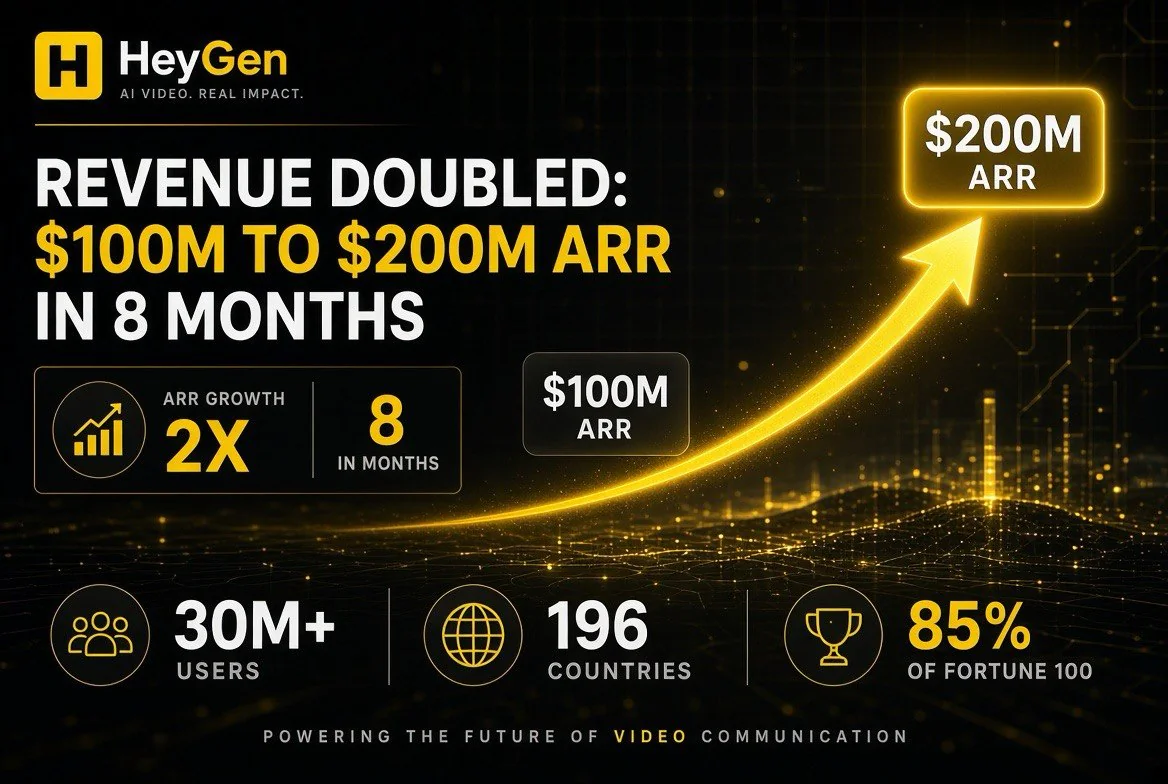
HeyGen revenue doubling from $100M to $200M ARR in 8 months, with 30M+ users, 196 countries, and 85% of the Fortune 100.
What the Milestone Means for Your Workflow
Three practical takeaways if you use HeyGen — or are choosing between HeyGen and an alternative like Synthesia — to produce video.
1. Platform longevity is no longer the top risk. The biggest fear with any AI tool is that the vendor disappears and your projects, credit packs, and trained avatar shut down with it. A cash-flow-break-even company at $200 million ARR is not a burn-rate zombie. It can fund continued R&D and absorb price competition without collapsing. That removes a real operational risk for anyone who has invested months into an avatar across dozens of videos.
2. Expect the tool to improve faster than before. More recurring revenue funds more research. HeyGen has already moved from static avatars to interactive “conversational” avatars that respond to live input, and it continues to push language coverage and appearance realism. The $200 million milestone is the fuel for that roadmap. If you’re comparing vendors, the one with a durable revenue base tends to ship features faster over a 12-to-24-month window — exactly the planning horizon most channel operators use.
3. The “avatar video is a fad” argument is dead. A market that sustains a $200 million ARR leader is not a temporary fad. It’s a category with real budget being allocated to it — largely from the localization, elearning, and marketing departments that had been paying human studios to produce multilingual video. That shift is structural, and it means the skills you’re building in AI video will stay relevant.
What It Doesn’t Tell You
For balance: $200 million ARR is a strong signal, but it doesn’t answer every question a creator should ask.
It doesn’t tell you about net revenue retention whether existing customers are spending more each year or churning. A company can grow to $200 million ARR by landing large contracts even if retention is mediocre, though the doubling trajectory suggests usage is expanding within accounts.
It doesn’t tell you about segment mix how much comes from a handful of whale enterprise deals versus broad SMB adoption. Heavy concentration in a few Fortune 100 logos is impressive but carries its own renewal risk.
And it doesn’t tell you whether the ranking changes versus competitors. The synth-enemy worth watching remains Synthesia, which has also raised significant capital and targets much of the same localization and corporate-communication use case. A $200 million ARR leader with a well-funded challenger is a healthy, competitive market — which tends to keep prices in check for buyers.
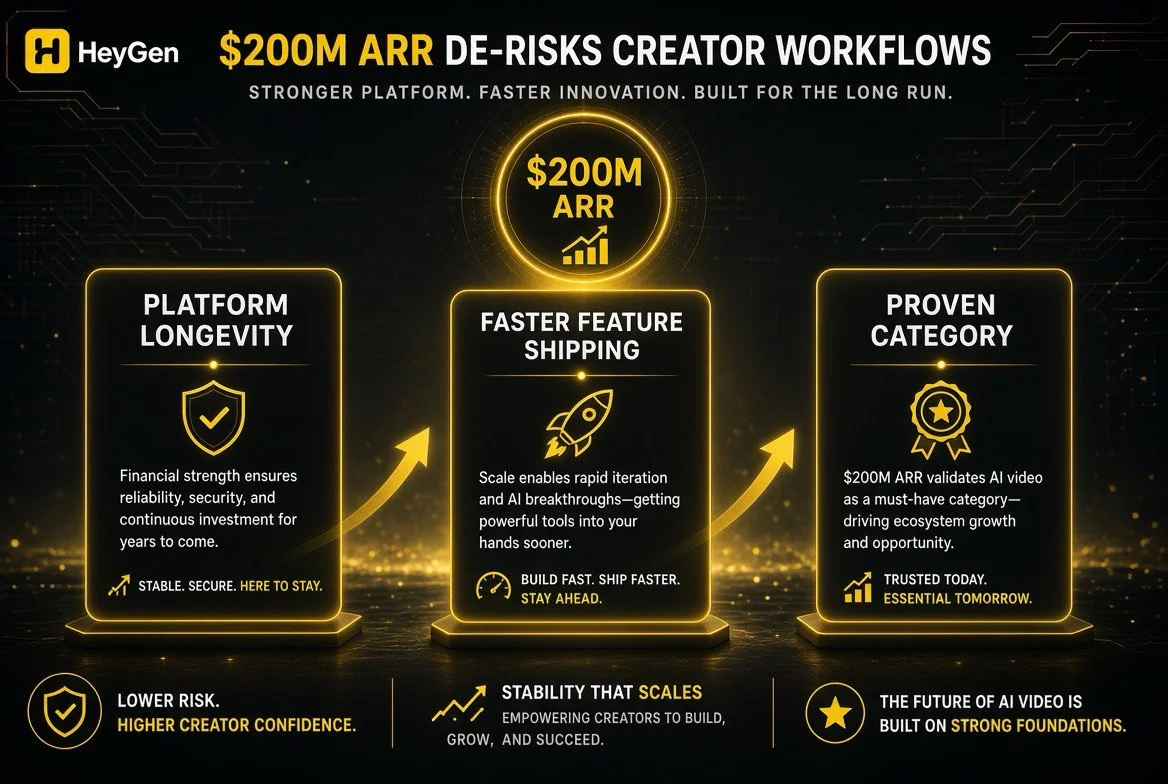
How HeyGen’s $200M ARR milestone de-risks your workflow: platform longevity, faster feature shipping, and a proven category.
How It Compares to the AI Video Landscape
Context helps you calibrate the number. Synthesia, HeyGen’s closest avatar-video rival, was widely reported to be valued around $2.1 billion in 2025 and has also grown fast on the same localization demand. Where HeyGen differentiates is its aggressive pricing on short-form and its Chinese supply chain for rapid iteration. Kling AI and Luma focus more on generative video (turning text into footage) than on avatar presenters, so they sit in a different lane of the market.
The practical read for a creator: HeyGen’s $200 million ARR makes it the clear revenue leader in the avatar-presenter segment. That leadership is a tie-breaker if you’re choosing between two feature-equivalent tools and weighing which one is more likely to keep improving and stay alive.
| Metric | HeyGen | What it Signals |
|---|---|---|
| ARR | $200M (June 2026) | Proven, durable video-AI revenue base |
| Growth | $100M to $200M in ~8 months | Sustained 2x growth trajectory |
| Users | 30M+ across 196 countries | Broad global adoption |
| Enterprise | 85% of Fortune 100 | Multi-year contract fuel for R&D |
| Unit economics | Cash-flow break-even | Not a burn-rate dependent startup |
| Valuation math | ~$2.70 ARR per $1 equity | Favorable revenue-to-capital ratio |
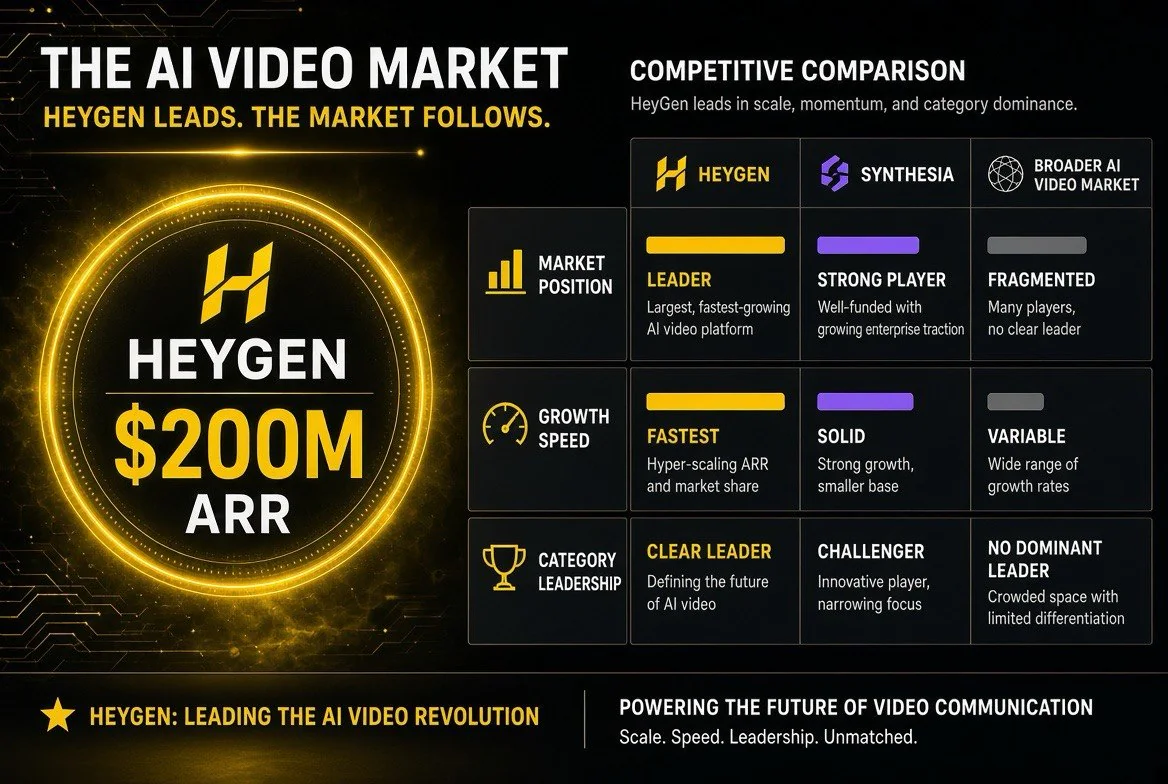
How HeyGen’s $200M ARR positions it against Synthesia and the broader AI video tool market.
Who Should Care About This Number
If you fall into any of these groups, the $200 million ARR milestone is actionable intelligence rather than trivia.
Channel operators and solo creators producing dozens of AI-avatar videos a month should treat HeyGen’s revenue base as a vendor-lock decision input. A $200 million ARR company is far less likely to raise prices arbitrarily or shut down than a smaller rival burning cash.
Localization professionals selling multilingual video services should watch this closely — HeyGen’s growth correlates with budget shifting out of traditional dubbing and subtitle work into AI translation.
Marketing teams evaluating avatar video for scale should see this as de-risking. The category leader has money to keep shipping, which lowers the risk of committing a team’s workflow to it.
Anyone priced out of enterprise tiers should note that HeyGen’s SMB pricing has remained competitive even as enterprise revenue grew — a sign the consumer line is deliberately subsidized by the enterprise tail.
The Bottom Line
HeyGen reaching $200 million ARR is the single clearest evidence yet that AI avatar video is a mainstream, durable business. It’s not a fad, it’s not a side experiment, and the vendor you’re trusting with your video workflow has a revenue engine capable of keeping the product alive and improving for years. For creators making a tool selection today, that’s a meaningful point in HeyGen’s favor — and a signal that the broader AI-video category has real, recurring dollars behind it.
If you’re weighing an avatar-platform switch, the revenue data is now on the table: $200 million ARR, 30+ million users, 85% of the Fortune 100, cash-flow break-even. Use it as the tie-breaker, then run your own head-to-head with a tool like Synthesia before you commit months of output to any single platform.
Frequently Asked Questions
What does $200 million ARR mean for HeyGen?
ARR (annual recurring revenue) is the forward-looking revenue HeyGen expects from recurring subscriptions and contracts. Crossing $200 million ARR signals strong product-market fit and a durable, growing customer base.
How fast did HeyGen grow to $200 million ARR?
HeyGen went from roughly $100 million to $200 million ARR in about eight months, a rapid doubling that is rare in software and reflects strong enterprise and consumer adoption.
Is HeyGen profitable?
HeyGen has reported it is cash-flow break-even, meaning its operations no longer require constant outside capital to stay solvent — a strong position for an AI company at this growth stage.
How many users does HeyGen have?
HeyGen reports more than 30 million registered users across 196 countries, with 85% of the Fortune 100 counted among its enterprise customers.
Is HeyGen or Synthesia better in 2026?
Both are leading AI avatar platforms. HeyGen now leads on revenue with $200 million ARR and broad enterprise adoption; Synthesia is a well-funded challenger targeting similar localization and corporate-use cases. The best pick depends on your specific workflow and pricing needs.

About Barak Schurr
Barak Schurr is a serial entrepreneur who built and exited a major ticketing platform before turning his attention to AI and content. He runs three AI-focused research sites and writes about the tools, workflows, and strategies that let solo creators build real channels — without a crew, a studio, or a Hollywood budget.
Email: [email protected]
More AI Video Resources