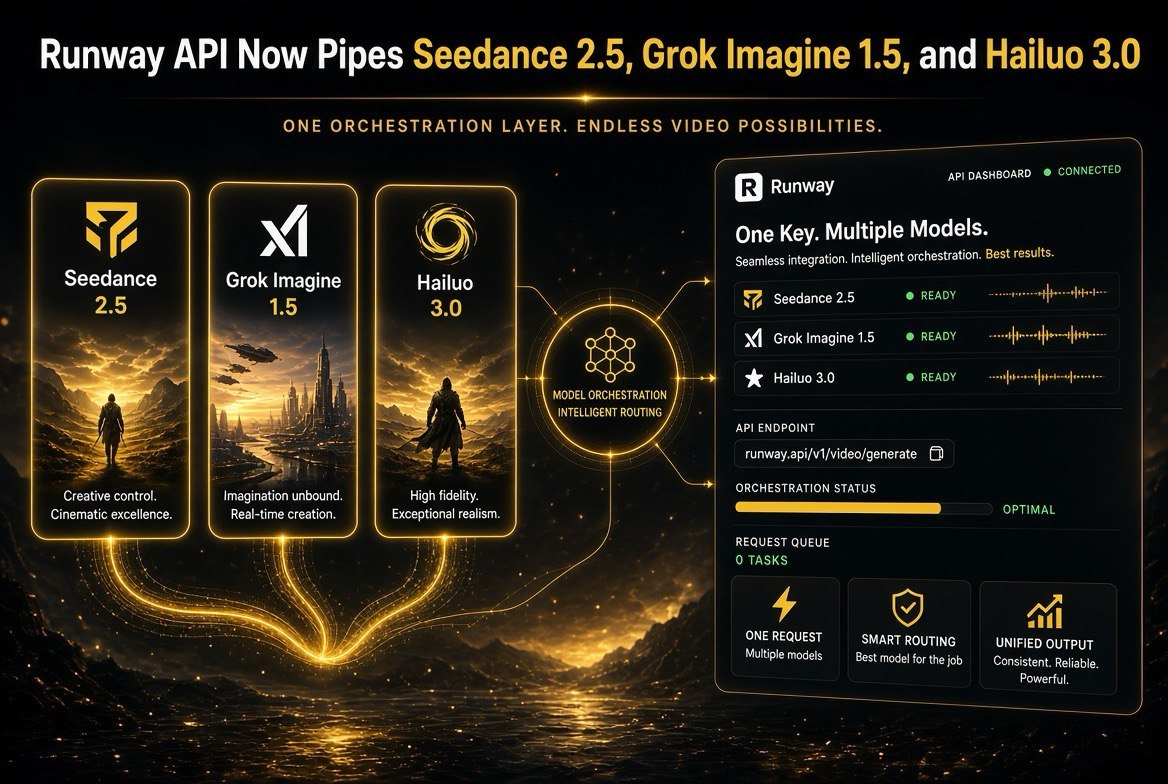
Runway API Now Pipes Seedance 2.5, Grok Imagine 1.5, and Hailuo 3.0
Get The Faceless YouTube Blueprint — Free
The exact AI tool stack and workflow used to build a faceless YouTube channel from zero.
Runway API Now Pipes Seedance 2.5, Grok Imagine 1.5, and Hailuo 3.0
⚡ Expert Summary: Between August 5 and August 7, 2026, Runway’s developer API quietly became the closest thing to a neutral multi-model hub for AI video. The changelog shows three major third-party models landing on the same endpoint pool: ByteDance’s Seedance 2.5, xAI’s Grok Imagine 1.5, and MiniMax’s Hailuo 3.0. For US creators and agencies, that means one API key can now route a single job across three different video engines — choosing the best model per shot instead of being locked to a single provider. The genuinely new angle is Grok Imagine 1.5 inside Runway: it is the first time xAI’s video model is callable through a third-party orchestration layer, opening cross-model pipelines (storyboard in one model, hero shot in another, upscale in a third) that were painful to build before.
One Changelog, Three Models: What Landed This Week
Runway publishes its developer changelog as a running log of API additions, and the first week of August 2026 packed three third-party video models into a single window. Read the upstream list at Runway’s API changelog — but the short version is that Runway stopped positioning itself as just a first-party generator and started operating like an AI video router.
The three additions are not minor point releases. Seedance 2.5 is ByteDance’s flagship 30-second native 4K video model, known for realistic motion and strong character consistency. Hailuo 3.0 is MiniMax’s cinematic-edit model, which excelled in the mid-2026 arena runs on camera control and scene-to-scene coherence. And Grok Imagine 1.5 is xAI’s fast image-to-video plus text-to-video model, which topped the image-to-video leaderboards in July 2026 according to the Artificial Analysis arena rankings.
For a creator operating in the United States, the practical meaning is simple: the same API dashboard that used to expose only Runway’s own engines now exposes three competing third-party models. You are no longer choosing a platform and living with its strengths and weaknesses. You are choosing the best engine per shot, and Runway is the switchboard.
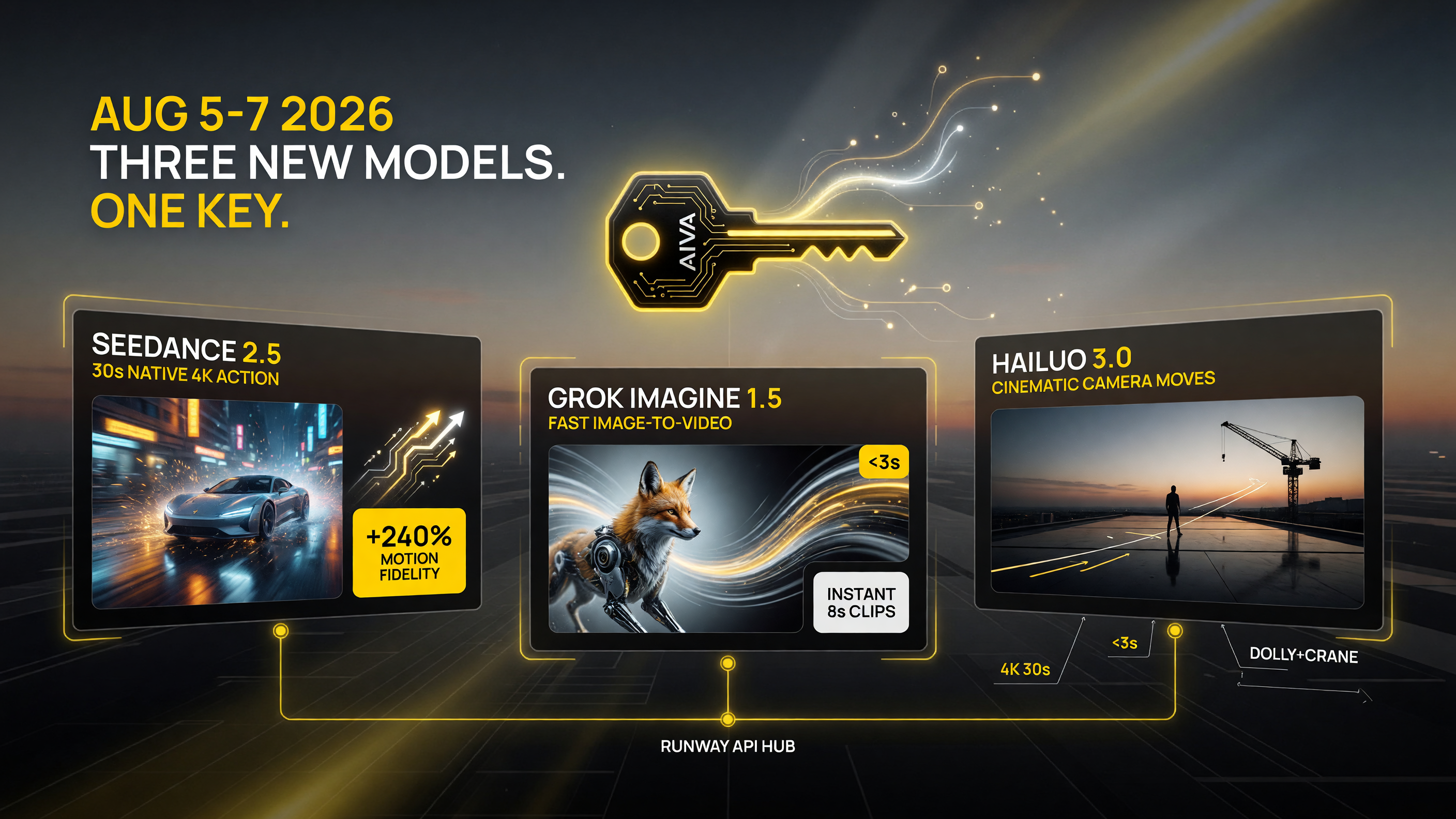
Runway now exposes three frontier video models — Seedance 2.5, Grok Imagine 1.5, and Hailuo 3.0 — behind a single API key, turning one integration into a multi-model video pipeline.
” alt=”Runway API multi-model changelog: Seedance 2.5, Grok Imagine 1.5, Hailuo 3.0 added Aug 5-7 2026″ style=”width:100%;max-width:100%;height:auto;display:block;margin:24px auto;border-radius:8px;”>
Runway’s changelog added all three third-party models inside a single week, turning the API into a multi-model hub.
Why Grok Imagine 1.5 Inside Runway Is the Real Story
Our site has covered Grok Imagine 1.5 before as a standalone model, and Seedance 2.5 and Hailuo 3.0 each have their own deep dives. What is genuinely fresh here is the orchestration layer. Grok Imagine 1.5 launching inside Runway is the first mainstream example of xAI’s video model being exposed through a third-party API rather than only through xAI’s own properties like GlobalGPT.
That matters for one reason: pipelines. A creator who wants to build a faceless channel or an agency that produces short-form at volume does not want to log into four different dashboards and export clips between them manually. They want a single API key that can ask for a Seedance shot when realism matters, a Grok shot when speed and image-to-video motion matter, and a Hailuo shot when camera control matters — all in the same project, all billed through one vendor.
Runway’s API is now effectively a multi-model gateway. The cross-model pipeline is the workflow that most individual competitors (Luma, Pika, Kling) still do not offer in a clean, unified way. Luma runs third-party models too, but Runway’s changelog cadence and routing layer make it the more explicit aggregator play.
What Each Model Brings to a Runway Job
To use the hub well you have to stop thinking in platforms and start thinking in strengths. Each of the three models that landed this week occupies a different lane, and understanding those lanes is what separates a good multi-model workflow from a messy one.
Seedance 2.5 is the workhorse for anything that needs to look physically grounded. It generates native 30-second clips at up to 4K, and its motion model holds up on fast action — running, vehicles, water, human movement — where older generators turned to mush. It also keeps characters consistent across a clip, which is why it is the default choice for brand content and product shots where the subject must stay recognizable.
Grok Imagine 1.5 is the iteration engine. It is fast and cheap enough to burn several passes on framing and composition before you commit to a hero render. Its image-to-video workflow is where it shines: drop in a still you like, and it produces motion from that specific frame, making it ideal for turning a strong keyframe into a moving shot with minimal prompt fiddling.
Hailuo 3.0 is the cinematographer. Where Seedance and Grok optimize for realism and speed, Hailuo optimizes for how the camera moves. Dolly moves, orbits, push-ins, and scene-to-scene coherence are its strengths, which is exactly what you want for narrative-adjacent cuts and transitions between shots that need to feel directed rather than merely generated.
None of the three is universally best. That is precisely the argument for running all three behind one key instead of picking a single vendor and living with its blind spots.
Building a Cross-Model Pipeline on One Key
The old model of AI video production was single-vendor: pick Kling for everything, or Runway for everything, and accept the trade-offs. The new model splits the job by weakness. Here is how a real pipeline breaks down when all three engines sit behind one Runway key:
- Storyboard and previz: Grok Imagine 1.5 — fast, cheap enough to iterate on framing and composition before committing to a hero render.
- Hero shot with realistic action: Seedance 2.5 — 30-second native 4K clips with strong motion physics for the centerpiece of the video.
- Cinematic camera move: Hailuo 3.0 — for dolly, orbit, and scene-to-scene coherence that looks directed rather than generated.
- Upscale and finish: feed the final cut through the sharpest available renderer before export.
The result is that a single job can route through three different video brains, and the only integration point is one Runway API key. For a US agency running several accounts, that collapses a formerly multi-platform workflow into a single code path.
| Model | Best For | Standout Strength | Role in a Pipeline |
|---|---|---|---|
| Seedance 2.5 | Realistic action, 30s native 4K | Motion physics + character consistency | Hero shot / centerpiece |
| Grok Imagine 1.5 | Image-to-video, fast iteration | Speed + top image-to-video arena score | Storyboard / previz |
| Hailuo 3.0 | Cinematic camera moves | Camera control + scene coherence | Directed shots / transitions |
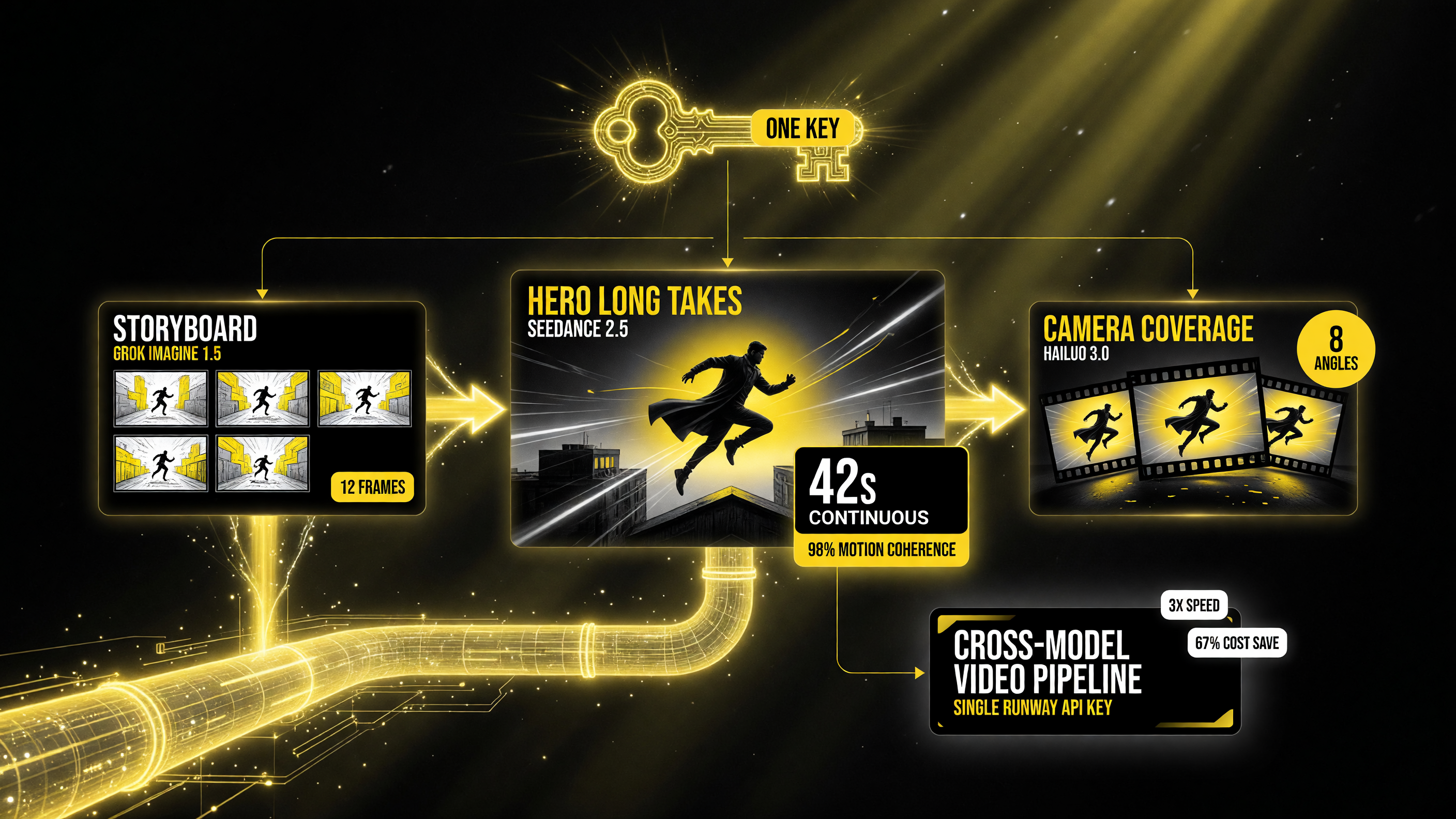
A cross-model pipeline keeps each stage on its strongest model — storyboarding in Grok Imagine 1.5, hero action in Seedance 2.5, and cinematic coverage in Hailuo 3.0 — all under one Runway key.
” alt=”Cross-model AI video pipeline: Grok Imagine 1.5 for storyboard, Seedance 2.5 for hero shot, Hailuo 3.0 for camera moves, all behind one Runway API key” style=”width:100%;max-width:100%;height:auto;display:block;margin:24px auto;border-radius:8px;”>
One Runway key can now route a single job across three different video engines, choosing the best model per shot.
What This Changes for US Creators and Agencies
For independent creators in the US, the biggest change is removing the lock-in tax. When every serious video model lives behind the same API, the cost of switching models per project drops to a function call. You are no longer rebuilding your workflow when the leaderboard shifts; you are just changing which model slug your request targets.
The practical payoff is speed. Rather than learning the quirks of three separate dashboards, you learn one API surface and three model profiles. For a solo creator putting out daily short-form, that saved overhead translates directly into more clips shipped per week, which is what platform algorithms actually reward in 2026.
For small agencies, the shift is operational. Instead of maintaining subscriptions to Kling, Runway, and xAI separately — and stitching outputs together by hand — a single Runway key gives the routing layer. Billing, rate limits, and versioning consolidate to one dashboard. That is the kind of simplification that compounds, especially for teams producing dozens of clips a week across multiple client accounts.
There is a real downside to watch: tying your whole pipeline to one orchestrator means a Runway outage or a pricing change hits every model at once, and you lose the ability to shop between vendors on price. The hub is convenient, but it is also a single point of failure. Smart teams keep a direct API key for at least one alternate model as a fallback.
The Cost and Throughput Trade-Off
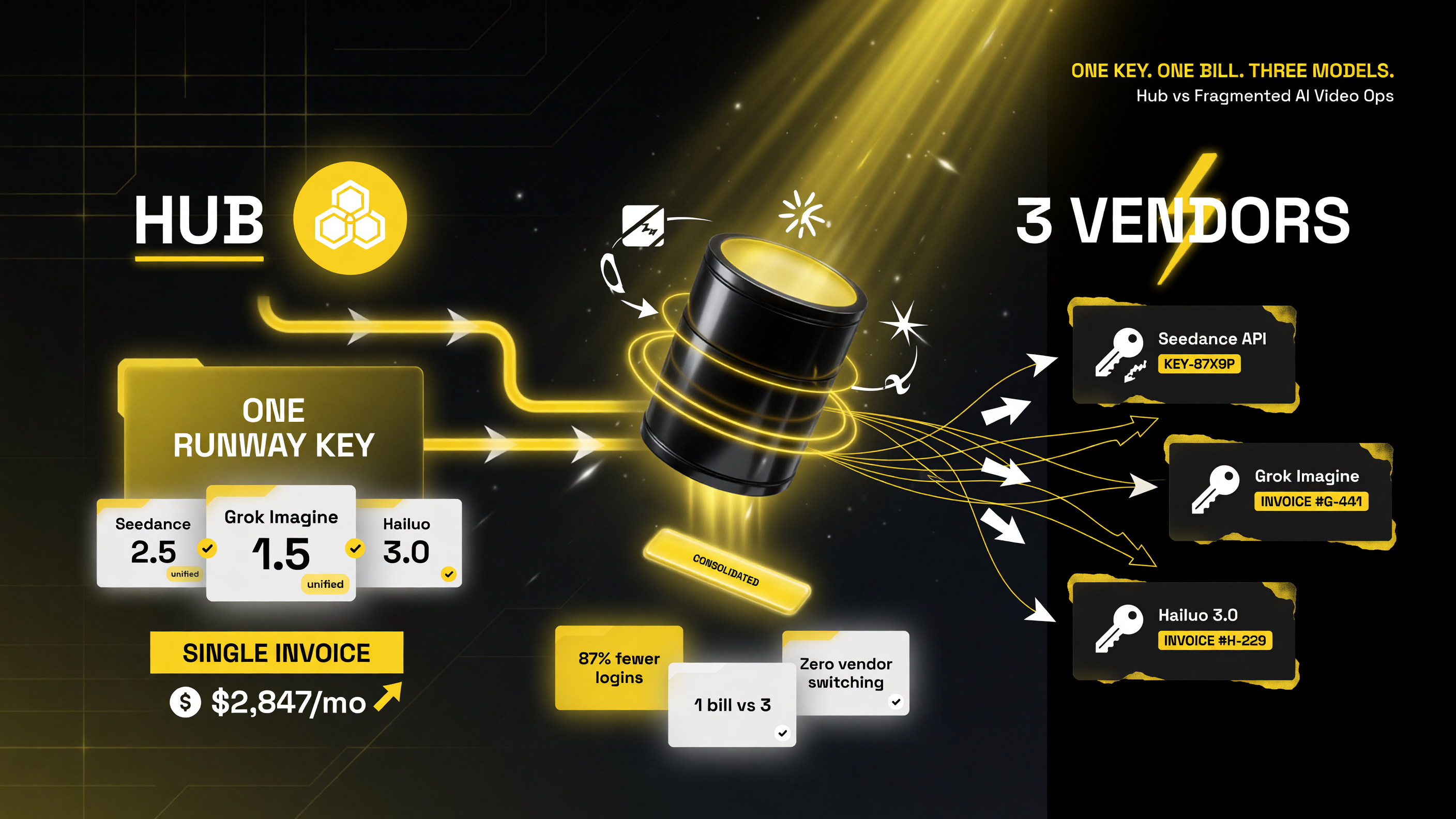
Consolidating three video models behind one Runway key replaces three vendor dashboards, three API keys, and three invoices with a single integration and one bill.
One question every agency asks is whether routing through a hub is more expensive than going direct. The honest answer is that it depends on volume. For low-volume creators who need one clip now and then, the hub’s consolidated billing and single key are almost always worth a small per-call premium, if one exists. You are paying for convenience and not maintaining three vendor accounts.
For high-volume production shops generating hundreds of clips a month, per-call differences matter more. At that scale you should benchmark the hub’s pricing against direct API rates for each model before you commit. The models are the same; the question is purely whether Runway’s routing fee justifies the operational savings. In most agency cases it does, because the time saved on stitching and billing is worth more than the marginal token cost.
| Factor | Single-Vendor Path | Runway Multi-Model Hub |
|---|---|---|
| API keys to manage | 3 (Seedance, Grok, Hailuo / their hosts) | 1 Runway key |
| Billing | 3 vendor accounts, 3 invoices | Consolidated to Runway |
| Model switching | Rebuild integration per vendor | Change model slug in the request |
| Single point of failure | No (independent vendors) | Yes, if Runway has an outage |
| Best for | Large shops optimizing per-call cost | Creators and small agencies wanting simplicity |
Should You Build on the Runway Hub Now?
The honest answer is yes for most creators, with one caveat. If editing is your bottleneck and you already publish short-form at volume, the multi-model hub is a genuine upgrade: you can match model to shot instead of making the whole video one vendor. The caveat is not to over-couple. Use the hub for routing convenience, but keep your source footage and prompts portable so you are not trapped if pricing shifts.
The decision rule is simple. If you produce a meaningful volume of AI video every week and you have ever wished you could mix engines, switch now. If you are a low-volume user happy with a single model, there is no urgency — the hub adds options without forcing you to migrate. And whatever you decide, keep a direct API key to at least one alternate model as insurance, because a routing layer is only as resilient as the fallback you hold yourself.
For US creators who measure success in weekly output, the friction removal here is the entire point. Whether you are building a faceless YouTube channel, running ads for local businesses, or producing social clips for clients, the Runway multi-model hub turns the messy work of “managing three AI video tools” into one clean pipeline — and that is a workflow shift worth testing this week.
Frequently Asked Questions
Does the Runway API now include Seedance 2.5, Grok Imagine 1.5, and Hailuo 3.0?
Yes. Runway’s developer API changelog shows all three third-party video models added between August 5 and August 7, 2026: Seedance 2.5, Grok Imagine 1.5, and Hailuo 3.0, making Runway a multi-model video hub.
What is new about Grok Imagine 1.5 on the Runway API?
It is the notable first: xAI’s video model exposed through a third-party orchestration layer, so creators can call it alongside Seedance and Hailuo with one Runway API key instead of using xAI’s own properties.
Can I use Seedance, Grok, and Hailuo in the same project on Runway?
Yes. Because they share one API endpoint pool, you can route different shots in the same project to different models — building a cross-model pipeline behind a single key.
Why would I use multiple AI video models instead of one?
Different models have different strengths: Seedance 2.5 for realistic 30-second 4K action, Grok Imagine 1.5 for fast image-to-video iteration, and Hailuo 3.0 for cinematic camera moves. Routing per-shot gets better results than forcing one engine to do everything.
Is the Runway multi-model hub right for my small agency?
If you produce video at volume and currently juggle multiple platforms, yes — one key consolidates routing, billing, and versioning. Just keep a direct API key to at least one alternate model as a fallback so you are not fully dependent on a single orchestrator.

About Barak Schurr
Barak Schurr is a serial entrepreneur who built and exited a major ticketing platform before turning his attention to AI and content. He runs three AI-focused research sites and writes about the tools, workflows, and strategies that let solo creators build real channels — without a crew, a studio, or a Hollywood budget. Contact: [email protected]
More AI Video Resources