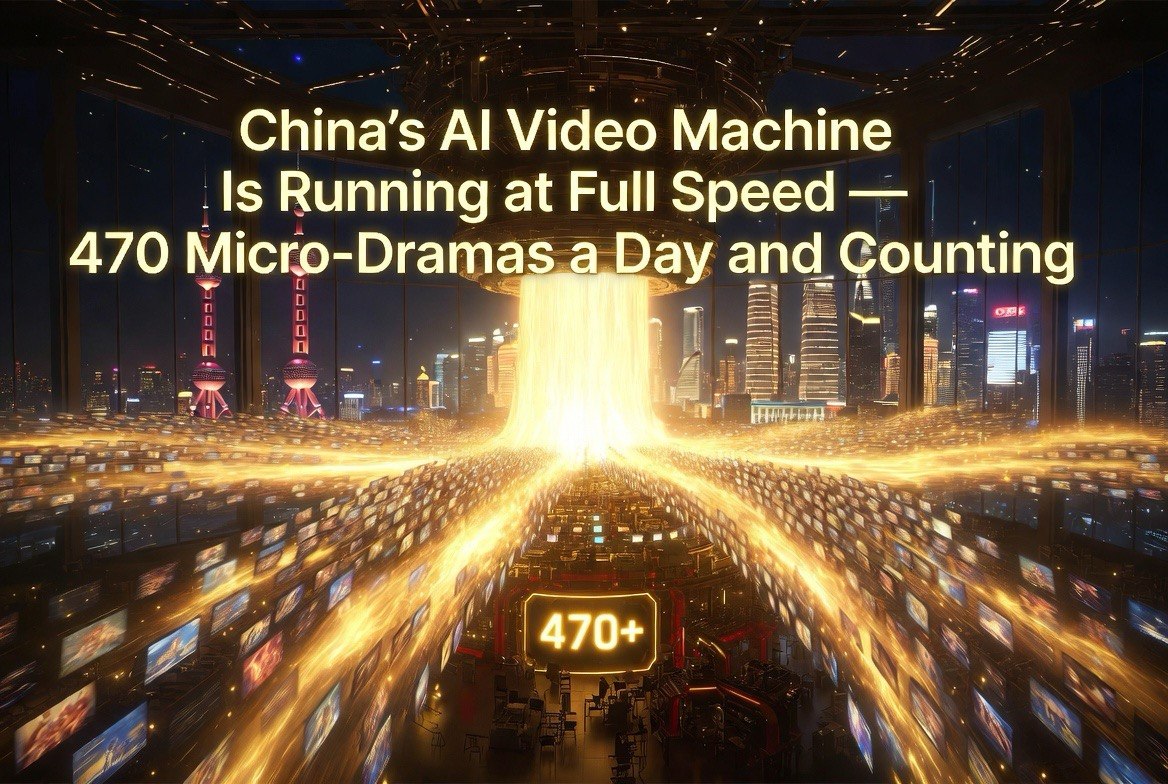
China’s AI Video Machine Is Running at Full Speed — 470 Micro-Dramas a Day and Counting
Get The Faceless YouTube Blueprint — Free
The exact AI tool stack and workflow used to build a faceless YouTube channel from zero.
China’s AI Video Machine Is Running at Full Speed — 470 Micro-Dramas a Day and Counting
⚡ Expert Summary
Chinese AI video platforms — led by ByteDance’s Seedance 2.0 — are now producing an estimated 470 AI-generated micro-dramas daily. Production costs for an 80-episode series have dropped from $280,000 to roughly $7,000, and the Chinese micro-drama market hit $9.4 billion annually by 2025, with local governments offering grants up to $275,000 per project. Western AI video tools are facing an increasingly difficult competitive landscape against subsidized, open-weight Chinese models integrated directly into distribution platforms. For content creators and indie filmmakers, this shift means the economics of video production have fundamentally changed — whether or not Western tools catch up.
There’s a production machine running in China right now that most Western creators don’t fully appreciate.
AI-generated micro-dramas — short-form serialized content typically 1-3 minutes per episode — are being produced at a rate of roughly 470 per day. That’s not a typo. Four hundred and seventy new shows, every day, powered primarily by ByteDance’s Seedance 2.0 and similar AI video platforms. The market is already worth $9.4 billion annually.
I’ve been watching this trend build for a year, and the speed at which it’s accelerating is something Western AI video companies should be paying very close attention to.
The Numbers Behind the Machine
Let me put the 470-per-day number in perspective because it’s easy to read and not fully absorb. That’s roughly 20 new episodes being generated every hour. If you sat down to watch everything produced in a single day, it would take you longer than a full work week with no breaks. The volume of AI-generated content entering the Chinese market every week exceeds what most Western studios produce in a year.
The economics driving this are brutal for traditional production. A 97.5% cost reduction doesn’t just change the profit margin — it changes the entire business model. Before AI, a micro-drama producer needed to be confident enough in a concept to risk $280,000. That meant heavy gatekeeping — scripts needed approvals, pilots needed testing, and most ideas never made it to production. Now, a producer can fund 40 series for the same budget and let the audience decide which ones succeed. The ones that flop get canceled after 10 episodes. The ones that catch fire get extended.
This is the same dynamic that YouTube and TikTok created for short-form content, but applied to narrative storytelling. The gatekeepers are gone. The audience decides.
To understand how dramatic this shift is, look at the production cost trajectory. Before AI, producing an 80-episode micro-drama series cost roughly $280,000 — mostly going to crew, equipment, locations, and post-production. Today, with AI video tools handling the visual generation, the same series costs around $7,000. That’s a 97.5% reduction in production cost.
When production costs drop by 97%, the volume math changes entirely. A production company that could afford to make one series per quarter can now make 40. A creator who couldn’t afford any series can now make one. The barrier to entry hasn’t just been lowered — it’s been removed for practical purposes.
The quality gap is closing too. Seedance 2.0’s cinematic physics update — released in May 2026 — improved motion realism, character consistency, and environmental rendering to the point where AI-generated content is increasingly difficult to distinguish from traditionally shot footage, especially in the short-form vertical format that dominates mobile consumption.
Local governments in China are actively subsidizing this. Some are offering grants of up to $275,000 per project to encourage AI content production. The government sees AI-driven content creation as a strategic industry, and they’re funding it accordingly.
Why Open-Weight Models Matter
The open-weight vs closed-model debate is usually a philosophical discussion about AI safety and democratization. In the context of Chinese AI video production, it’s a practical discussion about survival.
ByteDance’s release of Bernini as an open-weight framework is strategically brilliant. By making the underlying model freely available, they achieve several things simultaneously. They attract developers who build tools and workflows on top of Bernini, creating an ecosystem that competitors can’t easily replicate. They drive down the total cost of AI video production across the entire industry, which makes the Chinese ecosystem more competitive globally. And they collect usage data and feedback that helps them improve the model faster than their closed competitors.
One of the key structural advantages Chinese AI video platforms have over Western competitors is their open-weight approach. ByteDance’s Bernini framework — released as open source — allows developers and production companies to build custom pipelines on top of the base model without paying per-generation fees. The same model that powers a multi-million dollar production studio can run on a creator’s gaming PC at home.
This is the opposite of the Western approach, where companies like OpenAI, Runway, and Pika operate closed, API-access-only models with usage pricing. OpenAI reportedly shut down or heavily restricted Sora due to estimated inference costs of $15 million per day against lifetime revenue of roughly $2.1 million. The economics of closed, API-based video generation are broken at scale. Open-weight models don’t have that problem because the inference cost shifts to the user.
For an indie creator, the implication is clear: Chinese AI video tools offer better economics, comparable or better quality, and more flexibility than their Western counterparts. The main tradeoff is that the platforms, documentation, and community support are primarily in Mandarin, which creates a barrier for English-speaking creators.
The Quality Debate — Does It Look Good Enough?
Every time I write about AI video, someone asks whether the quality is good enough for professional use. The answer depends on what you’re making.
For hyper-realistic, cinema-grade footage with complex lighting, multiple characters, and precise camera movements — no, AI video isn’t there yet. Not Seedance, not Sora (when it was available), not Runway Gen-4. The artifacts, inconsistencies, and occasional hallucinations are still visible to trained eyes.
But for the formats that dominate actual content consumption — vertical short-form video, social media content, micro-dramas, explainer videos, marketing assets — the quality is already there. The vast majority of viewers cannot or do not distinguish between AI-generated and traditionally shot video in 15-60 second formats. And that threshold is what matters for production decisions.
The micro-drama boom in China is proof. If the quality weren’t acceptable to audiences, the market wouldn’t be worth $9.4 billion. Audiences vote with their attention, and they’re choosing AI-generated content in volumes that traditional production cannot match at any price.
What This Means for Western Content Creators
I don’t think Western AI video companies are going to disappear. What I do think is that the window for them to establish a dominant position is closing faster than most people realize.
ByteDance has the advantage of running an integrated pipeline: they own the model (Seedance 2.0), they own distribution (TikTok/Douyin), and they have a proven monetization model (micro-drama revenue). Western companies own one piece of that chain at most. OpenAI can generate video but has no distribution. Runway has creative tools but no consumer platform. Google has distribution (YouTube) but hasn’t fully committed to the AI video space.
For creators in the West, the practical takeaway is to start experimenting with Chinese AI video tools now. Seedance 2.0 is accessible through Higgfield and other aggregator platforms. The quality is production-ready for many use cases, and the cost is dramatically lower than Western alternatives.
Practical First Steps for Indie Creators
If you’re a content creator or indie filmmaker based in the West and you want to start leveraging these tools, here’s a practical entry point.
Create an account on Higgfield, which aggregates Seedance 2.0 alongside other models. Run your first test with a simple 10-second clip — a character walking through a location, a product demonstration, a landscape transition. Compare the output to what you’d get from Runway or Kling. You’ll notice differences in style and handling of motion, but you’ll also notice that the cost is substantially lower.
Once you understand the tool’s strengths and weaknesses, plan a short project — 5 to 10 episodes of 60 seconds each — as a proof of concept. Keep the scope tight. One character, simple locations, clear visual style. Use the character consistency techniques I covered in my previous guide to keep the protagonist looking the same across episodes.
Publish on TikTok, YouTube Shorts, or Instagram Reels. Track engagement. If the numbers look promising, scale up. The cost of experimentation is so low that you can afford to be wrong multiple times before you find the format that works.
The creators who will win in this new landscape aren’t the ones with the biggest budgets. They’re the ones who start experimenting now, learn the tools before the competition catches up, and build audiences on the formats that AI video serves best.
A Word on the Creative Implications
I want to address something that comes up every time I discuss AI-generated content volume. Critics argue that 470 micro-dramas a day means a flood of low-quality content drowning out human creativity. There’s truth in that concern, but I think it misses the bigger shift.
The volume of AI-generated content doesn’t reduce the value of great storytelling — it increases it. When anyone can produce passable video content, the differentiator becomes the quality of the writing, the originality of the concept, and the emotional connection with the audience. The technical barrier that previously protected mediocre productions also prevented talented writers and directors without resources from entering the market. AI removes that barrier without removing the need for creative skill.
The micro-dramas that succeed in China’s $9.4 billion market aren’t the ones with the most polished AI rendering. They’re the ones with the most engaging stories, the most relatable characters, and the most addictive release schedules. AI removed the production bottleneck, but creative bottlenecks remain — and they’re more valuable than ever.
The Bigger Takeaway
China’s AI video production machine isn’t a warning. It’s a signal. The technology is mature enough to support a multi-billion dollar content industry using tools that are available to anyone. The only question is who chooses to use them.
The gap between Western and Chinese AI video capabilities may narrow or widen, but the underlying reality won’t change: AI-generated video at scale is here, it’s economically viable, and it’s only going to become more dominant. The creators who recognize this and adapt will find themselves in a market with lower barriers, lower costs, and larger audiences than any previous era of content production has offered.
Frequently Asked Questions
Is Seedance 2.0 available outside China?
Yes, through aggregator platforms like Higgfield. The model itself is accessible, though English-language documentation is more limited than Chinese.
How does the quality compare to Sora or Runway?
Seedance 2.0’s cinematic physics update brought it on par with or ahead of Western competitors for motion realism and environmental rendering. Character consistency remains a challenge for all platforms.
Do I need to speak Mandarin to use these tools?
Basic usage is possible through English-language interfaces on aggregator platforms. Advanced workflows and community support are primarily in Mandarin.
Can I make money from AI-generated content on TikTok?
Yes, TikTok’s monetization programs cover AI-generated content as long as it’s labeled appropriately. The micro-drama format has proven highly monetizable in China.
Is this legal for commercial use?
Terms of service vary by platform. Seedance 2.0’s open-weight license allows commercial use of generated content. Always verify specific licensing terms for your use case.

About Barak Schurr
Barak Schurr is a serial entrepreneur who built and exited a major ticketing platform before turning his attention to AI and content. He runs three AI-focused research sites and writes about the tools, workflows, and strategies that let solo creators build real channels — without a crew, a studio, or a Hollywood budget.
Email: [email protected]
More AI Resources for Your Business