Seedance 2.0 Cinematic Physics Update — Why This Changes What AI Video Actually Looks Like
Get The Faceless YouTube Blueprint — Free
The exact AI tool stack and workflow used to build a faceless YouTube channel from zero.
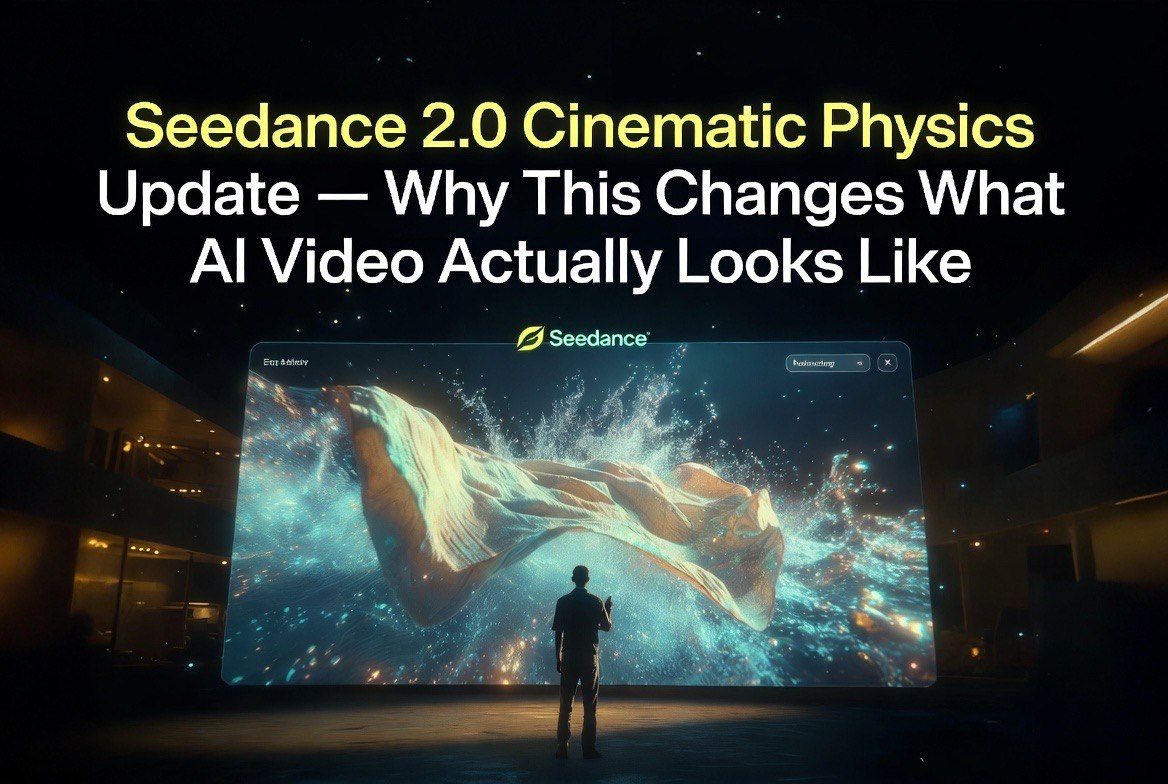
Seedance 2.0 Cinematic Physics Update — Why This Changes What AI Video Actually Looks Like
⚡ Expert Summary: ByteDance’s Seedance 2.0 has become the benchmark for AI video physics — gravity, fabric draping, liquid splashes, and character movement that feel real rather than generated. With a 9/10 motion quality score, it outperforms competitors on cinematic realism while adding atmospheric effects like volumetric fog, rain physics, and film-style camera moves. For content creators who need their AI video to look like it was shot — not rendered — Seedance 2.0 is currently the best option available.
The criticism of AI-generated video has been consistent since the technology emerged: it looks like AI video. Something in the motion is off. Characters glide instead of walk. Objects float instead of fall. Lighting looks plausible but never quite right.
Seedance 2.0 is the first widely available AI video model that mostly solves this. Released by ByteDance in February 2026, it has become the benchmark that other models are measured against for physics accuracy, motion quality, and cinematic atmosphere.
This article is about what it actually does differently, why it matters for content creators, and whether you should be using it instead of — or alongside — your current tools.
The Physics Problem That Every AI Video Model Has
AI video models generate frames by predicting what comes next based on training data. They learn motion patterns from millions of clips. But learned motion is not physics simulation. The model knows what a person walking looks like. It does not know that a person walking has weight, balance, and momentum.
The result is video that looks plausible in individual frames but wrong in motion. Characters move without weight shifts. Objects interact without force exchange. Physics becomes suggestion rather than simulation.
Seedance 2.0 approaches this differently. ByteDance built a physics-aware generation pipeline that simulates gravity, collision, fluid dynamics, and fabric behavior within the video generation process. The model does not just predict pixels. It simulates forces and renders the outcome.
This is why Seedance 2.0 clips of a car drifting actually show tire smoke, weight shifting to the outside wheels, and the suspension compressing. Not because the model was trained on car drifting clips — though it was — but because the physics layer enforces realistic behavior even when the training data alone would not.
What Cinematic Physics Looks Like in Practice
The difference between Seedance 2.0 and other models is most visible in three areas:
Gravity and weight. Characters land with impact. Fabric drapes naturally instead of floating. Objects fall at the correct speed and bounce realistically. This sounds obvious, but most AI video models still struggle with it. A character jumping in another model might hang in the air too long or land without a weight transfer. Seedance 2.0 handles the full physics arc.
Liquid and particle behavior. Water splashes, dust clouds, sparks, and smoke all follow simulated physics rather than visual approximation. A glass breaking in Seedance 2.0 produces shards that scatter with realistic velocity and trajectory. Rain falls and interacts with surfaces. This is the difference between video that looks like animation and video that looks like footage.
Character movement. Hands and fingers render correctly. Limbs do not clip through each other or through objects. Walking motions include the natural forward lean and arm swing that make movement look human. This is particularly important for content creators producing videos with people — whether real or AI-generated characters.
Atmospheric Effects: The Unsung Feature
Seedance 2.0 also handles atmospheric effects at a level that competitors have not matched. Volumetric fog, rain with surface interaction, dust motes in sunlight, reflections on wet ground — these are not just visual effects. They signal to the viewer that the video was produced with intention.
For content creators, this matters because atmospheric quality is what separates a video that looks like a demo from a video that looks like a production. Seedance 2.0 consistently produces the kind of lighting and atmosphere that traditional filmmakers achieve through set design, lighting rigs, and post-production grading.
The model also supports cinematic camera moves — tracking shots, push-ins, orbit rotations, and speed ramping — that feel intentional rather than accidental. The camera in a Seedance 2.0 clip moves like someone behind a camera decided where to point it, not like the model randomly selected a viewing angle.
How Seedance 2.0 Compares to the Competition
Kling 1.7 is Seedance 2.0’s closest competitor. Kling handles character consistency well and produces reliable output across a range of prompts. But in side-by-side comparisons of motion quality and physics accuracy, Seedance 2.0 consistently scores higher. Kling’s output can feel slightly weightless compared to Seedance’s physics-grounded clips.
Runway Gen-4/4.5 focuses more on editing features and integration — motion brush, inpainting, frame propagation. Runway’s output quality is good but does not match Seedance 2.0 for cinematic realism. Runway’s strength is the full editing suite, not the raw generation quality.
Google Veo 3.1 is competitive on quality but less accessible. Veo is available through Google’s Vertex AI platform, not as a standalone consumer product. For a solo content creator, Seedance 2.0 through Higgfield or PixVerse is easier to access and use.
Sora 2 (OpenAI) has shown impressive demo clips but remains limited in availability. Seedance 2.0 is production-ready and accessible today through multiple platforms.
Real-World Use Cases Where Seedance 2.0 Excels
Certain types of content benefit disproportionately from Seedance 2.0’s physics focus.
Product showcases with motion. If your product is something that moves, flows, or interacts with its environment — pouring a drink, driving a vehicle, operating machinery — Seedance 2.0 will produce footage that looks like a commercial rather than a render. The physics layer makes liquid behavior, mechanical motion, and environmental interaction feel authentic.
Atmospheric brand content. Brands that rely on mood and environment — hospitality, luxury goods, travel, outdoor gear — benefit from Seedance 2.0’s volumetric lighting and atmospheric effects. A hotel room scene with morning light streaming through curtains, dust motes floating, and fabric draping naturally is achievable with Seedance in a way it isn’t with other AI video tools.
Action and movement sequences. Car content, sports visualization, dance, or any clip involving dynamic physical movement benefits from accurate physics simulation. The difference between Seedance 2.0 and alternatives is most visible here.
Music videos and visual art. Creators producing music visualizers, short film aesthetics, or concept art in motion should use Seedance 2.0 for its cinematic camera moves and atmospheric rendering. The output reads as intentional filmmaking rather than AI generation.
Where Seedance 2.0 Falls Short
No tool is perfect. Seedance 2.0 has limitations worth understanding.
Clip length. Maximum 15 seconds per generation. You cannot generate long-form video in a single pass. Every Seedance project requires assembling multiple clips in an editor.
Prompt sensitivity. The model rewards detailed, physics-aware prompting and punishes vague descriptions. If you prompt generically, you will get average results. This is the opposite of tools like Canva AI that produce reasonable output from minimal input.
Character consistency across clips. Seedance 2.0 maintains good consistency within a single clip but does not reliably produce the same character across multiple generations. For narrative work that requires a character to appear identically across multiple scenes, you need additional tools or manual editing.
Cost at volume. At $0.10 to $0.50 per generation, producing 100 clips for a project costs $10 to $50. That is cheap compared to traditional production but expensive compared to lower-tier AI tools that offer unlimited generation subscriptions.
What You Need to Know Before Using It
Seedance 2.0 requires better prompting than most AI video models. You cannot just type “cool cinematic video” and get great results. You need to describe physics explicitly. Reference gravity, weight, force, and environment. A prompt like “a glass of water tips over on a wooden table, water splashes across the surface, droplets catch the light, slow motion, cinematic lighting” will produce dramatically better results than “glass tipping over.”
The output length is limited to 4 to 15 seconds per clip. Seedance is not designed for long-form generation. You create short clips that you edit together in your video editor.
Cost varies by platform. On PixVerse and Higgsfield, credits cost roughly $0.10 to $0.50 per generation depending on resolution and length. For professional use, the cost is manageable and significantly cheaper than shooting equivalent footage with a real camera and production crew.
Is Seedance 2.0 Right for You?
If you produce video content where visual quality matters — brand videos, product showcases, cinematic social content, client work — Seedance 2.0 is currently the best AI video generation model available. The physics accuracy and atmospheric quality produce output that does not look like AI video, which is the entire point.
If you need high-volume production of simple content — faceless social clips, basic explainers, template-based ads — Seedance 2.0 is overkill. Edimakor V5.0 or Canva AI will serve you better at lower cost.
If you want to test it, start with the Higgsfield platform, which offers the most user-friendly interface for Seedance 2.0 generation. Run 10 generations with physics-heavy prompts, compare the output to what you get from your current tools, and decide whether the quality difference justifies the price difference.
Pricing: Is Seedance 2.0 Worth It for a Solo Creator
At $0.10 to $0.50 per generation, the cost adds up fast if you are generating hundreds of clips. But you are not supposed to generate hundreds of clips. Seedance 2.0 is for the hero shots — the 3 to 5 key clips in a project that need to look cinematic. Everything else can come from a cheaper tool.
The smart workflow: use Edimakor or Canva AI for the bulk of your content, and route only the money shots through Seedance 2.0. You get cinematic quality where it matters without paying high per-generation costs for the filler clips that nobody scrutinizes anyway.
That workflow keeps monthly generation costs under $50 for most creators while delivering professional-quality hero clips that elevate the entire project.
The Future: Seedance 2.1 and Beyond
ByteDance has teased Seedance 2.1 with further improvements to physics coherence, longer clip times, and better multi-character consistency. The upgrade cycle suggests a release in late 2026.
If ByteDance follows the trajectory they established with Seedance 1.0 to 2.0, expect 2.1 to narrow the remaining gaps — particularly character persistence across clips and handling of complex multi-subject scenes. The physics engine will likely improve as more training data and user feedback inform the simulation layer.
For content creators, the takeaway is that Seedance 2.0 is good enough to use in production today, and the gap between AI video and traditionally produced video will continue to narrow with each iteration.
The Bottom Line
Seedance 2.0 sets the standard for physics-accurate AI video generation in 2026. If visual quality is the priority, it is the best tool available. If cost or simplicity is the priority, there are cheaper and easier options. But if your work depends on video that looks real, Seedance 2.0 is the choice that makes everything else catch up.
FAQ
Can I use Seedance 2.0 for free?
Some platforms offer free credits for new users. PixVerse and Higgfield both have free tiers with limited generations. For regular use, expect to pay per generation.
Does Seedance 2.0 support audio?
Yes. Seedance 2.0 supports audio input and can generate video with synchronized audio. The feature is available on supported platforms.
Is Seedance 2.1 coming?
ByteDance has teased Seedance 2.1 with further improvements to physics coherence and realism. No release date has been announced, but the upgrade cycle suggests a late 2026 timeline.
What platforms support Seedance 2.0?
Seedance 2.0 is available on Higgfield, PixVerse, RunDiffusion, and Freepik. Each platform offers slightly different pricing and features. Higgfield is currently the most popular option for content creators.

About Barak Schurr
Barak Schurr is a serial entrepreneur who built and exited a major ticketing platform before turning his attention to AI and content. He runs three AI-focused research sites and writes about the tools, workflows, and strategies that let solo creators build real channels — without a crew, a studio, or a Hollywood budget.
Email: [email protected]
More AI Resources for Your Business