What It Actually Costs to Start an AI Video Business in 2026
What It Actually Costs to Start an AI Video Business in 2026
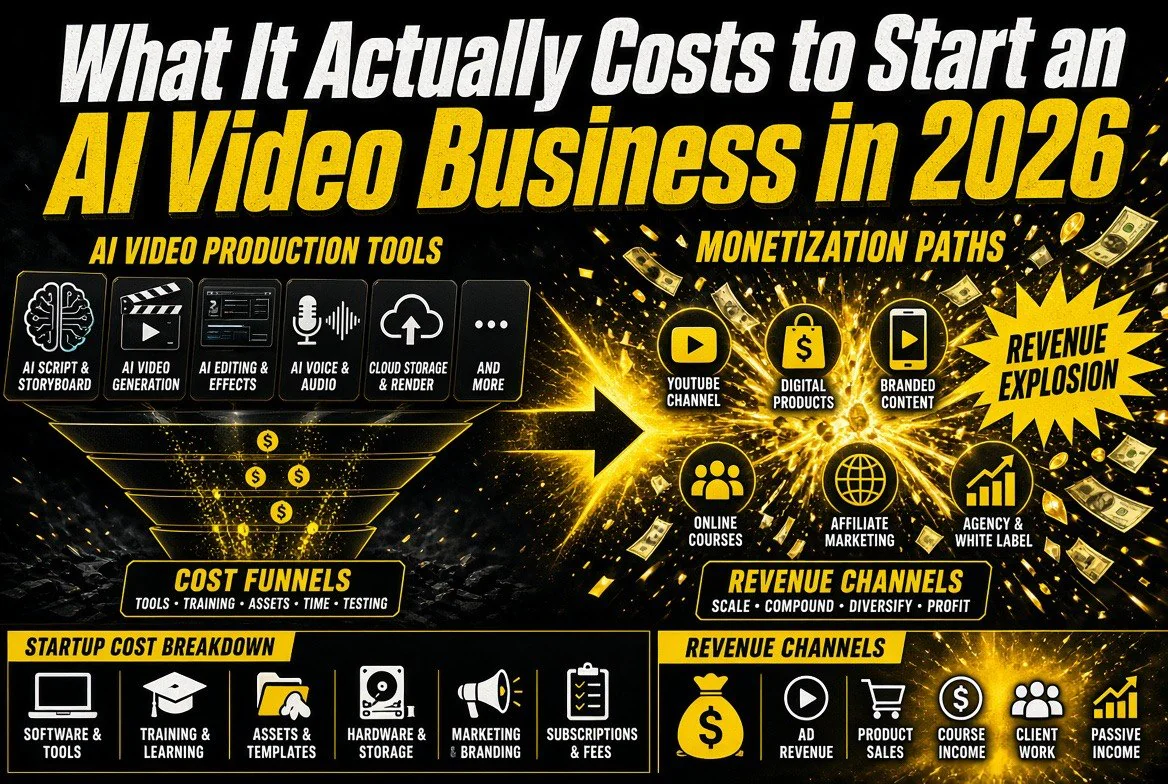
⚡ Expert Summary: You can legally start an AI video business for under $100 a month. You cannot start a profitable one for that. The real entry cost in 2026 is roughly $150-400/month in software, $1,000-3,000 in hardware you probably already own in some form, and — the part nobody budgets for — 200 to 400 hours of unpaid learning before your first paid client. The barrier is no longer money. It is the time you have to spend getting good while nobody is paying you.
Every week someone posts the same question in a creator forum: what do I actually need to start an AI video business? The answers are useless because they split into two camps. One camp says you can do it with a laptop and a free trial. The other says you need a workstation and a subscription stack.
Both are technically true and practically wrong. Here is what the numbers look like when you write them down.
The Honest Starting Numbers
Three categories matter: software, hardware, and time. The first two are the ones people talk about. The third is the one that decides whether you make it.
| Cost Category | Minimum to Start | Comfortable / Professional |
|---|---|---|
| AI video generation | $30-60/mo | $150-300/mo (multiple models) |
| Voice and narration | $0-29/mo | $49-99/mo |
| Editing software | $0 (free tier) | $23-60/mo |
| Music licensing | $0 (royalty-free) | $15-30/mo |
| Storage and delivery | $0-10/mo | $20-40/mo |
| Hardware | $0 (existing laptop) | $1,500-3,000 (once) |
| Software total | $30-100/mo | $260-530/mo |
That is the whole financial case, and it is smaller than most people expect. The gap between a hobbyist and a professional operation is a few hundred dollars a month. Nobody is priced out of this market by software.
What the Tools Actually Charge
Published pricing as of October 2026. These are list prices — annual billing cuts them by roughly 20-40%.
| Tool | Entry Price | Mid Tier | Top Tier |
|---|---|---|---|
| Runway | $12/mo annual ($84/yr) | $28/mo Standard ($228/yr) | $76/mo Pro ($95 monthly) |
| HeyGen | Free tier | $29/mo Creator | $49/mo Team |
| Synthesia | Free (limited minutes) | $29/mo Starter | $89/mo Creator |
| Google Veo (via Gemini) | Tied to AI Pro plan | ~$20/mo AI Pro | ~$250/mo Ultra tier |
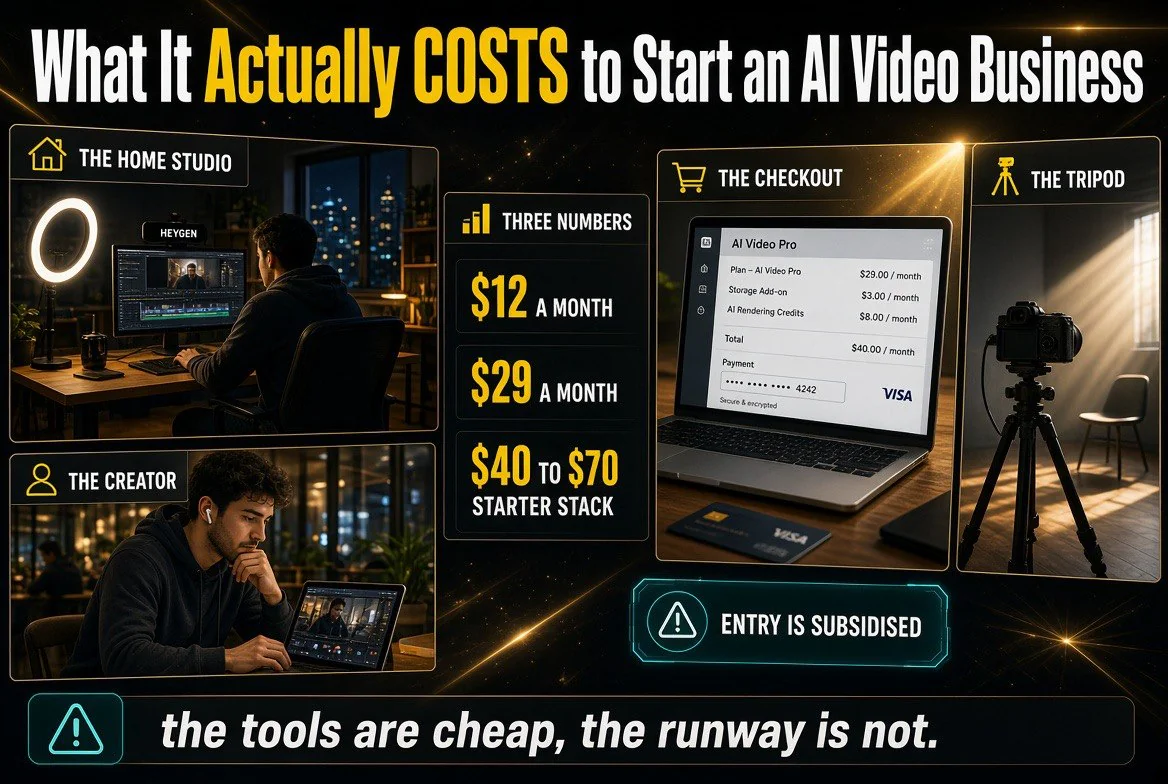
| Realistic starter stack | $40-70/mo | — | — |
Notice the shape of that table. Entry pricing in this category is aggressively cheap because every vendor wants to own the beginner. The margin is made on people who scale up. You are being acquired as a customer, which is good news: the tools are subsidising your entry.
The Cost Nobody Prices In
Software is a solved problem. Time is not.
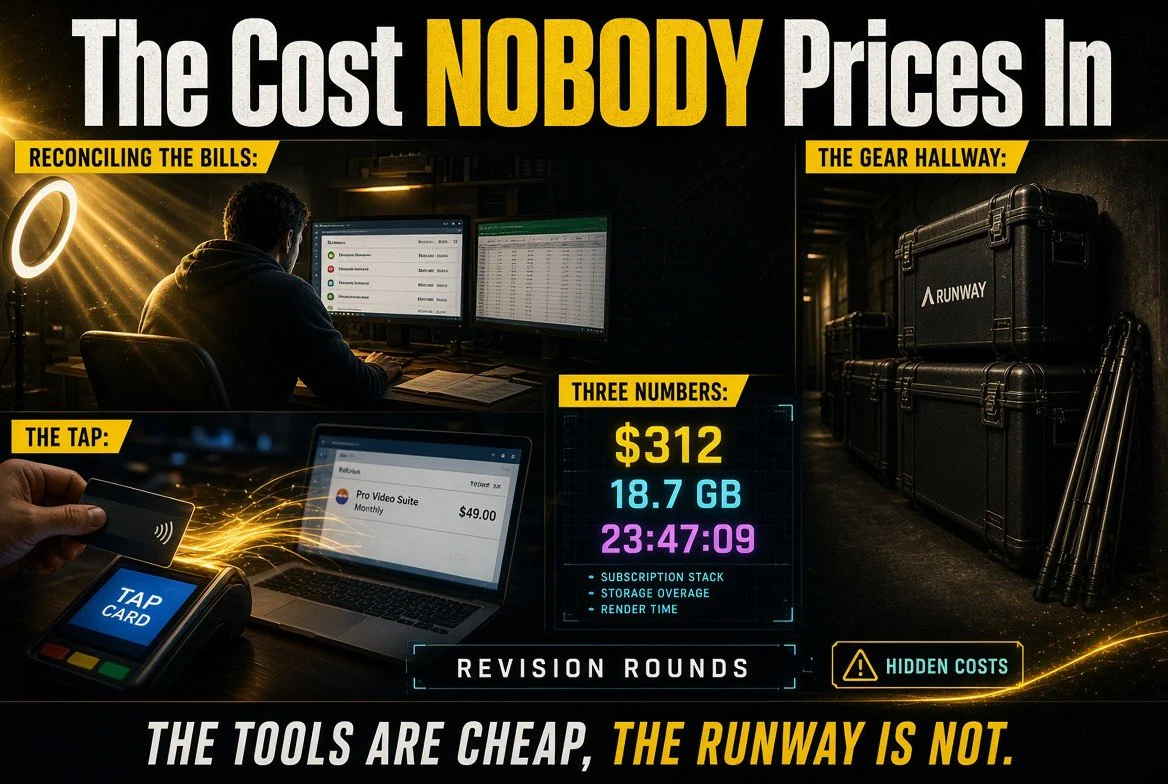
Here is the number you will not find in a pricing guide: it takes most people 200 to 400 hours of deliberate practice before they can produce AI video that a paying client would accept without embarrassment. Not 20 hours. Not 40. Two hundred plus, and that is the optimistic case for someone with existing video or editing background.
At a modest $25/hour opportunity cost, 300 hours is $7,500 of unpaid labour. That is your real entry ticket. It dwarfs every subscription line item combined.
This is why so many AI video businesses die in month three. The founder budgeted for tools, discovered they had budgeted nothing for the months where they were learning and earning zero, and ran out of patience before they ran out of money.
The three ways people get the hours down
Narrow the output. Someone who only makes 30-second product ads gets competent in a fraction of the time of someone who tries to make everything. Constraint compresses the learning curve.
Enter with an adjacent skill. If you already edit, already write scripts, or already understand lighting, you are not starting at zero — you are adding a tool to an existing craft. Those people hit paid work in weeks, not months.
Get paid early on things you can already do. Scripting, storyboarding, and editing are sellable before your generation quality is. Charge for those while you build the rest.
The Break-Even Maths
This is the part that decides whether the business is real. Assume a starter stack of $70/month and a first client package priced at $500.
| Month | Costs | Revenue | Running Position |
|---|---|---|---|
| Month 1 (learning) | $70 | $0 | -$70 |
| Month 2 (first free work) | $70 | $0 | -$140 |
| Month 3 (first paid client) | $70 | $500 | +$290 |
| Month 4 (two clients) | $95 | $1,000 | +$1,195 |
| Break-even | $305 total spent | — | Month 3 |
Three months and roughly $300 of real spend to break even, if you land a single $500 client in month three. That is a remarkably low bar — which is exactly why the market is crowded with people who cleared the financial bar and still quit, because they hit month three with no client and no pipeline.
The break-even math is easy. The pipeline is the hard part, and no pricing table covers it.
What You Are Actually Competing On
Access to the same models as everyone else is not a competitive advantage. Every competitor has Runway. Every competitor has HeyGen. The tool is not the moat.
What separates the operators who charge $3,000 per project from the ones charging $150 is not the model version. It is judgement: knowing which shot a client actually needs, knowing when a generation is good enough to ship, and knowing how to say no to a brief that will burn three days for no return.
That judgement is what the 300 hours buys you. You can lease the software for $30 a month. You cannot lease the taste.
Should You Start One
Yes, if three things are true.
You have an adjacent skill. Editing, scripting, marketing, or design. If you are starting from absolute zero on everything, the learning curve is not 300 hours, it is a year.
You can survive three months without income from it. Not thrive. Survive.
You already have a client in mind. An actual business, with an actual budget, who has already said something like “we should do more video.” That is not a lead. That is a test of whether you can close.
If all three are true, the financial risk is roughly $300 and a few hundred evenings. That is one of the cheapest business entries available in 2026.
If none of them are true, the subscription is not your problem. The sequence is.
The Four-Month Reality Check
Most cost guides stop at the shopping list. Here is what the first four months look like when you actually run the numbers instead of the fantasy.
Month one is pure burn. You buy the entry tier, you produce work nobody sees, and you discover that your first twenty generations are unusable for reasons you cannot yet articulate. That is not failure, it is calibration – but it costs money and it earns nothing.
Month two is where most people quit. The novelty has worn off, the outputs still look like AI, and there is no client on the horizon. The correct move is to stop optimising the model and start learning what a client actually needs, which is usually not a higher-fidelity render but a clearer message.
Month three is when the first paid work typically appears, and it will not look like what you imagined. It will be a fifteen-second product clip, a testimonial edit, or a social cutdown – low prestige, real money, and the single most useful thing that can happen to you.
Month four is where the business either has a repeatable offer or does not. Two clients at the same price with the same delivery process is a business. Four clients at four different prices with four different processes is a hobby that pays.
Where the Money Actually Goes Wrong
New operators overspend in three predictable places, and none of them are the model subscription.
Buying tiers they cannot fill. A $95-per-month plan with a monthly generation cap you hit in one week is fine. The same plan when you generate twice a month is a donation. Match the tier to the actual output volume, and revisit it monthly rather than annually.
Paying for overlap. Four tools that all do text-to-video means three of them are decoration. Pick one primary generator, one backup, and stop. The backup exists for the day a model changes behaviour, not for daily use.
Underpricing to win the first job. A $150 first project sets the anchor for every referral that follows. Clients talk to each other, and they compare line items. Price at what the outcome is worth, and if you need portfolio work, do it for free deliberately rather than cheaply forever.
What the Market Is Actually Paying
Rates in this category are wider than any other part of the creator economy because the deliverable is vague. A thirty-second social ad and a three-minute explainer can both be called “an AI video” and differ by a factor of twenty in price.
The operators earning well are not charging by minute or by render. They are charging by outcome – a launch, a campaign, a set of assets a client will run for six months – and they scope tightly so the deliverable is never ambiguous.
That is the actual barrier to entry. Not the $70 stack. The ability to price a vague request confidently enough that the client agrees and the project still makes money.

Frequently Asked Questions
How much does it cost to start an AI video business in 2026?
Roughly $30-100 per month in software if you start lean, or $260-530 per month for a professional multi-model stack. Hardware is optional if you already own a competent laptop, since most generation happens in the cloud. The larger cost is time: most people need 200-400 hours of practice before producing client-ready work.
Do I need a powerful computer for AI video?
Usually not. Runway, HeyGen, Synthesia, Veo and most competitors run generation on their own servers, so your machine mainly needs to handle editing and playback. A mid-range laptop from the last few years is generally sufficient, which is a significant change from the local rendering requirements of even two years ago.
How long until an AI video business is profitable?
With a starter stack around $70 per month, total costs stay under roughly $300 for the first three months. A single $500 client in month three puts the business at break-even or better. The constraint is not the cost, it is landing that first paying client.
Can I start an AI video business with no experience?
You can start, but the learning curve is far steeper without an adjacent skill such as editing, scripting or marketing. People entering with an existing craft typically reach paid work in weeks, while someone starting from zero may need a year of consistent practice before their output is client-ready.
What should I charge for AI video work?
Pricing should follow the client’s outcome, not your tool cost. A short product ad for a small business commonly sits in the $300-800 range, while ongoing social video retainers trend higher. Charging based on your $30 subscription guarantees you earn like a hobbyist.
Is the AI video market too crowded to enter?
The market is crowded with people who own subscriptions. It is far less crowded with people who have judgement about what to shoot, when a generation is good enough to ship, and how to manage a client brief. Access to models is not a competitive advantage because every competitor has the same access.
What is the biggest mistake new AI video businesses make?
Budgeting for tools and not for time. Software costs a few hundred dollars a year; the unpaid learning period costs hundreds of hours. Founders who plan for the subscription and not the learning phase typically run out of patience around month three, which is exactly when the first paid work tends to arrive.

About Barak Schurr
Barak Schurr is a serial entrepreneur who built and exited a major ticketing platform before turning his attention to AI and content. He runs three AI-focused research sites and writes about the tools, workflows, and strategies that let solo creators build real channels — without a crew, a studio, or a Hollywood budget.
Email: [email protected]
More AI Video Resources