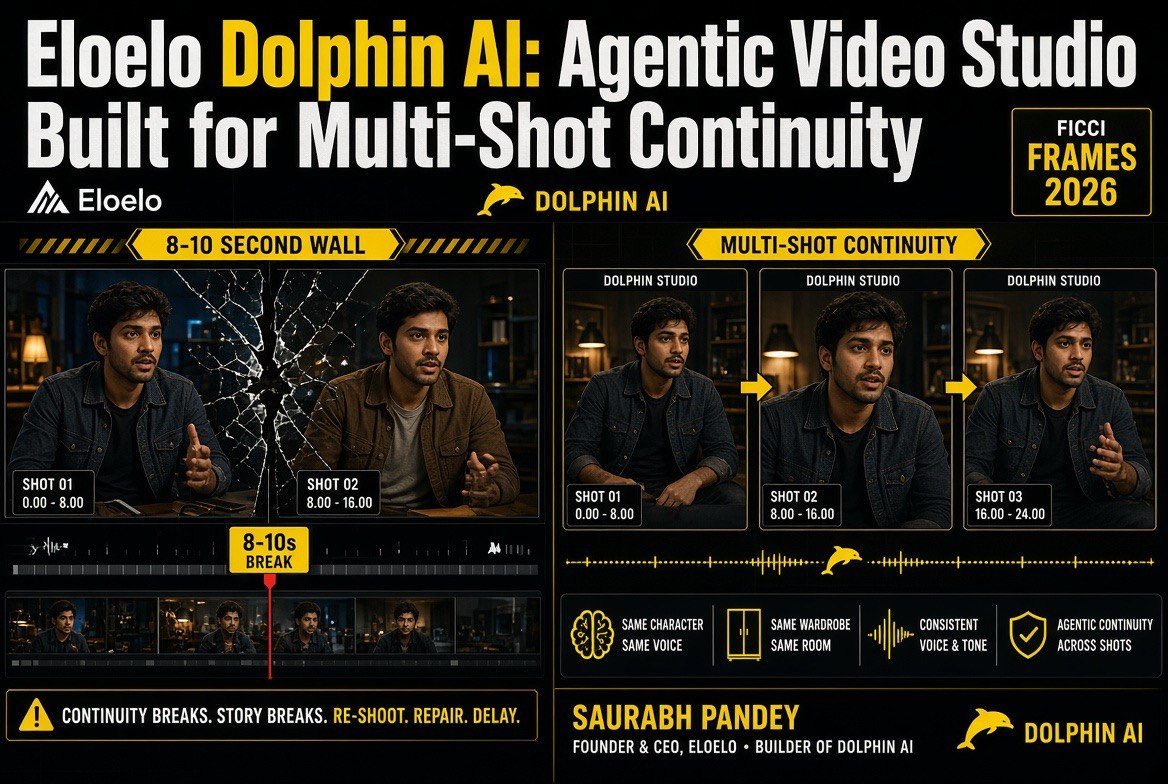
Eloelo Dolphin AI: Agentic Video Studio Built for Multi-Shot Continuity
Get The Faceless YouTube Blueprint — Free
The exact AI tool stack and workflow used to build a faceless YouTube channel from zero.
Eloelo Opens Dolphin AI: An Agentic Studio Built at Micro-Drama Scale
⚡ Expert Summary: Eloelo Group has opened Dolphin AI, an agentic video studio built from its own production line of 5,000+ dramas and 100,000 creatives tested monthly. The claim that matters to solo creators is not the model quality. It is multi-shot continuity: characters, voices, wardrobes and locations held across shots instead of collapsing at the 8-10 second wall most AI video tools hit.
What Eloelo Actually Built
Eloelo Group unveiled Dolphin AI at FICCI FRAMES 2026, with founder and CEO Saurabh Pandey presenting it in his keynote and the booth inaugurated by Shri Prithul Kumar, Joint Secretary at the Ministry of Information & Broadcasting.
The origin story is the interesting part. Dolphin was not built as a product first. It was built to solve Eloelo’s own production problem. Through Story TV the group has produced more than 5,000 original dramas, and internal teams test over 100,000 creatives every month. At that volume, the bottleneck stops being ideas and becomes assembly.
Pandey put the motivation plainly: “Dolphin came from solving our own production problems at that scale. We built proprietary workflows to make storytelling faster, more iterative, and more ambitious, and today we are opening that technology for the world.”
The tool is now open to creators, filmmakers, brands and studios globally, positioned for anything from a social clip to a tutorial to a D2C ad to a full micro-drama.
The 8-10 Second Wall and Why Multi-Shot Matters
Pandey named the industry’s actual constraint in his own words: “AI videos currently lack context preservation and struggle to build anything beyond 8 to 10 seconds.”
Any creator who has tried to make a narrative clip with AI knows that wall intimately. Shot one looks great. Shot two has a different face. Shot three wears the wrong jacket, sits in a different room, and speaks in a voice that belongs to neither of the first two. Generate longer and the model drifts until the piece is unusable.
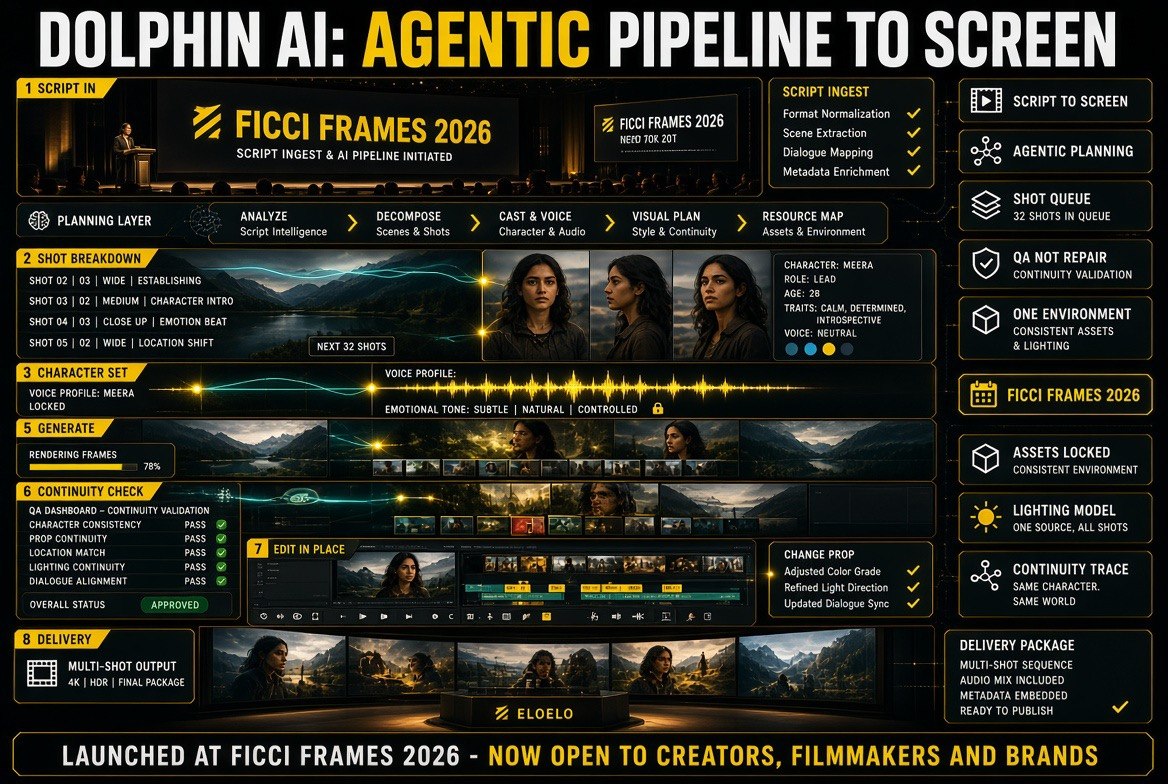
Dolphin’s answer is multi-shot production with proprietary planning and continuity systems, designed to preserve characters, voices, wardrobes, props, locations and visual language across shots. An agentic production layer reads creative intent, breaks a longer video into individual shots and tasks, then coordinates generation while holding context across the whole workflow.
Whether the output actually holds up at scale is the open question, and it can only be answered by putting it in front of real projects. The architecture, at least, targets the correct problem.
Eloelo Dolphin AI holds one character, voice and wardrobe across three consecutive shots.
Eloelo Dolphin AI vs the Current Creator Workflow
The comparison that matters for a solo creator is not Dolphin against another model. It is Dolphin against the workflow you are running today, which is usually a stitched chain of separate tools.
| Factor | Stitched Tool Chain | Eloelo Dolphin AI |
|---|---|---|
| Shot continuity | Manual re-prompting per shot | Held across the production |
| Practical clip length | 8-10 seconds, then drift | Multi-shot, longer form |
| Character consistency | Reference burden on you | Reusable visual and voice assets |
| Script to shots | You break it down by hand | Agentic planning layer |
| Editing surface | Export into a separate editor | Integrated in one environment |
Why an Indian Micro-Drama Studio Is Worth Your Attention
Eloelo Group has spent years building short-form drama at volume, producing more than 5,000 original dramas and testing over 100,000 creatives every month. Dolphin AI is the tooling that line needed, and it is now open to creators outside the company.
Pandey framed the ambition beyond the product, describing a world of infinite content where India moves from being one of the largest consumers of content to one of its largest exporters. The mechanism behind the rhetoric is concrete: drop the cost of a multi-shot production far enough and the volume of content changes shape.
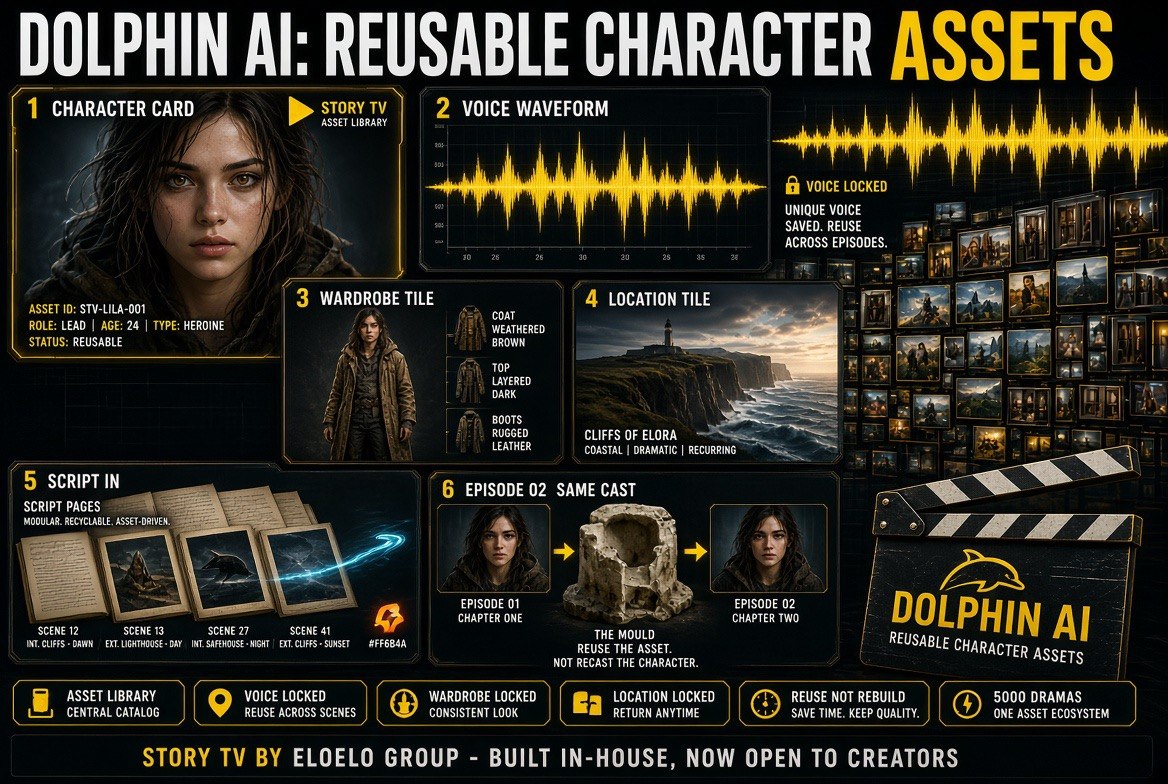
Story TV turns a single script into reusable character, voice, wardrobe and location assets.
For a solo creator, that cuts both ways. Cheaper production is an opportunity. Cheaper production everywhere is also more competition in the same feeds you publish to.
The Real Question: Does Continuity Hold Outside a Demo
Every AI video launch of 2026 has promised consistency. The ones that delivered could hold a character across a cut. The ones that did not showed a crisp demo and fell apart the moment a real script asked for the same person in two rooms.
Dolphin treats continuity as data rather than as a prompt instruction. Characters, voices, wardrobes, props and locations become reusable assets instead of text you retype and hope the model honours. That is the correct shape of the solution. Whether it holds across a hundred shots is what a two-week test tells you, and no launch post can answer it.
The Build-Out Checklist for Your First Project
If you are going to try it, run the test like a job rather than a curiosity. Write the hardest scene first, not the easiest: three shots, one character, two locations, a wardrobe change. If continuity survives that, the tool is real for narrative work.
Confirm asset portability before you invest hours, because building a character library you cannot move is a one-way door. Keep your existing chain running in parallel on one project so you have a true comparison. And measure the time a finished multi-shot piece takes end to end, because that number is the entire business case.
Where Dolphin AI Fits Alongside the Tools You Already Run
One more comparison is worth keeping, because it decides whether Dolphin replaces anything in your stack or simply adds a layer. Most creators run a generator, a voice tool, and an editor. The question is which of those it absorbs.
| Job in Your Stack | Standalone Tool | Dolphin AI |
|---|---|---|
| Shot generation | Yes, per clip | Yes, multi-shot planned |
| Voice | Separate subscription | Reusable voice assets |
| Continuity across shots | Manual, unreliable | Handled by the system |
| Editing | Dedicated editor | Integrated, lighter |
| Creative control | Total, per tool | Shot-level, guided |
The honest read is that Dolphin is strongest where your stack is weakest: holding a production together. It is not a replacement for a real editor on a piece where you want frame-level control, and anyone who tells you otherwise has not cut a video with a shot list.
Multi-Shot Workflow: Where the Time Actually Goes
| Stage | Manual + AI Tools | Agentic Studio | Where Time Moves |
|---|---|---|---|
| Script breakdown | You, by hand | Analysed automatically | Earlier, into planning |
| Character setup | Re-described each shot | Reusable asset | One-time cost |
| Generation | Tool by tool | Coordinated by agent | Less babysitting |
| Continuity fixes | Most of the work | Designed out | Turns into QA, not repair |
| Editing | Separate app | Same environment | Fewer handoffs |
Read the last column as the honest part of the pitch. An agentic studio does not delete work. It relocates it, and the value depends on whether the place it lands is cheaper than where it started.
What This Means for Solo Creators This Week
The practical move is not to migrate. It is to test one thing: whether multi-shot continuity holds on a scene you actually care about. Everything else about Dolphin AI is secondary to that single question, because a tool that cannot hold a character across a cut is not a production studio, it is a clip generator with better marketing.
Run the three-shot test. Check what you can export. Compare the end-to-end time against your current chain. If all three hold up, the tool earns a place in your workflow. If the first one fails, nothing else matters.
What the Chat, Templates and Playground Actually Do
Dolphin is not a single prompt box. It is structured as three surfaces that a creator moves through as a project matures.
Chat is the natural-language entry point. You describe what you want and the agent interprets creative intent rather than requiring a formatted prompt.
Templates give a guided middle path for common formats, which matters enormously for creators who do not want to author a prompt from scratch every time.
Playground exposes shot-level controls, with editing and enhancement integrated into the same environment rather than exported into a separate editor.
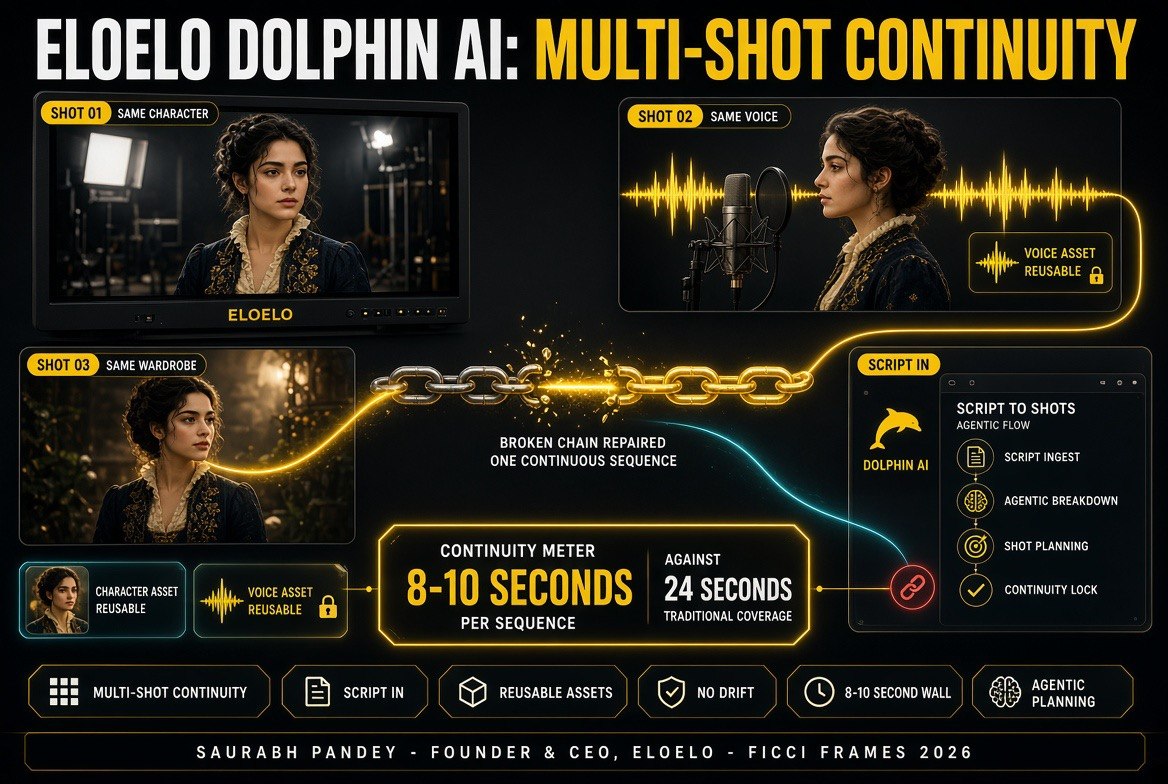
Dolphin AI runs script to delivered multi-shot piece in one agentic pipeline.
The logic is a staircase: describe it, follow a template, or take direct control of individual shots. That progression is the part most AI video tools get wrong, forcing experts and beginners into the same single interface.
Film Studio: Script In, Structured Production Out
The most ambitious piece is Film Studio, which converts a script into a structured, multi-shot production. It reads premise, tone, chronology and character arcs before identifying characters, locations and props, then builds reusable visual and voice assets from that reading.
This is the part that connects Dolphin to Eloelo’s actual business. A studio producing 5,000 dramas needs reusable assets more than it needs a better single clip. Consistency across episodes is the economics of the format.
Whether a solo creator benefits from that apparatus depends on what they make. A one-off social clip does not need a character bible. A ten-part faceless series absolutely does, and building one by hand in a stitched tool chain is the work that eats the week.
What This Means for Solo Creators
Three practical takeaways, in order of how much they change your workflow.
1. Multi-shot continuity is the feature to test first. Ignore the model comparisons. Take a three-shot scene with the same character and see whether the face, the clothing and the voice survive the cut. That single test predicts whether the tool is usable for anything narrative.
2. Ask what happens to your assets if you leave. A tool that stores reusable characters and voices is holding real work product. Confirm whether you can export those assets or whether they remain locked to the platform.
3. Do not migrate your whole pipeline on day one. Run one real project alongside your current workflow. The continuity systems either hold or they do not, and a project you actually care about is the only honest test.
Frequently Asked Questions
What is Eloelo Dolphin AI?
Dolphin AI is an agentic AI studio from Eloelo Group that handles end-to-end video production, from script through multi-shot generation with continuity across characters, voices, wardrobes and locations.
What problem does Dolphin AI solve that other AI video tools do not?
Context preservation across shots. Most AI video tools lose character and scene consistency beyond roughly 8-10 seconds. Dolphin uses multi-shot technology and an agentic planning layer to hold continuity across a longer production.
Who is Dolphin AI for?
The company has opened it to creators, filmmakers, brands and studios globally, and positions it for outputs ranging from social clips and tutorials to D2C ads and micro-drama series.
Is Dolphin AI available outside India?
Eloelo Group describes the platform as open to creators, brands and studios globally, and launched it publicly at FICCI FRAMES 2026.
Should solo creators switch to Dolphin AI now?
Test it on one genuine multi-shot project before changing anything. The decisive question is whether continuity holds across cuts in your own footage, not how the demo performs.

About Barak Schurr
Barak Schurr is a serial entrepreneur who built and exited a major ticketing platform before turning his attention to AI and content. He runs three AI-focused research sites and writes about the tools, workflows, and strategies that let solo creators build real channels — without a crew, a studio, or a Hollywood budget.
Email: [email protected]
More AI Resources for Creators