Vocci’s Ring Adds a New Form Factor to Meeting Note-Taking — What Wearable AI Capture Means for Creator Workflows
Get The Faceless YouTube Blueprint — Free
The exact AI tool stack and workflow used to build a faceless YouTube channel from zero.
Vocci’s Ring Adds a New Form Factor to Meeting Note-Taking — What Wearable AI Capture Means for Creator Workflows
⚡ Expert Summary: Vocci has released a ring-shaped AI notetaker at $249 — under 6 grams, titanium-coated, with a double-tap record button and a claimed 8 hours of capture per charge. Reviewers report it transcribes hour-long conversations accurately, even in loud cafes, but flag confusing software, slow feature rollout, and a privacy problem unique to the form factor: it looks like jewellery, and its recording indicator faces the wearer. For solo creators, the interesting question isn’t whether the ring wins — it’s what a capture device you never have to think about does to the interview-to-publish pipeline. This guide covers where wearable capture genuinely helps a solo channel, where it creates legal and trust risk, and the workflow that turns raw conversation into publishable content.
Meeting notetakers have already colonized every wearable surface a person has: pendants, pins, credit-card-shaped slabs, wristbands. Now there is a ring.
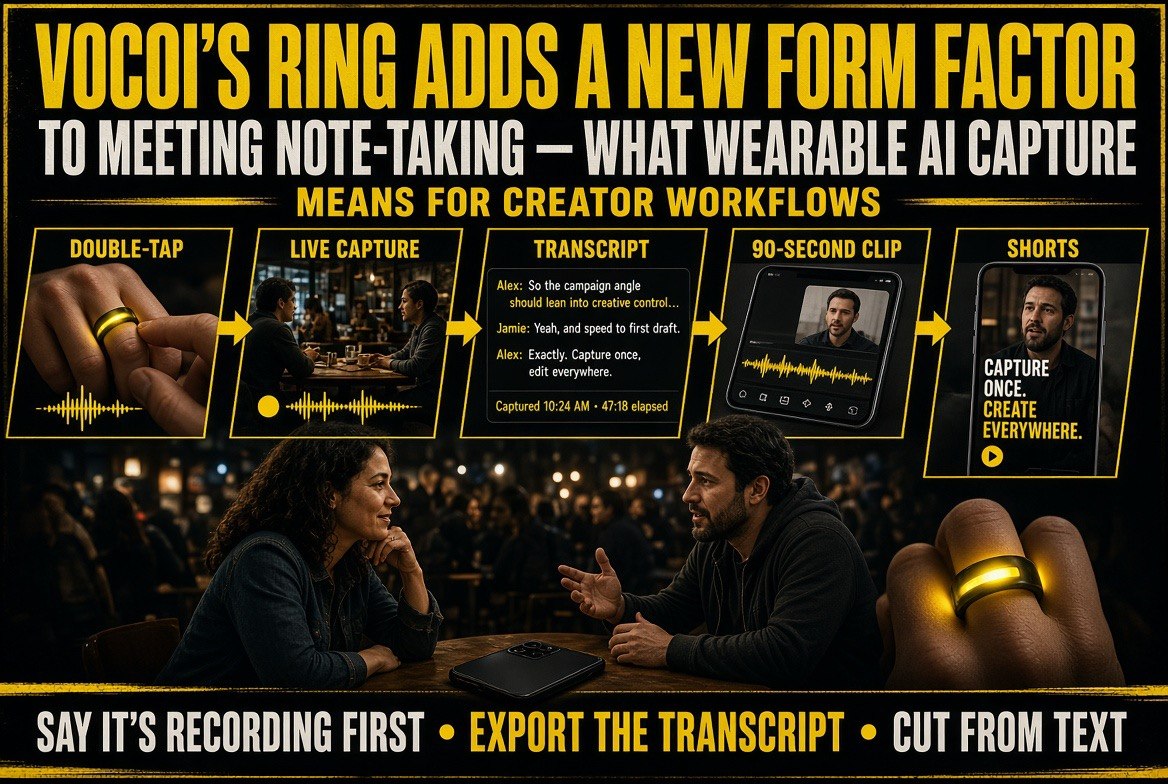
Vocci released a ring-form-factor AI notetaker at $249. It weighs under 6 grams, uses titanium on the inner and outer surfaces, and centers meeting note-taking as its primary job rather than reminders or voice memos. The controls are deliberately minimal: double-tap the button to start recording, double-tap again to stop. Tap and hold asks the AI a question, but only while the phone app is open. There’s an indicator light and a haptic motor so you know when it’s live. Vocci claims 8 hours of recording on a single charge, and the ring ships with a chunky plastic case that recharges it up to three times.
In hands-on testing reported by TechCrunch, the hardware did its job: conversations running over an hour in loud cafés converted into mostly accurate transcripts. The form factor is the pitch — it’s the easiest device to just press and start capturing with, no phone propped on a table, nothing clipped to a collar.
The software is where the review turns. The app is described as confusing, and short notes produced AI-generated insights longer than the notes themselves. Each recording splits into Chat (the main transcript), Highlights (snippets captured by pressing the button mid-conversation), and Notes (a summary of the whole session). There’s a redundant tab called Base holding transcripts, recordings, and anything generated from them, and no obvious way to start a chat with the AI about a specific session transcript. There’s no direct integration with reminder apps. Model Context Protocol support to connect external assistants only appeared weeks ago, and Vocci’s platform isn’t yet built out for automated insights and workflow the way competing notetakers are.
Then there’s the privacy issue, and it’s the one that matters most to anyone who publishes conversations for a living.
The ring looks like ordinary jewellery until someone spots the button. The recording indicator faces the user, not the room. Vocci says it encourages disclosure, and that’s good practice — but in some countries and regions, disclosing a recording is not a courtesy, it’s a legal requirement. A device that’s easy to conceal makes non-disclosure easy, and that risk lands on you, not on Vocci.
Why a Creator Should Care About a Meeting Notetaker at All
If you run a solo channel, your content inputs are conversations: guest interviews, expert calls, podcast appearances, collaboration planning sessions, and the stream-of-consciousness rambling you do while walking that occasionally contains your best material.
Every one of those has the same bottleneck. The conversation happens once. Turning it into published content means re-listening to it, transcribing it, finding the good 90 seconds, and cutting. For a solo creator with no editor, that post-production step is usually why an interview never ships.
So the real question about any capture device isn’t audio quality. It’s whether it removes the friction between a conversation happening and that conversation becoming content. And this is exactly where the ring form factor is interesting — not because rings are better microphones, but because the device you actually wear is the device that actually records. Pendants get left in a drawer. Slabs stay in a bag. A ring you never take off is always present, which changes your behavior more than it changes your audio.
That’s the genuine insight buried in the product review. The winning form factor isn’t the one with the best specs. It’s the one with the lowest activation cost.
| Factor | Ring Capture (Vocci, $249) | Phone or Laptop Recording (Free) |
|---|---|---|
| Activation friction | Double-tap; device already on your hand | Open app, start recording, hope phone mic reaches the guest |
| Audio in noisy rooms | Reported accurate transcripts in loud cafés over 1 hour | Highly variable; often unusable when the guest is 6 feet away |
| Long-session battery | Claimed 8 hours, plus 3 recharges from the case | Limited by phone battery, which you also need for everything else |
| Disclosure to guests | Must be stated out loud — indicator faces the wearer, not the room | A phone on the table is visible and self-announcing |
| Getting to publishable clips | Transcript plus highlights, but app-side workflow is thin today | Export audio to a transcription tool you already control |
| Upfront cost | $249 hardware | $0 |
Look at the disclosure row and notice it cuts against the device’s core advantage. The same invisibility that makes the ring effortless is what makes it a consent problem. You don’t solve that with better hardware. You solve it with a sentence you say before every recording starts.
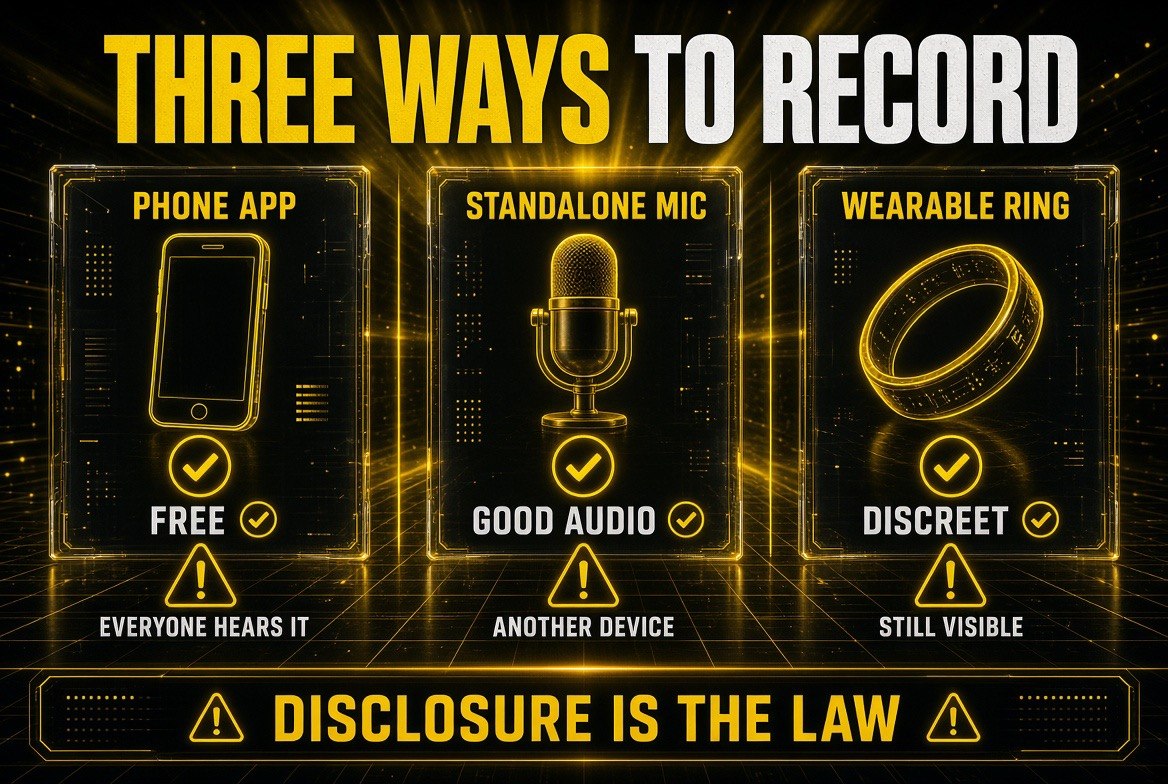
Three capture methods, three different trade-offs. The ring buys discretion and a lighter setup — not invisibility. Every one of these still triggers the same disclosure obligation.
The Legal Line Every Creator Needs to Understand
This is the part that gets creators in trouble, so let’s be blunt.
Two-party consent states. Several US states require all parties to consent before a private conversation is recorded. In those states, recording an interview or a phone call without telling the other person can expose you to civil liability and, in some circumstances, criminal penalties. Whether a café conversation counts as “private” depends on facts and jurisdiction — do not guess.
International matters more than you think. If your guest is in another country, or your podcast is distributed internationally, other regimes apply. Several jurisdictions treat recording disclosure as a hard legal requirement rather than a courtesy.
Platform and contract terms stack on top. Sponsorship agreements, brand partnership contracts, and guest release forms frequently include recording and consent language that’s stricter than the law. Signing a sponsor deal can bind you to disclosure standards that no statute requires.
The practical rule. Announce the recording, on the recording, before the substance starts. “I’m recording this for the show — is that okay?” Then leave their “yes” in the file. It takes four seconds, it protects you legally, it protects you in a dispute, and it is genuinely the reason guests trust you enough to come back.
The ring’s concealability is not an advantage here. Treat it as a reminder that disclosure is on you.
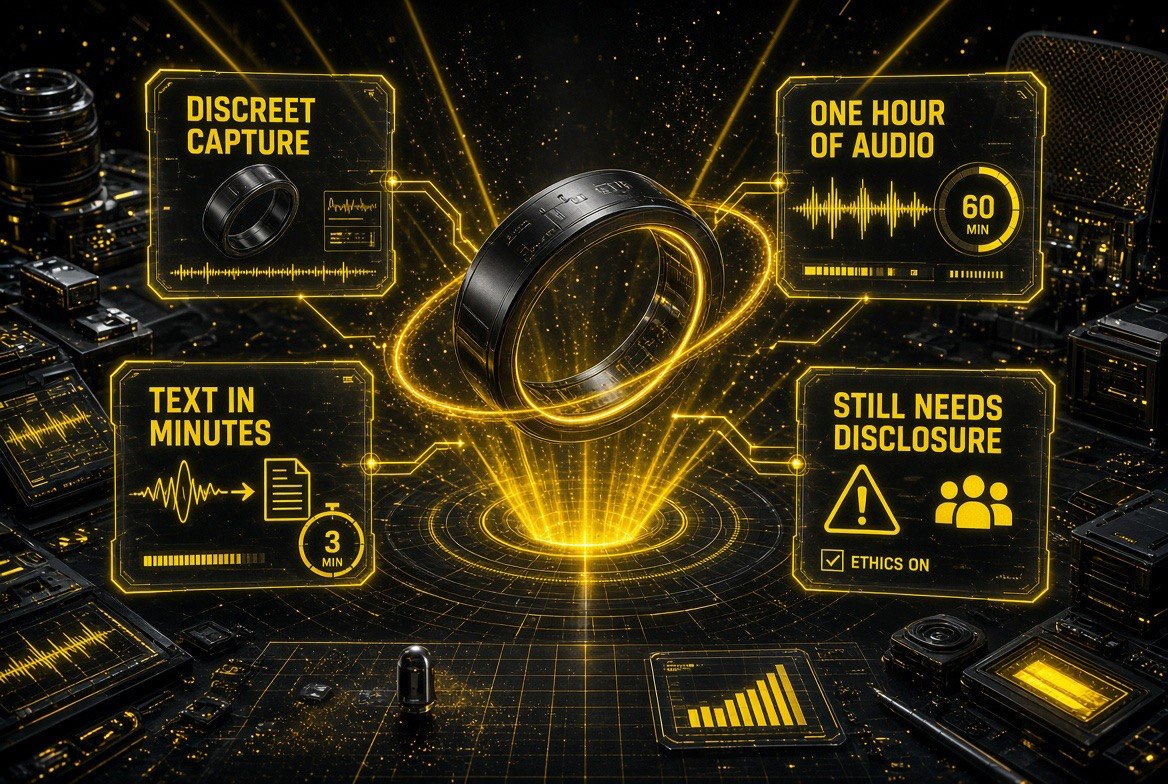
What the ring actually gives you — discreet capture, long recordings, fast transcripts — and the one thing it does not remove: your disclosure obligation.
The Wearable Capture Workflow That Actually Ships Content
Assuming you’ve handled disclosure, here’s how to turn a capture device into a publishing pipeline instead of a growing pile of unlistened recordings.
Step 1: Decide capture mode before the conversation starts. Long-form interview gets full recording. A 20-minute brainstorming call gets highlights only. A five-minute hallway conversation gets nothing, because the review is clear that short-note capture is the weakest part of this class of device. Being deliberate about mode is what keeps your library usable.
Step 2: Say the disclosure sentence and let it land on tape. One sentence, always, before anything substantive. This is both your legal protection and the moment your guest relaxes, because it signals you’re a professional operation.
Step 3: Capture highlights live, not after. The whole reason to wear a device is that the good line arrives before you know it’s good. Press the button in the moment. Reviewers note that AI-generated insights can be longer than the notes themselves — so your live highlights become the spine that keeps the AI summary honest.
Step 4: Export the transcript into tooling you control. Do not let your archive live only inside the hardware vendor’s app. The review flags a confusing app structure and slow feature rollout. Pull transcripts out into your own storage, then run them through the transcription and editing tools you already use.
Step 5: Cut clips from the transcript, not the audio. Read for the moment that lands, then cut. Solo creators lose their entire weekend re-listening to interviews to find one 90-second segment. Working from text is faster by an order of magnitude.
Step 6: Feed the transcript into your repurposing chain. One interview should become a long-form video, two or three shorts, a newsletter section, and several text posts. If your capture tool doesn’t feed that chain, it’s a notebook, not a production asset. This is also why owning your repurposing workflow matters more than owning the flashiest capture hardware.
That’s the whole pipeline. Notice that only steps one through three involve the ring at all. Everything that produces published content happens after the transcript lands in your own tools — which is why a $249 ring is only worth buying if you’ve already got steps four through six working. Buy it to fix capture, not to fix production.
| Capture Situation | Best Tool Choice | Why |
|---|---|---|
| Booked guest interview, studio or office | Dedicated mic into your recorder, not a wearable | Publishable audio quality matters; you control disclosure openly |
| Café meeting, conference hallway, walking call | Wearable capture | This is the scenario phones fail at and wearables win |
| Solo idea capture on a walk | Voice memo app you already own | Short-note mode is the weakest feature class review; $0 tool is fine |
| Multi-hour workshop or webinar | Laptop capture plus a backup audio track | Consecutive-hour battery and redundancy beat form factor |
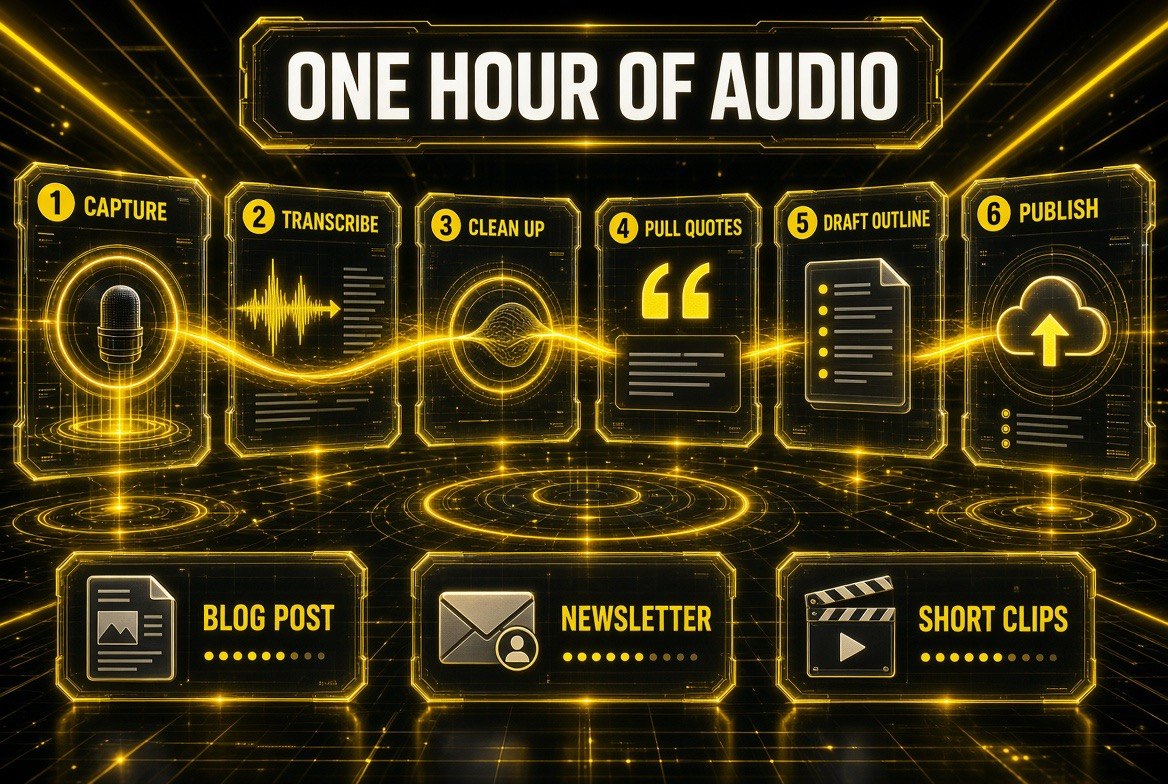
The whole workflow in one line: one hour of captured audio, six stages, three publishable outputs. The captured audio is the raw material — the pipeline is what turns it into something you can actually post.
Should You Buy One?
Honest answer: not yet, for most solo creators — and that’s a recommendation about sequencing, not a verdict on the device.
The hardware does what it claims. It transcribes long conversations well, including in noisy rooms, which is the one thing your phone genuinely can’t do. The form factor is legitimately the most frictionless of any notetaker on the market.
But the software is described as confusing, the feature rollout is slow, reminder integration doesn’t exist, and MCP-based assistant connections only showed up a few weeks ago. Meanwhile competing notetakers are actively building platforms to automate insights and workflow — the exact thing Vocci’s platform isn’t yet built out for. At $249 against rivals like Plaud and Pocket, you’re paying a premium purely for the form factor.
If your bottleneck is capturing conversations in environments where a phone fails, and you have your transcript-to-content pipeline already working, the ring earns its price. If your bottleneck is production — you have recordings piling up and nothing published — the ring will not fix that. It will just add a better-sounding pile.
What’s genuinely worth taking from this launch regardless of whether you buy: the form factor war is real and it’s going to keep producing options until creators settle on the shapes that work for them. Wearables will get cheaper and their platforms will get better. Building your disclosure habit and your transcript-to-content pipeline now means the hardware decision later becomes a five-minute choice instead of a workflow rebuild.
Frequently Asked Questions
Is the Vocci ring legal to use for recording interviews?
It depends on jurisdiction and disclosure. Several US states require all parties to consent before recording a private conversation, and some countries treat recording disclosure as a legal requirement. Always announce the recording and get verbal consent on the recording before substantive conversation begins. Check the rules for your state and your guest’s location.
How much does the Vocci ring cost and what is the battery life?
Vocci’s ring is priced at $249. The company claims 8 hours of recording on a single charge, and the included plastic case can recharge the ring up to three times. It weighs under 6 grams and uses titanium on the inner and outer surfaces.
Can the Vocci ring record short notes and reminders well?
Reviewers found short-note capture to be the weakest part of the device. When short notes were taken, AI-generated insights came out longer than the notes themselves. It performs far better on long conversations, where it accurately transcribed hour-long discussions in noisy environments.
What is the biggest privacy concern with a ring notetaker?
The form factor itself. It looks like ordinary jewellery, and its recording indicator faces the wearer rather than the room. That makes non-disclosure easy, which is why the responsibility to announce recording sits entirely with you, regardless of what the vendor encourages.
How does a ring compare to a phone for recording meetings?
For audio quality in noisy rooms, the ring wins clearly, transcribing long conversations that a phone mic across a table would fail on. For visibility and consent, the phone is safer because it announces itself. For cost, the phone is free. Choose based on whether your problem is capture quality or production workflow.
Should a solo creator buy one now?
Only if capturing conversations in noisy settings is your actual bottleneck and you already have a working transcript-to-content pipeline. If your problem is that recordings pile up unpublished, the ring adds a better pile rather than solving production. The hardware works; the software platform is still thin.

About Barak Schurr
Barak Schurr is a serial entrepreneur who built and exited a major ticketing platform before turning his attention to AI and content. He runs three AI-focused research sites and writes about the tools, workflows, and strategies that let solo creators build real channels — without a crew, a studio, or a Hollywood budget.
Email: [email protected]
More AI Video Resources