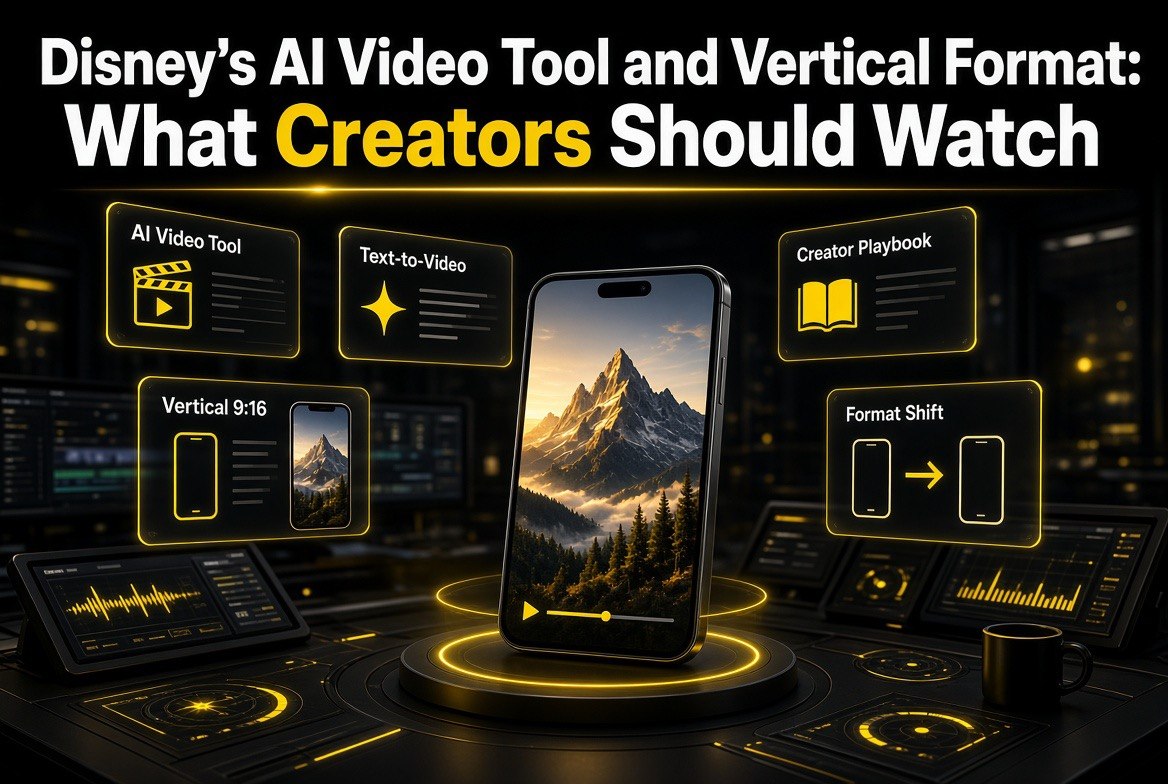
Disney’s AI Video Tool and Vertical Format: What Creators Should Watch
Get The Faceless YouTube Blueprint — Free
The exact AI tool stack and workflow used to build a faceless YouTube channel from zero.
Disney’s AI Video Tool and Vertical Format: What Creators Should Watch
⚡ Expert Summary: Disney unveiled an AI-powered video generation tool for advertisers at its CES 2026 showcase — a system that turns existing brand assets into connected-TV-ready commercials and lets marketers version a single creative across audience, context, placement, and performance signals. It runs on an agentic AI workflow that orchestrates specialised models for scripts, audio, and video under human oversight. Combined with Disney’s “Verts” swipeable vertical feeds rolling out across ESPN and Disney+, the message for creators is clear: vertical, versioned, and personalised motion content is becoming the default — and the tools to produce it are moving inside the platforms themselves.
For the last year, the AI-video story for independent creators has been about standalone tools: type a prompt, get a clip, drop it into your edit. Disney just moved the goalposts in an important way — not with a consumer toy, but with an industrial-grade pipeline built into the biggest media ecosystem in the world.
At CES 2026, Disney introduced an AI video generation tool for advertisers that turns existing brand assets into finished commercials and, more tellingly, versions that creative across every signal you could target. Paired with Disney’s push into vertical, swipeable feeds — “Verts” — it’s a clear statement about where short-form, personalised motion content is heading. For a solo creator, the details are worth studying even though the tool is aimed at brands.
What Disney’s AI Video Tool Actually Is
It’s not a toy clip generator. Disney describes it as an agentic AI workflow — a system that coordinates multiple specialised models in a single production process, each doing one job well, rather than one model trying to do everything.
- Script and storyboard models. One model develops the creative concept and structure from the brand’s inputs.
- Audio and music models. A separate model handles the sound layer, generating a score that fits the spot.
- Video generation. The final layer produces the moving footage, assembled from the brand’s assets.
- Human oversight baked in. Disney says the workflow includes guardrails, IP protection, and compliance — a person stays in the loop.
That architecture matters. Instead of one prompt-to-video blast, you get a control system where each stage is checked and the brand’s existing material — logos, product imagery, guidelines, prior creative — is the raw material rather than a prompt describing something from nothing.
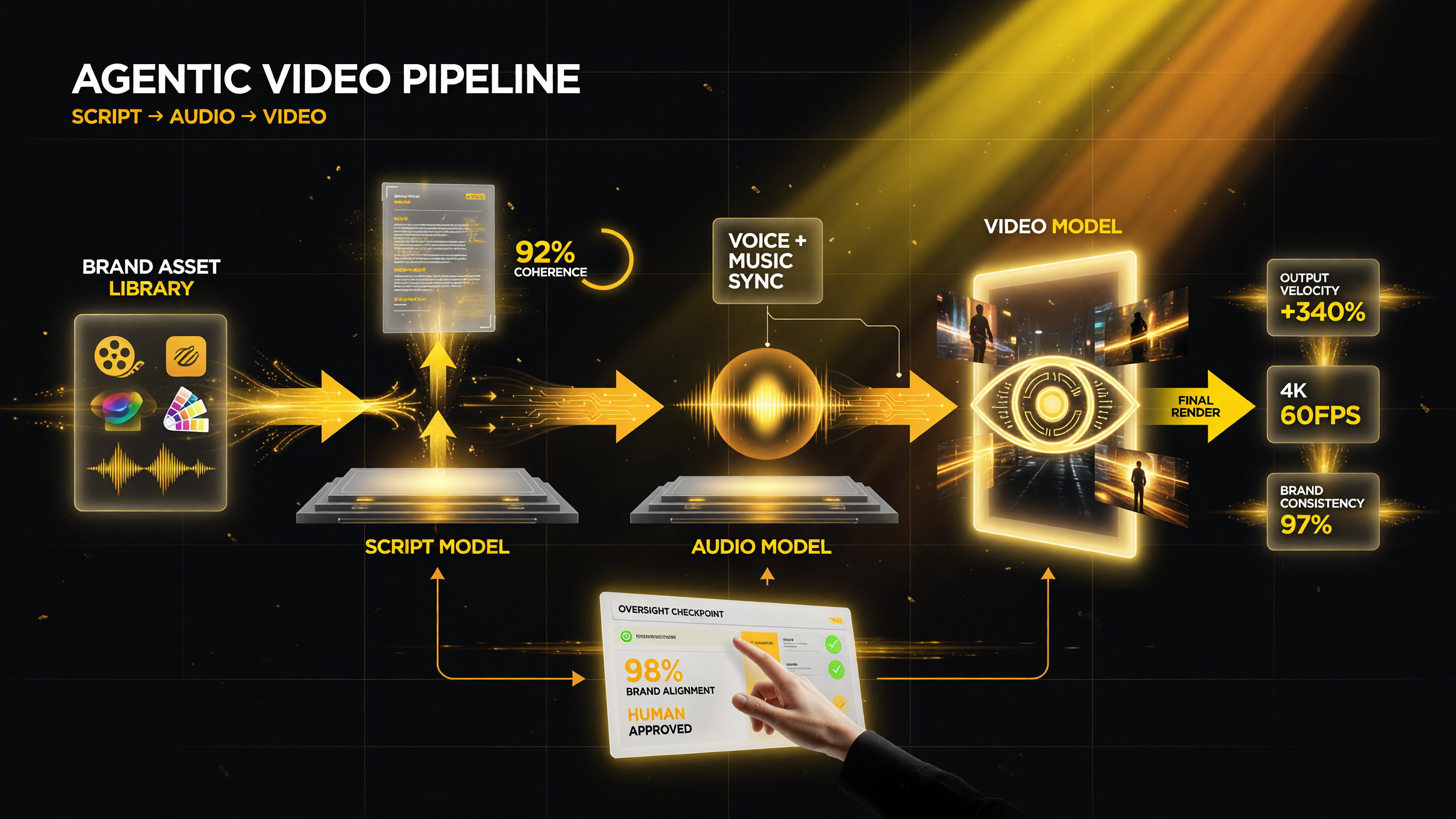
Disney-style agentic pipelines chain specialist models — script, audio, video — under one brand asset library, with a human oversight checkpoint on the way to the final render.
The Part That Changes the Game: Versioning
The headline feature behind the tool isn’t generating one good ad — it’s generating a hundred versions of it from a single source. Disney’s tool is designed to version creative tailored to audience, context, placement, objectives, geotargets, tone, and performance signals.
For a creator, translate that directly: instead of making one video and hoping it fits every platform and audience, you start from one master concept and let the pipeline adapt it per distribution slot. A single product story becomes a 9:16 vertical version for the feed, a shorter cut for a high-attention placement, and a softer tone for one segment — all from the same source creative.
That’s the workflow solo channels should be stealing the idea from, even if they can’t use Disney’s pipeline. The principle — one source, many versions, driven by placement and audience — is exactly how efficient short-form channels operate at scale, and the AI layer is what makes it practical for a one-person operation.
Why the Vertical Format Is the Real Story
Underneath the ad tool is a format shift Disney is betting on. The company is rolling out “Verts” — swipeable, personalised vertical video feeds — across its properties, starting on the ESPN app and expanding to Disney+ on mobile. These feed short, snackable clips from Disney’s library, personalised for daily engagement on a phone.
For creators, this is a structural signal, not just a product launch. The platforms that control distribution are deciding that vertical, personalised, mobile-first content is where engagement lives. Disney — which built its empire on long-form, lean-back viewing — is now investing in the exact short-form vertical mechanic that TikTok and Reels normalised.

A vertical-first “Verts”-style feed rewards short, swipeable clips that hit a niche hard — the format Disney-style AI tools are built to feed at scale.
Disney’s AI Tool vs. Standalone Creator Tools
To see where this fits, compare Disney’s platform-level pipeline directly with the typical standalone AI-video tool a solo creator uses today.
| Dimension | Disney AI pipeline | Standalone creator tool |
|---|---|---|
| Raw material | Existing brand assets and guidelines | A text prompt |
| Output model | Agentic: script + audio + video, orchestrated | Single model generates a clip |
| Versioning | Built-in: audience, placement, geotarget, tone | Manual — re-prompt or edit per version |
| Oversight | Human in the loop, guardrails, compliance | Self-serve, up to the user |
| Access | Disney teams; beta with select advertisers | Immediate, low barrier to entry |
The honest takeaway: standalone tools still win on access and simplicity — any creator can use one today. Disney’s edge is system integration: the versioning, the brand consistency, and the direct path into a distribution platform. As these two worlds converge, expect standalone tools to keep adding versioning and multi-model orchestration, and expect platforms to keep embedding generation deeper into their feeds.
What This Means for a Solo Creator
You’re not going to run Disney’s enterprise pipeline — but the direction it points is exactly where you should be heading, and you can adopt the underlying principles today with the tools you already have.
- Design for versioning from the start. Build each video so it can be cut to multiple lengths and aspect ratios. One strong master concept, adapted per platform, beats one one-size-fits-all upload.
- Treat vertical as a first-class format, not an afterthought. With Disney moving to vertical feeds at major-platform scale, 9:16 is the default home for discovered content. If your channel isn’t producing vertical-native material, you’re leaving engagement on the table.
- Use separate tools per stage, like the agentic model. You don’t need one all-in-one. Script with one tool, generate b-roll with another, and build the music bed with a third — orchestrating specialised tools by hand is the solo version of Disney’s agentic workflow.
- Keep a human eye on every piece. Disney’s guardrails and IP protection are partly legal, but the creative principle is universal: AI proposes, you dispose. Version and personalise hard, but the final judgment — taste, accuracy, and fit — stays yours.
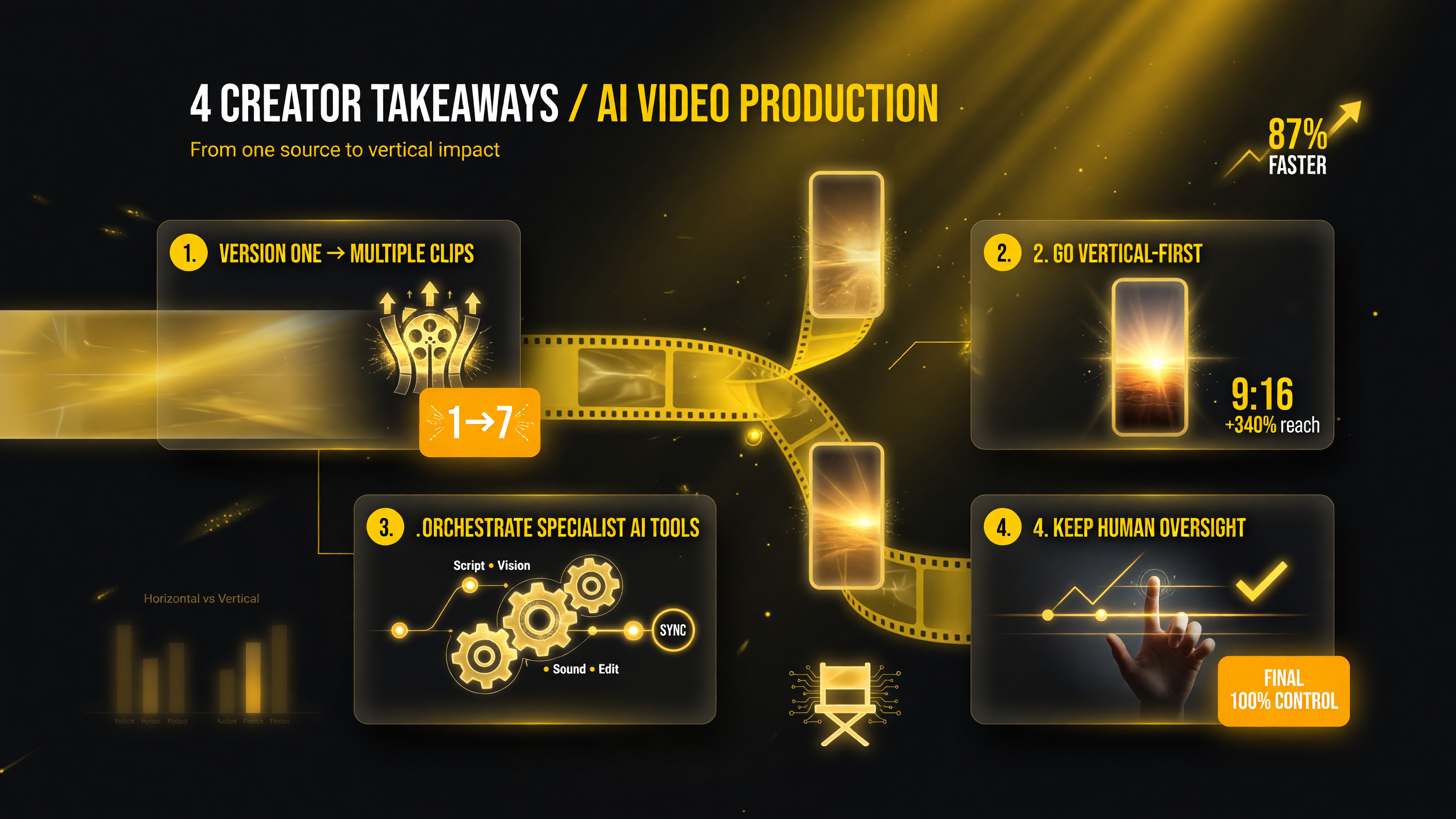
The four moves that matter for solo creators working with AI pipelines like the one Disney-style tools are leading with: repurpose one source, lead vertical, chain specialist tools, and keep a human in the loop.
Where the Opportunity Sits for Small Channels
There’s a window here that favours the nimble. Enterprise AI pipelines like Disney’s are powerful but slow to roll out and limited to advertisers with budgets. Meanwhile, the format they’re betting on — vertical, versioned, personalised short-form — is something a solo creator can produce today with accessible tools and real creative taste.
| Capability | Enterprise (Disney model) | Solo creator (now) |
|---|---|---|
| Versioning creative | Automated at scale | Manual re-cuts, doable per placement |
| Vertical-native output | Baked into the feed strategy | Directly accessible today |
| Multi-model orchestration | Automated agentic system | Manual stack of specialist tools |
| Speed to market | Slower rollout, budget-gated | Immediate, low barrier |
| Creative control | Shared within brand guardrails | Fully yours |
There’s also a question of positioning that the Disney announcement makes sharper. For years the accepted wisdom was that vertical short-form is where you build reach, while long-form is where you build depth and loyalty. Disney’s dual push — an AI ad pipeline plus vertical feeds inside its own streamers — suggests the line is blurring. The same eyeballs that scroll a personalised vertical feed are the ones that might then sit through a long-form piece. A solo creator who treats vertical as the entry layer and long-form as the keeper layer is building a funnel, not picking a format. Disney’s announcement is a useful reminder that the platforms are optimising for exactly that journey, and your content should be built to ride it — short, vertical, and personalised enough to pull someone in, then substantial enough to keep them.
And don’t underestimate the compounding advantage of starting now. Every vertical test you ship, every versioned cut you learn to make quickly, every time you figure out which specialist tool handles your specific audio or b-roll need — that’s workflow you’ll carry forward when the capability is built into every platform and every competitor catches up. The technical advantage of AI video tools is going to flatten quickly; the creative and process advantage of having already figured out what works for your audience will not. That’s the real asset to build while Disney and its peers normalise the format.
There’s a predictable arc here worth planning around. First, the platforms build enterprise-grade pipelines like Disney’s — powerful, but gated behind budgets and beta access. Next, the capability generalises: the versioning, multi-model orchestration, and vertical-first workflow that Disney is engineering today become features you can approximate with the consumer tools you already pay for. Finally, the format itself normalises — vertical, personalised short-form stops being a TikTok mechanic and becomes the default expectation across every feed, including the big streamers. If you build your workflow around vertical-first and versioned production now, you’re not chasing Disney’s tech — you’re already fluent in the format the whole industry is moving toward, and you’ll have early proof of what audiences respond to before the crowd arrives.
One practical note on pacing yourself: you don’t need to adopt every AI video tool that launches this year. The discipline that separates sustainable solo channels from ones that burn out on shiny new toys is applying new capability to an existing, working workflow rather than rebuilding everything around each launch. When a tool genuinely de-risks versioning, vertical output, or audio matching — the three capabilities Disney’s announcement highlights — slot it in. When it’s just a slightly faster clip generator, it can wait. The goal isn’t to be the most automated channel; it’s to be the one with a repeatable, vertical-first, versioned production loop that keeps publishing while the field settles.
The Bottom Line
Disney’s AI video tool and vertical-format push are a reliable sign of where the industry is heading: personalised, versioned, mobile-first motion content produced with AI assistance inside the platforms people already use. For a solo creator, the move is not to chase Disney’s pipeline, but to absorb its logic — version from one source, make vertical native, orchestrate specialist AI tools, and keep your judgment at the centre.
The future of video isn’t one perfect clip. It’s one strong idea, adapted everywhere, made personal for every audience — and the sooner you build that workflow, the better positioned you’ll be when AI makes it effortless for everyone.
Frequently Asked Questions
What is Disney’s AI video generation tool?
It’s an AI-powered tool for advertisers announced at CES 2026 that turns existing brand assets — logos, product imagery, guidelines, and prior creative — into connected-TV-ready commercials. It uses an agentic AI workflow where specialised models handle scripts, audio, and video under human oversight.
What does “versioning” mean in Disney’s tool?
It means starting from a single source creative and automatically generating many versions tailored to audience, context, placement, objectives, geotargets, tone, and performance signals — instead of making each variation by hand.
What are Disney’s “Verts” vertical feeds?
Verts are swipeable, personalised vertical video feeds. They launched on the ESPN app and are expanding to Disney+ on mobile, serving short, snackable clips personalised for daily engagement on a phone.
Is Disney’s AI tool available to creators?
Not directly. It’s built for advertisers and is in internal use at Disney, with beta testing with select clients planned. The broader lesson for creators is the workflow — versioning, vertical-first, and multi-model orchestration — which they can adopt with accessible tools today.
Does this mean AI is taking over commercial production?
No. Disney frames the tool as complementing rather than replacing agency and creative work. AI handles versioning and production lift, while human oversight, brand judgment, and creative direction remain essential — the AI proposes, people decide.

About Barak Schurr
Barak Schurr is a serial entrepreneur who built and exited a major ticketing platform before turning his attention to AI and content. He runs three AI-focused research sites and writes about the tools, workflows, and strategies that let solo creators build real channels — without a crew, a studio, or a Hollywood budget.
Email: [email protected]
More AI Video Resources