The Cheap AI Video Engine Died and the Replacement Costs Four Times More
The Cheap AI Video Engine Died and the Replacement Costs Four Times More
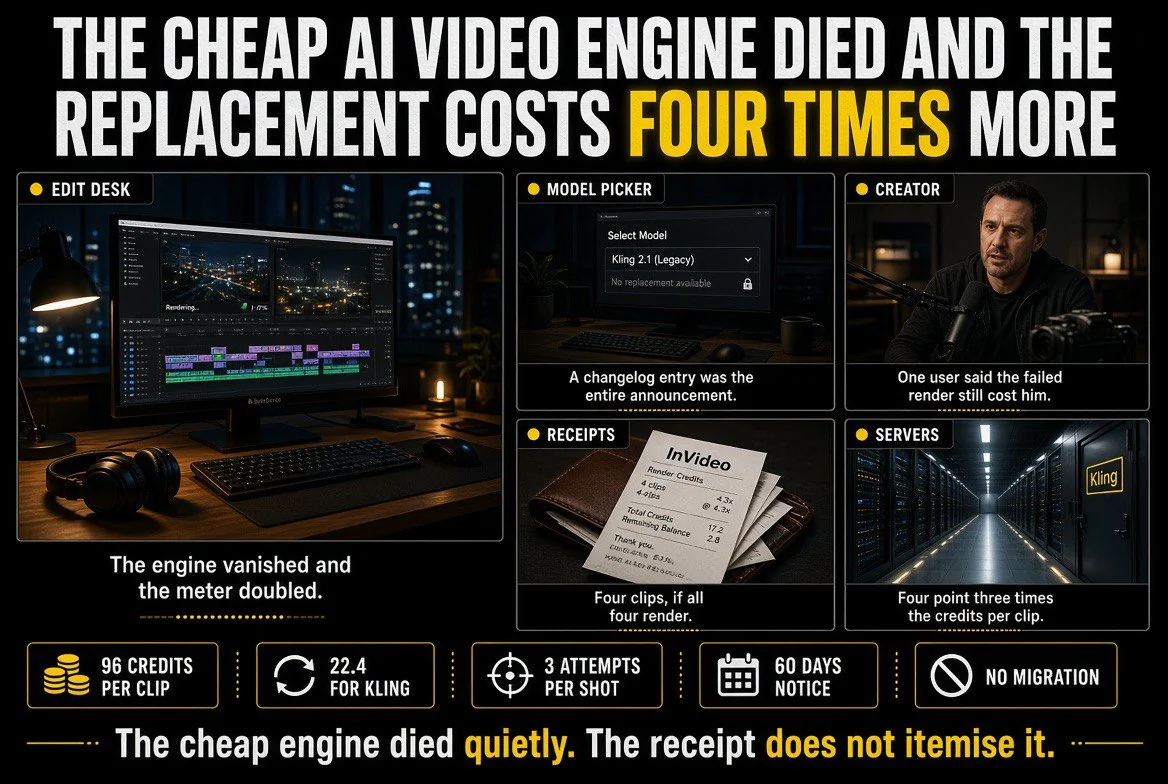
⚡ Expert Summary: On November 11, 2026 at 17:00 UTC+8, ByteDance shut down Seedance 1.5 Pro with a notice that said it would not be automatically migrated. The replacement meters four times the credits per clip. And on at least one major platform, a generation that fails is charged anyway — InVideo’s own FAQ puts it at about three generations per usable shot. Read together, the cheap engine you were budgeting against is gone, and the allowance you thought bought four clips buys one shot you can actually use. Nothing was announced as a price rise. It arrived as a model deprecation.
Here is the exact text from ModelArk, ByteDance’s model platform, published in its documentation: “The seedance-1-5-pro-251215 model will be shut down after 17:00 on November 11, 2026 (UTC+8) and will not be automatically migrated to a new model. Switch models in advance to avoid service disruptions.”
No transition credit. No grandfathered pricing. No automatic migration. The notice was first issued on September 8 and appears in the changelog snapshot of November 8 — roughly sixty days of warning, which is enough time to notice if you were watching, and not enough if you were mid-project.
The shutdown itself is unremarkable. Models get retired; that is the nature of the layer. What makes this specific retirement a pricing event is what the replacement costs on the platforms creators actually use, and how those platforms count a “generation” when the generation fails.
The Four Times Problem
On InVideo, the Starter plan runs $20 monthly or $10 annually for 400 credits. Plus runs $60 monthly or $30 annually for 2,000 credits. If you were running Seedance on that allowance, you were getting a certain number of clips for your money. Here is what the same five-second 1080p clip costs across the engines, per ToolColumn’s November 3 comparison:
| Engine | Credits per 5s 1080p clip | What it means on a 400-credit allowance |
|---|---|---|
| Kling 3.0 | ~22.4 | About 17 clips from 400 credits |
| Seedance 2.0 Fast (720p) | ~30 | About 13 clips |
| Veo 3.1 (4s) | ~64 | About 6 clips |
| Seedance 2.5 | ~96 | Four clips, if every single one works |
| The real ratio | 96 vs ~22.4 | 4.3x the credits per clip versus Kling |
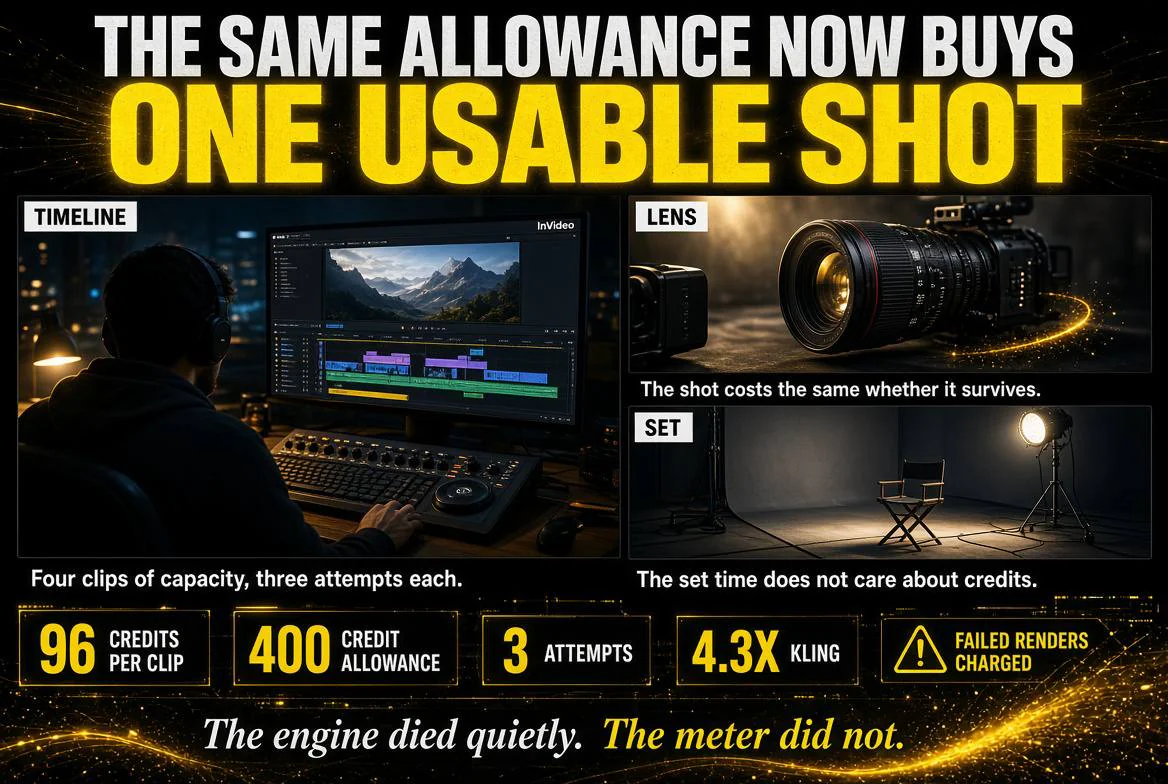
Four hundred credits, ninety-six per clip. That is four clips on the Starter plan. If you were budgeting on the ladder before the retirement — a cheaper engine at a lower meter — the arithmetic on your next project got worse without a single subscription price changing.
For a parity check outside the credit system, fal.ai’s raw listing for the model works out to roughly $0.473 per second at 720p and $0.2205 per second at 480p. On those numbers a five-second 720p clip lands around $2.37 of raw compute, and ten shots of a short sequence can pass $20 in generation alone. The allowance is not abstract. It converts to dollars at a rate you can check.
Failed Generations Are Charged On At Least One Major Platform
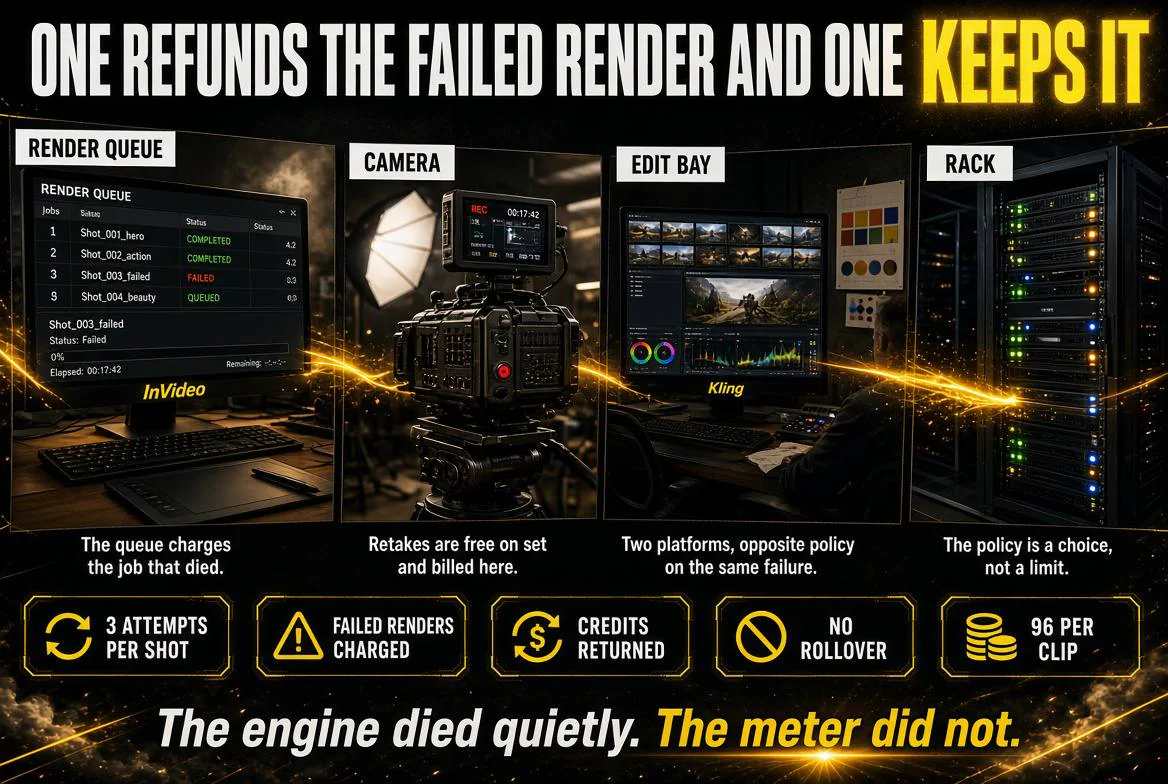
This is the part that changes the maths more than the four-times ratio does. InVideo’s own FAQ states that every generation is charged, discarded ones included, at about three generations per usable shot.
Three. Not 1.1. Three. The credit meter is counting attempts, and most attempts do not survive to the edit.
Put that against the 96-credit figure and the allowance collapses. Four clips of nominal capacity, at three attempts per usable shot, is roughly one usable shot per 400-credit allowance. That is the sentence that should be on the pricing page and is not: the Starter plan buys about one usable five-second Seedance clip per month.
Not every platform works this way, and the contrast is worth naming because it proves the policy is a choice rather than a law of the medium. Kling Studio’s documentation, as described by AIGE, states plainly: “A generation that fails gives its credits back.” Same category of product, same class of model, opposite policy on failure.
| Policy question | InVideo | Kling Studio |
|---|---|---|
| Failed generation | Charged, per its own FAQ | Credits returned |
| Attempts per usable shot | About 3 | Not published |
| Unused credits at month end | Do not carry into next month; extra packs last up to 12 months | Plan dependent |
| What the creator pays for | Attempts | Output |
There is a second squeeze in the same FAQ: InVideo credits do not carry into the next month, while extra packs last up to twelve months. So the allowance you do not use expires, and the top-ups you buy to cover a heavy week stay on the books — which is a structure that rewards buying top-ups and penalises steady planning. Neither policy is hidden. Both are the kind of thing you find after the first month’s bill, not before.
The User Who Said It Out Loud
Only one named creator is on the record about the friction, and it is worth quoting because it matches the arithmetic exactly. Tim Thatcher, an InVideo user, described the credit problem in October 2026: the cost of a render that does not work is real, and it is charged.
That is the whole complaint in one line, and it is not a complaint about quality. Most creators accept that the first generation of a shot is a lottery. What they do not accept is paying for lottery tickets they already know lost, on a meter that counts attempts rather than outputs, with an expiry date on the unused balance. Every one of those three terms is a policy decision by the platform, and every one of them moves cost from the platform’s P&L to the creator’s.
Why ByteDance Says It Retired the Model
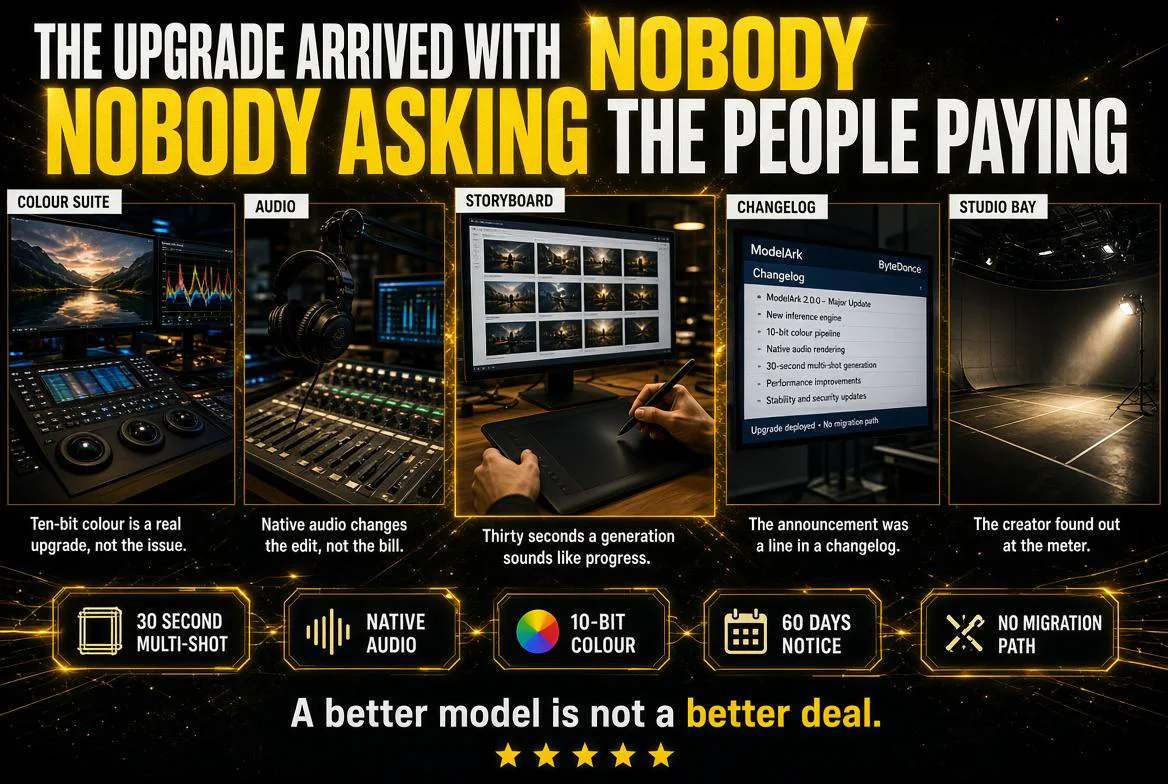
The vendor’s own framing for Seedance 2.5 is a shift in what users expect “from merely generating a clip to completing a creative work” — with native 30-second multi-shot generation, native audio and 10-bit colour as the headline capabilities.
None of that is a lie and none of it is unreasonable. A native 30-second multi-shot with audio is genuinely a different product from a five-second silent clip. The question is not whether the new model is better. It is whether the creator who was making a living on five-second silent clips asked for it, was asked about it, or was simply moved onto it and told the meter had changed.
The deprecation notice answers that question by omission. It gives a date, a time and a timezone — and one instruction: “Switch models in advance to avoid service disruptions.” There is no migration path, no credit conversion, and no acknowledgment that the switch changes unit economics. The notice is technically complete and commercially silent.
The Sixty-Day Problem
Sixty days is the notice window, from the September 8 first issue to the November 11 shutdown. For an enterprise with a vendor-management function, that is thin but workable. For a solo creator running a client project on a monthly credit plan, sixty days is roughly two billing cycles — which means the notice arrives, the balance expires, and the switch happens whether or not the creator ever opened the changelog.
That asymmetry is the actual story here. Model deprecation is normal and will keep happening. What is not normal is a deprecation that lands as an unannounced price increase, delivered through a documentation page, on a meter that charges failures and expires the remainder. The creator is not being asked to upgrade. They are being repriced, and the interface for that repricing is a changelog entry.
What Actually Protects You
You cannot stop a model retirement. You can make your stack indifferent to one, and the controls are specific.
Price your shots in outputs, not attempts. Find the attempts-per-usable-shot figure for your platform and your style before you commit to a plan. InVideo publishes about three; ask the others the same question in writing. Multiply your planned shot count by attempts, then by per-clip credits, and compare that against the allowance. A plan that looks generous at 96 credits per clip looks very different at 288 credits per delivered shot.
Prefer platforms that refund failures. This is a checkable policy and it is worth more than a small difference in per-clip price. Kling’s published position returns credits on a failed generation. Over a hundred attempts, that is the difference between a working meter and a one-way drain.
Treat unused balance as expiring capital. If credits do not roll over, a large allowance is not an asset — it is a deadline. Right-size the monthly plan and buy top-up packs only where they hold value longer, because that is exactly what the two-part structure is designed to make you do.
Keep two engines warm. The creators who were hurt on November 11 were not hurt because Seedance 1.5 Pro was retired. They were hurt because it was their only engine at that price point. A second platform with a similar meter turns a forced migration into an inconvenience.
What the Record Does Not Say
Several things that would settle the question are absent. ByteDance has not published whether any credit or refund arrangement exists for users who bought allowance specifically for the retired model. No affected headcount, project count or revenue figure has been disclosed by anyone. Nobody has said whether the sixty-day window was coordinated with the platforms that resell these models, or whether InVideo, and others, learned the shutdown date on the same day their users did. And no regulator anywhere has taken a position on credit expiry combined with charging for failed generations.
What can be stated without qualification is the arithmetic. Seedance 2.5 meters at roughly four times Seedance-adjacent alternatives per five-second clip. On InVideo’s own published figure, about three generations are needed per usable shot, and the discarded ones are charged. Credits reset rather than roll. Any one of those facts is a footnote. Together they are the reason your cost per usable five-second clip went up by a multiple this month while every subscription line on your card stayed the same.
The cheap engine died quietly at 17:00 on a Tuesday. The receipt arrives on the first of the month, and it does not itemise the difference.
Frequently Asked Questions
What exactly happened to Seedance 1.5 Pro?
ByteDance’s ModelArk platform shut the model down after 17:00 on November 11, 2026 (UTC+8). The notice states it “will not be automatically migrated to a new model,” and instructs users to switch models in advance. The notice was first issued September 8, 2026, giving roughly sixty days.
How much more does the replacement cost?
Seedance 2.5 meters at roughly 96 credits per five-second 1080p clip, against about 22.4 credits for Kling 3.0 — a multiple of about 4.3 times per clip. On a 400-credit InVideo Starter allowance, that is four clips at full efficiency rather than the double-digit clip count cheaper engines allow.
Are failed AI video generations really charged?
On InVideo, yes, per its own FAQ, which states every generation is charged including discarded ones, at about three generations per usable shot. Kling Studio’s documentation states the opposite — that a failed generation returns its credits. It is a platform policy choice, not a technical limit.
Do InVideo credits roll over to the next month?
No. Credits on the monthly plan do not carry into the following month, while separately purchased extra packs last up to twelve months. That means an unused allowance expires, but top-ups bought for a heavy production week hold their value.
Was I notified about the shutdown?
Only through ModelArk’s documentation and changelog, first issued September 8, 2026 and present in the November 8 snapshot. There was no announcement of a price change, no migration path and no credit conversion. If you do not monitor the provider’s changelog, the first signal was a model that stopped working.
What should a creator on a monthly credit plan do now?
Price your output per usable shot rather than per generation, verify each platform’s failed-generation policy in writing, right-size the monthly plan so unused credits are not expiring capital, and keep a second engine warm so a retirement is an inconvenience rather than a lost week.

About Barak Schurr
Barak Schurr built and sold a major ticketing platform, ran global nightlife operations at Eventbrite, and now spends his time testing AI video tools against real production budgets — what they cost per usable shot, and whether the meter tells the truth. No hype. No fluff. Just what works.
Email: [email protected]
More AI Resources for Your Business